

Artificial Intelligence: A Clash of Giants Between East and West... Is America Losing Its Technological Crown?
In the digital hall of the universe, where algorithms stitch the dreams of the future with the needle of data, a race unfolds that resembles a modern star war. It is the race for artificial intelligence, where technology giants collide from East to West, carrying weapons of numbers and equations and dreams of controlling the throne of the new world. In this battle, China is no longer the diligent student in the shadow of the American teacher. It has become a rival shaking the pillars of Western dominance, sounding an alarm in Silicon Valley: "Attention.. the game has changed!"
Technological Chess: When Algorithms Become a Geopolitical Currency
Artificial intelligence is no longer merely a tool for optimising advertisements or improving user experience. It has become a political currency par excellence. While the United States celebrated the surge of "ChatGPT" as a crown of its digital glory, the world was surprised by the emergence of China's "DeepSeek," which slipped like a drop of mercury through the cracks of Western superiority, carrying in its code the dreams of an Eastern empire. The question echoing in the corridors of Washington: how did the Chinese dragon succeed in turning "domestic intelligence" into a global weapon?
DeepSeek: The Brightly Shining Star
The depth of the competition cannot be reduced to an algorithmic leap alone, but lies in the Chinese model's capacity to absorb the complexities of language and culture. While "ChatGPT" masters the dance of words in English, "DeepSeek" masters the art of Chinese calligraphy, blending ancient wisdom with modern technology. This cultural flexibility raises a fundamental question: is the strength of language models measured by how artificially intelligent they are, or by how well they understand human intelligence?
The Race of Trillions: Who Buys the Future?
The figures here speak in stark language: in 2023 alone, China injected 30 billion dollars into the arteries of artificial intelligence research, while Washington spent 40 billion as a "booster shot" to protect its position. Yet the paradox is that Beijing invests each dollar like a raindrop in a national cloud, while American investments scatter among private companies competing like cats over a ball of wool. Does quantity compensate for quality in the financing equation? History will judge, but what is certain is that every dollar spent here plants the seeds of a digital cold war.
Quantum: The Next Smart Bomb
The battle will not be decided on the software battlefield alone. As the age of quantum computing approaches, where algorithms become faster than the speed of light, data centres turn into new nuclear arenas. China has announced its plans to merge quantum computing with artificial intelligence by 2030, while the American DARPA works on a "quantum brain" project, as does Google, which launched its quantum computer. Will we one day see artificial quantum intelligence replace military strategists? The answer may be hidden in a quantum entanglement we have not yet discovered.
Hardware: The Hidden Silicon War
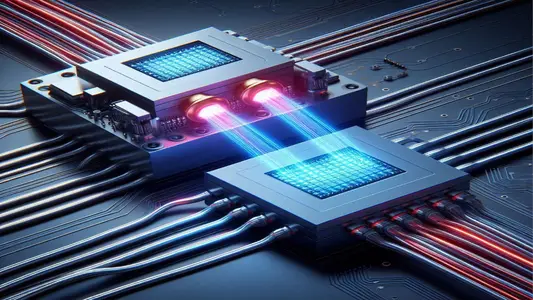
Beneath the rubble of the chip war, a decisive battle is being fought. While the American NVIDIA tries to protect its throne in processor manufacturing, the Chinese Huawei stands like a phoenix rising from the ashes of sanctions, developing alternatives and relying on its own people. The paradox may be ironic, but every click on ChatGPT depends on American-designed chips manufactured in Taiwan, the island that ignites the flames of geopolitical tension. Can artificial intelligence become a weapon in the silicon war? History shows that technology has never been innocent.
Digital Diplomacy: When Data Becomes an Ambassador
In an era of soft power and concealment behind digital shadows, language models have turned into digital ambassadors. While ChatGPT promotes liberal values through its open dialogues, DeepSeek works as a cultural bridge carrying Eastern philosophy to the world. But is it not paradoxical that China, known for its censorship, exports intelligent models that speak the language of freedom? Perhaps the answer lies in the art of "smart control," where culture is offered as bait for influence, not as an end in itself.
The Paradox of Ethics: Who Holds the Reins of Artificial Intelligence?
While companies are preoccupied with the technological race, profound philosophical dilemmas surface. Can Washington claim ethical standing while using ChatGPT to analyse user data in order to tighten its grip? And can Beijing be believed when it promotes "responsible" intelligence while its technologies are used to monitor the Uyghurs and Muslims of China? The questions here resemble an ethical contradiction: which of the two giants will sacrifice its principles on the altar of progress?
Technological Integration: The Beast That Will Not Be Tamed
When small nuclear power meets super-cloud computing, and algorithms wed quantum networks, a technological beast is born before which every prediction of science fiction shrinks. China is combining these elements in its projects like a digital storm, while the United States works on "Project Minerva" to integrate artificial intelligence with vital infrastructure, to map electronic networks, the internet, resources and the virtual archive. The frightening question: who will be the Frankenstein of this age? Or will we all become technological monsters without consciousness?
The Chinese Shock: How Did the Dragon Breach the Western Fortress?
The story of DeepSeek's rise resembles a cinematic film: a model that combined artificial intelligence with a sense of collective purpose to create a model that understands the Chinese spirit first; it has a foothold in promoting a great China. The result? A model that surpassed ChatGPT by a large margin in understanding complex cultural contexts in several fields such as mathematics, programming, writing and logic. This shock prompted technology makers in America to declare: "We thought we had ten years of progress... we were wrong."
The Future: Will We All Become Fuel for the Machine?
As the two giants race, human destiny remains suspended like a puppet between the arms of robots. Reports from the World Economic Forum warn that 40% of jobs may disappear by 2035, while the United Nations speaks of a "new digital divide." But perhaps the real danger lies not in unemployment, but in our decisions being designed by algorithms that know only the language of profit and loss.
Conclusion: Humanity at a Crossroads
At the end of this journey, we find ourselves before a double mirror, which on one side shows the capacity of artificial intelligence to solve the most complex problems, and on the other reveals our fragility as humans in the face of our machines. China and the United States may wage their battle, but the real war is between human creativity and artificial intelligence. Perhaps we must always remember that machines, however intelligent they become, will never know the taste of morning coffee, the warmth of a child's laughter, or the madness of human love. Is this enough to save us? The answer lies in remaining human.. even if machines learn to be more than us.
Sources:
Emirates Policy Center | China's AI Strategy: Strategic Competition Through Self-Sufficiency
DeepSeek: The Innovation Threatening Nvidia's Market Dominance - Misr Alan


