

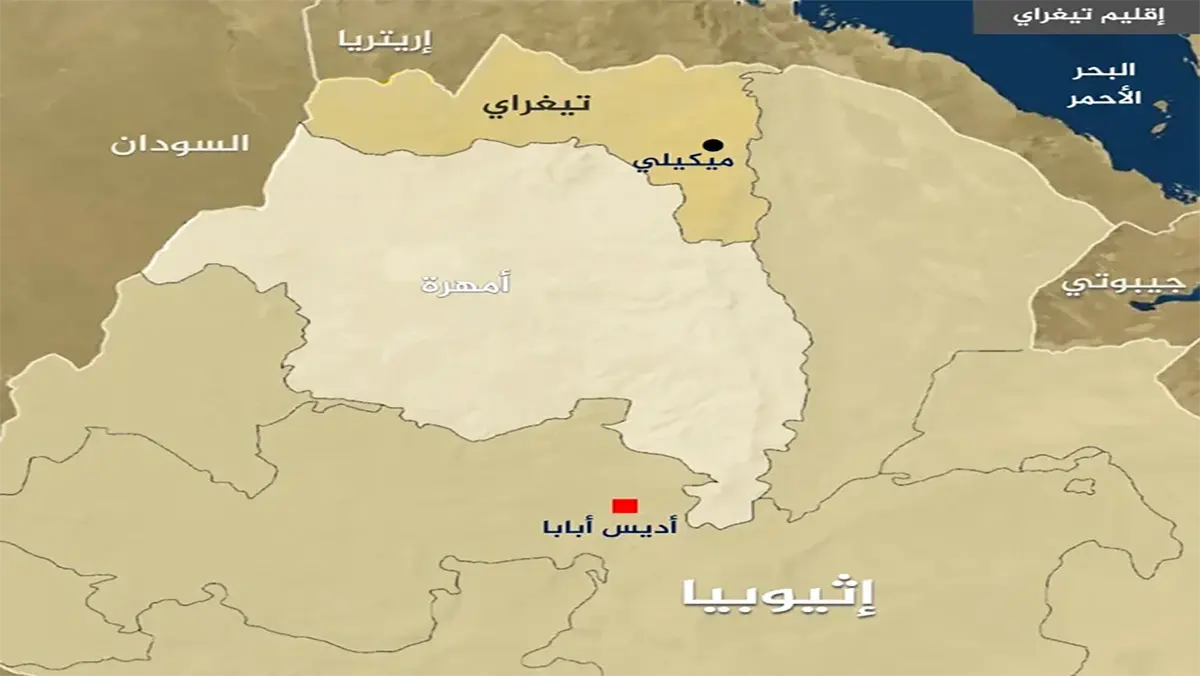
The Congressional Research Service (CRS) has warned that escalating armed conflict inside Ethiopia, and the deterioration of its relations with Eritrea, Sudan and Egypt, could push the Horn of Africa toward a broad regional confrontation, at a time when internal conflicts are intertwined with competition over ports, Nile waters and military influence in the Red Sea.
In a research briefing titled "The Unfolding Conflict in Ethiopia," issued on 6 November 2026, the service documented the widening armed opposition to the government of Prime Minister Abiy Ahmed, and the growing likelihood of a new war with Eritrea, alongside the risk that confrontations could spread to neighbouring countries already suffering acute security and humanitarian crises.
The study is of particular importance because it was issued by a non-partisan research body that provides information and analysis to members of the US Congress, and it addresses the crisis from the perspective of American interests and the diplomatic and security options available to Washington, not only from the perspective of battlefield developments.
The briefing indicates that a war between Ethiopia and Eritrea, coinciding with the continuation of the Sudanese conflict and the war in Yemen, could further disrupt the Red Sea and weaken efforts to counter armed groups in the region.
A new armed alliance expands the challenges facing Abiy Ahmed's government
Among the most notable developments addressed by the study is the announcement, on 20 September 2026, of the formation of the "Alliance for Survival," with the participation of armed opposition groups from multiple Ethiopian regions.
At its announcement, the alliance comprised seven groups, most prominently the Tigray People's Liberation Front, the Amhara "Fano" movement, and the Oromo Liberation Army, along with organisations from the Afar region, Ethiopia's Somali region, and Benishangul-Gumuz.
The alliance announced its aim of toppling Abiy Ahmed's government, forming a transitional administration, and holding a dialogue on a new constitution.
However, this rapprochement does not necessarily mean that the participating groups have become a unified military force. Some had previous disagreements and clashes, and differences have emerged over the membership of some organisations and the nature of coordination among them.
The significance of the alliance lies in its bringing together movements that differ in their backgrounds and areas of activity, but that converge in opposing the federal government.
This development raises concerns about the widening of the fronts faced by government forces, as the conflict is no longer confined to Tigray in the north, but extends to Amhara and Oromia and parts of Afar and Benishangul-Gumuz.
Strategically, the spread of confrontations across distant fronts could drain government forces and complicate their capacity to enforce security, particularly if internal fighting coincides with military escalation on international borders.
Tigray: a peace agreement that did not address the roots of the war
One of the core knots of the crisis goes back to the Cessation of Hostilities Agreement signed in Pretoria in November 2022, which ended the broad war between the Ethiopian government and Tigray forces after two years of fighting.
Although the agreement halted the major confrontations, it did not resolve all the political and regional disputes that contributed to the outbreak of the war.
Disputes over disputed territories, the return of displaced persons, the disarmament of local forces, and arrangements for governance and political representation remained without final settlement.
Eritrean forces and Amhara armed groups were also not direct parties to the agreement, despite their participation in the earlier war.
The US briefing indicates that disagreements within Tigray over authority and the implementation of the peace agreement contributed to the aggravation of the crisis, particularly after the split between the leadership of the Tigray People's Liberation Front and the transitional authorities that emerged following the agreement.
During 2026, armed confrontations between federal forces and Tigrayan forces resumed, intensifying in August and September, alongside the use of drones and mutual accusations regarding the targeting of civilians and infrastructure.
By October, government forces and their allies had regained control of key sites in the region, including the capital, Mekelle, but this did not end all confrontations or address the political divisions.
This course reveals a fundamental problem: retaking cities and military sites may change the balance of forces on the ground, but it is not sufficient on its own to end the conflict if its political and humanitarian causes persist.
Ethiopia and Eritrea: from military alliance to the spectre of war
Ethiopian-Eritrean relations have undergone a striking transformation in recent years.
After decades of tension and a border war between 1998 and 2000, the two countries reached a political reconciliation in 2018, and then formed a military alliance during the war against the Tigray People's Liberation Front between 2020 and 2022.
However, relations deteriorated again after the Pretoria agreement, with disputes escalating over Tigray, the border areas and each side's regional orientations.
Addis Ababa accuses Eritrea of supporting armed groups opposed to the Ethiopian government, while Asmara accuses the Ethiopian government of seeking to provoke a confrontation that would allow it to take control of an Eritrean sea outlet.
The mutual accusations have led to troop mobilisation and increasing military movements near the shared border.
In a development following the study's publication, Reuters reported on 18 November that the Ethiopian and Eritrean armies had massed their forces near the border, according to local sources and organisations specialised in monitoring conflicts.
The agency cited information from the Armed Conflict Location & Event Data Project (ACLED) about Ethiopian drone strikes on sites believed to be Eritrean near Badme on 12 November, followed by artillery shelling and clashes.
However, Reuters clarified that it was unable to independently verify the occurrence of direct clashes between the two armies, given the conflicting accounts from sources.
This means that the risk of war has become the subject of growing warnings, without a comprehensive confrontation being a foregone conclusion.
The Red Sea and Assab port: the core of the strategic dispute
The CRS study places the question of sea access at the heart of regional tensions.
Ethiopia, which lost its coastline after Eritrea's independence in 1993, relies heavily on the ports of neighbouring countries, foremost Djibouti, to conduct its foreign trade.
In recent years, Prime Minister Abiy Ahmed has raised securing a guaranteed sea outlet as a strategic matter linked to Ethiopia's national security.
Addis Ababa has also begun rebuilding its naval capabilities, strengthening military cooperation with Russia and acquiring advanced military equipment.
These orientations have raised Eritrean concerns, especially with the recurring talk in Ethiopian circles about the port of Assab on the Red Sea.
Asmara fears that Ethiopian economic demands could turn into an attempt to impose arrangements that affect its sovereignty over its territory and ports.
However, Abiy Ahmed stated in earlier remarks that his country seeks to obtain a sea outlet by peaceful means.
The danger of this issue lies in the fact that it does not concern ports and trade alone. The Red Sea is a vital corridor linking the Indian Ocean with the Suez Canal, and it encompasses the economic and military interests of multiple regional and international powers.
Accordingly, any armed confrontation related to Assab port or the Eritrean border could extend its repercussions beyond the two countries to regional navigation and the military alliances surrounding the Red Sea.
Somalia and Egypt: a widening network of regional disputes
Ethiopia's crisis with Eritrea is not separate from its disputes with Somalia and Egypt.
In 2024, an Ethiopian understanding with the authorities of the unilaterally declared Somaliland, concerning access to a port on the Gulf of Aden in exchange for possible political arrangements, provoked a sharp crisis with the Somali government, which regarded the step as a violation of its sovereignty and territorial integrity.
Despite Turkish mediation that sought to ease tensions between Mogadishu and Addis Ababa, the dispute highlighted the sensitivity of the file of ports and sovereignty in the Horn of Africa.
In parallel, Egypt maintains a long-standing dispute with Ethiopia over the Grand Ethiopian Renaissance Dam on the Blue Nile, particularly the operating rules of the dam and its potential effects on Egypt's water security.
The US briefing indicates that these disputes have contributed to a rapprochement between Somalia, Egypt and Eritrea, while the Ethiopian government has accused neighbouring countries of providing support to armed groups operating within its territory.
These accusations, however, are contested and should not be treated as established facts without independent evidence.
This network of disputes illustrates how a conflict beginning within one state can become a wider crisis if neighbouring powers consider that the balance of war affects their security or economic interests.
Sudan: the risk of war spilling across borders
The CRS study gives attention to the intersection of the Ethiopian crisis with the Sudanese war, which has entered its fourth year amid continued fighting between the Sudanese army and the Rapid Support Forces.
The Sudanese government accuses Ethiopia of helping facilitate support reaching the Rapid Support Forces, and of allowing its territory to be used in operations linked to the war, including drone attacks.
The briefing refers to reports of supply routes passing through Ethiopian territory, in the context of the close relations between Addis Ababa and the United Arab Emirates.
In turn, Ethiopia accuses Sudan of supporting the Tigray People's Liberation Front and groups opposed to Abiy Ahmed's government.
Not all of these accusations have been independently established, and some parties concerned deny certain claims regarding support for armed groups.
The danger of the situation, however, lies in the possibility that the Ethiopian-Sudanese border could become an additional arena for proxy war, allowing the parties to each conflict to influence the conflict in the other country.
Experts who spoke to the Associated Press on 16 November warned that this intersection could widen both conflicts together, rather than leaving them as separate crises.
Any new escalation would add pressure on border communities and displaced people, and on humanitarian aid systems already suffering from funding shortages and difficulties of access.
What does the study say about the Trump administration's position?
US policy forms one of the core angles of the Congressional Research Service briefing, which tracks a shift in how the administration of President Donald Trump has approached Ethiopia and Eritrea.
According to the study, the administration sought to strengthen relations with Addis Ababa while working to improve relations with Asmara after years of tension.
The rapprochement with Ethiopia included efforts to expand commercial relations, among them cooperation between the American company Boeing and Ethiopian Airlines, alongside steps to facilitate security cooperation.
Among the notable shifts recorded by the study is the lifting of US restrictions on arms exports to Ethiopia, and a waiver of some security assistance restrictions linked to the Child Soldiers Prevention Act.
The administration also allowed the US national emergency concerning Ethiopia to expire in September 2026, which led to the termination of sanctions imposed on the Eritrean military and the ruling party in Eritrea over their role in the earlier Tigray war.
The briefing further notes that the administration reduced US assistance to Ethiopia, including humanitarian aid.
At the same time, Washington expressed its wish to avoid the outbreak of a new war, and called on Ethiopia and Eritrea to respect the sovereignty of neighbouring states and return to dialogue.
These policies reveal a complex American course: Washington seeks to strengthen cooperation with the region's governments, but also faces growing concern that military escalation could destabilise the Horn of Africa.
Congress proposes firmer options to prevent war
Days after the Congressional Research Service briefing was issued, calls emerged within the US legislative body to review some aspects of the policy pursued toward Ethiopia.
On 10 November, five Democratic senators sent a letter to Secretary of State Marco Rubio warning that the continuation of military operations could lead to a multi-front war threatening the Horn of Africa, the Red Sea and vital trade routes.
In the letter, published the following day, the members called for intensified diplomatic mediation between the Ethiopian government, the armed groups and Eritrea, and for efforts toward a ceasefire and a broader political dialogue that includes parties excluded from the Pretoria agreement.
They also called for suspending new arms sales to Ethiopia as long as hostilities continue, and for pressure to prevent external military intervention and the provision of armed support to warring groups.
They further stressed the need to rule out the military seizure of Assab port from any diplomatic arrangements or proposals, to protect civilians and aid workers, and to increase humanitarian assistance.
They called for reconsidering the decision to end temporary protected status for some Ethiopians residing in the United States, given the renewed risks they may face upon return.
These demands represent the position of the five members, and are not binding decisions issued by Congress as a whole or policies that the Trump administration has announced it adopts.
Comparing the two courses shows that the debate in Washington concerns not only preventing war, but also the nature of the tools used to achieve that: whether through strengthening relations and security cooperation with existing governments, or through diplomatic pressure, restrictions on arms and a push toward a more comprehensive political settlement.
Why is Washington concerned about the collapse of stability in the Horn of Africa?
Ethiopia's importance extends beyond its national borders. It is the second most populous country in Africa, and occupies a pivotal position between the Red Sea, the Nile basin and East Africa.
A broad war involving Ethiopia and Eritrea could affect border security, ports and trade routes, and add a new displacement crisis to a region that already hosts large numbers of refugees and displaced people.
The spread of confrontations could also disrupt efforts to counter armed groups in Somalia, if regional states are compelled to redirect their military and security resources toward new conflicts.
An analysis published by the Brookings Institution on 12 November indicates that a potential war between Ethiopia and Eritrea could draw outside powers into supporting opposing sides, and increase the risk that scattered conflicts in the Red Sea region merge into a far more extensive security crisis.
This does not mean that the outbreak of a regional war has become inevitable, but it shows that the cost of failing to contain escalation could be far greater than the limits of the Ethiopian-Eritrean confrontation alone.
Hence the importance of settlements concerning Tigray, of ensuring that the question of sea access is not used as a pretext to undermine the sovereignty of neighbouring states, and of preventing external interference in internal conflicts.
Can the crisis be contained before it becomes a regional war?
The Congressional Research Service briefing presents a picture of a region where three principal crises overlap: internal conflicts over power, representation and territory; border and strategic disputes between states; and regional competition over ports, resources and influence.
Such overlaps make reaching a settlement more difficult. Halting fighting in Tigray alone may not be enough if disputes with Eritrea continue, and calming the borders will not automatically address the ongoing conflicts in Amhara and Oromia.
Containing the crisis therefore requires, according to a reading of the developments tracked in the study and subsequent diplomatic positions, parallel tracks that include halting military escalation, reviving internal negotiations, addressing border disputes, and preventing Sudan and Somalia from becoming additional arenas for regional rivalry.
As for Washington, the challenge lies in how to use its relations with the region's governments to push them toward de-escalation, without its military or economic policies encouraging any party to believe that the conflict can be decided by force.
Ultimately, the US study reveals that the greatest danger lies not only in the possibility of a new war breaking out between Ethiopia and Eritrea, but in the scattered conflicts in the Horn of Africa turning into interconnected confrontation, in which internal conflict becomes a means of regional pressure and disputes over ports and borders become a cause for expanding existing wars.
As warnings about this course intensify, the most pressing question remains: will diplomatic efforts succeed in containing the conflicts before their fronts merge, or will the Horn of Africa find itself facing a new war whose effects extend from the Blue Nile to the Red Sea and the Gulf of Aden?


