

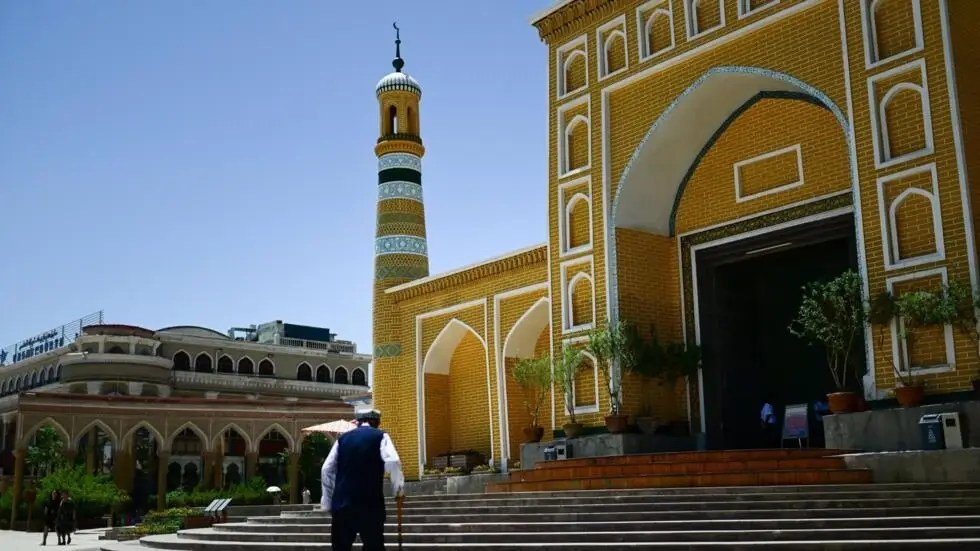
China Expands Crackdown on Mosques Beyond Xinjiang (East Turkestan)
Authorities have closed mosques in the Ningxia Hui Autonomous Region and in Gansu Province, which are home to large numbers of Hui Muslims, as part of a process officially known as "unification," according to the report, which relies on public documents, satellite imagery and witness testimony.
Local authorities have also removed the architectural features of mosques to make them appear more "Chinese," as part of the ruling Communist Party's campaign to tighten control over religion and reduce the risks of potential challenges to its rule.
In 1437 AH (2016 CE), President Xi Jinping called for the "Sinicization" of religions, and launched a crackdown that has focused largely on Xinjiang in western China, known as East Turkestan, home to more than 11 million Uyghurs and other Muslim minorities.
A United Nations report last year found that China may have committed "crimes against humanity" in Xinjiang (East Turkestan), including through its construction of a network of extrajudicial detention camps that are believed to have held at least 1 million Uyghurs, Hui, Kazakhs and Kyrgyz. Other reports have spoken of 2 million, while reports have confirmed that the number of detainees reaches 3 million.
Chinese authorities have shut down, closed, demolished or converted mosques to secular use in areas outside Xinjiang (East Turkestan) as part of a campaign aimed at suppressing religious expression, according to Human Rights Watch.
The Chinese Ministry of Foreign Affairs did not immediately respond to questions from Agence France-Presse, sent by fax, requesting comment on the report and its official policies towards Muslim minorities.
One of the earliest known references to "mosque unification" appears in an internal Party document from Shaban 1439 AH (April 2018) that was leaked to American media as part of a set of documents known as the "Xinjiang Papers." The document directed state agencies across the country to "strengthen the unified management of the construction, renovation and expansion of Islamic religious venues," and stressed that "there should be no newly built Islamic venues" in order to "compress the total number (of mosques)."
Maya Wang, acting director of the China division at Human Rights Watch, said: "The Chinese government is not 'strengthening' mosques as it claims, but closing many of them in violation of religious freedom. The Chinese government's closure, destruction and repurposing of mosques is part of a systematic effort to restrict the practice of Islam in China."
In the villages of Liaoqiao and Chuanke in Ningxia, authorities dismantled the domes and minarets of seven mosques and demolished the main buildings of three of them between 1440 and 1442 AH (2019 and 2021 CE), according to videos and photographs published online, which the group's researchers supported with satellite imagery.
In addition, the ablution hall of one of the mosques inside was damaged, according to videos obtained by the group.
The Associated Press was unable to independently verify the changes described in the report.
The "mosque strengthening" policy was also referenced in a document issued in March 2018 by the government of Yinchuan, the capital of Ningxia. According to the newspaper, the government wanted "strict control over the number and size of religious venues" and called on mosques to adopt "Chinese architectural styles."
The newspaper noted that "merging and consolidating mosques" could "solve the problem of too many religious venues."
In Gansu Province, several local governments have made detailed efforts to "unify" mosques.
In Guanghe County, where the majority of the population is Hui, authorities in 1441 AH (2020 CE) "deregistered 12 mosques, closed five mosques, and improved and strengthened five others," according to the government's annual yearbook, cited in the Human Rights Watch report.
News reports also indicate that the Chinese government has closed or altered mosques elsewhere across the country, and has sometimes faced violent public reaction. In May, protesters in Nagu town in Yunnan Province in southern China clashed with police over the planned demolition of a mosque dome.
News agencies, adapted.


