

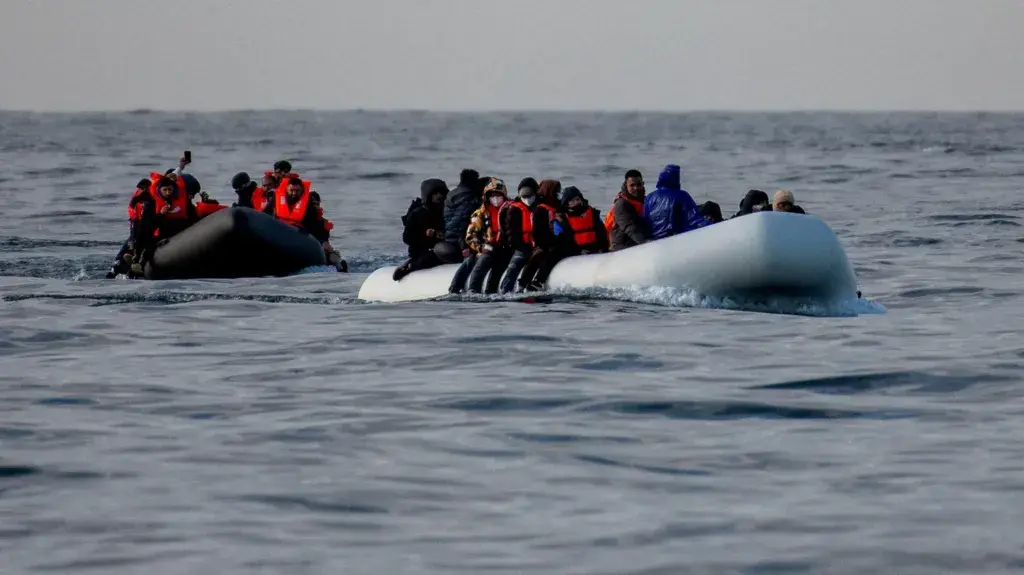
Britain refuses citizenship to refugees who arrive by small boats
The government has tightened the rules, making it almost impossible for a refugee who reaches the United Kingdom on a small boat to become a British citizen, according to the BBC.
The new guidance states that anyone who enters the United Kingdom illegally after undertaking a dangerous journey, which can be by boat but also by means such as concealment in a vehicle, will normally be refused citizenship, regardless of how much time has passed.
The Home Office said in a statement that the enhanced procedures make clear that anyone who enters the United Kingdom illegally will face refusal of a British citizenship application.
However, the change was condemned by the Refugee Council and by some Labour MPs, including Stella Creasy, who said the change "means that refugees will remain second-class citizens forever".
The changes, which were first revealed by the Free Movement blog, were introduced into the guidance for visa and immigration staff on Monday.
The changes mean that anyone considered to have entered the country illegally, including those already in the country, will not be able to apply for citizenship.
It is described as a "clarification" of the guidance for caseworkers assessing whether an applicant is of "good character", and it states: "Anyone applying for citizenship from 10 February 2025 who has previously entered the UK illegally will normally be refused, regardless of the time elapsed since the illegal entry occurred."
Another new entry in the same guidance says: "A person applying for citizenship from 10 February 2025 who previously arrived without a valid entry clearance or electronic travel authorisation, having undertaken a dangerous journey, will normally be refused their citizenship.
"A dangerous journey includes, but is not limited to, travelling on a small boat, concealed in a vehicle or other means of transport."
Previously, refugees who arrived by irregular means had to wait 10 years before their use could be considered.
Under UK law, entering the country without permission is now a criminal offence. This is despite the fact that the UK has signed international law treaties, such as the 1951 UN Refugee Convention, which states that asylum seekers and refugees should not be penalised for illegal entry.
The government has a new Border Security, Asylum and Immigration Bill, which scraps the Conservatives' Rwanda plan and strengthens police powers against people smugglers. Its first Commons vote was approved on Monday.
The Border Security, Asylum and Immigration Bill sets out Labour's plan to treat people smugglers like "terrorists", and creates a new offence of endangering another person during an illegal crossing of the Channel.
The Home Office also released footage of law enforcement teams raiding 828 premises, including nail bars, car washes and restaurants, as part of a UK-wide crackdown on illegal working earlier this week.
Responding to the new guidance for refugees, Labour MP Creasy said she had worked with a young man after he fled Syria and received a certificate, "who now contributes to our community, and has now obtained British citizenship".
"This process will deny that," she told the Today programme on BBC Radio 4.
Creasy also claimed that the change in refugee citizenship rules would "prevent" Paddington Bear from obtaining a British passport.
The fictional character became well known for arriving in the UK by hiding on a boat from his home in Peru.
Creasy said: "Basically, well, frankly, Paddington."
"Paddington did the same thing. He came through an irregular route, but we gave him sanctuary but we didn't give him a passport."
Lord Blunkett, a former Labour Home Secretary, urged the government to "think about the societal and cohesion aspects" of the policy.
He called on ministers to consider the "impact on children and their right to British citizenship and the statelessness that will hit individuals if their country of origin refuses to renew or retain their nationality".
He told the House of Lords: "Surely this Parliament should have a say on such a major change."
In response, Home Office minister Lord Hanson of Flint said children would "be looked at sympathetically under the current legislation so far".
The Home Office confirmed that the new restrictions "are unlikely to apply" to children, "given that illegal entry is generally considered to be outside the child's control".
However, each citizenship application will continue to be assessed on a case-by-case basis, it added.
The Refugee Council estimates that the guidance will prevent at least 71,000 refugees from obtaining British citizenship.
Anwar Solomon, chief executive of the charity, said the government's move "defies reason".
"The British public want refugees who have been given safety in our country to integrate into their new communities and contribute to them, so it makes no sense for the government to erect further barriers.
"We know that refugee men, women and children want to feel part of the country that has given them a home and support to rebuild their lives.
"We urge ministers to urgently reconsider."
Meanwhile, immigration lawyer Colin Yeo argued on social media that it is "a clear breach of the Refugee Convention".
Although the Conservatives have not yet responded to the government's decision, Conservative leader Kemi Badenoch told the BBC last week that she believes the right to citizenship and indefinite leave to remain "should only go to those who have shown a genuine commitment to the United Kingdom".
Badenoch spoke of proposals to tighten citizenship rules by making it harder for new immigrants to be able to settle permanently in the UK.
A Home Office spokesperson said: "There are already rules which can prevent those who arrive illegally from obtaining citizenship.
"This guidance strengthens procedures to make clear that anyone who enters the UK illegally, including on small boats, will face refusal of a British citizenship application."


