


In the heart of south-eastern Europe, among the mountains and valleys of Bosnia and its old Ottoman towns, one of the most distinctive Muslim peoples in modern European history took shape: the Bosniaks. They are not a recent Muslim community that arrived on the continent with the waves of migration of the twentieth century. Rather, they are a South Slavic people whose identity was formed in the Balkans over many centuries, and since the Ottoman period Islam has been one of the most important components of their historical and cultural character.
The story of the Bosniaks is not merely the story of Islam's arrival in Bosnia. It is the story of a people who over five centuries passed between the Ottoman and Austro-Hungarian empires, then the Kingdom of Yugoslavia and communist Yugoslavia, before finding themselves in the 1990s facing a war that targeted their existence across wide areas of their homeland, and which ended with the darkest chapter of it, the Srebrenica genocide.
Who are the Bosniaks?
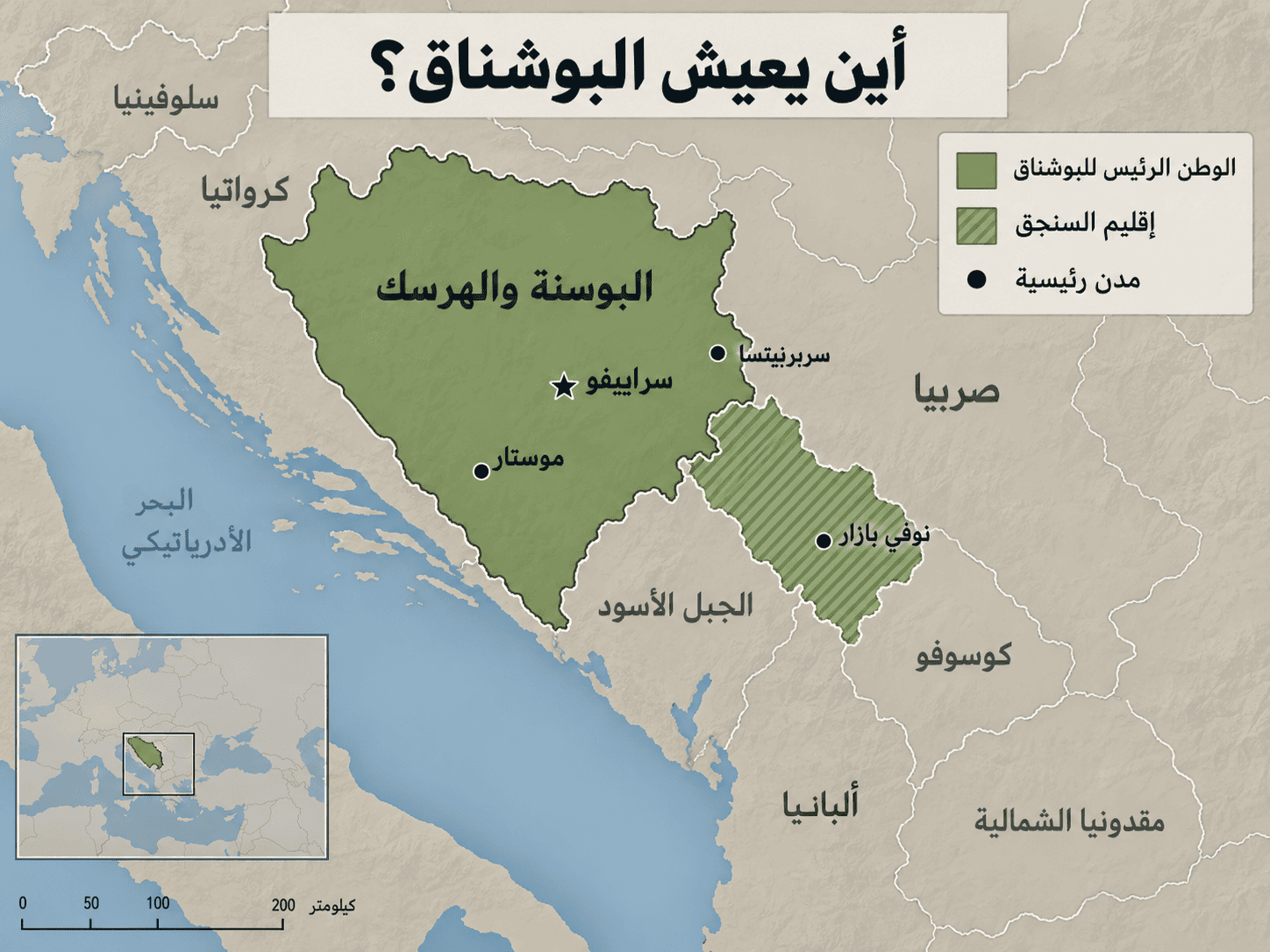
The Bosniaks, in Bosnian Bošnjaci and singular Bošnjak, are a South Slavic people whose main historical homeland is Bosnia and Herzegovina, with an important historical presence in the Sandžak region, which today extends between Serbia and Montenegro.
It is necessary to distinguish between two terms that are often confused in Arabic: "Bosnian" (al-busni) and "Bosniak" (al-bushnaqi). "Bosnian" is a geographic or civic description that can apply to any citizen of Bosnia and Herzegovina, whether Bosniak, Serb, Croat or from another group. "Bosniak", by contrast, is a specific ethnic national affiliation. For this reason a person can be a Bosnian Serb or a Bosnian Croat without being a Bosniak, and there are Bosniaks outside the state of Bosnia and Herzegovina.
The term "Bosniak" as commonly used in Arabic came largely through the Ottoman and Turkish form "Boşnak", which was used to refer to the people of Bosnia. However, Bosniak identity in its modern national sense developed over long stages, and the boundaries between geographic, religious and national affiliation in past centuries were not the same as what we know today.
Islam has historically been the faith of the overwhelming majority of Bosniaks, but this does not mean that "Bosniak" is a literal synonym for "Muslim". Bosniakness today is also a national and cultural identity, and there can be Bosniaks who are non-religious or secular, just as Balkan Muslims do not all belong to the Bosniak nationality; there are Albanians, Turks, Gorani and others.
Before Islam: Bosnia in the Middle Ages
Bosnia existed as a geographic and political entity centuries before the arrival of the Ottomans. After the South Slavic peoples settled in the Balkans in the early Middle Ages, a Bosnian political entity developed among the surrounding powers, and a medieval Bosnian kingdom emerged that reached its height under King Tvrtko I, who was crowned king in 779 AH/1377 CE.
Before the Ottoman conquest, Bosnian society comprised several Christian affiliations: Catholics and Orthodox, alongside the "Bosnian Church" whose doctrinal nature provoked wide debate among historians.
Here one of the most widespread accounts of the origin of Bosnia's Muslims appears: the account which says that the followers of the Bosnian Church were persecuted "Bogomils", and therefore converted to Islam en masse as soon as the Ottomans arrived. However, modern studies do not accept this simplified account as a complete explanation of the Islamisation of Bosnia; the religious transformation was longer and more complex, and involved multiple social, economic, urban, religious and political factors.
This matters for understanding the Bosniaks: they are essentially an extension of the local population of Bosnia, a large part of which underwent a gradual religious and cultural transformation during the Ottoman era, and they are not a Turkish people that migrated to Bosnia and settled there.
1463: The beginning of the great transformation
Most of Bosnia came under Ottoman rule in 867 AH/1463 CE, and the subjugation of the Herzegovina regions was completed in the following decades. From here began a period lasting nearly four centuries, from 867 AH/1463 CE to 1295 AH/1878 CE, which reshaped Bosnia politically, socially and culturally.
But Islam did not become the religion of a large part of the population on the night the kingdom fell.
Studies based on Ottoman tax registers indicate that conversion to Islam was a gradual process that extended throughout the fifteenth and sixteenth centuries and reached its peak roughly at the transition to the seventeenth century. A recent historical economic study estimates that Muslims may have made up around 70% of Bosnia's population at that stage, with the caveat that older figures are approximate due to changing borders and the nature of the records.
There was no single cause for the conversion to Islam. Cities flourished under the Ottoman state, administrative, military and judicial functions were linked to the institutions of the Islamic state, and Sufi orders played a role in spreading Islam. There were also social, economic and legal incentives to join the Muslim community, in a society where status, taxes and positions were affected by religious affiliation.
Therefore, portraying the Islamisation of Bosnia either as a "forced collective conversion" or as a simple event that happened all at once does not match what historical studies show. It was a process extending across generations, and by the seventeenth century a rooted local Bosnian Muslim community had formed.
Bosnian Islam in a Slavic tongue
The adoption of Islam did not turn Bosnia's Muslims into Turks in language or nationality. The population continued to speak their local Slavic language, while Ottoman Turkish, Arabic and Persian became important languages in administration, religious sciences and literature.
From this interaction a distinctive Bosnian Islamic culture emerged. The Arabic script was also used to write the Bosnian language in a form known as "Arebica", and written Bosnian literature in the Arabic script appeared, included within the traditions of "Aljamiado" literature in Islamic Europe.
In belief and jurisprudence, the traditions that came with the Ottoman state were consolidated: historically, the Bosniaks are Sunni, predominantly following the Hanafi school in jurisprudence and Maturidi creed, with an ancient presence of Sufi orders. The Islamic Community of Bosnia and Herzegovina still stipulates in its institutional framework the Hanafi school and Maturidi creed as the traditional reference for interpreting religious affairs.
This is one of the important features of the Bosniaks: the Islam that took shape among them was not a temporary foreign phenomenon, but became a system of institutions, customs, endowments, education and urban architecture that lasted for centuries.
Mosques, madrasas and endowments: how Bosnia's face changed
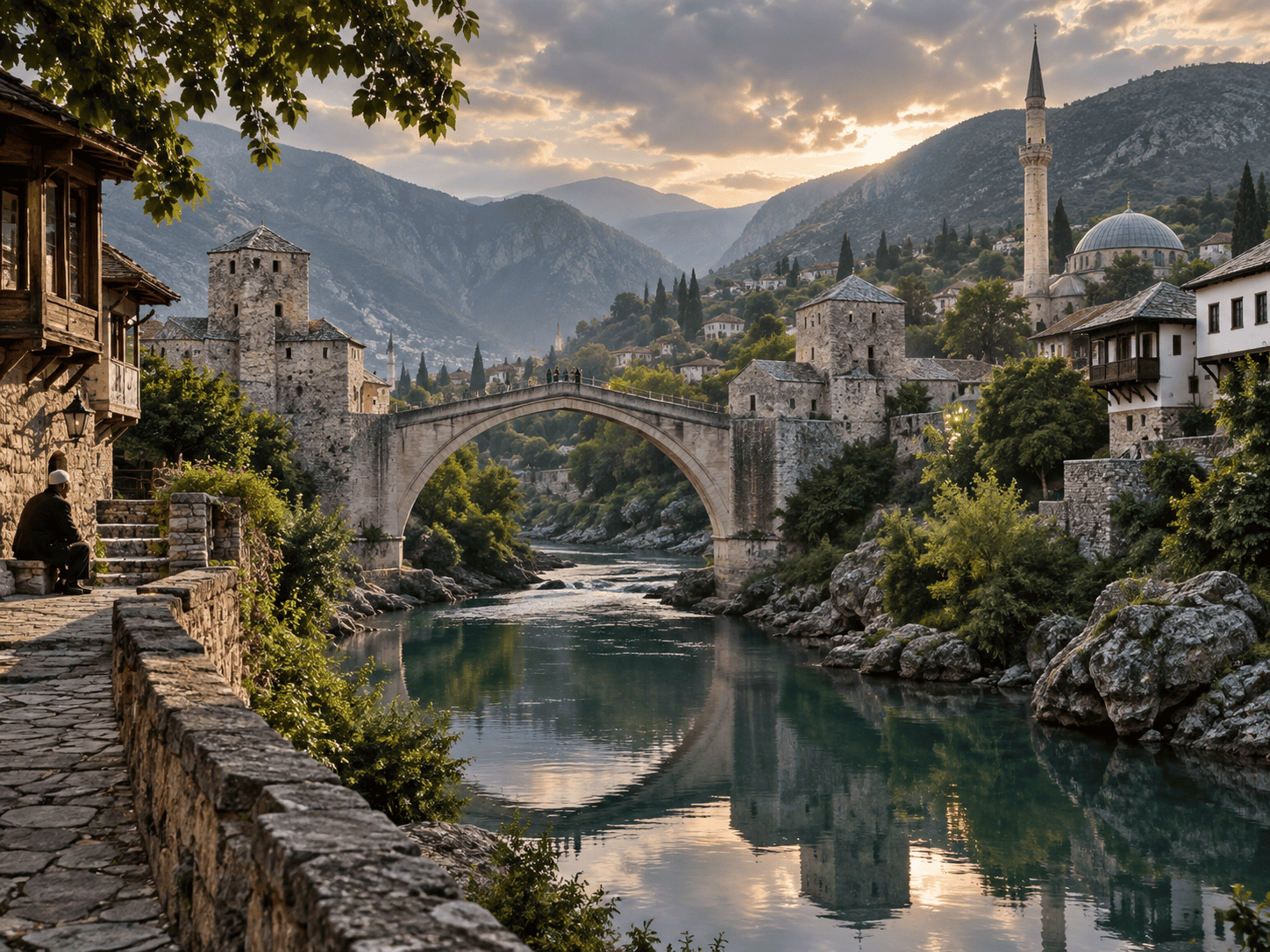
With the Ottoman era, Sarajevo, Mostar, Travnik, Banja Luka and other towns became commercial and scholarly centres with a clear Islamic character. Mosques, madrasas, Quranic schools, inns, baths, markets, bridges and endowments spread.
Endowments were among the most important institutions that shaped the Muslim Bosnian town.
Here stands Gazi Husrev-beg, governor of Bosnia and one of the most important figures in Sarajevo's history. In the sixteenth century, in 944 AH/1537 CE, he built in the city a mosque, a madrasa and charitable and commercial facilities, and founded his famous library, whose founding date goes back to the same year.
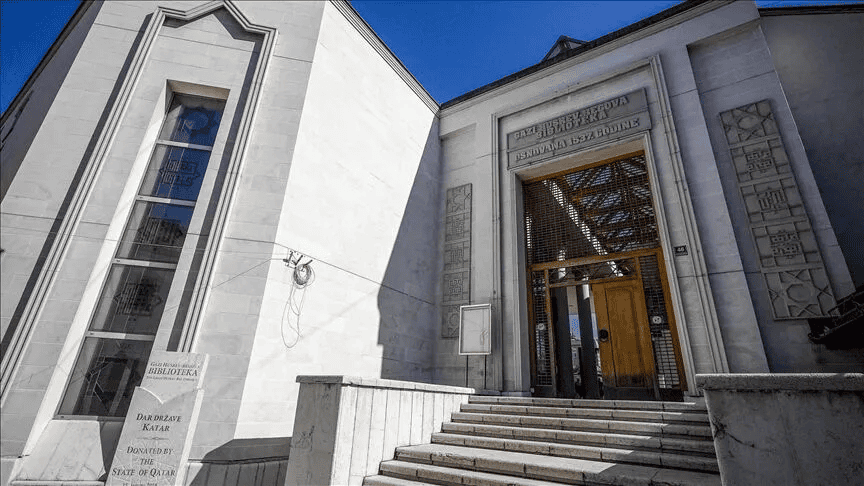
The Gazi Husrev-beg Library in Sarajevo still stands today, and holds tens of thousands of books and documents and thousands of manuscripts, among them works in Arabic, Turkish, Persian and Bosnian, making it a material witness to the depth of Islamic scholarly life in the Balkans.
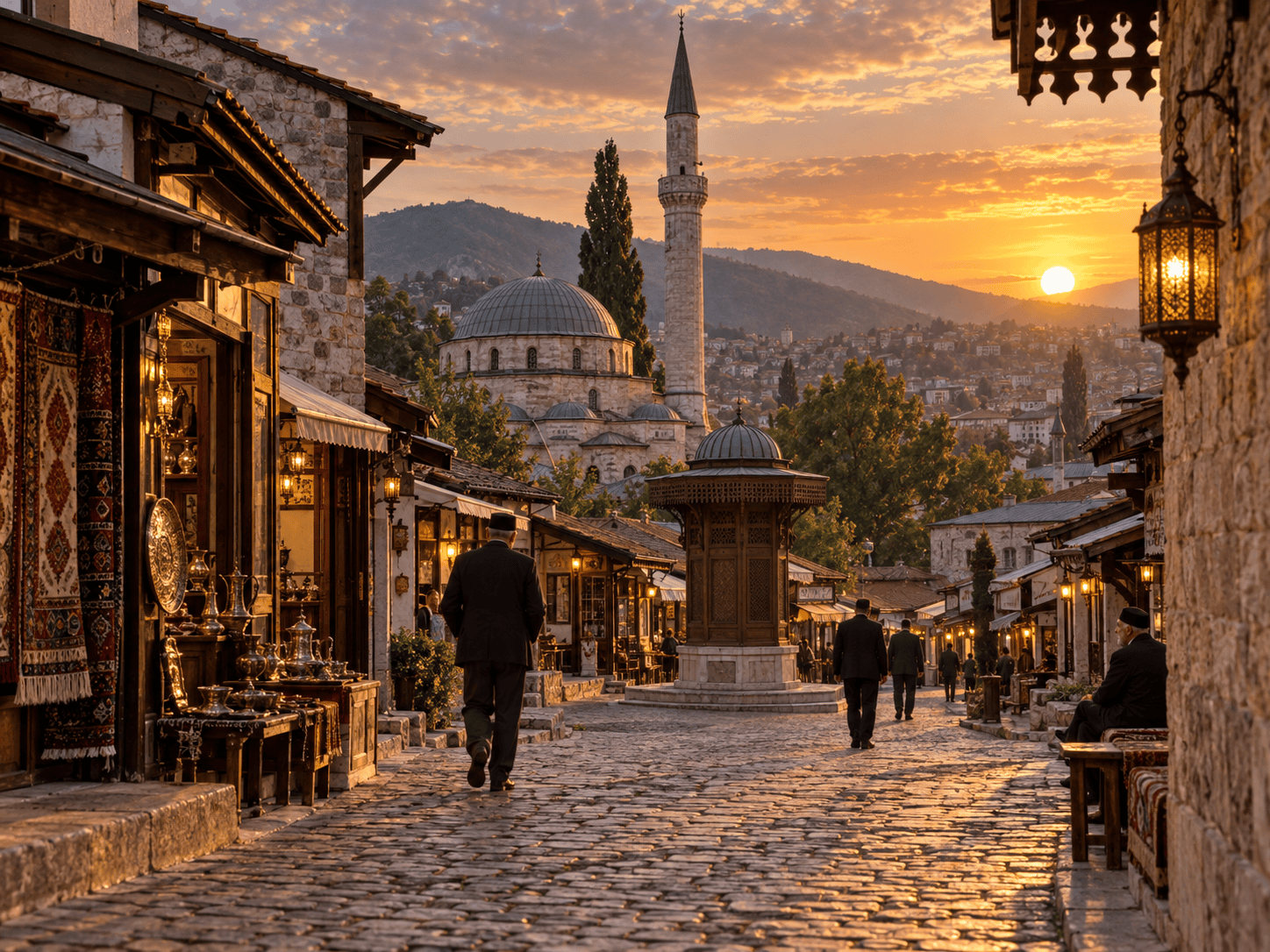
Architecture was not merely an external Ottoman legacy; it became part of the local identity. Hence the particular image of Bosnia's old towns emerges: the stone bazaar, the bridge, the public fountain, the café, the Bosnian house, the Islamic cemetery, and the mosque with its tall minaret, in a scene that is geographically European and civilisationally Islamic at the same time.
Bosnia: an Ottoman outpost facing Europe
Bosnia was one of the most important western border provinces of the Ottoman Empire. For centuries it lay on the lines of confrontation with the Habsburgs, Venice and the kingdoms of central Europe.
This led to the development of a local military class and a system of commanders, notables and influential families, and Bosnia's Muslims developed a strong sense of their country's distinctiveness within the Ottoman state.
As the empire weakened and central reforms began in the nineteenth century, the Ottoman state clashed with Bosnian elites who feared losing their privileges and local autonomy.
This erupted in the movement of Husein Kapetan Gradaščević in 1247 AH/1831 CE, known in Bosnian memory by the title "Dragon of Bosnia". Gradaščević led a movement that demanded self-rule for Bosnia and objected to some reforms of Sultan Mahmud II, and his forces achieved victories before the Ottoman state defeated them in 1248 AH/1832 CE. In Dhu al-Hijjah 1247 AH/September 1831 CE Gradaščević was chosen as governor of Bosnia by his supporters, but the Sultanate did not recognise him.
Despite the movement's failure, Gradaščević remained in Bosniak national memory an early symbol of the idea of defending Bosnia's political distinctiveness.
1878: The great shock
The harshest transformation in the life of Bosnia's Muslims in the nineteenth century came after the Congress of Berlin in 1295 AH/1878 CE, when the Austro-Hungarian Empire obtained the right to occupy and administer Bosnia and Herzegovina, although nominal Ottoman sovereignty remained for a period.
A large part of the population resisted the occupation by force, and Muslims were at the forefront of the resistance; Vienna was obliged to send huge forces to take control of the country. In 1326 AH/1908 CE Austria-Hungary formally annexed Bosnia and Herzegovina.
For Bosnia's Muslims this was not merely a change of flag. After centuries of living within a vast Islamic state, they suddenly became Muslims under the rule of a Christian European empire.
Questions arose that the Bosnian Muslim society had never before been forced to confront in this way: Was it permissible to remain in a country ruled by non-Muslims? Should they migrate to Ottoman lands? How could they preserve their endowments, schools and personal status law? And what was the relationship of their scholars to the Shaykh al-Islam in Istanbul?
Tens of thousands of Bosnian Muslims left for Ottoman territory, especially Anatolia, in successive waves that continued until the First World War. Estimates of the total number vary, but Bosnian academic sources put it at around 150,000 migrants between 1295 AH/1878 CE and 1336 AH/1918 CE, while more recent studies confirm that the reasons for migration combined religion, economics, forced conscription and legal and social changes.
From here too, large communities of Bosniak-origin people formed in Turkey.
A forgotten tragedy for the Muslims of Sandžak: what happened to the Bosniaks in Hajiyet?
\
The office of "Reis-ul-ulema": Islam adapts to a new Europe
The fall of Ottoman rule produced a development of great importance whose effects persist to this day.
In 1299 AH/1882 CE an independent religious leadership for the Muslims of Bosnia and Herzegovina was established, and Mustafa Hilmi Effendi Omerović was appointed the first "Reisu-l-ulema".
The creation of this office was an attempt to organise Muslims' life in a new political reality after administrative separation from the Ottoman state. Over time the "Islamic Community of Bosnia and Herzegovina" developed into the central institution that manages mosques, religious education, endowments, fatwas and Islamic affairs.
The significance of this experience lies in its creation of an early European Islamic institutional model: Muslims living in a non-Islamic state, yet having a national religious leadership, relatively independent institutions, and firmly established jurisprudential and educational traditions.
The Bosniaks within the Kingdom of Yugoslavia
After the First World War and the fall of Austria-Hungary in 1336 AH/1918 CE, Bosnia and Herzegovina became part of the Kingdom of Serbs, Croats and Slovenes, which later became the Kingdom of Yugoslavia.
Once again the Bosniaks faced a new state, this time one whose political centre was dominated by the Serbian element.
Land reforms beginning in 1337 AH/1919 CE dismantled a large part of the old agrarian system, and the Muslim landowning class, which had considerable weight in Bosnia, was severely affected. Liberating peasants from feudal relations was a genuine social demand, but the way the reform was implemented also became a source of political and national conflict, especially since a very large proportion of major landowners were Muslim.
In this climate the "Yugoslav Muslim Organisation" was founded in 1337 AH/1919 CE, and under the leadership of Mehmed Spaho it became the main political force of Bosnia's Muslims, demanding protection of their institutions and property and the preservation of Bosnia's political distinctiveness within the state.
But the fundamental problem remained: what was the national identity of Bosnia's Muslims?
The state and surrounding national projects sometimes treated them as Serbs who had converted to Islam, and sometimes as Muslim Croats, while a separate identity gradually developed among them that did not wish to dissolve into either project.
The Second World War: between rival powers
When Axis forces invaded Yugoslavia in 1360 AH/1941 CE, Bosnia and Herzegovina was attached to the fascist "Independent State of Croatia", a satellite of the Axis powers.
Bosnia's Muslims found themselves in the midst of an extremely complex war: a fascist Ustaše regime that committed massacres against Serbs, Jews and Roma; Serb Chetnik forces that in turn committed widespread massacres against Muslims and Croats; and the communist Partisan movement led by Josip Broz Tito, which fought the occupation, Axis forces and their collaborators.
The Bosniaks did not take a single position; individuals joined different formations, and a large number later took part in the Partisan movement.
A notable page of that period is the issuing of what became known as the "Islamic Declarations" in Bosnian towns during 1360–1361 AH/1941–1942 CE, signed by Muslim scholars and notables, which condemned attacks on civilians, especially Serbs, Jews and Roma, and rejected collective blame of Muslims for crimes committed by individuals or forces aligned with the regime.
On the other hand, entire Muslim communities in eastern Bosnia and other areas were subjected to massacres during the war, a page that later received less attention in the public memory of socialist Yugoslavia. Historical studies indicate that a number of sites where Muslim civilians were killed during the Second World War remained unmarked and without memorials for decades afterwards.
Communist Yugoslavia: a people without a clear name
After Tito's victory in 1364 AH/1945 CE, Bosnia and Herzegovina became one of the six republics that made up socialist Yugoslavia.
However, the communist authorities initially did not recognise Bosnia's Muslims as a distinct nationality. In the early years it was politically expected that many of them would choose a Serb, Croat or Yugoslav identity, while for the state Islam remained essentially a religious classification.
At the same time Islamic institutions faced harsh changes: property and endowments were nationalised, and many religious schools and Quranic schools were closed, with only limited institutions remaining, among them the Gazi Husrev-beg madrasa. Nevertheless the Islamic Community managed to continue, and gradually regained some space for religious and educational work.
During the 1960s an important shift occurred in state policy. The Yugoslav leadership began to acknowledge that Bosnia's Muslims were not merely a religious community that could be divided nationally between Serbs and Croats.
In the late 1960s they were recognised as a nation, and the 1971 census (1391 AH) introduced the national category "Muslims" in a national sense, not merely as a religious affiliation. Academic studies confirm that this recognition was the outcome of a long political and intellectual process during the 1960s, before their status as one of the peoples of Yugoslavia was firmly established.
The return of the name "Bosniak"
With the breakup of Yugoslavia and the outbreak of the war in Bosnia, the question of the name returned with force.
On 11–12 Rabi' al-Awwal 1414 AH / 27–28 September 1993, at the height of the war, the "First Bosniak Congress" convened in Sarajevo and resolved to readopt the historical name "Bošnjak", i.e. Bosniak, instead of using "Muslim" as the name of the nation.
The aim was not to abandon Islam, but to separate religious affiliation from national name: Islam is a religion, and the Bosniaks are a people. From that time on, the name became the official national designation of the community that had been known in Yugoslav documents as "Muslims".
1992: The Bosniaks face a struggle for survival
The collapse of Yugoslavia was the most dangerous moment in the modern history of the Bosniaks.
After Bosnia and Herzegovina declared independence in 1412 AH / 1992, the national leadership of the Bosnian Serbs rejected the creation of the new state, and Bosnian Serb forces, with substantial support from the Yugoslav army and Serbia, began a campaign to seize large areas and expel non-Serb inhabitants from them.
Bosniak and Croat forces also committed war crimes against civilians of other communities, and at one stage of the war an armed conflict broke out between Bosniak and Croat forces. However, the documentation of the courts and international institutions shows that the most extensive and organised campaign of ethnic cleansing in large areas was the one carried out by Bosnian Serb forces against non-Serb inhabitants, and the Bosniaks were the greatest victims of it.
Sarajevo: a city under siege
From Ramadan 1412 AH / April 1992 until late 1415 AH / 1995, Sarajevo endured one of the longest sieges of a city in modern history.
The capital was surrounded by Bosnian Serb forces positioned in the mountains, and its inhabitants were subjected to shelling, sniper fire, and shortages of electricity, water and food.
The siege lasted 44 months, or some 1,425 days. Data from a documentation project run by the Balkan Investigative Reporting Network indicate that more than 11,000 of the city's residents were killed during the siege, including some 1,600 children.
In those years Sarajevo became a symbol of the paradox of Bosnia as a whole: a European city of many religions, home to the mosque, the Orthodox church, the cathedral and the synagogue, which at the end of the twentieth century turned into a city whose people lived under artillery and sniper fire.
Ethnic cleansing of Muslims in Bosnia and the Srebrenica massacre\
Srebrenica: when the massacre became genocide
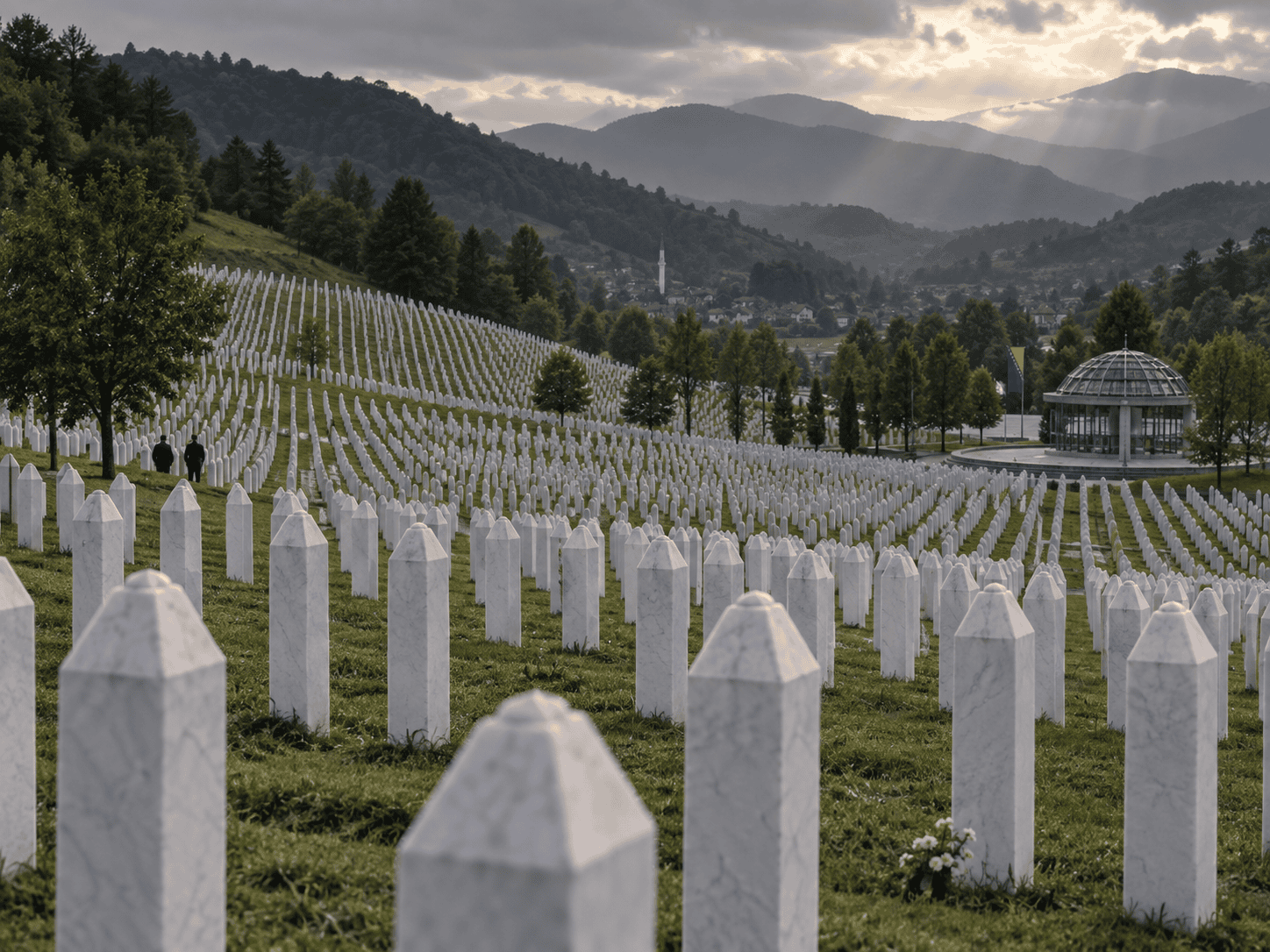
The tragedy reached its peak in Muharram 1416 AH / July 1995. Srebrenica, in eastern Bosnia, had been declared a "safe area" by the United Nations, and thousands of Bosniaks had fled there to escape the ethnic cleansing of the surrounding villages and towns.
On 11 July the town was taken over by units of the Army of the Republika Srpska under General Ratko Mladić.
In the days that followed, Bosniak men and boys were separated from the women and children, and thousands of them were taken to various detention and execution sites and systematically killed. Some 30,000 women, children and elderly people were also forcibly transferred out of the area.
International institutions estimate that more than eight thousand men and boys were killed or went missing. The International Commission on Missing Persons has identified more than seven thousand victims, relying mainly on DNA analysis, after their remains were found in primary, secondary and tertiary mass graves; the perpetrators later moved the bodies in an attempt to conceal the evidence.
International justice has settled the legal characterisation of the crime. The International Criminal Tribunal for the former Yugoslavia, and subsequently the International Court of Justice, determined that what took place in Srebrenica constitutes "genocide" in the legal sense of the term.
In 1445 AH / 2024, the United Nations General Assembly adopted 11 July as an International Day of Reflection and Commemoration of the Srebrenica Genocide, and condemned the denial of the genocide and the glorification of those convicted of war crimes, crimes against humanity and genocide.
The Dayton Agreement: the state survives, at a price
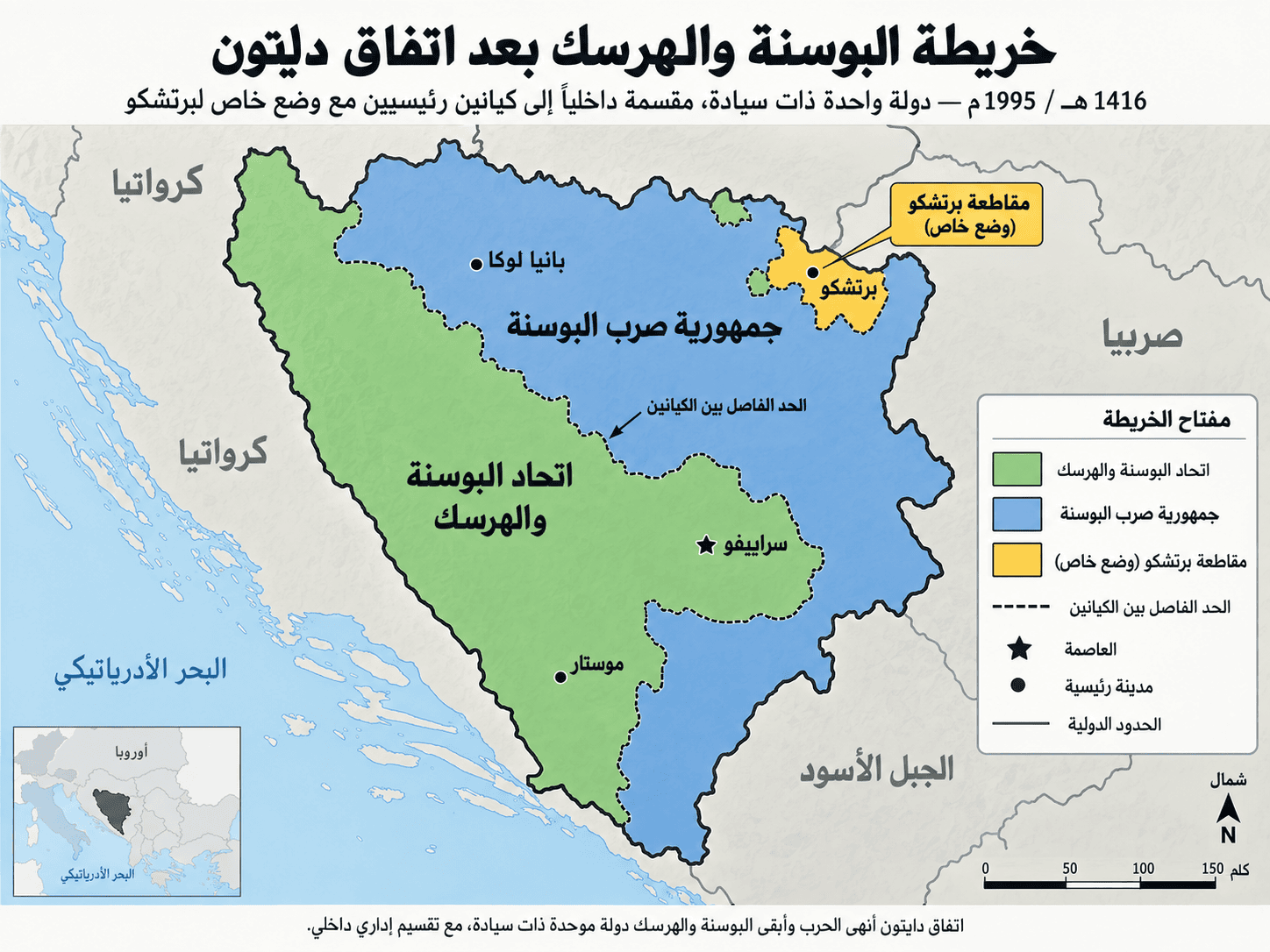
The war ended in late 1416 AH / 1995 with the Dayton Agreement. The agreement preserved Bosnia and Herzegovina as a single sovereign state, but divided it internally into two main entities: the "Federation of Bosnia and Herzegovina", in which Bosniaks and Croats are concentrated, and the "Republika Srpska", alongside the special status of the Brčko district.
The agreement ended the war, but at the same time it entrenched a highly complex political system based largely on a balance between Bosniaks, Serbs and Croats.
For many Bosniaks the outcome was bitter: Bosnia survived, but areas in the east and north of the country that had large Bosniak communities before the war became, after ethnic cleansing, part of the Republika Srpska entity. Refugees were granted the right to return, but the demographic make-up of many towns did not return to what it had been before 1412 AH / 1992.
Where do the Bosniaks live today?
Bosnia and Herzegovina is their main homeland. In the last comprehensive population census conducted in the country, in 1434 AH / 2013, 1,769,592 people identified themselves as Bosniaks, around 50.1% of the population, making them the largest of the country's three constituent nations. No national census has been held since then, so caution is needed in offering a precise recent figure for their number inside Bosnia in 1448 AH / 2026.
A large historical Bosniak population lives in the Sandžak, a region divided today between south-western Serbia and north-eastern Montenegro, whose principal towns include Novi Pazar, Tutin, Sjenica, Rožaje and Bijelo Polje.
In Serbia's 2022 census, 153,801 people identified themselves as Bosniaks. In Montenegro, the census of 1445 AH / 2023 recorded 58,956 Bosniaks, representing 9.45% of the population. Notably, both censuses also record a separate category for people who chose "Muslim" as their national identity instead of "Bosniak", a direct legacy of the old Yugoslav classifications.
Today there are large Bosniak communities in Germany, Austria, Sweden, Switzerland, the Netherlands, the United States, Canada and Australia, in addition to very large numbers of descendants of emigrants from Bosnia and the Sandžak in Turkey.
What remains of the Ottoman era?
More than a century after the end of Ottoman rule, its traces are still clearly visible in Bosniak life.
Personal names such as Mustafa, Ahmed, Mehmed, Emina and Fatima sit alongside Slavic surnames that mostly end in "-ić". Turkish, Arabic and Persian words have entered the Bosnian language. The cuisine includes burek, ćevapi, Bosnian coffee and oriental sweets. Old towns still contain mosques, endowments (vakufs), bridges and markets.
But Bosniak identity is not Ottoman alone. The people also lived through forty years of Austro-Hungarian rule, then more than seven decades within the Yugoslav states, and experienced the age of industry, modern education, secularism, communism, war and diaspora.
For this reason, a contemporary Bosniak can be at once a Muslim, a Slavic speaker, and European in culture and geography, connected to the Ottoman legacy and carrying a very particular historical experience within the Balkans.
There is no contradiction in this; rather, this very combination is what shaped the Bosniak character.
Islam among the Bosniaks: religion, identity and memory
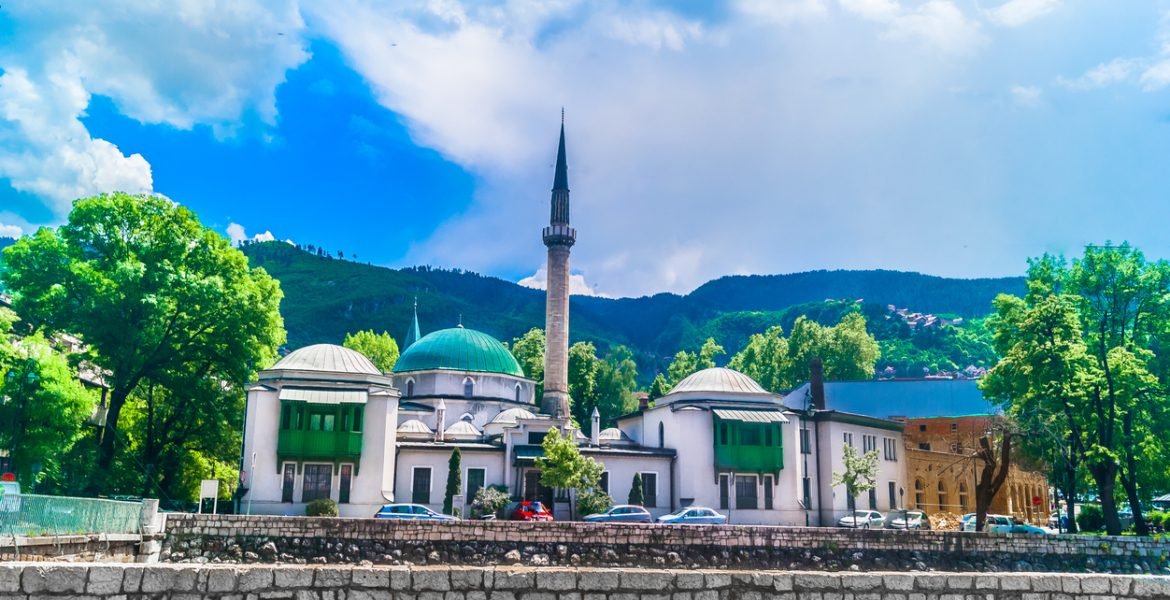
Islam has played a role in Bosniak history that goes beyond individual worship, because for long periods it was the framework that preserved their distinctiveness from the surrounding Orthodox Serbian and Catholic Croatian national projects.
But this did not make Bosniak society a single religious bloc. From the nineteenth century onwards, reformist, conservative and secular currents emerged within it, and then communist rule and emigration to Western Europe brought greater diversity in patterns of religiosity.
Nevertheless, religious institutions have remained extremely important. The "Islamic Community in Bosnia and Herzegovina", headquartered in Sarajevo and headed by the Reis-ul-Ulema, regards itself as the religious framework for the Muslims of Bosnia and of the historical homeland regions and the Bosniak diaspora.
The Bosnian model also includes its long experience of coexisting with a civil state and European law, an experience that began in practice in 1295 AH / 1878, about a century before the major waves of Muslim migration to Western Europe.
The memory that has not yet closed
The Bosnian war ended militarily more than three decades ago, but the struggle over memory has not ended.
Denial of the Srebrenica genocide, or minimisation of it, persists in some Bosnian Serb nationalist circles, and the debate over glorification of leaders convicted of war crimes continues.
In Rabi' al-Awwal 1448 AH / September 2026, this was made clear once again after large-scale ceremonies were held in Serbia for Ratko Mladić, who died while serving a life sentence after being convicted of genocide, crimes against humanity and war crimes. The honours paid to him drew international criticism and a new diplomatic crisis with Bosnia and Herzegovina.
This explains why the Bosniaks do not view Srebrenica as merely a distant historical event. For thousands of families, the search for remains, the burial of victims, the establishment of the truth and resistance to denial remain part of the present.
A people that endured through all the changes
Perhaps the phrase that best sums up Bosniak history is that they are a people who were repeatedly compelled to redefine their place without ever leaving their homeland.
They were the inhabitants of medieval Bosnia; then a large part of them became Muslim under the Ottomans. When the Ottomans withdrew, they found themselves a religious minority within the Austro-Hungarian Empire. After its fall they entered a Yugoslav state that for a long time did not recognise their nationhood. Under the communist system they eventually received the name "Muslims" as a nationality, and then during the wars of the 1990s they reclaimed the name "Bosniak".
At the very time when the world was debating the end of the Cold War and the building of a "New Europe", their towns were being ethnically cleansed, their mosques destroyed, Sarajevo besieged, and thousands of their men and boys ended up in mass graves around Srebrenica.
Yet Bosnia did not disappear, and the Bosniaks did not disappear.
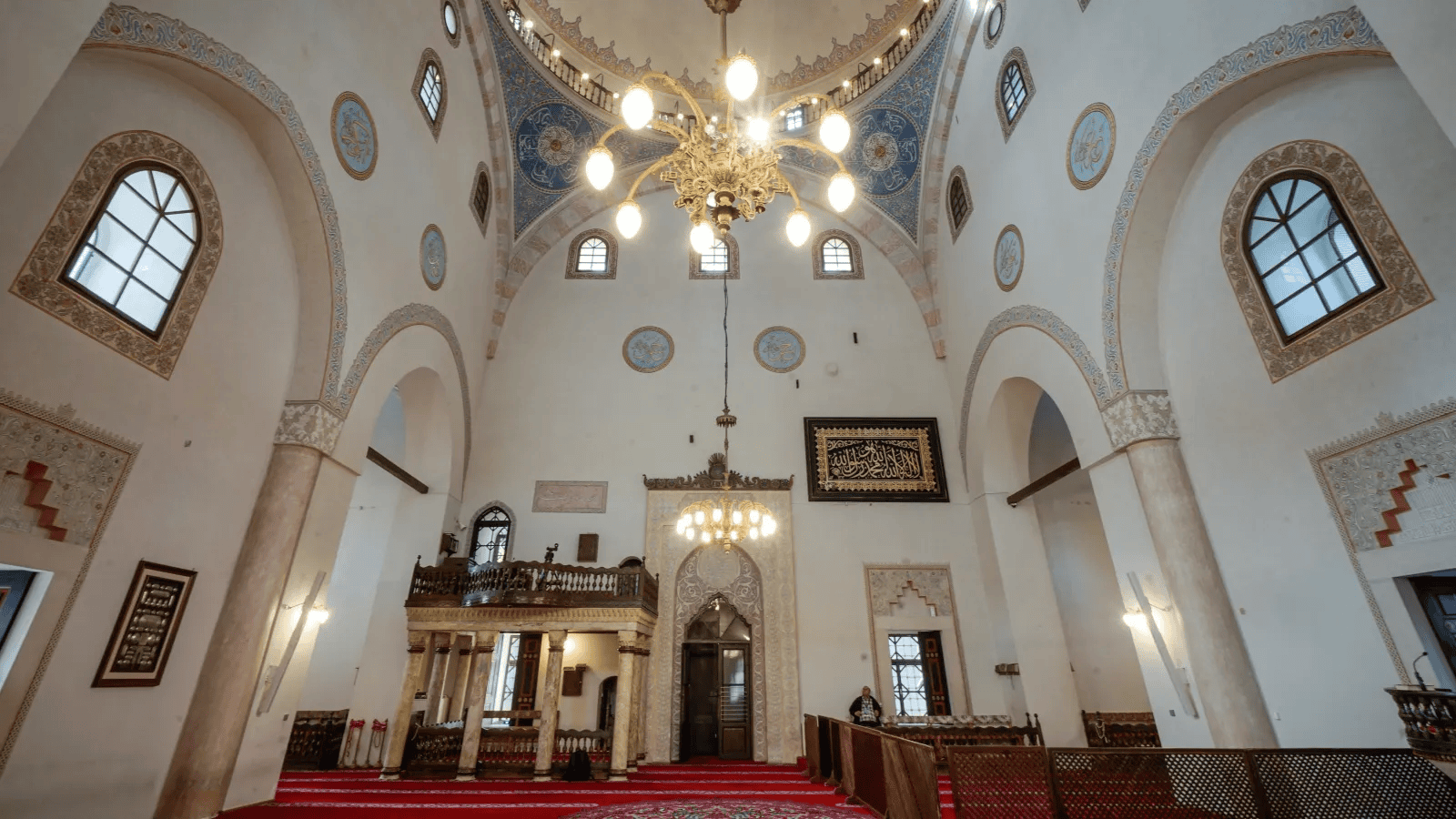
Today Friday prayers are still held in the Gazi Husrev-beg Mosque, which dates back to the sixteenth century, its library still preserves its manuscripts, and the call to prayer rings out from Sarajevo, Mostar, Travnik and Novi Pazar, while every year the remains of more victims of a war that ended decades ago are identified and buried.
For this reason, the story of the Bosniaks is too large to be reduced to the wars of the 1990s or to the legacy of the Ottoman state alone. It is a story of the shaping of a local European Islam; a story of a community that kept its Slavic language, its religion and its institutions through the shifting of empires and borders; and a story of a people whose identity was denied or renamed more than once, and who arrived at the end of the twentieth century defending not only a state but their right to continue to exist under their own name and on their own land.
In this sense, the Bosniaks are not merely "Muslims in Europe"; they are part of Europe's own history, and a living witness that Islam on the continent is neither a recent nor an imported phenomenon, but has in the heart of the Balkans a memory of cities, institutions, endowments, cemeteries and mosques, and a people whose presence spans centuries.


