

For the past three years, Mohammed Lalo has been saving bit by bit to achieve one goal: securing $2,000 for himself and his family of eight to cross the Naf River and reach a Rohingya refugee camp in neighbouring Bangladesh.
Lalo was not among the some 750,000 Rohingya refugees who fled Myanmar in Dhu al-Qadah 1438 AH (August 2017 CE), fleeing what the United States and various human rights groups have recognised as genocide committed by the Myanmar army.
He had no wish to leave his village of Buthidaung, a small town in Myanmar's Rakhine State, and abandon his home and farmland. Lalo told Anadolu Agency that his area had been relatively protected from violence and massacres.
However, after the coup in 1442 AH (2021 CE) and the escalating clashes between the rebel Arakan Army and the Myanmar army, he was always fearful for his family's safety and future.
The situation worsened in Jumada al-Ula (November) of last year, when several houses in his village were destroyed by mortar shells and bombs dropped by drones. By Safar (early August) of this year, his village and the surrounding area had effectively become a battlefield.
Although he did not have the $2,000 needed to flee, Lalo seized the opportunity and persuaded a boat owner to attempt the crossing.
Speaking to Anadolu Agency at a refugee camp in Cox's Bazar in southern Bangladesh, Lalo said: "I heard that the Bangladeshi government had fallen on the first of Safar (5 August) and that the border was unprotected, so we tried to cross on the second of Safar (6 August)."
On reaching the Naf River, Lalo saw "at least 100 floating bodies." He said: "I was horrified when I learned that drones were bombing people trying to cross on the first of Safar (5 August). My family and I hid in a small forest near the shore and tried to cross again at night."
When they returned to their homes a few hours after midnight, Lalo was seriously injured in his right leg by the explosion of a mortar shell. He said: "I felt as if bombs were falling all around us. I lost my leg. One of my brothers was hit in the head and died."
Lalo is one of at least 2,000 people who have crossed the Naf River since the first of Safar (5 August), risking their lives to reach the world's largest refugee camp in Bangladesh.
Like many law enforcement officials in the country, Bangladesh Border Guard officials abandoned their posts out of fear of reprisals when massive student-led protests forced the former prime minister Sheikh Hasina from power.
At least two officials of the Bangladesh Border Guard, who asked not to be named and were among many who resumed their duties on 17 Safar (21 August), told Anadolu Agency that "there has been a large influx of new Rohingya refugees since 1 Safar (5 August)."
Officials at the refugee camps told Anadolu Agency that the figure of 2,000 new arrivals is a conservative estimate and the actual number may be higher.
Sona Mia, 40, also took the same route across the Naf River with his entire family to reach the Hakimpara refugee camp in Ukhiya, southern Bangladesh.
"The Arakan Army was slaughtering our neighbours and forcibly recruiting young Rohingya men," Sona told Anadolu Agency. "Those who resisted were killed with their families." He feels relieved to be in Bangladesh and hopes for a new beginning. "At least we no longer fear for our lives, and we are safe here."
Hope for the Rohingya?
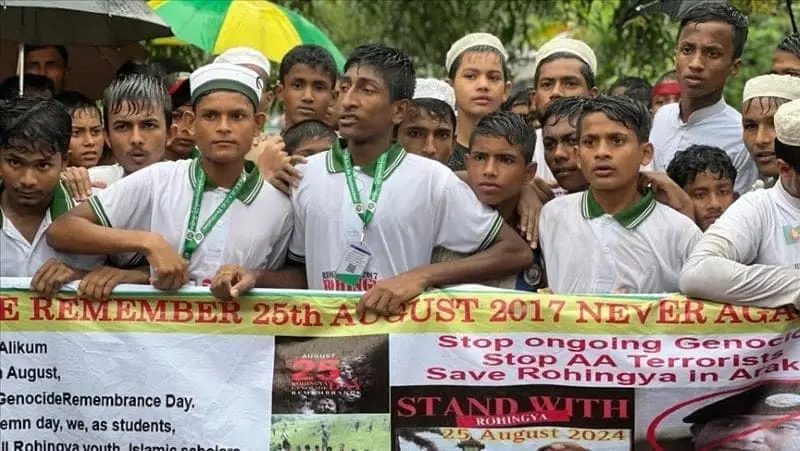
Last Sunday, 21 Safar (25 August), marked the seventh Rohingya genocide day.
At a large gathering in Camp 4 in Cox's Bazar, Rohingya leader Mohammed Alam repeated their call for safe return and the protection of their rights as refugees.
He added: "To the new government in Bangladesh led by Muhammad Yunus, we urge them to ensure the rights of our refugees first, and then facilitate our safe and voluntary return."
Maung Zarni, co-founder of the human rights group "Free Rohingya Coalition", told Anadolu Agency that he hopes the interim government's policies on the Rohingya issue will be "kinder and more strategic" than Hasina's administration.
Mohammed said the first step should be "recognising the one million survivors of the Rohingya genocide as refugees with rights under international law and as ethnic Rohingya individuals."
However, Zarni warned that Western countries are "unlikely to resettle any of the Rohingya survivors," pointing to "racist and anti-Muslim attitudes and policies entrenched in Europe, the United States, Canada and Australia."
He added that the West "will also struggle to help Yunus secure meaningful cooperation" from the Arakan Army or the Myanmar army.
He added that even if Western parties were willing to help resolve the conflict in Myanmar, this would not "guarantee the return of the Rohingya."
The Express Tribune.


