

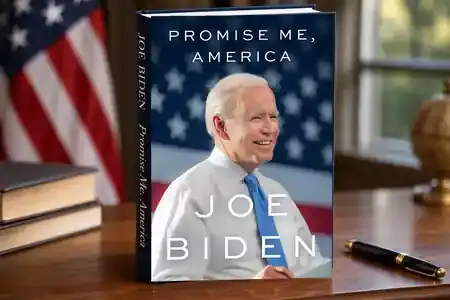
Excerpts from the memoir of former US President Joe Biden have revealed sharp disagreements with Israeli Prime Minister Benjamin Netanyahu during the war on the Gaza Strip, accusing him of making repeated promises to reduce civilian casualties without keeping them, and of prioritising his political and personal interests over Israel's long-term interests.
Yet what the memoir reveals raises a question that goes beyond the troubled relationship between the two men: how did the US administration continue to provide military and political support to Israel, despite its president acknowledging that he knew promises to protect civilians were not being implemented, and that military operations were causing more Palestinian casualties?
These admissions appear in Biden's new book "Promise Me, America", scheduled for publication on 17 November of this year, copies of which US media outlets obtained in advance. They published excerpts relating to the war in Gaza and Biden's attempts to defend his administration's record.
Netanyahu promised to protect civilians, then continued military operations
According to excerpts obtained by CNN and published on 13 November, Biden says that since the beginning of the war he demanded that Israel take precautions to reduce the suffering of civilians, and that he raised the issue repeatedly in his private conversations with Netanyahu.
The former president reveals that Netanyahu acknowledged the impact of rising Palestinian casualties on Israel's image and on American support for the war, but did not translate his commitments into concrete measures.
Biden describes a recurring pattern: Netanyahu would promise additional steps to protect civilians, after which new military operations would follow, leading to further deaths.
Biden goes on to accuse him of making promises he had no ability to keep or did not intend to fulfil, noting that Israeli officials offered explanations and excuses whenever Washington raised the continuing loss of life.
This account carries particular weight because it comes from the US president who led political and military support for Israel for most of the war, rather than from a Palestinian source or a rights organisation critical of US policy.
However, it remains Biden's account of private conversations; the initial coverage of the excerpts did not include a response from Netanyahu or anyone else.
Criticism of Netanyahu: a defence of Israel rather than of Palestinian rights
Biden's criticism is not limited to the conduct of military operations but extends to Netanyahu's character and political behaviour.
According to the Washington Post's account of the book, Biden compares the Israeli prime minister to US President Donald Trump, accusing him of being lax with the truth and of bending democratic institutions to serve his personal interests.
He also argues that Netanyahu failed to act as a statesman who puts Israel's long-term interests above his immediate political needs.
Notably, these criticisms, however sharp, stem essentially from Biden's concern for Israel's future and standing, rather than from a fundamental review of US policy towards the Palestinians.
He presents civilian deaths as a humanitarian tragedy, but also links them to the deterioration of Israel's image and the decline of American support for it, making the protection of Israel's strategic interests a central yardstick in his criticism of Netanyahu.
This orientation is confirmed by his warning in the memoir that the era of American leaders who defend Israel with a fervour matching his own may be coming to an end.
The disagreement Biden portrays therefore does not appear to be about the basis of the American commitment to supporting Israel, so much as about the way Netanyahu conducted the war and its consequences for shared interests.
Biden laments Gaza's victims, but does not regret supporting Israel
In one of the most prominent passages reported by the Washington Post, Biden acknowledges that large numbers of innocent Palestinians were killed, that civilians with no connection to Hamas suffered grievously, and that sufficient quantities of food, water, medicine and fuel did not reach Gaza for long periods.
He says he still carries this tragedy with him.
Yet in the same memoir Biden insists that he will not regret standing by Israel after the attacks of 7 October 2023, and defends continuing to provide assistance as part of protecting American interests and supporting allies.
Here lies the most striking contradiction in his account: the former president acknowledges the scale of the human suffering and the failure of his publicly stated efforts to curb military operations, yet at the same time maintains that the strategic decision which kept the United States a principal backer of Israel was the right one.
His admissions therefore cannot be read in isolation from the decisions his administration took when it held political and military tools that could have been used to pressure the Israeli government.
The US veto: when decisions contradicted warnings
The American role during the war was not confined to the private conversations Biden describes. It also included Washington using its diplomatic influence to shield Israel from international resolutions calling for a ceasefire.
On 8 December 2023, the United States used its veto in the Security Council against a draft resolution calling for an immediate humanitarian ceasefire in the Gaza Strip, although it received the support of 13 members.
On 20 February 2024, Washington again used its veto against a draft resolution submitted by Algeria calling for an immediate ceasefire, which in turn received the support of 13 council members.
The US administration justified its opposition to these drafts on grounds related to negotiations over hostages and arrangements for ending the war.
These decisions nonetheless form an essential part of the administration's record, which cannot be ignored when assessing Biden's account of his attempts to limit civilian suffering.
While the US president, according to his memoir, was urging Netanyahu to reduce human losses, his administration was obstructing the adoption of specific international resolutions calling for an end to the fighting.
American weapons: continued support despite concerns over violations
Facts relating to military assistance reveal another gap between the criticisms voiced by the Biden administration and its practices.
On 10 May 2024, a report issued by the US administration concluded that it was reasonable to assess that Israel had used US weapons in instances inconsistent with international humanitarian law, without reaching conclusive proof regarding specific incidents, due to difficulties in verification.
Despite the importance of this assessment, it did not translate into a comprehensive halt to US military supplies.
In May of the same year, Washington suspended one specific shipment of heavy bombs, over concerns they could be used in the assault on Rafah, but it continued to supply other types of weapons and military equipment.
On 13 August 2024, the United States approved a package of military sales to Israel worth more than $20 billion, including fighter jets, equipment and munitions, with most of the deliveries scheduled for later years.
It is important to distinguish here between weapons delivered during the war and future sales. The package in question does not mean that all the weapons it covers were used in Gaza, but it does confirm the Biden administration's continued commitment to strengthening Israel's military capabilities over the long term.
A warning on humanitarian aid with no change in policy
In October 2024, the Biden administration issued a formal warning to Israel, demanding that it improve humanitarian access to Gaza within 30 days, with the possibility of restrictions on US military aid if the demands were not met.
However, when the deadline expired on 12 November, the US State Department announced that its policy on military assistance would not change, stating that Israel's steps did not at that time warrant a determination that US law had been violated.
This position was taken despite objections from aid organisations to the administration's assessment, and their insistence that Israel had not met American demands to improve the humanitarian situation.
This episode particularly illustrates the limits of the pressure Washington applied: the administration moved from warning of possible consequences for Israel to maintaining its policy, despite the continuing humanitarian crisis.
A memoir to clear the political record, or genuine reassessment?
The defensive character of Biden's memoir is not confined to Gaza. According to Associated Press's reporting and other US media that reviewed it in advance, the book includes a broad defence of his presidential decisions, including his run for a second term in 2024, his withdrawal from Afghanistan, and his political record in the face of criticism from opponents and allies.
On the Palestinian file, Biden faces a criticism that dogged him throughout his presidency: how can a leader who declares concern over civilian deaths continue to arm the state carrying out the military operations that cause those losses?
The excerpts published offer his own explanation, based on distinguishing between his strategic commitment to Israel's security and his disagreement with Netanyahu's decisions.
However, this explanation leaves the most important question unanswered: why were repeated warnings, and awareness of the worsening catastrophe, not translated into more effective US pressure to halt the violations and protect Palestinian civilians?
This reading does not absolve Netanyahu or the Israeli government of direct responsibility for their military decisions. It highlights, rather, a separate American political responsibility for those decisions, which should be assessed in light of the support Washington provided and the choices it actually made.
Late admissions do not erase earlier decisions
The significance of the published excerpts from Biden's memoir lies in adding the testimony of a former US president to the historical record of the war on Gaza, and in revealing that, by his account, he saw Netanyahu repeating promises he did not keep while civilians continued to be killed.
Yet acknowledging the failure of those promises is not, by itself, enough to show that the American administration used all available means to prevent the tragedy from continuing.
Security Council records, decisions on military aid, and statements by US officials in 2023 and 2024 provide a record that can be compared with what Biden recounts today.
Ultimately, the memoir highlights a fundamental contradiction between a president who says he tried to limit the suffering of Palestinians, and a president who, at the same time, defended the continuation of support for Israel despite knowing that his repeated warnings had not produced the results he claimed to seek.
For Palestinians who have paid for the war with their lives, homes and future, the question raised by this memoir concerns not only how sincere Netanyahu was in his promises to Biden, but also the responsibility of an American administration that had effective means of pressure, and chose to maintain much of its military and political support despite the continuing tragedy, bloodshed and injustice.


