

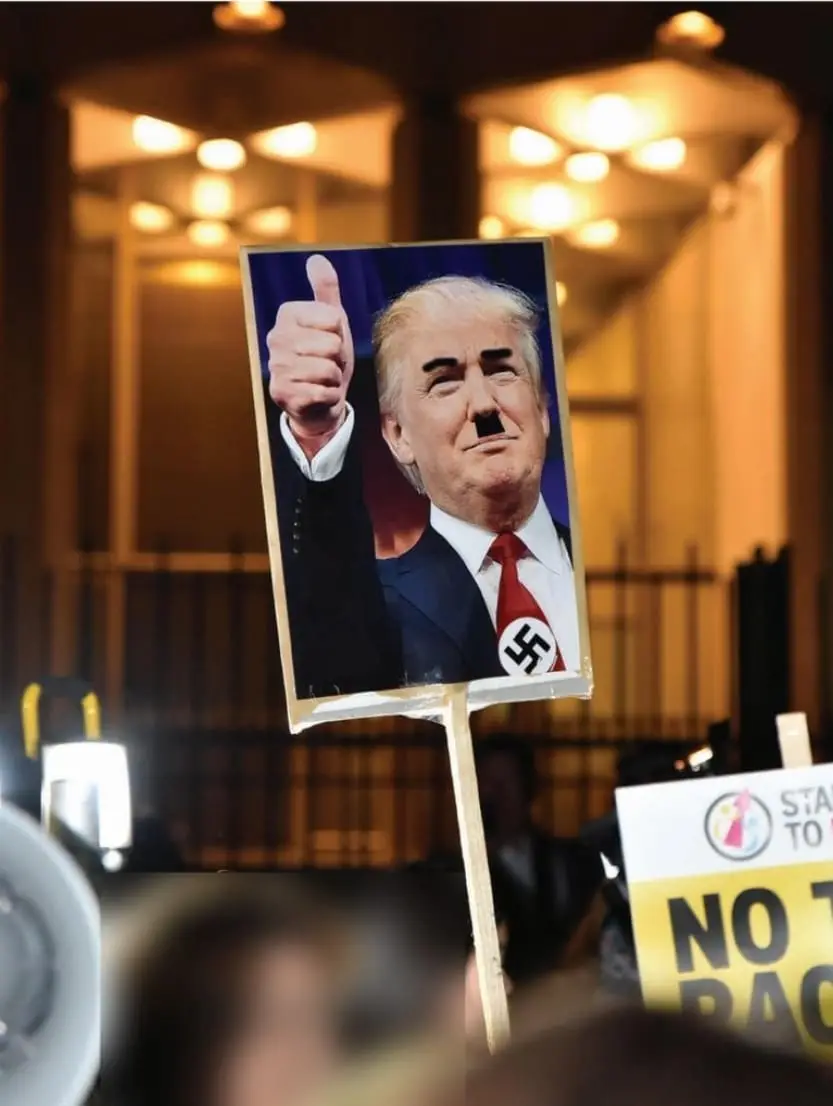
Is "Trump's America" a new Reich?! This is the title of an article recently published in the British magazine "Prospect," in which the prominent historian Richard J. Evans (1) presents a disturbing idea for the Western mind: that what Germany witnessed in the 1930s, the transformation from democracy into Nazi dictatorship, was not a sudden deviation but a series of gradual erosions within the political system itself, and that some of these erosions may be underway today, at the heart of the most powerful Western democracies, particularly in the United States under the phenomenon of "Trumpism."
The article may not directly compare "Trump" to "Hitler," but it asks whether the political and social patterns that paved the way for the rise of the Third Reich have begun to recur in contemporary America, and whether history foreshadows the return of "another tyranny" creeping in with populist features through the very doors of democracy.
The article draws on the ideas and warnings of the German Jewish philosopher and jurist Franz Neumann (the text names him "Frantz Kasenstein"), one of the leading thinkers of the Frankfurt School, who fled Germany after the rise of the Nazis and later became one of the first to study the nature of the "totalitarian state" and to dissect the logic by which democracies collapse. He believed that the danger lies not only in authoritarianism, but in the erosion of democracy from within, through its own instruments, and that the danger lies not in leaders alone, but in the transformation of masses into an obedient, led, angry public seeking a leader who relieves them of responsibility.
He warned that the linguistic and symbolic shifts societies undergo, from the "democratic state" to the "strong national state," are not mere slogans but indicators of a fundamental transformation in political and social structure.
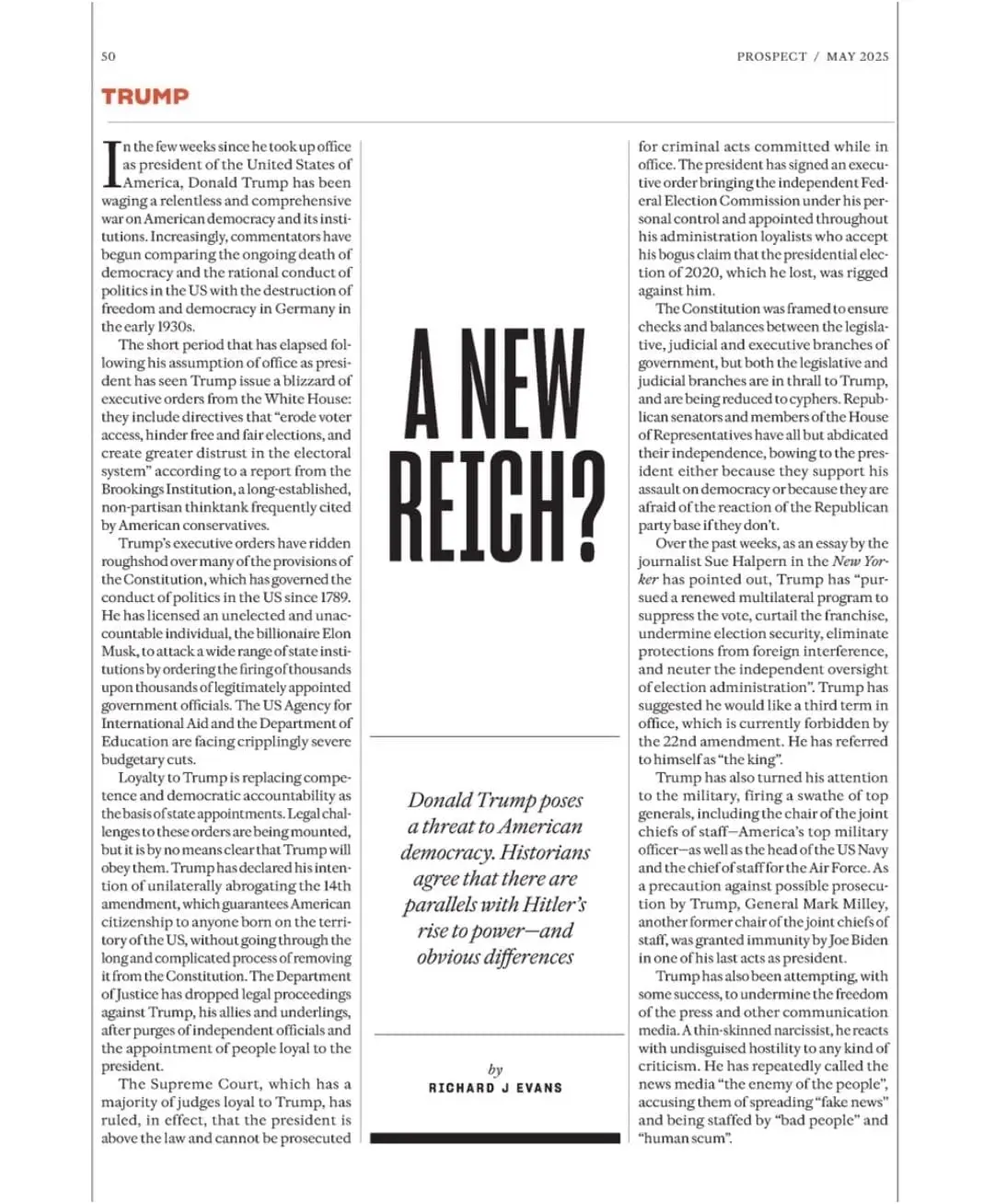
The first page of the article
The article warns that democracies do not necessarily collapse through military coups or wars, but may disintegrate from within, when they are stripped of their moral spirit, when their institutions are emptied of meaning, when their opponents are demonized, and when public discourse is turned into an arena of populist mobilization filled with fear and hatred.
From this standpoint, the author re-reads German history to reflect on the features of the crisis in present-day America under Trump's rule, trying to identify the "warning signs" that preceded the Third Reich (2), and how they are being reproduced today in less bloody but no less dangerous ways.
Between the Third Reich and Trumpism
Despite differences in context and circumstances, the article insists that patterns of political behavior and populist leadership rhetoric recur in disturbing ways, and it draws a comparison between "Trumpism" and "Nazism," though the two differ in their early phases:
- Disparagement of elites and institutions: In pre-Hitler Germany, liberal and parliamentary elites were a constant target of attack, portrayed as "weak," "corrupt," and "detached from the people." Trump followed the same approach: he attacked the media, the judiciary, universities, and the bureaucracy, and considered them part of the "deep state" obstructing the will of the people.
- Demonization of the other: The Nazis promoted the theory of a Jewish conspiracy and classified Jews as internal enemies. Trump demonized Muslims, immigrants from Latin America, Black Americans, and even progressive Democrats, making the enemy always internal and the threat always existential.
- Aggressive nationalism: The Nazis glorified the German nation and rebuilt national identity around "racial purity" and "blood and soil." Trumpism relies on the slogan "America First," yet carries the same meanings: a white, conservative, religious America confronting a continuous external and internal threat.
- Hostility to democracy from within: Both models do not directly overturn democracy but use its tools. Hitler came to power through the ballot box, and so did Trump, but both exploited democracy to undermine it, through rhetoric that sows doubt about the legitimacy of elections, as happened after the 2020 elections, and incited insurrection, as in the storming of the Capitol on January 6, 2021.
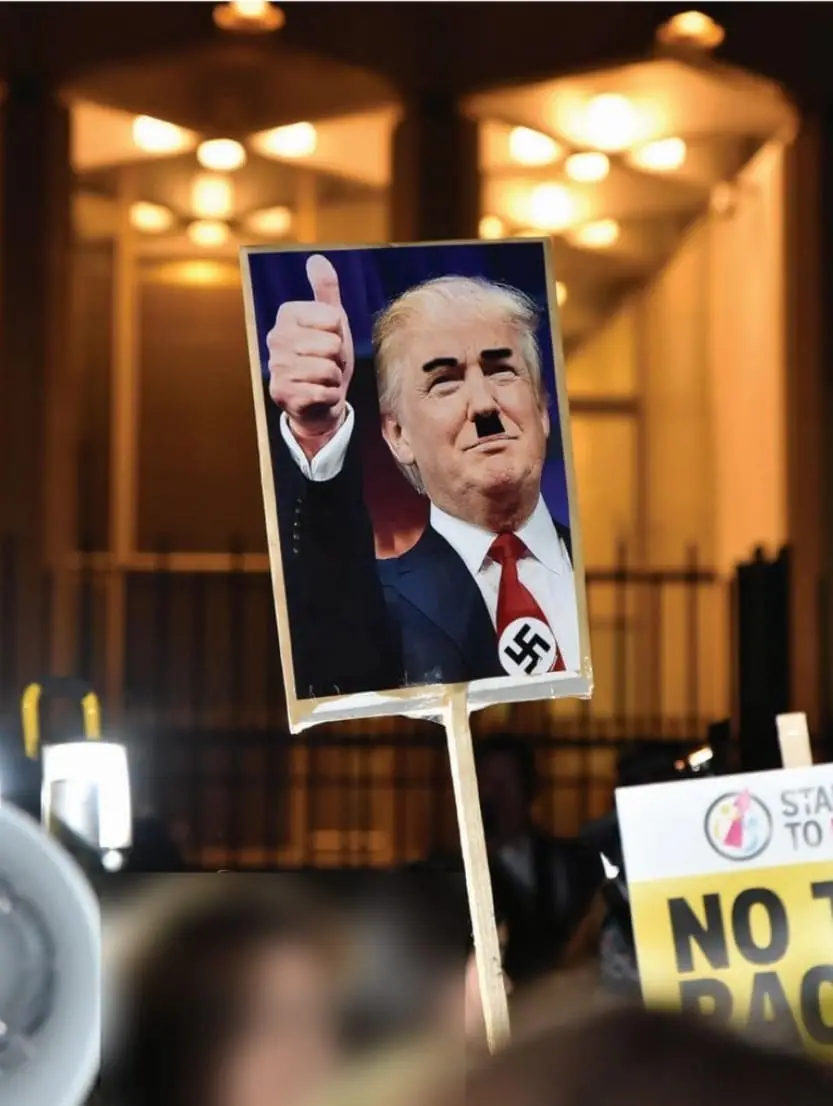
Is Trumpism Nazism?
The article does not claim a complete equivalence. Trump is not a traditional dictator, and he seeks to undermine the rules of the democratic game. America has institutions stronger than Germany's under Hitler, but they are not immune to rhetoric of hatred and division. Today's digital media landscape also allows lies to spread and fear to take root faster and more widely than in the 1930s.
Some may feel that linking Nazism and Trumpism is exaggerated, but the real danger lies not in exaggeration but in complacency. Democracy does not collapse in a single blow; it erodes gradually from within, when institutions are demonized, reason is held in contempt, opponents are besieged, the public is incited, and the homeland is reduced to the person of the leader.
Neumann saw from the heart of Nazi Germany how democracy turns into an illusion when it abandons its moral values and becomes a tool in the hands of popular anger. Today, those warnings echo again, with the voice of history, in the corridors of Washington, amid the clamor of the media and the polarization of politics.
The Ghosts of the Third Reich
When Hitler declared that the Third Reich would last "a thousand years," he expressed an ambition for eternal rule based on absolute loyalty and singular power. Today, the scene is not very different when Trump hints at his desire for a third term, posts images of himself wearing a crown like a king, or when his supporters chant that "America needs him forever," and some even call for a system resembling a caliphate!!
The similarity between the Nazi and Trumpist experiences lies not only in political rhetoric or symbolic imagery, but is manifested in the psychological makeup of masses who, as in 1930s Germany, seek an individual savior and a unified identity, even if the price is surrendering what is called "the values of democracy."
What makes Trumpism dangerous is not only Trump's personal inclination toward authoritarianism, but the growing popular belief that he is the sole savior and an indispensable national redeemer. In the eyes of a large segment of his supporters, Trump has been transformed from a merely elected president into a quasi-religious figure, a person on whom they project their hopes, justify everything for him, refuse to hold him accountable, and even confer upon him qualities of sanctity.
Some of his supporters have likened him to "King Cyrus," chosen by God!! Others see him as an inspired leader who must remain for life. Among "Christian nationalist" circles, they justify his authoritarian ambition as divine destiny, just as the European fascist movements glorified the leader as a gift of divine providence to the nation.
This kind of blind loyalty, in which the leader becomes an object of worship, is what allows institutions to be suspended, violations of laws to be justified, and the idea to be normalized that democracy can be suspended "temporarily" for the sake of "national salvation." It is the same path European peoples followed a century ago, when they chose of their own will to end their republics.
The real lesson, as the author sees it: if we do not read history well, we allow it to repeat itself, not in the same forms, but with the same destructive logic, and then we will find ourselves at a new moment of decline. Will America learn from the experience of the Third Reich, or, as Richard Evans put it, can democracies sometimes vote for their own end, of their own will?
Notes
- Richard J. Evans: One of the most prominent British historians of modern history, especially the history of Germany, the Third Reich, and Nazism. He is Emeritus Professor at the University of Cambridge, specializing in modern German history, Nazism, World War II, and fascism, and is the author of a monumental trilogy considered among the most important works written in English on Nazism: (The Coming of the Third Reich, The Third Reich in Power, The Third Reich at War).
- "Reich" means empire in German, and was used to refer to stages of the German state: the First Reich: the Holy Roman Empire (962–1806); the Second Reich: the German Empire under Bismarck (1871–1918); the Third Reich: the name Hitler gave his regime, claiming it was a "sacred" continuation of German history that would last a thousand years, though it lasted only 12 years (1933–1945).
Quoted from the researcher Hasan Qatamish.
https://x.com/HasanQatamish/status/1909222629044789682?t=Ur8FmtmJVP69y5hH-0IIvA&s=19


