

After Wagner's Departure from Mali, "Africa Corps" Maintains Russia's Presence in Africa
The failure of the 2023 mutiny by the late Wagner leader Yevgeny Prigozhin led to the takeover of Wagner's operations in Africa, to a large extent, by the Africa Corps, a paramilitary group fully subordinate to the Russian Ministry of Defence.
The operations of the Africa Corps in place of Wagner support Russia's presence in Africa, but they deprive the Kremlin of the ability to distance itself from any crimes that Russian paramilitary operations may commit on the continent.
On 6 June, the private military company (PMC) Wagner announced that its mercenaries would withdraw from Mali after a presence of three and a half years in the country.
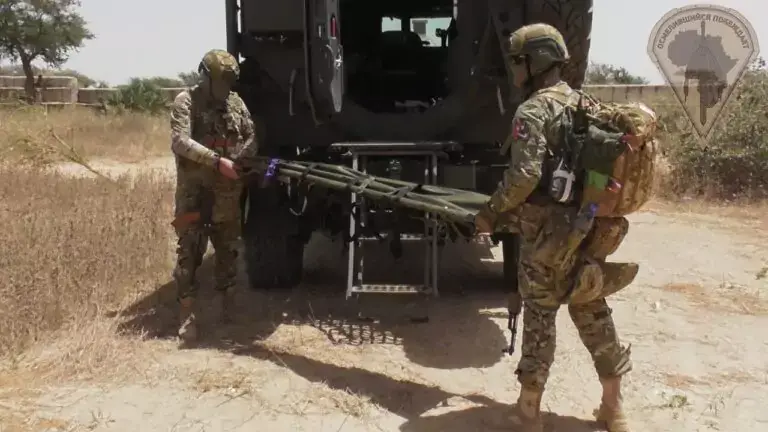
However, the Russian military presence in Mali does not end, but shifts to another paramilitary formation under the command of the Russian Armed Forces: the Africa Corps.
On 23 June 2023, Yevgeny Prigozhin, the late leader of Wagner, turned his private army against the Russian Ministry of Defence.
The Wagner leader aimed to confront the then Russian Defence Minister Sergei Shoigu and Chief of the General Staff Valery Gerasimov, whom he accused of attacking the rear positions of the mercenaries.
Prigozhin's personal accusations against Russia's top military leadership quickly became politicised, prompting a response not only from state media but also from Russian President Vladimir Putin himself.
In addition, regular army units and law enforcement agencies refused to resist in the areas where the "mutineers" were active, raising broader questions about the authority of the central government in federal provinces, which may concern the Kremlin.
The mutiny faded as quickly as it began, but Wagner continues to reap its fruits two years later, gradually ceding its spheres of influence in Africa to other Russian paramilitary structures. Despite Wagner's departure, the Kremlin aims to maintain its influence in Africa, but through a military structure that is directly under the control of the Ministry of Defence.
Prigozhin's mutiny set in motion long-term transformations in both Wagner's operations and its role within the Russian military system. The Kremlin recognised the need to eliminate independent power centres, such as Prigozhin, and began redistributing Wagner's external operations, a process that has not yet fully taken shape.
To a large extent, thanks to Prigozhin's entrepreneurial and organisational skills, Wagner began building a network of influence in Africa from 2017.
This suited the Kremlin as a tool of foreign policy, enabling Russia to access strategic resources and assets in African countries. Wagner's influence took various forms and extended to the Central African Republic, Sudan, Libya, Burkina Faso, Niger, Chad, Mozambique and Mali.
For years, the authorities turned a blind eye to the explicit legal ban on private military companies, as Wagner's operations in Africa were extremely beneficial to Moscow.
Russian legislation prohibits the use of private military companies abroad and within Russia.
However, this did not prevent Wagner from steadily expanding its influence across the African continent.
In the Central African Republic, for example, at least a thousand Wagner mercenaries were responsible for the security of President Faustin-Archange Touadéra and key facilities. The private military company also controlled gold and diamond deposits, ensuring Russia's access to the country's natural resources.
Wagner became so entrenched in the Central African Republic that its representative, Valery Zakharov, became a security adviser to the president.
In countries such as Sudan, Burkina Faso, Mali and others, Wagner mercenaries provided security to local regimes, often in exchange for access to natural resources.
A complex network of mutually beneficial relations with local authorities in the field of resource extraction emerged. Since Russia's full-scale invasion of Ukraine in 2022, the export of African gold through these links has brought more than $2.5 billion to the Russian leadership, money that was used, among other things, to fuel Russia's sanctioned war machine.
At the same time, Wagner's presence in African countries was accompanied by reports of the torture and killing of local residents, which investigative journalism has repeatedly confirmed.
One such investigation revealed evidence that Wagner established a network of secret prisons to hold hundreds of people suspected of collaborating with Islamist insurgents or Tuareg separatists in Mali. In these temporary prisons, Russian mercenaries tortured local residents. In addition, kidnapping for ransom was a common practice.
The publication of the investigation into the atrocities committed by Wagner in Mali coincided with the group's announcement of its withdrawal from the region, as reported by Wagner's press service and its Telegram channels on 6 June.
The Jamestown Foundation


