

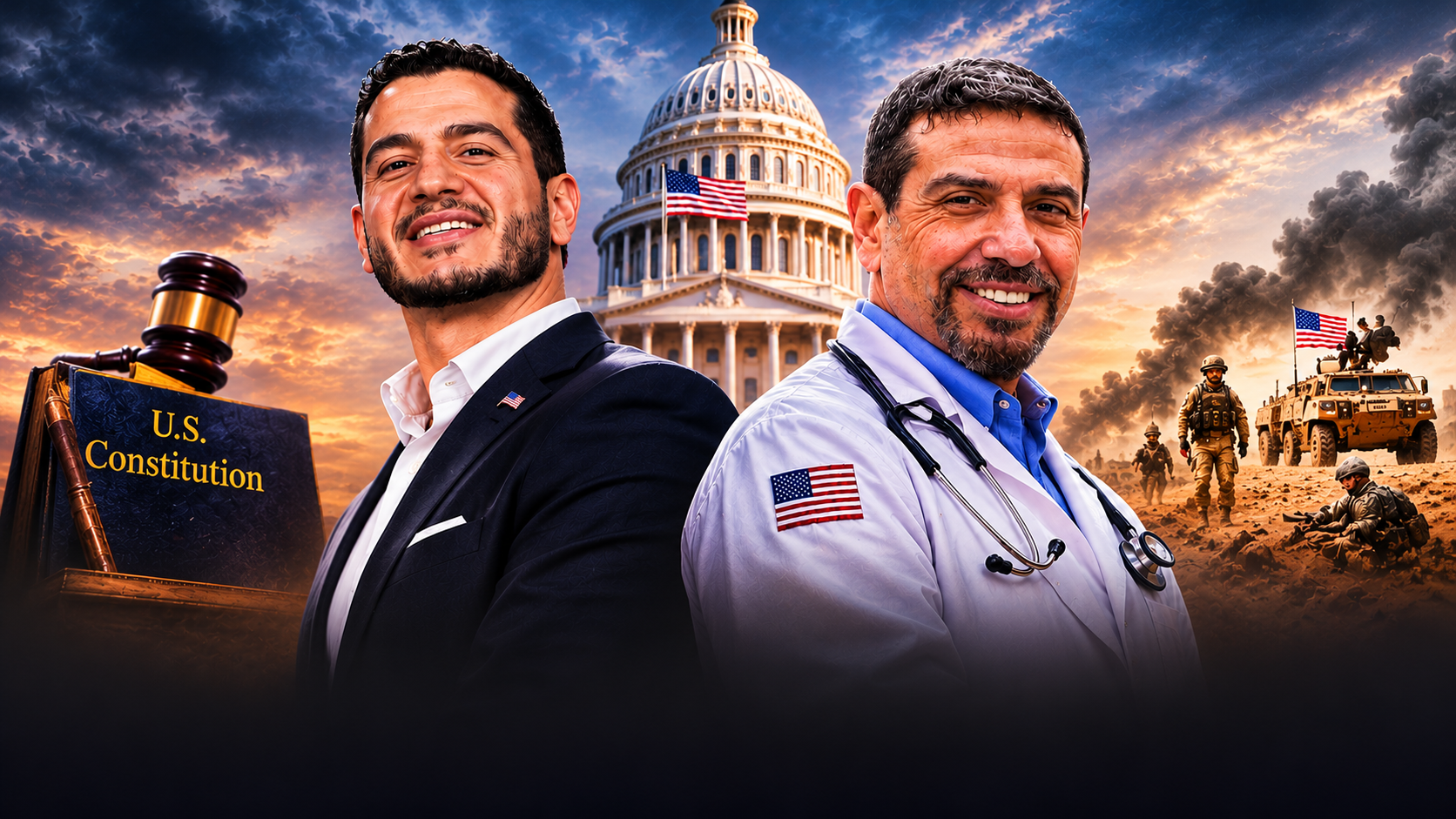
This article is not part of the "MAGA" campaign supporting Trump that targets Abdul El-Sayed, nor of the campaigns waged against him by Jewish groups, nor of the Egyptian campaigns prompted by his critical positions toward the Egyptian regime. We are not concerned with defending Trump, nor with exonerating Abdul's opponents, nor with justifying the smear and racist campaigns he faces. But neither are we obliged to set our minds aside and regard a person's arrival in Congress as a victory for Islam merely because his name is "Abdul Rahman El-Sayed," or because his origins are Egyptian, or because he took a position opposing the war on Gaza.
The question is not who won at the polls, but what he won with respect to his positions.
This is the compass that has gone astray for some enthusiastic Muslims, who have moved from celebrating the electoral representation of a person bearing the title "Muslim" to presenting him as a victory for the religion, as if identity conferred immunity from criticism, and as if mere affiliation were enough to lend legitimacy to positions.
Abdul El-Sayed has declared clear positions on matters that admit no Islamic embellishment. He has expressed support for the rights of gay and transgender people, defended their legal protection and access to care linked to gender identity affirmation. He has also received the endorsement of the American organisation "Human Rights Campaign," one of the most prominent organisations defending the rights of the LGBTQ community. These are not accusations made by his opponents, but openly stated positions and documented endorsement from the organisation itself.
To those who raise his images as a banner of victory for Islam, we ask: by what standard does adopting these positions become a victory for the religion? Is Islam reduced to the identity of a candidate, with its rulings suspended whenever they conflict with his political programme?
God Almighty said regarding the people of Lot: "Do you indeed approach men in lust instead of women? Rather, you are a people who are ignorant." How, then, can political positions that defend a person who endorses what revelation prohibited be celebrated, while Muslims are asked to call this a victory for Islam?
Nor does shelter in identity, lineage or social status help here. The Qur'an cited the example of the wife of Noah and the wife of Lot, saying: "Allah presents an example for those who disbelieve: the wife of Noah and the wife of Lot. They were under two of Our righteous servants but betrayed them, so they availed them nothing against Allah" [At-Tahrim: 10]. This is one of the Qur'an's most powerful narratives supporting "loyalty and disavowal," for the bond of marriage to a prophet did not benefit them when they opposed faith. What matters is not affiliation, but the truth a person adheres to and the stance he takes.
Then there is the American constitutional oath that Abdul will take upon assuming his Senate seat, a constitutional commitment to support and defend the Constitution of the United States. Here is a question that must not be silenced: what are the limits of commitment to a man-made constitution that contains a legislative and value system in conflict with the rulings of Islamic law? And may this commitment become beyond discussion simply because its holder has achieved an electoral gain? Therefore, if you insist on celebrating him, celebrate him as an "American citizen," not as a "victory for Islam."
As for his objection to what is happening in Gaza, it is a position deserving of praise to the extent that it is rightful, but it does not erase his other positions or grant him comprehensive endorsement. There are non-Muslims who objected to the aggression, denounced the killing of civilians, and called for an end to military support, and this did not lead us to grant them religious loyalty or adopt everything they say.
We take truth from whoever brings it and reject falsehood from whoever utters it, and we do not confuse agreement on one issue with endorsement of creed and method.
The same applies to Adam Hamawi. In his electoral profile, the man presents his American military service as an essential part of his career, citing more than twenty years of military service, his rise to the rank of lieutenant colonel, and his work as a military surgeon in Iraq during the peak of the American invasion. He also mentions his contribution to treating American soldiers, among them Senator Tammy Duckworth, who was wounded in Iraq. He then highlights his participation in medical missions to Gaza in 2024 and 2025, and his treatment of the wounded and children there.
We do not deny the merit of a doctor who saves a wounded person or treats a child, nor do we equate the doctor who treats the injured with one who engages in combat.
But the question we refuse to drop is this: how does images of treatment in Gaza become an absolute political certificate of endorsement, while the record of service in the American army that killed our children and women and did what it did to our nation is overlooked? And how is this presented as a victory for Islam without reading the full record, and without distinguishing between humanitarian work, political stance and military involvement?
Treating the injured is a virtue in its place, but it does not erase the questions relating to the rest of the career. The standard is fairness, not selectivity.
Most dangerous in this trial is the exploitation of the words of Shaykh al-Islam Ibn Taymiyyah to silence those who object.
Some quote his saying, may God have mercy on him: "The wise person is not one who knows good from evil; rather, the wise person is one who knows the better of two goods and the lesser of two evils," and cite his words on securing benefits and perfecting them, and neutralising harms and minimising them, then leap from this principle to a ready-made conclusion: one must vote for Abdul or Hamawi, and whoever abstains or objects does not understand reality or grasp the jurisprudence of weighing considerations!
But they detach the principle from its conditions and overlook a decisive qualification that Ibn Taymiyyah mentioned in Majmu' al-Fatawa (20/53): "Repelling what is worse than them when it cannot be repelled except by them."
Consider it: when it cannot be repelled except by them.
Not every lesser harm is permissible merely because a greater harm exists, and not every candidate described as less evil makes voting for him a religious obligation. It must be established that the greater harm cannot be averted by any other means, that voting for this candidate will actually avert it, and that the benefit achieved outweighs the harm according to the measure of the Shariah, not according to partisan calculations alone. Otherwise, the jurisprudence of weighing considerations becomes a jurisprudential veil for a political decision already taken, after which scholars' texts are sought to justify it.
Have these people shown that the danger cannot be repelled except by Abdul? Have they shown that supporting and celebrating him will actually prevent the harm? Did they include the option of abstention in the weighing? Or did they assume the outcome, then make Ibn Taymiyyah's words a religious seal upon it?
Even more striking is that some treat their political judgment as if it were a binding legal ruling for the entire community, classifying dissenters as ignorant and lacking understanding. This inverts the matter: sound legal weighing requires knowledge of the Shariah, awareness of reality, and assessment of outcomes; it does not become a stick with which to beat everyone who did not vote for the candidate its holder chose.
Nor is it permissible to invoke the verses of Surat ar-Rum to depict Abdul's or Hamawi's victory as a continuation of the joy of the believers at the triumph of the Romans over the Persians. Those verses refer to a specific historical event, the believers' joy at the People of the Book prevailing over the Magians, and they do not grant an open religious mandate to endorse every individual or political project bearing a label close to their identity. The Romans' victory in that event did not make all their beliefs and practices true; how, then, can a ruling be extracted from the verse that it does not state, and words be burdened with what they cannot bear?
We do not want Abdul as a devil, as the smear campaigns portray him, nor as an Islamic hero, as the endorsement campaigns construct him. We want a scale that does not tilt with desire: we give him fairness where he is right, critique him where he errs, reject the exploitation of his name in battles involving Trump, his opponents, or opponents of the Egyptian regime, and equally reject turning his victory into an illusory triumph for Islam.
Islam is not an electoral card, nor a campaign slogan, nor the image of a candidate raised aloft while people are asked to overlook his positions.
Islam is taken in its entirety: creed, worship, morality, legislation and a stance toward truth and falsehood. We do not take from it what suits our calculations and leave what contradicts them, nor do we drop its fixed principles because a candidate has delivered a political gain for us.
God Almighty said: "If you support Allah, He will support you and plant firmly your feet" [Muhammad: 7], and He said: "Allah will surely support those who support Him. Indeed, Allah is Powerful and Exalted in Might" [Al-Hajj: 40].
Victory is not that a person bearing a Muslim name reaches the Senate, nor that another enters the House of Representatives, and then we announce that Islam has triumphed. Victory is that we support the command of God, establish His law within ourselves, remain steadfast upon the truth, and do not sell the fundamentals for the price of a fleeting political gain.


