

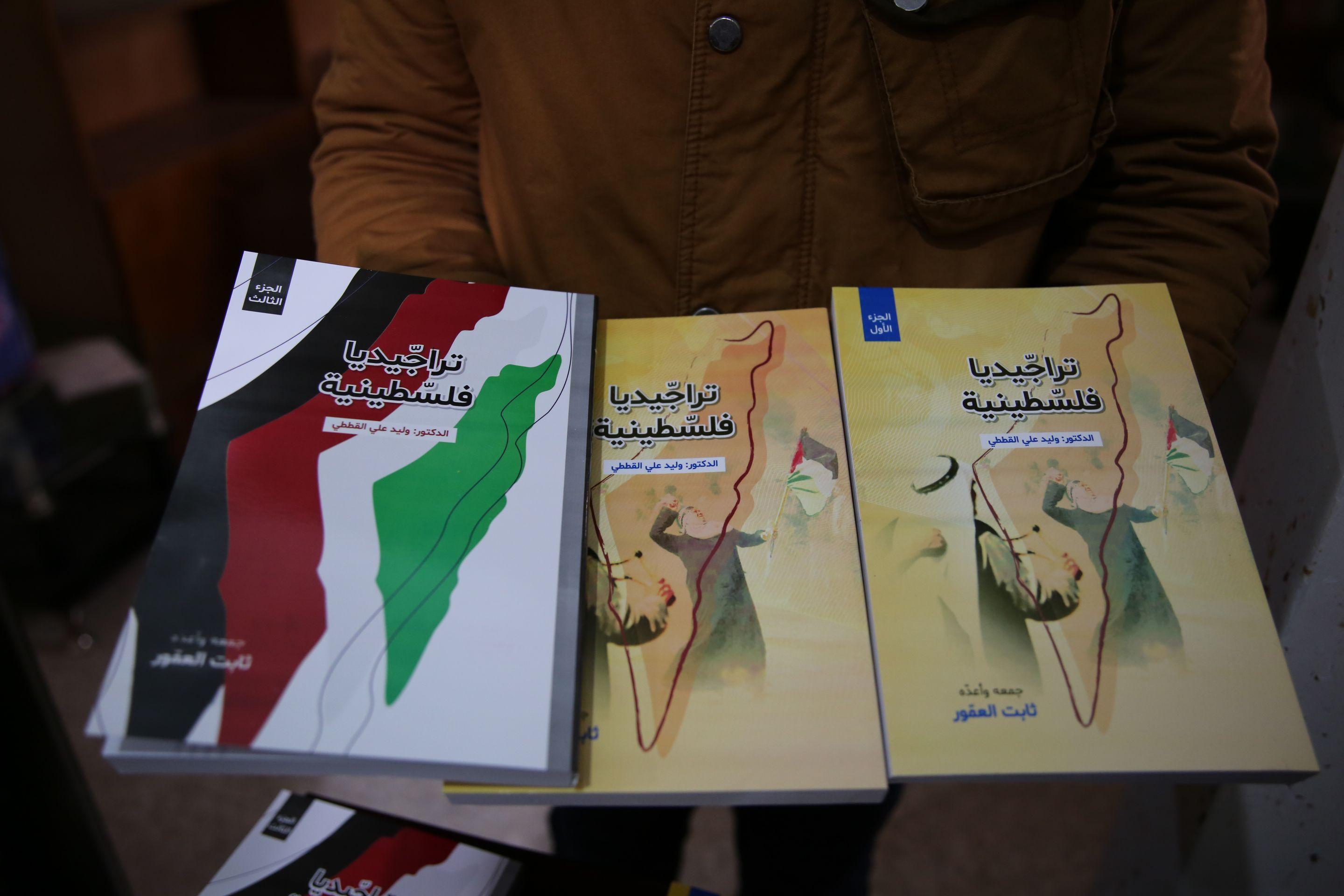
A critical reading of the fifth volume of Dr. Walid Ali Al-Qatati's book (2023–2025)
Some books are written after wars to recount what happened, while others are written during them, retaining within their pages the trembling of the moment, the pain of the experience, and questions of destiny that have not yet found their answers. The book "A Palestinian Tragedy Born of War" by Dr. Walid Ali Al-Qatati belongs to the second category. It is neither a history recounted from a safe distance nor a political analysis reflecting on events after they have passed, but a human and political testimony written under bombardment, among the tents of the displaced, and amid the hunger, fear and loss that have swept through the Gaza Strip since October 2023.
The book's importance goes beyond documenting suffering to questioning the decisions and perceptions that accompanied the war, and reviewing the Palestinian political discourse, particularly within the Islamic movement, from a position of belonging to it rather than hostility toward it. Herein lies its distinctiveness: its author did not content himself with being a witness to the tragedy, but made it an occasion to review the ideas that helped shape the reality, and to search for ways out of it.
The Author: An Experience Combining Thought, Politics and the Field
Dr. Walid Ali Al-Qatati was born in the Egyptian city of Al-Arish in 1963, moved with his family to the city of Rafah in the Gaza Strip in 1979, and obtained a PhD in Philosophy, specialising in psychology, from Cairo University.
In the early 1980s, he met Dr. Fathi Al-Shiqaqi, founder of the Islamic Jihad Movement in Palestine, and joined the revolutionary Islamic current from which the movement emerged. He was imprisoned in Israeli occupation prisons and spent years in the Negev desert prison, before rising through political and organisational work until he was elected twice as a member of the movement's Political Bureau.
This background is not a secondary detail when reading the book. Al-Qatati does not write from outside the Palestinian Islamic experience, nor does he view the decisions and perceptions of the factions as a distant observer. Rather, he subjects to review ideas and practices to which he belonged and within which he worked for decades.
The book, compiled and introduced by researcher and political analyst Thabit Mohammed Al-Amour, is the fifth volume of the "Palestinian Tragedy" series, published by the Al-Sham Center for Studies and Research in Gaza in 2025. It contains some five hundred entries distributed among human reflection, field testimony, political articles and intellectual review.
Gaza as Not Fully Shown in the News
Perhaps the most notable feature giving this book its human value is that the author does not treat the war merely as military movements, political negotiations and mounting casualty figures, but enters into the details of everyday life that often fall out of the grand narratives.
Here we find the tent become a harsh substitute for the home, the donkey cart as a means of transport in a world where the foundations of life have collapsed, lentils ground in place of wheat, firewood returning to kitchens, water whose acquisition has become an arduous journey, and children who moved from school benches to markets in search of daily bread.
In a chapter titled "Tamer.. From the School Bench to Selling Tea," the tragedy of education in Gaza turns from a statistical issue into the story of a child whom the war deprived of his right to childhood. In "Safaa Returned Carried in a Flour Sack," food aid acquires a tragic significance, revealing how the search for food itself became a path to death.
The author affirms this humanitarian orientation when he writes: "The martyrs have names"; a phrase that encapsulates an important aspect of the book's philosophy. The victim here is not a number added to a daily toll, but a human being with a family, memories, dreams and a future that was cut short.
Al-Qatati does not limit himself to recounting the misfortunes of others; loss extends to his own family, friends and acquaintances, and his personal story enters the fabric of the narrative, so that private memory intertwines with collective tragedy.
This ability to move from individual fate to the broad national scene gives the book a value that goes beyond journalistic documentation to what may be called the social and human history of the war: a history that preserves not only the names of leaders and battles, but also the names of ordinary people, how they lived, what they lost, and how they tried to endure.
Between the Heroism of Resistance and the Catastrophe of Society
Yet the most controversial aspect of the book is its political reading of the war, particularly its critique of the strategic premises that governed "Operation Al-Aqsa Flood" and what followed it.
Al-Qatati places the reader before a difficult paradox: how can a military operation achieve a major tactical surprise, yet end in strategic outcomes of extremely high cost?
He expresses this paradox in a concise phrase: "Strategic failure devours tactical success."
From this angle, the author revisits the distinction between the strategy of "harassment and attrition," associated with the thought of Fathi Al-Shiqaqi, and the strategy of accumulating strength toward a comprehensive liberation battle. He argues that the transition from the former to the latter requires subjective, regional and international conditions for which military readiness alone is not sufficient.
In the author's view, this critique does not stem from denying the Palestinian people's right to resistance, but from questioning the relationship between means and ends, and the responsibility of leadership in assessing balances of power and protecting the society in whose name the battle is fought.
Hence arises one of the book's most important questions: Is the success of a battle measured by the scale of losses inflicted on the enemy, or by its capacity to achieve sustainable political objectives while preserving society from collapse?
Al-Qatati does not hesitate to criticise the discourse that celebrates military achievement while human losses mount, nor to question leaderships that, in his view, failed to review their calculations in light of field outcomes.
His courage in raising these questions from within the political environment to which he belongs is to his credit, especially when he makes acknowledging failure a political virtue and refuses to equate a considered retreat with surrender.
Nevertheless, reading his argument requires distinguishing between the direct responsibility of the Israeli occupation for the killing of civilians and the destruction of the foundations of life in Gaza, and the political responsibility that the author discusses regarding the assessment of options and the management of confrontation. A strategic review of the Palestinian decision does not shift responsibility for war crimes onto the victims, and condemning the occupation's crimes does not exempt Palestinian leaderships from criticism and accountability.
This distinction is necessary so that the discussion does not become a closed dichotomy between unconditional glorification of every military decision and placing on the resistance responsibility for what the occupation committed.
Criticism from Within: When Protecting Society Becomes the Priority
The book does not stop at criticising military choices, but expands into diagnosing what afflicted Palestinian society and its institutions during the war.
Al-Qatati records the rise of lawlessness, the emergence of gangs of theft and extortion, some traders' exploitation of the displaced's need, and the decline of social values under the weight of hunger, siege and the collapse of institutions of order and protection.
In these passages, the war appears not merely as a confrontation with an external enemy, but as a catastrophe that reshapes society from within and tests its solidarity, its ethics and its capacity to endure.
Notably, the author does not present these phenomena to condemn a society exhausted by war, but to reveal how much continued violence, hunger and the collapse of public order can do to the social fabric.
Thus, his concept of steadfastness goes beyond mere physical survival to include preserving the human being, the family, their dignity and their capacity to live.
In this context, his call for the priority of ending the war and saving what remains of the people and the foundations of their existence stands out, even when this requires difficult political decisions.
The People Are the Resistance: Towards Reviewing the National Project
The book's most important conclusions crystallise in two short phrases: "The people are the resistance" and "The people are the day after."
These are not mere rhetorical slogans; they reflect a deeper review of the place of the Palestinian individual in the national project.
Al-Qatati seeks to shift the centre of thinking from the faction to the people, from the survival of the organisation to the survival of society, and from managing the conflict through inherited slogans to searching for a national project capable of confronting the major transformations the war has produced.
Here stands out his call for the Palestinian Islamic movement to develop into "a Palestinian national movement with a comprehensive Islamic frame of reference," beyond organisational closure and narrow partisan interests.
This call gains importance from its author's own trajectory: he began his political experience seeking a formula uniting Islam and Palestine, and decades later returns to argue for renewing that formula in light of the crises the war revealed.
In our assessment, this review is among the book's ideas most deserving of discussion, because it goes beyond evaluating a particular battle to question the intellectual and political structure that produces decisions and sets priorities.
Yet it remains an intellectual project requiring further elaboration: How can the transition from factional organisations to a comprehensive national framework be practically achieved? How can the Islamic frame of reference be protected from becoming a popular choice subject to competing passions? What institutions and guarantees could create a mechanism of accountability rather than slogans invoked in discourse?
Raising these questions does not diminish the value of Al-Qatati's vision, but reveals the distance between the courage of intellectual review and the difficulty of turning it into an applicable political programme.
The World in the Mirror of Gaza
The book does not overlook the regional and international dimensions of the war. It addresses American bias toward the Israeli occupation, the contradictions of Western discourse on human rights alongside political positions on the Gaza tragedy, official Arab impotence, and the roles of the support fronts in Lebanon, Yemen and Iran.
Al-Qatati offers a sharp critique of the international system that failed to halt the war or provide effective protection for civilians, and sees in the Palestinian experience a revealing test of the gap between declared values and the interests governing international relations.
The significance of the author's judgments lies in their expressing the vision of a witness who lived through the outcomes of those policies, rather than a researcher treating them as mere diplomatic positions.
Between the Value of Testimony and the Limits of Method
Despite the considerable value of this work, a fair review requires considering its methodological and literary limits.
The most prominent of these limits is that the book is closer to extended intellectual and political diaries than to an academic study with a sequential structure. The nature of writing during the war imposed the repetition of some ideas, particularly the critique of political discourse, warnings about strategic miscalculation, and depictions of the suffering of displacement and hunger.
Likewise, adopting chronological order rather than thematic division makes tracing the development of a specific idea a task requiring additional effort from the reader and researcher.
A tone of bitterness and anger also appears at many points, sometimes reaching categorical political judgments. While this tone is understandable in the context of the experience the author lived, it does not replace testing conclusions against multiple facts and other accounts, particularly on questions concerning the assessment of intentions, responsibilities and strategic alternatives.
Moreover, one should distinguish between direct testimony, which rests on what the author saw and lived, and political analysis, which remains an interpretation open to criticism and disagreement.
Yet what may appear as weakness in academic construction represents, from another angle, part of the book's authenticity: the text retains the features of the moment in which it was written, including hesitation, anger, fear, hope and the shifting of assessments as events unfolded.
The book does not present a final historical truth, but an important primary source for anyone wishing to understand how Palestinians lived the war, and how one of the prominent figures of the Palestinian Islamic movement read its events and transformations from within the field.
Conclusion: A Testimony for Generations and Questions for the Future
In the final pages of the book, Al-Qatati recounts a meeting with a young doctor who, knowing he was about to publish his testimony, made him a single request: "Honesty. Write the people's suffering honestly."
This phrase may serve as a key to reading the entire work. The honesty the author seeks is not merely precision in conveying the details of suffering, but an attempt to confront oneself and others with painful questions that silence might be easier than raising.
For this reason, "A Palestinian Tragedy Born of War" cannot be reduced to a book about displacement and hunger, nor to a critique of "Operation Al-Aqsa Flood," nor even to a political review from within the Palestinian Islamic movement.
It combines these dimensions into a single testimony, in which individual experience intertwines with the fate of the community, the memory of the home with the questions of the homeland, the heroism of resistance with the catastrophe of society, and faith in the Palestinian cause with the necessity of holding political choices to account.
The deeper value of the book lies in its refusal to let the Palestinian people be merely a price paid in the equations of conflict, restoring the human being to the centre of the cause for which people struggle.
The work therefore deserves to be read as a humanitarian and historical document, and as a serious contribution to a Palestinian debate that cannot be postponed: how the people's rights are to be preserved, their lives protected, the errors of their leaders reviewed, and their liberation project rebuilt after this tragedy?
Perhaps Al-Qatati does not offer complete answers to these questions, but he possesses the courage to raise them at a time when merely acknowledging the scale of the catastrophe has become, for some parties, a matter of dispute.
When the reader closes the last page, what remains in memory is not the question of who won the battle, but a more pressing one: How do we ensure that the life of the Palestinian, for whose sake the cause exists, is not lost between the violence of occupation, the errors of politics and the illusions of slogans?
This, in the end, is the great question that the book makes the Palestinian tragedy a gateway to confronting.


