


Yemeni Women… Unseen Suffering in Displacement Camps
Since the war in Yemen broke out in 2015, the lives of millions of Yemenis have changed radically. Displacement was not merely a move from one place to another; it was a harsh uprooting that left thousands of families suspended between the loss of the past and the uncertainty of the future.
Thousands of families live in temporary camps spread across several governorates, most prominently Marib, Taiz, Hodeidah, Hadramout, Dhale and Lahj. But these camps, which were meant to be a temporary stop, have over the years turned into a permanent reality.
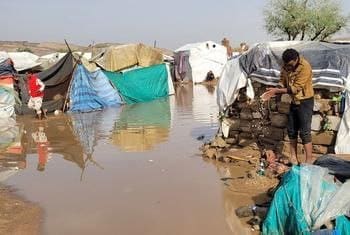
Tattered tents barely stand against the wind, offering no protection from the scorching summer heat or the bitter winter cold. In every rainy season, the floors of the tents turn into pools of mud and water.
One displaced woman, describing her life inside the camp, says:
These words are not a passing complaint, but a summary of a harsh daily life endured by thousands of women who find themselves facing shortages of water, food and basic services, amid conditions that are not worthy of human dignity.
Jawhara al-Raai, a displaced woman living in a camp in Taiz governorate, recounts part of this suffering, saying that she moved between four camps during her years of displacement before settling in the Al-Barakani camp. She describes her life there, saying:
Holding her young child, she adds that the family is forced to sleep, cook and eat inside the same tent, in the absence of even the most basic necessities such as blankets, beds or heating.
As the war continued, many families lost their breadwinner: some men were killed in fighting, others were injured or lost their jobs. As a result, a large proportion of displaced families have come to depend on women to support the household.
Humanitarian estimates indicate that about a quarter of displaced households are headed by women, a heavy burden that Yemeni women did not choose but that the harsh years of war imposed on them.
Other estimates indicate that more than 10 per cent of families displaced by the conflict are supported by women, while girls under the age of 18 head approximately 3 per cent of these families, a clear indicator of the scale of early responsibilities that displacement has imposed on women and girls.
In a story published by the United Nations Population Fund, a woman named Haifa, who was displaced to Marib governorate after her husband was injured in the war, says:
In another testimony from one of the camps, Huda al-Danani, a mother of several children, says that her family was displaced months ago and has not received any regular support from humanitarian organisations.
She adds that the harsh conditions pushed some women to beg in markets in order to secure the minimum food for their children.
The suffering is not limited to poverty; it extends to other dangers inside the camps. The absence of privacy in the tents and the scarcity of basic services double women's sense of insecurity.
The spread of insects and reptiles in some camps also poses an additional threat to the lives of the displaced. Huda al-Danani says that residents killed a snake near one of the tents a few days ago, adding:
One displaced mother says:
Thousands of girls have also been unable to continue their education at school.
Nashwa, a 19-year-old displaced girl living in a camp in Marib governorate, says she was forced to leave her studies after displacement and to work at simple jobs to support her family.
The effects of displacement do not stop at material losses; they leave deep psychological wounds on women and girls. The loss of home and stability, and living in overcrowded camps, creates a constant sense of insecurity.
One displaced girl, describing the sudden change in her life, says:
Often the suffering does not end upon arrival at the camps; the camps are exposed to natural disasters such as torrents and floods that wash away tents and leave families without shelter.
In a United Nations report on floods that struck some displacement camps, a displaced woman in the Al-Rawda camp named Suad recounts how torrents swept away her tent, saying:
"I was in shock… what was left to be destroyed in my life?"
Yemeni journalist Afaf al-Abara affirms that women and children are the most affected by displacement in Yemen, noting that millions of women live in harsh conditions in the camps. She says that many women suffer from hunger and disease, while others have lost their lives due to the absence of health services, particularly during childbirth.
In the context of the scale of the humanitarian catastrophe in the country, the United Nations Humanitarian Coordinator in Yemen, Jamie McGoldrick, says: "This country is suffering a complete absence of humanity, and the world has turned a blind eye to what is happening in Yemen."
This statement reflects the scale of the tragedy experienced by millions of Yemenis, above all women and children, who have found themselves in a harsh confrontation with poverty, displacement and the loss of the most basic necessities of life.
Proposed solutions to reduce this suffering:
- Activating the duty of social solidarity that Islam enjoins and strengthening the role of society in supporting displaced families.
- Urgent intervention by government bodies to address the problems facing the displaced, especially women.
- Providing suitable housing or insulating covers that protect tents from the sun's heat and rainwater.
- Organisations taking responsibility for providing food and urgent assistance, in addition to building schools and providing educational services to facilitate children's and girls' access to education.
In conclusion, the suffering of Yemeni women in displacement camps remains a human story that figures and reports cannot capture in full. Behind every tent lies a story of loss and patience, and behind every displaced woman lies a strength trying to protect her family and hold on to hope despite the harshness of reality.
Among tents exhausted by heat and rain, thousands of women are still waiting for something more basic than aid: a dignified life, a safe roof, and the chance to recover what the war has taken from their homes and dreams.


