


The military escalation in Yemen has entered a new phase with the expanding scope of external support for Saudi Arabia, coinciding with the kingdom's launch of a broad air campaign to support Yemeni government forces against the Houthis, while Turkey and Pakistan move to deploy forces and military capabilities in the kingdom under a trilateral defence agreement.
Recent developments indicate that the confrontation is no longer limited to intensified Saudi airstrikes and ground operations inside Yemen. The United States has resumed aerial refuelling of Saudi fighter jets for the first time in eight years, while hundreds of American military personnel and analysts are working from inside Saudi Arabia in intelligence and target-selection support.
At the same time, Saudi Arabia has announced an air campaign that it said involved 100 fighter jets in its first phase, amid simultaneous fighting on the ground, particularly in Taiz, the western coast and Bab al-Mandab.
Washington resumes refuelling Saudi fighter jets
According to a US official who spoke to Al Jazeera, the United States has resumed aerial refuelling of Saudi fighter jets during military operations in Yemen, a step that restores one of the most prominent forms of US military support that sparked wide controversy during the early years of the war.
The United States had halted refuelling of coalition aircraft in November 2018.
That decision came months after an August 2018 strike on a school bus in Saada province, which killed at least 40 children. Reports later revealed that the bomb used in the attack was of US manufacture.
However, the administration of US President Donald Trump did not formally link the halt in refuelling to civilian casualties, and the US Department of Defense said at the time that the coalition had become capable of carrying out aerial refuelling using its own capabilities.
The decision also came at a time when pressure was mounting in Congress to end US support for the war, particularly following the killing of Saudi journalist Jamal Khashoggi in October 2018.
The following year, both the House of Representatives and the Senate passed a resolution under the War Powers Act to end certain forms of US support for Saudi military operations in Yemen, but Trump used his veto against it.
After refuelling operations were halted, Congress included restrictions on this practice in successive National Defense Authorization Acts. The most recent such ban was included in the 2024 National Defense Authorization Act for one year, meaning that the restriction is no longer currently in force.
More than 200 Americans provide intelligence and military support
According to reports, the current US role is not limited to refuelling Saudi fighter jets.
The New York Times reported, citing sources, that more than 200 American military and intelligence analysts and advisers are working with the Saudi government in command centres inside the kingdom.
According to the sources, the Americans help analyse information and support the process of identifying and selecting targets inside Yemen.
This represents a significant level of American involvement in ongoing operations, although the United States has not so far carried out direct airstrikes against the Houthis in the current round of the war.
This comes amid the continuation of a separate ceasefire between Washington and the Houthis, reached in May 2025.
Two levels of involvement can therefore be distinguished: direct US support for Saudi operations in refuelling, intelligence and targeting on the one hand, and the fact that US aircraft themselves have not so far taken part in carrying out airstrikes inside Yemen on the other.
Saudi Arabia announces participation of 100 fighter jets
In parallel, on 5 October, Saudi Arabia announced the launch of a broad air campaign against Houthi sites under the name "Dawn of Yemen".
Coalition spokesperson Turki al-Maliki said that 100 fighter jets took part in the operation at dawn, claiming the destruction of 324 targets which he described as high-value at the start of the campaign.
Al-Maliki said Saudi forces are providing air cover for the Bab al-Mandab area, that engagement with moving targets is ongoing, and that air support for ground forces is being provided around the clock.
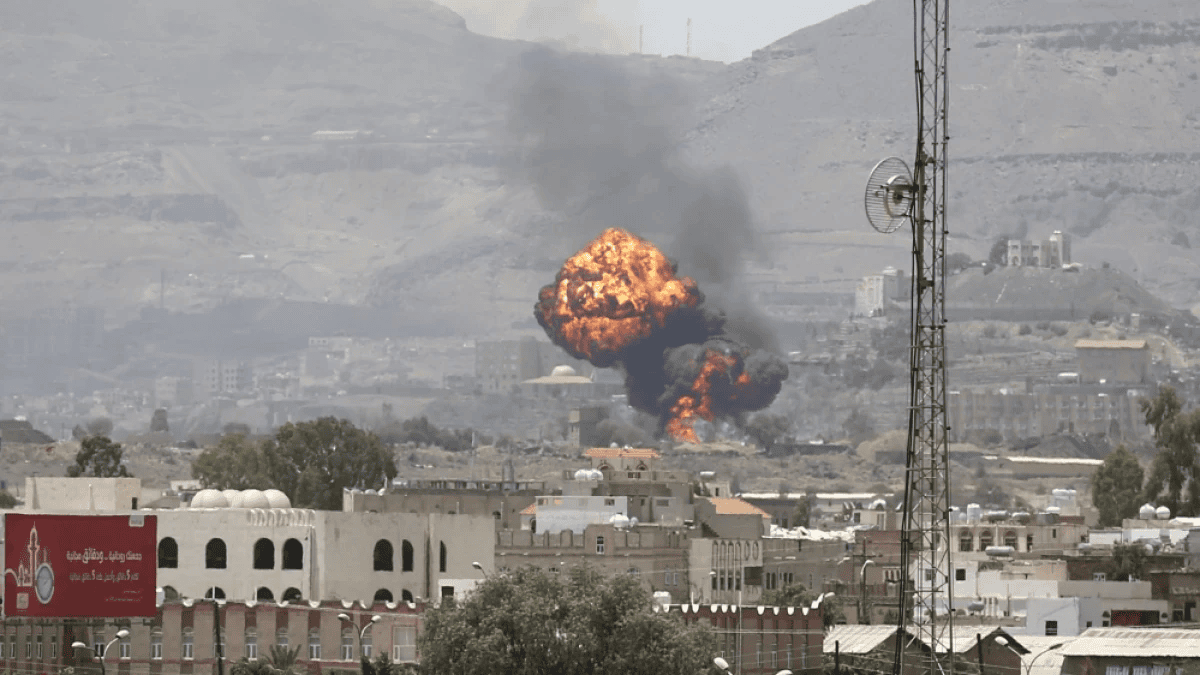
Intensive airstrikes were carried out in various areas of Yemen, including Saada and areas in Sanaa governorate.
Meanwhile, sources affiliated with the Houthis spoke of civilian casualties resulting from some of the airstrikes. Details of the losses, amid the continuing operations, require independent verification, while the parties exchange conflicting accounts regarding the nature of the targeted sites and the scale of the losses.
Airstrikes coincide with a ground offensive
The air campaign is not a separate operation from what is happening on the ground.
Saudi-backed Yemeni government forces have launched a broad offensive to retake areas that the Houthis seized during their recent advance, with a significant part of operations focused on the western coast, Bab al-Mandab and Taiz.
Government forces announced progress in Dhubab district and control of important sites, including Dhubab airfield, and cutting the road between Dhubab and Mokha and imposing fire control over it.
Government sources later spoke of rapid advance northward along the coast towards Mokha, coinciding with the withdrawal of Houthi forces from a number of coastal positions.
These operations follow a major Houthi advance in recent weeks that included areas on the western coast and near Bab al-Mandab, in addition to a wide advance south of Taiz and their seizure of the city of At-Turba and other areas.
At the same time, the Houthis have continued to pressure the roads leading to the city of Taiz, making the governorate a theatre of two opposing directions of operations: government advances on parts of the western coast, against Houthi pressure on mountain axes and the roads leading to Taiz city.
Turkey and Pakistan move to deploy forces in Saudi Arabia
The other notable development came from Turkey and Pakistan.
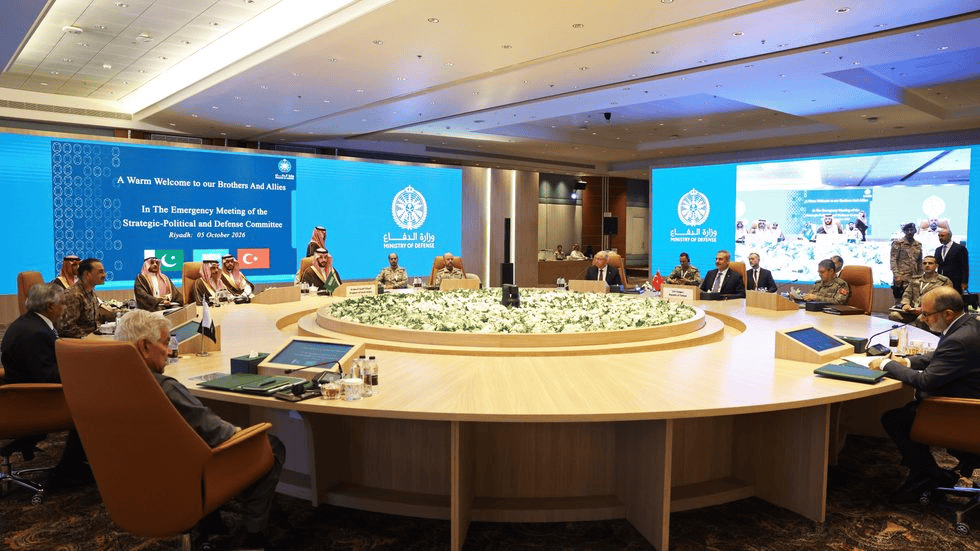
Following a meeting of senior officials from Saudi Arabia, Turkey and Pakistan in Riyadh on 5 October, the three countries announced their move towards the practical implementation of the collective defence commitments stipulated in the Mecca Trilateral Defence Agreement signed in August.
The joint statement said they would move "immediately towards the practical implementation of collective defence commitments" and take the necessary measures to provide the agreed military forces and capabilities and ensure their rapid deployment inside the kingdom.
However, the statement does not yet mean that Turkish and Pakistani forces will take part in operations inside Yemen.
The nature of the forces to be deployed, their numbers and their operational tasks remain unclear, and it has not been officially announced that Ankara or Islamabad has decided to carry out airstrikes against the Houthis.
This is an important distinction: deploying forces to defend Saudi Arabia, particularly in air defence and the protection of installations, differs from those forces entering the war directly inside Yemen.
Pakistan already has forces and air capabilities in the kingdom
However, the move does not start from zero. Reuters reported in May that Pakistan had deployed a squadron of fighter jets, thousands of troops and air defence capabilities in Saudi Arabia during the war with Iran.
The existence of these capabilities makes an expansion of the Pakistani role militarily possible should a political decision be taken to that effect, although there is currently no confirmed information that Pakistani aircraft are taking part in bombing Yemen.
As for the anticipated Turkish role, its details remain less clear.
Houthis warn against expanding foreign intervention
For their part, the Houthis have previously warned the United States against direct military entry into the war, and threatened that this would lead to widening the confrontation and closing Bab al-Mandab to American ships.
As external military support for Saudi Arabia expands, this warning gains additional significance, especially if the Turkish or Pakistani role goes beyond protecting Saudi territory to direct participation in operations inside Yemen.
The developments also come at a time when the Houthis continue to launch missile and drone attacks on targets inside Saudi Arabia, including energy facilities and military targets, alongside the continuation of ground battles.
From a Yemeni war to a wider regional confrontation?
What is happening does not yet mean that the United States, Turkey and Pakistan have become direct parties to the fighting inside Yemen to the same degree. But the map of intervention is clearly expanding.
The United States has resumed refuelling Saudi fighter jets and is providing intelligence and military support for targeting, Saudi Arabia has greatly intensified its air operations and is providing air cover for the ground offensive, while Turkey and Pakistan are preparing to deploy additional forces and military capabilities in the kingdom.
On the other side, the Houthis, who are backed by Iran, continue their operations inside Yemen and their attacks on Saudi Arabia.
Therefore, the question in the coming period will concern not only who controls Mokha, Bab al-Mandab or the roads of Taiz, but whether this round will remain a war led by Saudi Arabia through its Yemeni allies with external support, or will develop into a wider regional confrontation in which other powers become directly involved.
For now, the dividing line remains clear: there is a significant expansion of external support for Saudi Arabia, but nothing has yet confirmed direct American, Turkish or Pakistani participation in carrying out airstrikes inside Yemen.


