

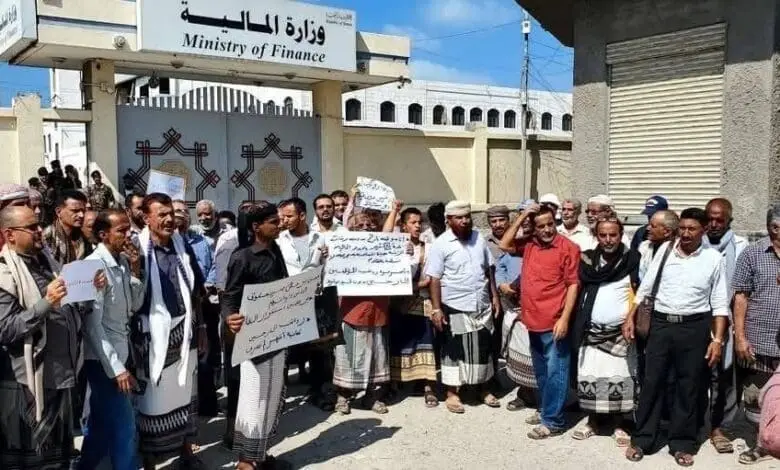
Yemen Monitor: Promises Without Salaries — Four Months of Waiting Weigh Heavily on Yemeni Employees
Government employees in Yemen have entered their fourth month without receiving their salaries, despite repeated government promises to correct financial imbalances and control the disbursement process. While Prime Minister Salem bin Breik, of the internationally recognised government, announced steps to curb corruption and rationalise spending, employees now find themselves facing a suffocating living reality, foremost among them teachers, who are experiencing a real paralysis in their daily lives.
"From Promises to Chaos"
When the prime minister announced measures to address the financial imbalances, employees were optimistic about the regular payment of salaries and the closing of the page on previous crises. It seemed as though a window of hope had finally opened after years of stagnation. Those promises, however, did not last long; they turned into an additional burden that strained household living and disrupted the educational process, and questions began to mount about the viability of the government's steps and the fate of the overdue salaries.
Steps That Were Not Completed Turned Into a Crisis
The prime minister issued a series of measures that included forming a national committee to regulate imports, prohibiting dealings in foreign currencies in the local market, directives to rationalise spending and remit revenues to the central account, along with activating market oversight and reviewing the general budgets.
However, these measures, which appeared on the surface to be a serious attempt to control disbursement, were not reflected on the ground. Employees entered their fourth month without wages, facing a real living crisis that threatens the collapse of trust in state institutions.
How Does the Yemeni Employee Live?
Thousands of government employees, foremost among them teachers, face unprecedented living pressures. Many have been forced to borrow or take on additional work to secure their families' needs, while others struggle to provide the basic requirements for their children.
In schools, teachers continue to carry out their duty despite the difficult conditions, but the teachers' union has announced a strike in protest at the delay in salaries. This situation has affected the quality of education: teachers now divide their time between teaching and working in other jobs, which has led to a decline in the regularity of lessons and lower attendance in a number of governorates.
"40 Years of Suffering in Four Months"
Al-Shaibani says, in an interview with "Yemen Monitor," that his life has turned into a daily struggle for survival, and that he is unable to buy the simplest needs of his children, such as a school notebook or a kilo of sugar. He added that he was forced to use a friend's phone to communicate after he could not afford an internet card, while grocery debts pile up on him day after day.
He adds sorrowfully: "My disability deprives me of any additional job opportunity that could ease the burden, which has made me live in a suffocating psychological crisis that goes beyond the material to the human."
He concludes his remarks with a message to the government, saying: "In every country in the world the teacher is honoured and empowered, except in Yemen, where he is humiliated and degraded. But this injustice will not last, and the dawn of justice and fairness will break however long the night."
"The Crisis's Repercussions on Education and Services"
The effects of the salary cutoff have gone beyond individuals' living conditions to paralyse state institutions. In schools, teachers' ability to keep to full working hours has shrunk, and in health and service centres the level of performance and commitment has declined.
Experts believe that the continuation of the crisis without radical solutions will lead to a gradual collapse of the public services on which millions of citizens depend, at a time when the gap between the state and its employees is widening.
"Repeated Promises Without Implementation"
Despite repeated government promises to find urgent solutions, nothing has actually been achieved. Amin al-Mesni, director of the teachers' union in Taiz, says in his interview with "Yemen Monitor": "After more than twenty marches and protest sit-ins and government promises that were never implemented, we are still demanding our legitimate rights and the payment of our overdue salaries. We have addressed the financial authorities and the local authority repeatedly, but it has amounted to promises that were not kept."
Al-Mesni added that the union had been relying on the promises of Prime Minister Salem bin Breik, but salaries have been cut off since he assumed the post until today. He noted that the last official step was a memorandum submitted by the governorate following the announcement of the strike, but it was not followed by tangible practical or executive steps.
"Complaints of Arbitrary Practices"
Alongside the salary crisis, al-Mesni spoke of practices he described as "arbitrary" that affected a number of teachers and school principals.
He said the union had recorded arbitrary administrative changes in the Shmaitin and Al-Silw districts, including the dismissal of five school principals, three of whom filed official complaints. Reports were also received of pressure and threats against teachers in the city and the countryside, in addition to the imposition of extra levies and registration fees on parents.
"Appeals and Anticipated Escalation"
The continued delay in paying salaries has led to a wave of appeals to government bodies, followed by strikes and partial suspension of study in a number of schools.
Al-Mesni said the union called for "unity of position and the exercise of the legal right to strike until the overdue salaries are paid," warning that "patience has limits, and ignoring the teachers' demands will lead to an escalation from which there is no return," and affirming that "the dignity of the teacher must not be humiliated."
"Ongoing Follow-Up From the Education Office"
For its part, the media director of the Education Office in Taiz Governorate, Mahmoud Taher, confirmed that the salary delay crisis is not limited to Taiz but includes most governorates under the control of the legitimate government.
Taher told "Yemen Monitor": "The issue goes beyond the powers of any local authority and requires solutions at the central government level. The Education Office is continuously following up on the file with the competent bodies, and we have submitted official memoranda and held multiple meetings in the interim capital, Aden, to expedite and regularise the payment of salaries."
He added that the office appreciates the teachers' commitment and their high sense of responsibility, but warned that the continuation of the crisis would leave inevitable negative effects on the quality of education.
Commenting on the calls for a strike, Taher stressed the importance of dialogue and coordination between the education unions and the official bodies, calling for consideration of the continuity of the educational process and the achievement of a balance between rights and duties.
He said the office "is working to mobilise community efforts to support the continuation of education in cooperation with the local authorities, supporting organisations and voluntary initiatives," affirming that monitoring the payment of salaries will remain a priority to ensure the stability of the educational process.
"A Crisis That Goes Beyond the Economy to Dignity"
The salary crisis continues in areas of the legitimate government amid the absence of radical solutions and an exchange of accusations between the financial and administrative bodies. While teachers and employees continue to carry out their duty under the pressure of need, the educational process remains threatened with complete halt if government neglect continues.
The matter has gone beyond the economic to become a question of dignity and humanity, and with it the employees' trust in official promises is eroding day after day.
Ignoring this crisis is no longer merely a financial or administrative matter; it has become a humanitarian issue touching the essence of social justice and citizens' trust in state institutions. The teacher who shapes generations cannot remain a hostage to deferred promises, and it is unreasonable for the educational process to continue while its cadres are deprived of their most basic rights. The question everyone keeps asking remains: how long will promises of solutions stay ink on paper?


