


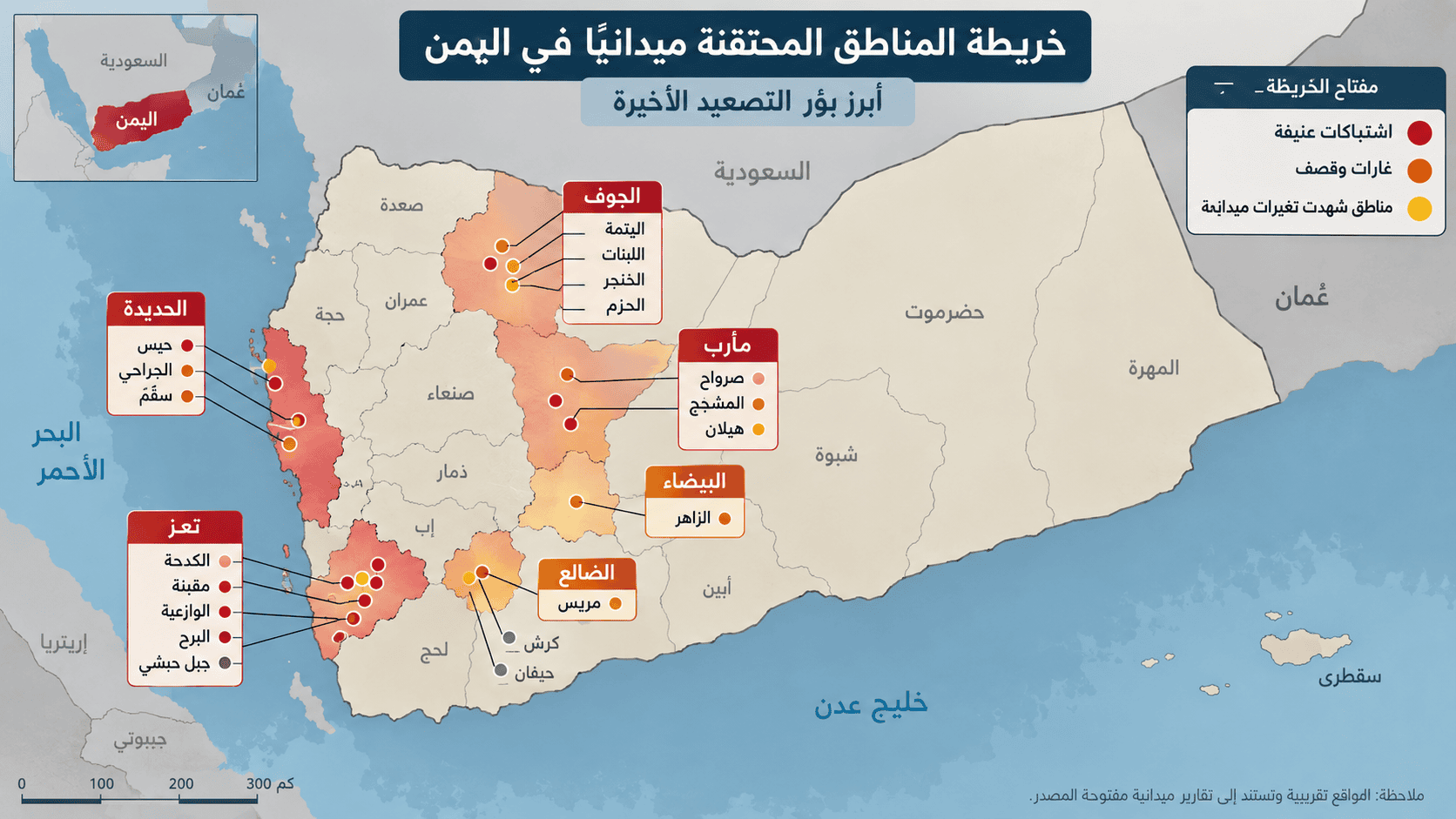
Fighting in Yemen widened on Wednesday as Saudi-backed government forces announced a large-scale operation in Marib Governorate, while battles continued in western Taiz, al-Jawf and al-Dhale, and air strikes hit Houthi positions in several governorates.
In the latest developments, government forces announced the start of a large military operation on the Marib fronts, saying they had made progress along several axes in the northern, southern and western sectors of the governorate, seized a number of positions, and captured Houthi fighters. A correspondent for "Al Arabiya/Al Hadath" reported that forces advanced in southern Marib, while warplanes struck the Hilan mountains west of the governorate, alongside artillery and rocket-launcher fire targeting Houthi positions on the Mashjah front.
Military sources spoke of advances by units of the Seventh Military Region toward Mahzam Mas and Mas Camp, while government forces said the operation was a response to Houthi attacks against civilians and military forces. As of now, there is no full independent confirmation of the extent of the areas in Marib that have passed under government control.
Taiz: Al-Kadha Operation Continues
In Taiz Governorate, the joint military operation continues on the al-Kadha front in Muqbil district, west of the governorate. Government forces had earlier announced the recapture of the al-Makazimah and al-Mihal areas, in addition to al-Makazimah hill and the Al-Hamra, Al-Sawda and al-Shiki hills, with clashes continuing in al-Kadha and al-Barh.
The latest reports on Wednesday indicated that government forces continued to advance and seized additional positions and villages on the al-Kadha front, amid artillery fire and air strikes targeting Houthi positions, gatherings and reinforcements. Fighting also continued on the al-Barh front.
Warplanes struck Houthi positions on the Himyar front in Muqbil and others in al-Wazi'iyah district, along with a strike on what government sources said was a Houthi command centre and gathering at al-Rahbah School in Jabal Habashi.
In al-Wazi'iyah, clashes continued in the al-Ghail and al-Hanaya areas after a Houthi attack on government positions, amid the arrival of reinforcements from the Fourth Military Region and al-Amaliqa brigades. Media outlets close to the National Resistance also reported the capture of the Houthi leader known as "Abu Ali al-Ayani," who they said commands the rapid intervention force in al-Barh, along with a number of his fighters. I have not found independent confirmation of this detail so far.
Field sources also reported overnight that aircraft targeted Houthi reinforcements on the Hayfan front, south-east of Taiz, alongside other strikes in Karsh in Lahj Governorate.
Al-Jawf: Fighting Continues After Control of al-Yutmah
In al-Jawf Governorate, battles continue after government forces announced on Tuesday that they had taken control of the al-Yutmah area in Khabb wa al-Sha'af district. Al Jazeera coverage on Wednesday reported renewed clashes in al-Yutmah hours after government forces entered the area's market, indicating that the Houthis are still trying to pressure the advancing forces there.
Field sources also reported that government air defences shot down a Houthi unmanned aerial vehicle early Wednesday in the vicinity of the al-Lubanat area. The sources spoke of continued fighting on this axis and government movements toward the city of al-Hazm, but no reliable confirmation has yet emerged that government forces have entered the centre of al-Hazm city.
Houthi media, meanwhile, said the governorate had been hit by new air strikes, citing five strikes on Khabb wa al-Sha'af district. The Houthi-run Al-Masirah channel, citing the Houthi Ministry of Health, said 21 people had been killed in air strikes on al-Jawf over the previous two days. Saudi Arabia has not confirmed carrying out those strikes or the announced toll.
Al-Dhale: Counterattack in Murays
In al-Dhale Governorate, government forces announced that they had repelled a Houthi attack on the Murays front, then launched a counter-offensive against the group's positions. Clashes had focused around the al-Qahrah and al-Hamra positions, with artillery, medium weapons and drones being used, but no reliable announcement of a new change in the control map has been made so far.
Air Strikes in Three Governorates
According to Houthi media, around 20 air strikes were carried out on positions in three governorates on Wednesday morning: ten in Sirwah district in Marib, five in Khabb wa al-Sha'af in al-Jawf, and five on the al-Barh area in Taiz. This account agrees with government-source reports that aircraft have continued to support ground operations in Marib, Taiz and al-Jawf in terms of wide-scale air strikes, although the details of the number of strikes and targets differ between sources.
On the West Coast and Hodeidah, fighting continues on the al-Barh and Saqam east of Hays axes, but as of Wednesday noon no reliable announcement has emerged of a new district centre or main area passing to the control of either side.
Escalation Extends to Saudi Arabia
The internal fighting comes amid the continuing repercussions of large-scale Houthi attacks on southern Saudi Arabia on Tuesday, which targeted Khamis Mushait, Abha, Jazan and Najran and, according to Saudi authorities, resulted in 73 civilians being injured and fires breaking out at energy facilities.
Saudi authorities announced on Wednesday morning that the danger alert in Khamis Mushait had been lifted after an early warning was issued, while the UN Special Envoy for Yemen and the European Union condemned the Houthi attacks on Saudi civilian and economic facilities, warning that cross-border attacks could widen the scope of the conflict.
Thus, the most prominent developments of the day are concentrated in government forces moving into a broader offensive in Marib, while continuing to try to consolidate their gains in al-Kadha west of Taiz and al-Yutmah in al-Jawf, and opening a counterattack in Murays in al-Dhale, at a time when heavy reliance on air power and artillery continues across several fronts.
As of Wednesday noon, there has been no reliable confirmation of the fall of the city of al-Hazm, the al-Jarrahi centre or any other major city, meaning that the most notable changes at present remain concentrated in the positions, heights and villages surrounding the fighting axes.


