


Chinese President Xi Jinping warned US President Donald Trump on Thursday that mishandling disagreements between the two countries over Taiwan could push Sino-American relations into a "dangerous slide," during a summit closely watched by both leaders.
Xi's remarks on Taiwan, the democratically governed island that Beijing claims, were made during a closed-door meeting between the leaders of the world's two largest economies that lasted more than two hours, according to China's Foreign Ministry.
The remarks amounted to a stark warning, if not an unprecedented one, at a solemn ceremonial occasion that was otherwise marked by a friendly and relaxed atmosphere, although the US summary of the talks did not mention Taiwan.
Taiwan has long been a major point of tension in relations between the United States and China. Beijing refuses to rule out the use of military force to take control of the island, while the United States is bound by law to provide Taipei with the means to defend itself.
US Secretary of State Marco Rubio, who is accompanying Trump in China, told NBC News that the Taiwan issue had indeed been discussed, saying the Chinese "always raise it on their side, and we make our position clear, and then we move on to other topics."
The US summary of the talks focused on the shared desire of the two leaders to reopen the vital Strait of Hormuz waterway, which has effectively been closed because of the war with Iran, as well as Xi's evident interest in buying American oil to reduce China's dependence on Middle Eastern supplies.
With Trump's approval ratings damaged by the war with Iran, which shows no signs of abating, the first visit by a US president to China in nearly a decade has taken on additional importance, as he seeks economic gains.
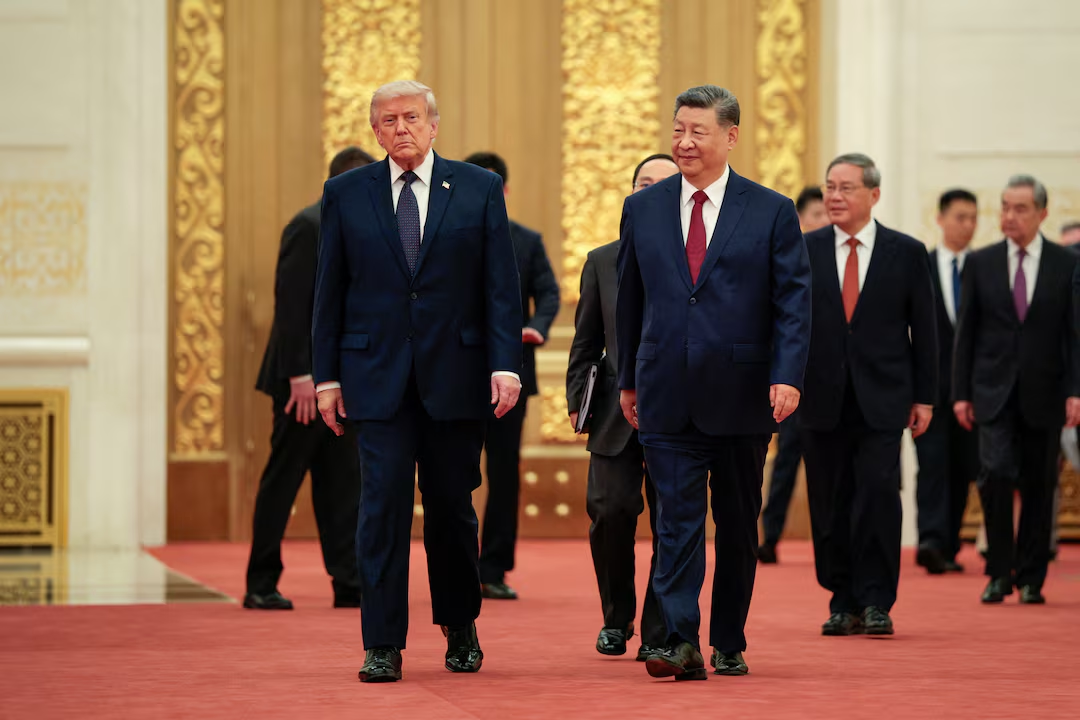
Speaking to Xi in brief opening remarks after a welcome ceremony featuring an honour guard and crowds of children waving flowers and flags in the Great Hall of the People in Beijing, Trump said: "Some people are saying this may be the biggest summit ever."
Xi told Trump that preliminary negotiations between American and Chinese economic and trade teams, held on Wednesday in South Korea, had produced "balanced and positive results," according to China's Foreign Ministry summary.
Those talks aimed to preserve a fragile trade truce reached at the leaders' last meeting in October, when Trump suspended triple-digit tariffs on Chinese goods and Xi backed away from his threat to choke global supplies of vital rare earth minerals.
US Treasury Secretary Scott Bessent, who led the Wednesday talks, said he expected progress in establishing mechanisms to support bilateral trade and investment in the future, in addition to an announcement on large Chinese orders for Boeing aircraft.
China's red lines
Earlier this week, Trump had anticipated that Xi would raise the thorny issue of US arms sales to Taiwan. With the fate of a $14 billion weapons package, still awaiting Trump's approval, unclear, China reiterated its strong opposition to such sales.
Trump did not respond to a shouted question from a journalist asking whether the two leaders had discussed Taiwan, as he stood beside Xi for photographs later at the Temple of Heaven.
For its part, Taipei said there was nothing surprising in the outcome of the summit, stressing that Chinese military pressure is the real threat to peace.
Underscoring Taiwan's exceptional importance to the US economy, the island, with a population of 23 million, is the United States' fourth-largest trading partner, after China, whose population is about 1.4 billion.
At a state banquet attended by senior officials and business executives, Xi told those present that the relationship between China and the United States is the most important in the world. He added: "We must make this relationship succeed and never spoil it."
The two leaders are scheduled to have tea and lunch together on Friday before Trump departs.
Trump's visit is accompanied by a number of chief executives seeking to resolve outstanding issues with China, among them Elon Musk, who is viewed in China as a visionary and at times a controversial figure, as well as Nvidia CEO Jensen Huang, who joined the delegation late.
The United States had granted approvals to about 10 Chinese companies to buy Nvidia's powerful H200 AI chip, but no deliveries have taken place so far, according to Reuters, which cited an exclusive report.
Trump invites Xi to Washington
Trump entered these talks in a weaker position.
US courts have restricted his ability to impose broad tariffs on exports from China and other countries, while the war with Iran has pushed up inflation at home and increased the risk that the Republican Party, to which Trump belongs, will lose control of one or both chambers of Congress in the midterm elections scheduled for November.
Although the Chinese economy has faltered, Xi does not face similar economic or political pressures.
Alongside Boeing aircraft, Washington seeks to sell agricultural and energy products to China in order to narrow the trade deficit that has long irritated Trump. In return, Beijing wants US restrictions on exports of advanced chip-manufacturing and semiconductor equipment eased, according to officials involved in the planning.
Trump is expected to encourage China to persuade Iran to reach an agreement with Washington to end the conflict, especially since about a fifth of global oil and natural gas supplies normally pass through the Strait of Hormuz.
However, analysts doubt Xi's willingness to exert strong pressure on Tehran or to end his support for its military, given Iran's importance to Beijing as a strategic counterweight to the United States.
Rubio told Fox News that it is in China's interest to help resolve the crisis, as many of its ships are stranded in the Gulf and a slowdown in the global economy would harm its exports.
Iran's Fars News Agency reported on Thursday that an agreement had been reached allowing some Chinese ships to pass.
In the same vein, on Thursday Trump extended an invitation to Xi to make a reciprocal visit to the White House on 24 September, which would be his first visit to Washington since 2015, and his first visit to the United States during the second term of the US president.
Source: Reuters.


