


World Cup
Introduction: The Enchantress That Captivated Minds
At the dawn of the twentieth century, no one could have imagined that a leather ball kicked about by boys in the streets of England would grow into an industry earning billions of dollars and shaping the moods of entire nations.
Football has turned from a mere sport, whose purpose was entertainment and physical fitness, into a new "earthly religion" with its own rituals, its temples (the stadiums), its gods (the players), and its followers, who revere the colours of their shirts and raise the club slogans as though they were sacred texts.
When the German atheist "Karl Marx" coined his famous phrase "religion is the opium of the people," in the context of his critique of how religion in Europe was used to sedate the masses and prevent them from revolting against their bitter reality, he could not have known that the twenty-first century would witness the birth of a new "opium," secular in its appeal and global in its identity, with an extraordinary capacity to sedate millions, not through resounding promises but through a green rectangle lasting ninety minutes.
This article is not an attack on sport as a healthy value. It is a cry of awareness that dismantles the political, economic and social structures surrounding contemporary football, revealing how the "round enchantress" has been transformed from a tool of entertainment into a systematic mechanism of sedation that diverts peoples from their fateful issues and drains their mental and material energies in imaginary struggles.
First: Historical Roots, From "Bread and Circuses" to "Goal and Applause"
Throughout history, authority has never been oblivious to the masses' need for entertainment as a tool of social control.
In the Roman Empire, the policy of "Bread and Circuses" prevailed. Emperors understood that providing cheap food and organising contests of gladiators in the Colosseum would be enough to keep the people occupied and away from demanding their political rights or thinking of revolt against tyranny.
In the modern age, football inherited the throne of the Colosseum. Political systems, Western and Arab, dictatorial and "democratic" alike, realised that controlling minds does not always require the security baton; it can be achieved with great cleverness through the ball.
Second: The Political Exploitation of the Game
The Use of the Game by Dictatorial Regimes
History abounds with examples confirming how fascism and Nazism saw in football a means of proving racial and political superiority.
Mussolini's Italy: Italy hosted the World Cup in 1934, and the dictator Benito Mussolini used it as a propaganda tool to demonstrate the strength of the Fascist regime.
Referees were under clear intimidating pressure, and winning was the only option to highlight the superiority of the "Fascist man."
Argentina of the Generals: In 1978, Argentina was living under a bloody military rule led by General Jorge Videla, where thousands of opponents were forcibly "disappeared" and tortured.
At precisely this time, Argentina hosted the World Cup and won it. The regime used the tournament to whitewash its reputation internationally and to sedate its people domestically with cries of joy, while the screams of the tortured rose a few metres from the stadiums.
Third: Anaesthetising Social Crises
The Opium of the Peoples in the Arab and Islamic World
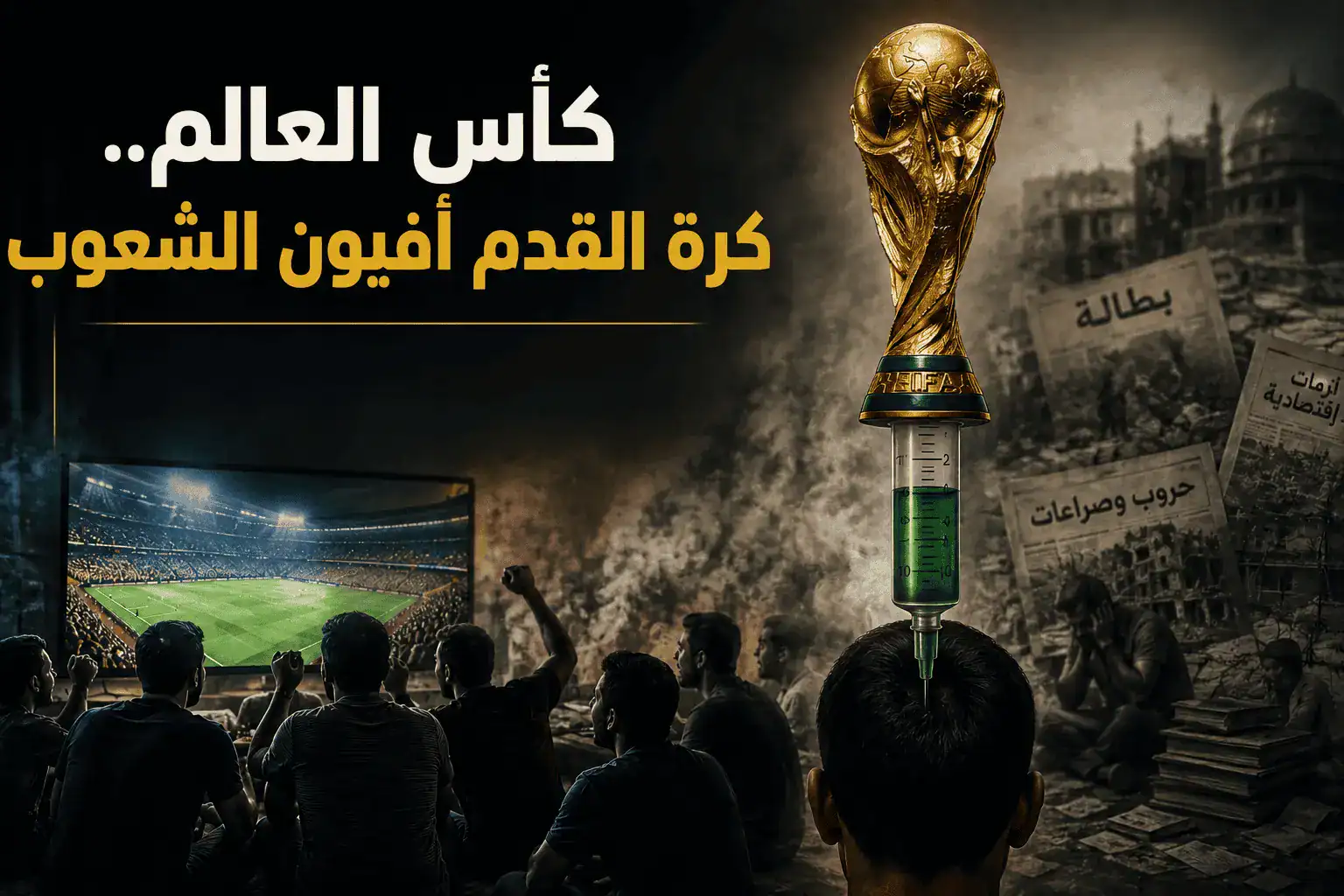
The Arab citizen lives in an environment surrounded by compounded crises: rising living costs, widespread unemployment, declining quality of education and health services, and ultimately the absence of political freedoms. In the face of this impasse, football offers a "temporary lifeline."
In the contemporary world, football appears as a lifeline for governments that have failed in development. When a state is unable to provide job opportunities, improve the quality of education and health, or curb inflation, the victory of the "national" team in a match or tournament becomes a long-lasting "local anaesthetic."
Citizens take to the streets waving flags, celebrating an imaginary triumph that changes nothing in their living conditions. The masses sleep hungry but "happy" with the victory, and the regimes exploit these moments to pass harsh economic decisions or laws restricting freedoms, benefiting from the state of "football intoxication" that pervades the country.
Read also: The Soft War: When the Word and the Image Are Stronger Than Bullets
Fourth: The Economic Structure: Commodifying Passion and the Savage Capitalism of Football
For decades, football has abandoned its simple sporting character and turned into a massive capitalist industry.
The club no longer represents the neighbourhood, the city, or the working-class identity from which it emerged; it has become a "joint-stock company" or a plaything in the hands of billionaires and sovereign investment funds.
The Shift from Sport to Commodity
In the past: players had a blind loyalty to the club shirt and received wages close to those of workers and above.
Today: astronomical contracts, a player stock market, the sale of television broadcasting rights for billions of dollars, and the transformation of the fan from a "lover" into a "consumer."
Draining the Pockets of the Poor
It is a glaring paradox that football, born from the womb of the streets of the poor in Britain and the suburbs of Latin America, now brutally targets the pockets of those same poor. To follow your favourite team, you must subscribe to encrypted channel packages that devour a considerable part of your monthly income. And to wear your team's original shirt, you must pay amounts equal to several days' wages of hard labour.
Fifth: Manufacturing "False Social Role Models" and Marginalising Minds
In societies that need scientists, thinkers, doctors and engineers to emerge from the tunnel of developmental backwardness, Arab sports media works to invert the hierarchy of values.
It spotlights the details of a footballer's life: what he eats, what he wears, what his new car is, and presents him to young people as the sole "hero and role model" and inspiration.
By contrast, the Arab scholar, researcher and innovator sinks into marginalisation and poverty, and no one turns to them.
This distortion of values sends an indirectly destructive message to the rising generations: "Knowledge does not feed bread, awareness is a burden, and chasing the ball is the road to glory and prestige."
Sixth: The New Blind Fanaticism
The Emotional Alienation toward European Clubs (Detachment from Reality)
The influence of football has exceeded the boundaries of local stadiums, and the Arab world has witnessed a striking phenomenon of absolute loyalty to European clubs with which the fan has no real bond beyond sports following.
Millions of young people spend long hours analysing the performance of clubs such as Real Madrid, Barcelona and Manchester City, and follow their news and daily details with a passion exceeding their interest in the issues of their own society and reality.
Here football ceases to be merely a means of entertainment and becomes a tool for draining emotions and energies in imaginary struggles that yield no real benefit.
This is a form of falsifying the concept of belonging, in which concern for the issues of society and nation is replaced by excessive preoccupation with a player's fitness, a referee's decision, or the result of a passing match, as though the fate of individuals and groups were tied more to what happens inside the green rectangle than to what happens in their daily lives.
Seventh: Media Misinformation: Directing Awareness and Displacing Priorities
Sports media plays the main role of "distributor" of football's opium doses. Sports media is no longer merely a conveyor of news; it has become a massive industry for directing public opinion and managing attention.
Screens and digital platforms are filled with sports programmes that run for hours. These programmes do not discuss playing tactics; they rely on sterile debate about a player's statement or a club president's tweet.
Meanwhile, the space allotted to political, scientific, cultural and economic news is shrinking. The citizen is meant to wake up and go to sleep thinking about the transfer market, rather than thinking about his future and the future of his nation.
Towards a New Awareness: How Do We Regain the Enjoyment of the Game Without Falling into the Trap of Sedation?
Criticising football as "opium" does not mean calling for boycotting it, forbidding its practice, or preventing enjoyment of it.
Sport in its essence is a noble activity that develops body and mind. The crisis lies not in "the ball" itself, but in the "ideology" that manages and exploits it.
To transform football from a "tool of sedation" into a "healthy means of entertainment," a new collective awareness must be formed, grounded in the following axes:
- Reordering personal and collective priorities
The individual must understand that football is merely a "game," a secondary activity in life that falls within the realm of recreation and amusement, and that it may by no means take precedence over fateful priorities: education, work, self-development, attention to the real political and economic issues of society, and family responsibilities. - Stripping the game of sanctity
It is necessary to remove the quality of "the sacred" from clubs and players. Losing a match is not a catastrophe; winning and losing are a natural part of sporting competition, and they should not become a source of hatred or enmity between peoples. - The conclusion of the Arab awareness required:
The need of Arab peoples for entertainment and relaxation in difficult circumstances is undoubtedly a legitimate need. But the catastrophe lies in "recreation" turning into "oblivion," and in the ninety minutes becoming the centre of the universe and the ceiling of ambition. Recovering the Arab mind begins with placing football at its natural size: a passing diversion that does not buy dignity, does not feed the hungry, and does not liberate land.


