

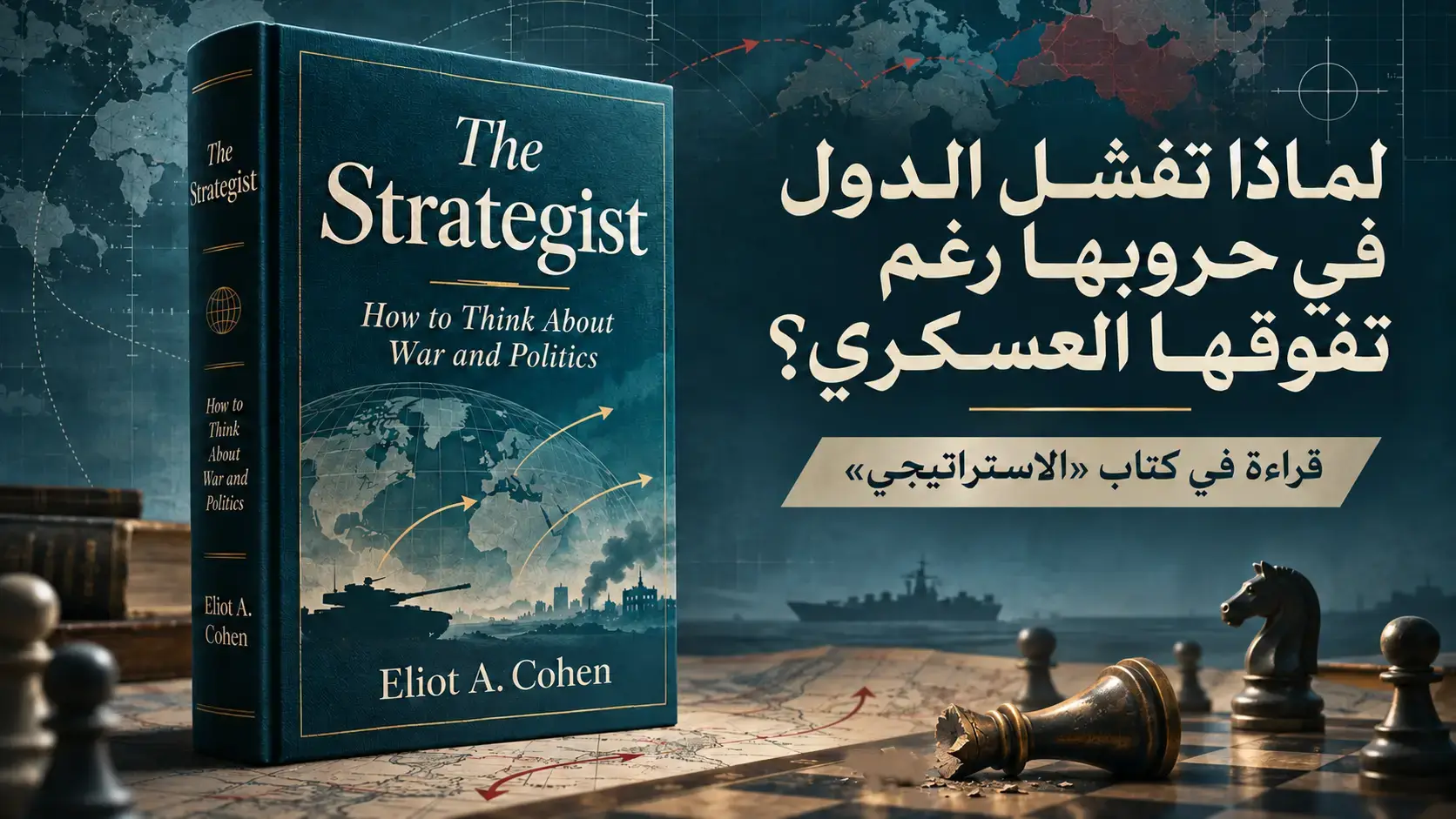
A state may possess a superior army, advanced weapons and vast intelligence capabilities, and its forces may succeed in destroying its adversaries' targets and seizing wide areas of territory, only to find itself unable to achieve the political objectives for which it entered the war.
This paradox lies at the heart of the book «The Strategist: How to Think About War and Politics» (The Strategist: How to Think About War and Politics), published by the American strategic thinker Eliot A. Cohen through Princeton University Press on 20 October 2026.
Over 312 pages, Cohen attempts to answer a question that seems simple but is highly complex: why do military and political leaders misjudge wars, despite possessing information, plans, experience and resources?
The book presents a conception of strategy that does not reduce it to the number of troops and weapons or to plans drawn up before fighting begins. Rather, it links strategy to political judgement, understanding of adversaries, the ability to set priorities, dealing with surprises, and revising decisions as the conditions of war change.
The importance of the book derives from its author's experience. Cohen served as a counsellor at the US State Department during the administration of George W. Bush, worked in defence and intelligence institutions, and taught strategic studies and military history at a number of American universities and military institutions.
Cohen currently holds the Arleigh A. Burke Chair in Strategy at the Center for Strategic and International Studies (CSIS), and is Professor Emeritus at the Johns Hopkins School of Advanced International Studies.
However, the book does not offer a neutral account of American policy. It comes from a thinker who took part in American strategic decision-making discussions, who previously supported the invasion of Iraq, and who later addressed aspects of the failures of American policies in subsequent wars.
Its significance, therefore, lies not only in the lessons it presents, but also in what it reveals about reconsiderations within American strategic thinking circles of how military force is used.
First: What is strategy, and why does the author reject broadening its meaning?
Cohen begins with a critique of the excessive spread of the term "strategy", which has come to be used to describe corporate plans, electoral campaigns, daily administration, and even limited military operations.
He argues that this expansion has caused the term to lose its precision and weakened the ability to distinguish between political and military levels of action.
For this reason he chooses a specific definition of strategy, as the preparation of armed force and its actual use, or the threat of its use, to achieve political objectives.
In doing so he draws on the Prussian military thinker Carl von Clausewitz, who made the relationship between war and politics a central axis in the study of armed conflict.
But Cohen does not treat Clausewitz's ideas as fixed rules applicable to every age. He acknowledges that the author of "On War" did not know cyber warfare, space operations, or the transformations brought about by drones and artificial intelligence.
The value he draws from the Clausewitzian tradition lies not in offering ready-made recipes for victory, but in learning to ask the right questions about war.
This means that strategy, according to this conception, does not begin with asking about the number of aircraft or the size of the arsenal, but with defining the relationship between the use of force and the political outcome sought.
Second: Why does a good military plan not mean a successful strategy?
Cohen distinguishes between planning and strategy.
Planning deals with procedures, resources, timing and organisation, whereas strategy encompasses the implementation of decisions and their adjustment when conditions change.
A military commander may draw up a precise plan that specifies the phases of operations, the movements of forces and the resources required, only to discover that the adversary behaves in a way entirely different from what he expected.
Here the difference appears between possessing a plan and possessing strategic capacity.
The strategic leader, in the author's view, is not the person who anticipates all the events of war before they occur, but the one who can revise his judgements and deal with unexpected outcomes without losing the connection between military action and political purpose.
This idea is important for reading contemporary wars, in which a limited tactical development, the entry of a new party, or an internal political crisis can change the course of a conflict.
Cohen affirms that implementing strategy is not a later stage separate from thinking about it; it is part of its nature, because strategic decisions are tested and reformulated during application.
Third: Seven questions that Cohen considers the basis of strategic thinking
The book presents seven main questions that it regards as the starting point for understanding any armed conflict or making a decision concerning the use of force.
The author does not present these questions as a procedural list guaranteeing success merely by answering them. He stresses that their real difficulty lies in the fact that answers change, information is incomplete, and objectives and interests conflict.
The questions are:
- What is going on in the surrounding environment? That is, how do international, regional, political and economic conditions affect the conflict, and which other parties might become involved?
- Who is the adversary, really? It is not enough to know the number of his forces and weapons; his aims, fears, way of thinking and reasons for continuing to fight must be understood.
- What political objective is to be achieved? And what outcome can be considered success, bearing in mind that objectives may change during the war?
- What means are available? This includes not only weapons but institutions, organisational capabilities, experience and human resources.
- What is the priority? When fronts and objectives multiply, each cannot be given the same degree of attention and resources.
- What is the sequence of steps and decisions? Because early decisions may impose constraints on the options available later.
- What is the theory of victory? That is, the reasonable explanation of how military actions are supposed to turn into political results that achieve the required objective.
The author gives this last question particular importance. A command may be able to specify the forces, resources and operations required, yet be unable to offer a convincing explanation of why these actions would be sufficient to achieve its objectives.
Cohen thus distinguishes between expecting victory and possessing a testable conception that explains how it is supposed to be achieved.
Fourth: The problem of misunderstanding the adversary
Among the most prominent strategic errors discussed by Cohen is the assumption that the adversary will behave in the way that the leaders planning war against it expect.
A militarily superior state may base its calculations on the belief that the opposing party will collapse after the first strikes, or that its losses will compel it to accept a political settlement.
But these expectations may ignore the nature of the adversary's political system, the sources of its endurance, its capacity to bear costs, or differences in its understanding of victory and defeat.
In an interview with the Council on Foreign Relations, Cohen cites what he considers failures to understand adversaries during American interventions in Iraq and Afghanistan, as well as errors made by Russia in assessing Ukraine's capacity to resist.
He also criticises the assessments of the American administration in the war with Iran during 2026, arguing that it did not sufficiently understand the nature of the Iranian regime or how it would respond to attacks.
These assessments represent the author's reading of events.
These examples reveal a broader issue: superiority in gathering information does not necessarily ensure understanding of an adversary's behaviour, and destroying his material capabilities does not automatically mean the collapse of his political will.
Fifth: Why is military force alone not sufficient to achieve political objectives?
The historical examples discussed by Cohen help clarify the difference between success in military operations and success in managing a conflict more broadly.
An attacking force may be able to topple a government or take control of a capital, but then faces questions that were not resolved when the decision to go to war was taken: who will govern the country? What will the nature of the new authority be? How will local groups respond? And how long must the military and political commitment last?
The author discusses the American experience in Iraq and Afghanistan through this dilemma, especially with regard to shortcomings in understanding the societies and institutions Washington sought to influence.
Among the examples he recalls is the lack of a sufficient number of Pashto speakers among some American institutions during the war in Afghanistan, despite the importance of the language for understanding broad sections of the population.
This example does not concern language alone; it reflects the effect of organisational and bureaucratic constraints on a state's ability to implement its objectives.
Possessing vast resources does not mean that institutions can easily convert them into tools suited to the nature of the task.
Here appears one of the book's most important ideas: means should be assessed by their suitability to the political problem to be solved, not merely by their material strength or ease of use.
Sixth: Strategic blindness: how an institution can prevent itself from seeing its mistakes
Cohen devotes a separate chapter to what he calls "the blindness of strategists", dividing its causes into individual, collective and analytical factors.
Individual factors include those that affect a leader's capacity to think and judge, such as exhaustion, health pressures, emotions and cognitive biases.
Collective factors appear when a uniform way of thinking prevails within an institution and objecting to official assessments becomes difficult.
Officials may hesitate to contradict the president or the supreme commander, avoid presenting assessments that are politically unwelcome, or see group discussion turn into confirmation of prevailing ideas rather than their testing.
In an interview explaining the book, Cohen indicates that assigning a person to play the role of devil's advocate in a meeting is not necessarily sufficient to address the problem, if the institution treats his objections as a formality and then returns to its earlier convictions.
This idea reveals the importance of institutional culture, the nature of the relationship between a leader and his advisers, and an institution's capacity to receive information that contradicts its expectations.
A strategic decision depends not only on the quality of information, but also on who can reach the decision-maker, and on how alternatives and risks are discussed.
Seventh: Churchill as a model of strategic thinking under pressure
The author devotes an extended chapter to studying the experience of British Prime Minister Winston Churchill during the Second World War.
He focuses on the memoranda Churchill prepared during his voyage across the Atlantic to meet the American president Franklin Roosevelt, after the United States entered the war in December 1941.
This case gains its significance from the circumstances in which decisions were taken: British and American leaders faced a global, multi-front conflict and disagreed over priorities and appropriate military operations.
Cohen uses these documents to show how military information, political considerations, alliances and future expectations can be combined.
But he does not present Churchill as an infallible leader; he also addresses the aspects on which Churchill misjudged, and argues that distinguished strategic judgement does not mean knowing the future with certainty.
Churchill thus becomes, in the book, an example of practising strategy as a process of continuous thinking and review, rather than simply possessing a correct plan from the outset.
Eighth: Can artificial intelligence replace the strategist?
The book discusses the future of strategic thinking in light of military and technological changes, including artificial intelligence, unmanned systems and cyber warfare.
Cohen does not deny the importance of technology in changing the means of war, but he opposes the belief that it can eliminate the need for human judgement.
Technical systems may help process vast quantities of data, improve some assessments and accelerate analysis.
But choosing political objectives, estimating the cost of war, understanding human reactions, and dealing with errors and surprises remain matters that go beyond technical calculation.
For this reason the author calls for preparing leaders through the study of history, political thought, language and literature, rather than relying only on military and engineering disciplines.
He argues that broad education helps develop qualities such as curiosity, intellectual humility, the ability to understand others, and the courage to take difficult decisions.
Here appears a proposition unusual in a contemporary military book: improving technology alone is not enough to improve strategy, if the patterns of thinking within decision-making institutions remain unable to understand the reality in which they operate.
Ninth: A critical reading: what are the limits of Cohen's conception of strategy?
One of the book's strengths is its resistance to reducing war to military capabilities, and its insistence on the difficulty of prediction and the need to subject assessments to review.
But its choice of a narrow definition of strategy raises questions.
Contemporary wars do not take place in the military domain alone; they intersect with economic sanctions, information warfare, technological competition, diplomatic alliances and prolonged social conflicts.
It may be useful to distinguish between military strategy and the overall strategy of a state, but rejecting the broadening of the concept does not eliminate the need to analyse the relationships between these domains.
Evaluating strategy according to its capacity to achieve political objectives also raises an important ethical question: is a state's success in attaining its political goal sufficient to judge its strategy a success?
Military operations may achieve political gains for the party carrying them out, while causing grave violations or enormous humanitarian harm.
It is therefore necessary to separate strategic effectiveness on the one hand from the legitimacy of war, its means, and the obligations to protect civilians on the other.
Likewise, Cohen's historical judgements should be read in light of his intellectual position and his experience within American foreign policy institutions, rather than treated as final judgements not open to review.
In this context, the book may be viewed as an important entry point for understanding the way some American strategic elites think, rather than as a universal recipe applicable to managing every conflict.
Tenth: What does this reading add to understanding contemporary conflicts?
The book's significance comes at a time when many regions of the world are witnessing growing use of drones, artificial intelligence, long-range strikes and multi-front military operations.
But developments in the tools of war do not automatically resolve the political problems that lie behind conflicts.
The balance of power on the ground may shift while the causes of war continue, and one party may inflict heavy losses on its adversary without possessing a realistic vision for ending the dispute.
Dealing with complex conflicts, in which local groups intersect with regional interests and external interventions, also poses challenges that go beyond direct military calculation.
The questions Cohen sets out provide a general framework for reading such cases: Do the parties understand one another? Are the means used proportionate to the stated objectives? Is there a clear conception of what follows military operations? Can leaderships adjust their decisions when reality changes?
Nevertheless, answering these questions requires studying each conflict in its own context, with attention to the situation of civilians and to the legitimate rights, political and social, of the affected parties.
Conclusion: The Strategic Leader Does Not Have a Ready Answer
The central idea of the book The Strategist is that success in managing war depends not on military superiority alone, nor on preparing detailed plans, but on the ability to understand the relationship between force and politics and to make difficult decisions in an environment lacking certainty.
Cohen seeks to explain why leaders fail this test despite their experience and capabilities, and how history, institutional debate, intellectual openness and the review of assumptions can improve strategic judgment, without guaranteeing results.
One of the most important conclusions drawn from the book is that the capacity to wage war does not necessarily equate to possessing a realistic view of what it should achieve, or how it should be ended.
The strategic dilemma does not begin with a shortage of force alone; it may begin when the ability to use force outpaces the ability to understand its political and human consequences.
Methodological note: This reading is based on the first chapter, the book's table of contents and the author's published statements, and does not claim a direct review of the text of the chapters that are not available.
For more: The book's official page; Chapter one and table of contents (PDF).


