

By Mohammad Zunaed
While global attention is currently focused on rising geopolitical tensions between the United States, Israel and Iran, another crisis continues quietly in Bangladesh.
Beginning 1 April 2026, the World Food Programme began implementing a revised Targeting and Prioritisation Exercise (TPE) for Rohingya refugees residing in the Cox's Bazar and Bhasan Char camps, according to a statement issued by the United Nations in Bangladesh on 2 April.
Under the new system, refugee households will receive food assistance of US$12, $10 or $7 per person per month, based on their assessed level of food insecurity. All refugees had previously received $12 per person.
In theory, targeting the most vulnerable groups seems logical. In many humanitarian crises, such systems help ensure that limited resources reach those most in need. However, the situation of the Rohingya is different.
Nearly nine years after fleeing genocide and persecution in Myanmar, more than one million Rohingya refugees remain confined to camps in Bangladesh, according to the latest data from the UN High Commissioner for Refugees in Bangladesh, which includes 144,456 new arrivals biometrically identified and 1,040,408 registered refugees born in the 1990s and after 2017. 78% of them are women and children.
Unlike refugees in many other countries, the Rohingya in Bangladesh have extremely limited freedom of movement and are not legally permitted to work or run small businesses inside the camps. Refugees are also not formally employed by humanitarian organisations, except for volunteering in exchange for small daily allowances. As a result, they remain almost entirely dependent on humanitarian aid.
In this context, the reduction in aid raises serious concerns. When refugees are not allowed to engage in meaningful economic activity, food insecurity becomes not merely a household condition but a structural outcome.
Humanitarian organisations have provided life-saving support for years, and their efforts should not be overlooked. But survival is not the same as stability. Rather than creating pathways to self-reliance for the Rohingya and host communities in Cox's Bazar affected by the refugee presence, the current system has largely entrenched dependency.
Many programmes classified as "livelihood initiatives" have not produced tangible results. Vocational training courses, such as electrical appliance repair or other technical courses, often fail to provide real employment opportunities, because refugees do not own motorcycles, electricity is limited in many camp areas, they are not legally permitted to travel outside the camps in search of work, and humanitarian organisations do not employ trained refugees within their operational structures.
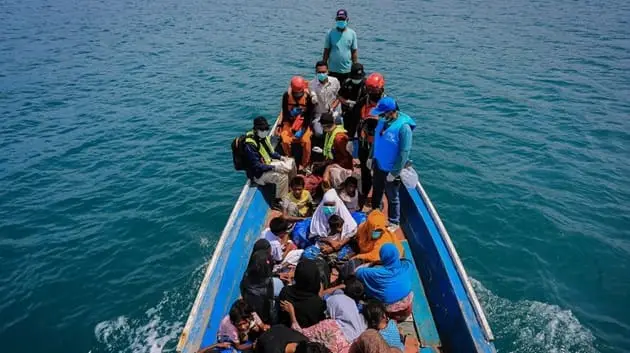
Reduced food assistance affects Rohingya refugees in camps in Sittwe, western Myanmar
The new targeting model classifies refugees into three categories: those experiencing severe food insecurity, those experiencing significant food insecurity, and those experiencing food insecurity. Some vulnerable households, such as those headed by elderly people, persons with disabilities or children, will continue to receive the highest level of assistance.
But the broader reality remains unchanged: all Rohingya in Bangladesh face severe restrictions on their economic participation.
Recent protests in the camps have often been described as reactions to reduced food rations. In reality, these protests reflect deeper concerns about uncertainty and the absence of long-term planning. Refugees ask a simple question: what will happen if funding declines further in the future? Where will we go? Will Bangladesh be left alone to face the Rohingya crisis?
They want to send a message to the world: the dependency system was built on the Rohingya's case. It is time to think beyond relief and give them the tools to rely on themselves.
There is an urgent need for long-term strategic thinking. This includes serious discussions on ensuring a safe and dignified life in the camps until the Rohingya are able to return to Myanmar, expanding the economic participation of refugees, and developing policies that allow them to contribute economically while remaining under appropriate oversight.
At the same time, Bangladesh is going through a post-election transitional period, and the new government has announced its intention to work closely to facilitate the return of the Rohingya to their homes, and has shared data on 829 thousand Rohingya with Myanmar.
But the Rohingya crisis cannot be downplayed. The new government must recognise that prolonged displacement cannot be managed indefinitely through restrictions and relief alone, which is the same approach that characterised the policies of the previous government.
Carefully structured employment opportunities, such as existing projects in the camps, pilot employment programmes, or limited work permit schemes, could help reduce dependence on humanitarian aid while maintaining government oversight.
If only one or two individuals from each refugee household were permitted to work legally within well-defined frameworks, humanitarian aid costs would gradually decline, camp economies would stabilise, and youth frustration would diminish.
More importantly, dignity would gradually return.
Nearly nine years on, international organisations have managed one of the largest refugee operations in the world with considerable logistical capacity. Yet the central question remains: what sustainable systems have been created to help refugees rely on themselves?
As pressure on global funding grows and donor fatigue increases, humanitarian aid is being reassessed and reduced. Without structural reforms, this situation threatens to manage dependency more efficiently rather than reduce it.
The Rohingya did not choose aid dependency; restrictions imposed upon them made it inevitable. Food assistance remains necessary, but the future of an entire people cannot be determined by ration cards and vulnerability categories alone.
The Rohingya crisis requires more than improved aid targeting. It requires policies that combine protection, participation and living in safety.
The world has learned how to feed the Rohingya.
The real test is whether it will enable them to endure until the day they return safely to their homes in Myanmar, with rights, security and dignity.
Otherwise, families will be forced to secretly reduce their meals. Young people will turn to unsafe informal work. The risks of child labour, early marriage, unsafe migration and involvement in illicit activities will grow. When opportunities fade, despair fills the void.
Mohammad Zunaed, one of the honourees of the 2025 Rohingya Protection programme, is an independent journalist, award-winning photographer and coordinator. He works with international agencies and has contributed to Myanmar Now, Arakan Express News, The Diplomat, Frontier Myanmar, Inter Press Service and Myanmar Press Photo Agency.


