


The image of French President Emmanuel Macron's visit to Damascus was not an isolated event, separate from the controversy surrounding him at home. While Macron seeks to present himself as one of the most prominent European leaders on the international stage, voices inside France are increasingly describing him as among the most divisive presidents in the history of the Fifth Republic, to the point that some of his critics go so far as to call him "the worst French president".
Although this description remains a political judgment that reflects the views of a section of the French public, repeated opinion polls have indeed shown a sharp decline in his popularity, the result of an accumulation of domestic and foreign crises that have placed his presidency under sustained pressure.
Economic reforms that ignited the streets
Since arriving at the Élysée Palace in 2017, Macron has pursued a liberal economic programme focused on reforming the labour market, reducing public spending, and restructuring the pension system.
These reforms, however, faced wide rejection from trade unions and large segments of society, who viewed them as serving the interests of capital owners more than the middle and lower classes.
The crisis over raising the retirement age from 62 to 64 was the most prominent flashpoint of popular anger, especially after the government used Article 49.3 of the constitution to pass the law without a full parliamentary vote, which its critics regarded as an overriding of parliamentary will, and which led to months of protests and strikes.
The Yellow Vests protests
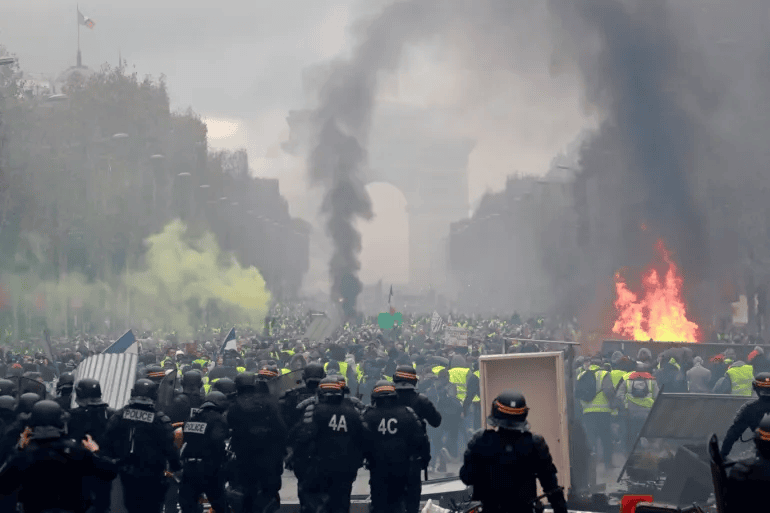
The "Yellow Vests" movement was one of the greatest challenges Macron faced.
What began in 2018 as a protest against fuel tax increases quickly turned into a broad social movement against the rising cost of living and the widening economic gap between the capital and the provinces.
During that period, France witnessed violent clashes between protesters and security forces, which caused significant damage to the government's image both at home and abroad.
The crisis of trust with the French people
Many of Macron's critics argue that he presents himself as a technocratic president close to economic elites rather than to ordinary citizens.
His controversial statements contributed to entrenching this image, as his opponents at times accused him of condescension toward the poor and the working class, which was reflected in declining levels of trust in him during his two terms.
A divided parliament and political difficulties
Legislative elections cost Macron's camp its absolute majority in parliament, making the passage of laws more difficult and forcing the government to rely on exceptional constitutional tools on some files.
Analysts see this parliamentary weakness as revealing a decline in the political momentum that accompanied the early years of his term.
Immigration and security
The government faced criticism from two opposing directions: the right accuses it of leniency on immigration and security files, while left-wing forces see some security and immigration policies as having become harsher and as affecting public freedoms.
This contradiction caused Macron to lose support from sections of both sides, without succeeding in building a broad political consensus.
Foreign policy: international presence and disputed results
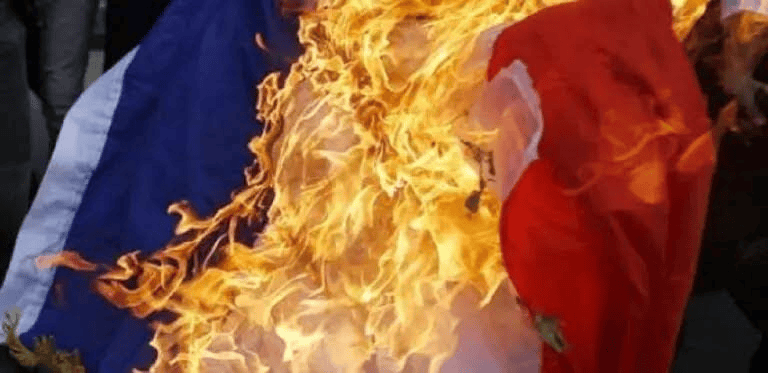
On the foreign front, Macron sought to present France as an independent diplomatic power within Europe, and played prominent roles on the files of Ukraine, the Middle East and Africa.
However, this policy faced growing criticism, particularly after the decline of French influence in the African Sahel region and the withdrawal of French forces from Mali, Burkina Faso and Niger, amid rising anti-French sentiment in a number of countries in the region.
He was also criticised for his positions on the war on Gaza, where some French people considered him hesitant at first, while others felt he failed to maintain a clear balance between support for the Israeli occupation and calls to protect Palestinian civilians.
Successive crises
Macron's presidency also coincided with a series of major crises, including:
- The COVID-19 pandemic and the restrictions and exceptional measures that accompanied it.
- The energy and inflation crisis following the Russian war on Ukraine.
- Rising public debt and higher living costs.
- Growing political polarisation and the rise of the national right led by Marine Le Pen, alongside the growing presence of the radical left.
The mocked president
Among the personal matters that dogged Macron and affected his public image is the recurring controversy over his relationship with his wife, Brigitte Macron, which began when he was 15 years old and she was his schoolteacher at about 40 years of age, before the two later married. This relationship has become a constant subject of media and social media coverage, particularly among his opponents inside and outside France.
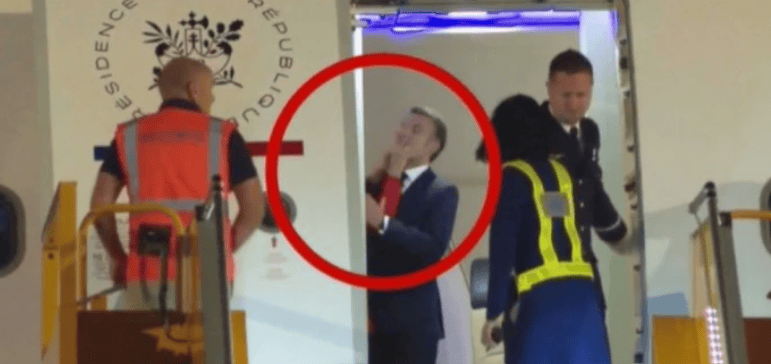
The controversy grew in 2025 after a video spread showing Brigitte appearing to push Macron's face with her hand as they descended from the presidential plane, which triggered a wave of comments and speculation about the nature of their relationship, although the Élysée Palace affirmed that the scene was merely playful banter between the couple.
Macron's opponents also exploited the incident to mock him, and US President Donald Trump later commented jokingly that he "has to make sure the door stays closed", adding that Macron is "fine and that they are a wonderful couple", a remark that received wide media coverage. Nevertheless, most other narratives circulating on social media, including claims that he is repeatedly beaten or has bruises he hides behind sunglasses, continued to fuel debate about his personal life as a president said to be at the mercy of circumstances.
The gravest historical error of Macron: insulting the Prophet, peace be upon him
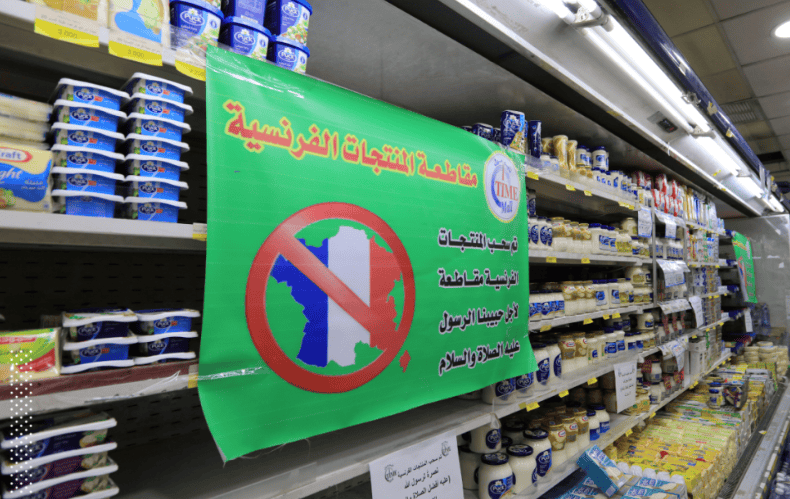
Among the positions that affected Macron's image among broad sections of Muslims was his stance during the 2020 controversy over offensive caricatures of the Prophet ﷺ, when he defended the right to publish those caricatures as part of freedom of expression in France and part of the values of the French Republic.
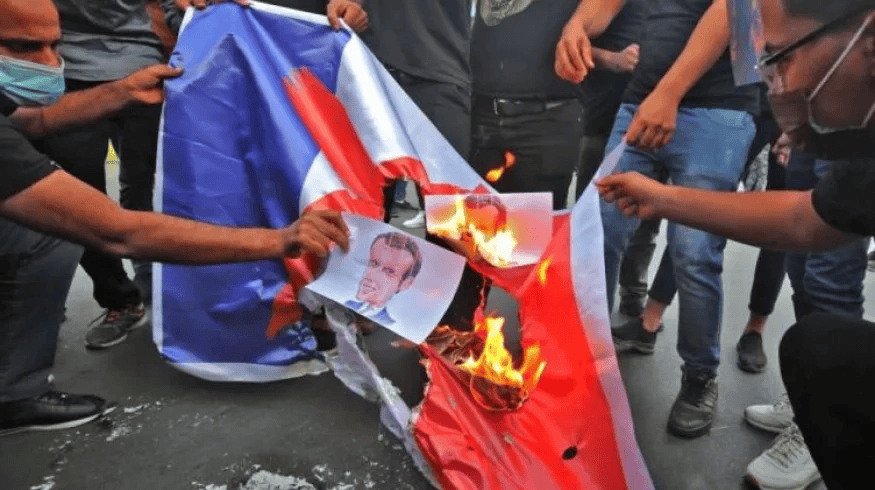
His statements and his permitting the publication of caricatures offensive to the Prophet, peace be upon him, sparked a large wave of anger in the Islamic world, followed by protests and boycotts of French products in a number of Muslim countries. His position, which Muslims regarded as demeaning, also left a negative impression of his image in the Islamic world, where the French president was accused of hypocrisy for failing to balance freedom of expression with respect for religious beliefs. Critics cited his insistence on strict punishment for antisemitism as a red line in French law, while the rights of Muslims are considered fair game and open hostility towards them and insults to their sacred symbols are justified.
Since that crisis, Macron's name has remained associated in the Islamic world with the animosity of French secularism and with a politicised notion of freedom of expression used to justify war on Islam and the Prophet of Islam, peace be upon him. This is the unforgivable mistake attributed to Macron, recorded in the ledger of his presidential disasters.
The Macronian syndrome of crises
Among the files that left a major impact on Macron's image abroad were his remarks about Islam during 2020, when he said that "Islam is in crisis everywhere in the world", in a speech in which he addressed what he described as "separatism from the Republic" and the confrontation with currents he called "extremist".
The statement provoked wide anger in the Islamic world, and many regarded it as a deliberate war on Islam and Muslims. These remarks coincided with the controversy over the offensive caricatures of the Prophet ﷺ, which turned them into one of the largest diplomatic crises of his tenure with Muslim states and peoples.
Macron's critics argue that this period revealed his weakness in managing relations with religious and cultural components outside France, while his supporters argue that he was defending the model of French secularism and freedom of expression. Nevertheless, those statements remained a turning point in his image among broad sections of Muslims and became part of the wider debate about his domestic and foreign policies.
His remarks about Islam were followed by a series of crises that France faced under Macron's turbulent leadership, making him the subject of wide criticism and ridicule. These crises began with France's withdrawal from the Sahel region and its loss of influence and military bases there, then escalated with protests in French streets, culminating in a sharp decline in Macron's popularity within his country.
Macron remains the "worst president"
Describing Macron as the "worst French president" does not prevent some from arguing that he succeeded in sustaining relatively modest economic growth compared with some European economies, reduced unemployment to levels lower than when he took office, and strengthened France's role within the European Union.
Against this, his critics argue that these achievements were not sufficiently reflected in citizens' daily lives, and that his style of governance, his repeated reliance on exceptional procedures, and his failure to contain protests are all factors that led to a marked decline in his popularity.
Ultimately, Emmanuel Macron's legacy appears set to remain a subject of long debate within France. His supporters regard him as a reformist president who took difficult decisions to address complex challenges, while his opponents believe he deepened social and political division and left the country more polarised than when he came to power. Between these two assessments, the final verdict depends on the credibility of the slogans he raised, while his hostile stance towards the Prophet, peace be upon him, will remain an indelible stain and the most damaging cause of his fall.


