

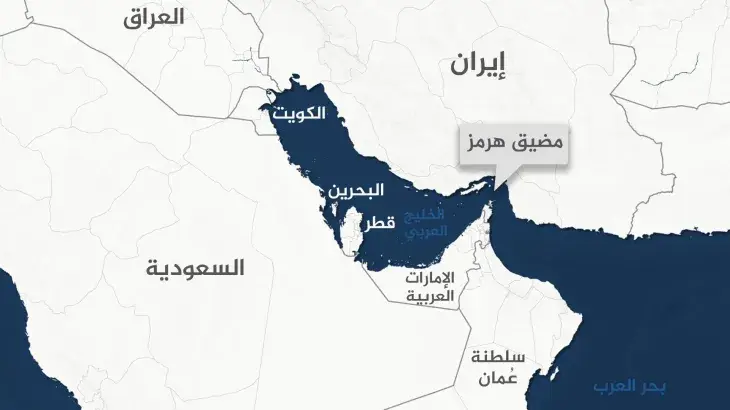
Why Is the Strait of Hormuz Called That? And Who Was Hormuz?
The Strait of Hormuz is one of the most important waterways in the world, but behind this name lie stories that blend myth, trade and major wars.
- Why is the Strait of Hormuz called that?
One theory holds that the name of the Strait of Hormuz goes back to the name of the ancient Kingdom of Hormuz, founded in the tenth century CE. It was originally located on the Iranian coast, then moved to the island of "Jerun" (today's Hormuz Island). This kingdom was the "key to India," and it controlled Eastern trade for centuries.
Another theory, according to what historians believe, holds that the word derives from (Ahura Mazda), a derivation of "Hormuz," the Arabic pronunciation of the name of the god "Ahura Mazda" (the god of good and wisdom in Zoroastrianism), reflecting the ancient Persian cultural influence in the region.
From the perspective of linguistic interpretation, there is an opinion that it derives from the Persian "Khur-Muz"; "Khur" means estuary or gulf, and "Muz" may refer to the banana fruit or a type of palm, but this explanation is less common among historians.
- Who is "Hormuz," the commander who confronted the Muslims?
If the strait was named after the kingdom or the purported god, Islamic history immortalised another figure named "Hormuz," the ruler of the region of "al-Ubulla" (today southern Iraq) belonging to the Sasanian Empire.
Hormuz was one of the greatest Persian commanders, from the class of the "Asawira" (the Persian elite), and it is said that he wore a crown worth one hundred thousand dirhams, an honour attained only by senior princes and commanders close to Khosrow.
He was known for his extreme arrogance and hatred of the Arabs, and he represented the first line of defence of the Sasanian Empire on the side of the Arabian Peninsula. His end, however, came at the hands of the noble companion Khalid ibn al-Walid, may Allah be pleased with him, in the Battle of Dhat al-Salasil.
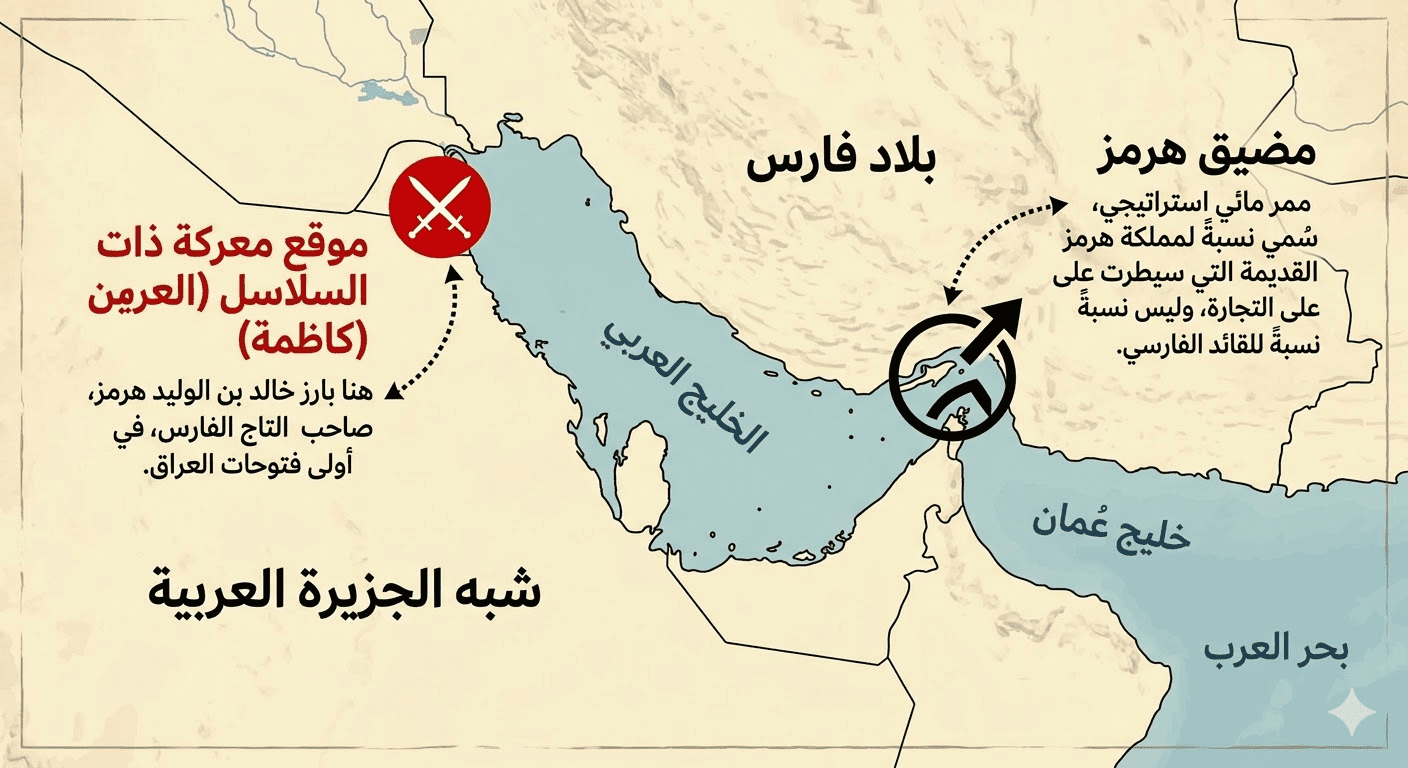
- The Battle of Dhat al-Salasil: When "Hormuz," the owner of the crown, fell
The historic confrontation took place in the year 12 AH (633 CE), the first of Khalid ibn al-Walid's battles in Iraq, and it is known as the "Battle of Kazima" (in present-day Kuwait).
It was named "Dhat al-Salasil" because Hormuz ordered his soldiers to be chained together to prevent them from fleeing the battlefield before the Muslims, a strategy reflecting his fear of his army's psychological collapse.
At the start of the battle, Hormuz challenged Khalid ibn al-Walid to single combat, not only out of bravery, but also having planned a prior treachery. Hormuz agreed with a group of archers and horsemen to assassinate Khalid while he was occupied with the duel.
When the two commanders engaged, Hormuz's men attacked suddenly, but al-Qaqa' ibn Amr al-Tamimi did not wait for orders; he rushed forward like lightning and killed the attackers, while Khalid ibn al-Walid completed his task and struck off Hormuz's head.
The killing of Hormuz was a crushing blow to the morale of the Persians, which led to a sweeping victory for the Muslims and opened the way to the fall of the Sasanian Empire.
Conclusion
There is "Hormuz" the place, and "Hormuz" the man. If the strait bears the name after the place, it carries an ancient geographical and historical name tied to kingdoms and legends; if it bears the name after Hormuz the commander, it is a symbol of Sasanian arrogance that was broken before the military genius of Khalid ibn al-Walid.


