


لماذا أصبح طريق البحر الأبيض المتوسط أكثر فتكًا بالمهاجرين؟
Early 2026 was the deadliest start in more than a decade for migrants travelling the Mediterranean route to Europe, according to the International Organization for Migration. Experts say a combination of increasingly restrictive border policies and restrictions on private sea rescue operations is making this already dangerous route even more perilous.
At least 1,003 people have died in the Mediterranean since the beginning of this year while attempting to reach Europe, according to the UN's International Organization for Migration. The IOM has not recorded such a high number since it began tracking migrant deaths and disappearances in 2014.
Experts say overcrowded boats, long distances, increasingly restrictive border policies, tighter border surveillance, and restrictions on the capacity of private sea rescue organisations are all factors that increase the risk facing migrants attempting to cross the Mediterranean.
Suzeuk Dubouï, operations director of the sea rescue organisation SOS Méditerranée, and Arno Pagnoux, a migration specialist at the French National Centre for Scientific Research (CNRS), spoke to InfoMigrants about the growing risks migrants face along the Mediterranean route.
Have Mediterranean crossings become more dangerous?
Suzeuk Dubouï: During our maritime missions, we are observing an increase in the use of rubber boats. They had been abandoned between 2023 and 2024 in favour of iron or metal boats, but they are now back. These boats are dangerous because they are less suitable than metal boats for long journeys at sea.
Boats are also increasingly overcrowded, which increases the risk of them sinking.
Arno Pagnoux: Border and coast guards are increasingly turning to preventing migrants from leaving the external borders of the European Union. This practice of preventing migrants has become widespread in recent years.
At the same time, crossings have become more dangerous. Fewer people are reaching European shores, but the number of victims is greater.
Around 66,000 migrants entered Italy irregularly in 2025. A similar number arrived in 2024, but the figure had more than doubled in 2023, when more than 150,000 migrants arrived.
When people are prevented from leaving, they look for the shortest possible routes to their destination and the least dangerous conditions. People do not necessarily give up on crossing if the optimal conditions for departure are not available; instead they look for alternatives, which are often more dangerous. People board ships, even when they are in poor condition (dilapidated ships, overcrowded ships…), because there is no other option.
Migrants to Europe: the road of death and a future in hell, or reverse migration
Does this figure include crossing attempts in winter?
Arno Pagnoux: Departures now take place in both summer and winter. When governments try to prevent migrants from leaving, migrants may attempt to cross the sea during storms to avoid being spotted, which increases the risk of boats sinking.
Around 30 boats left the coast of Tunisia while Storm Harry was hitting southern Italy and Malta in January 2026. Humanitarian organisations estimated that as many as 1,000 people were lost at sea because of the storms brought by the cyclone in the Mediterranean. For its part, the International Organization for Migration estimated that at least 380 people were lost.
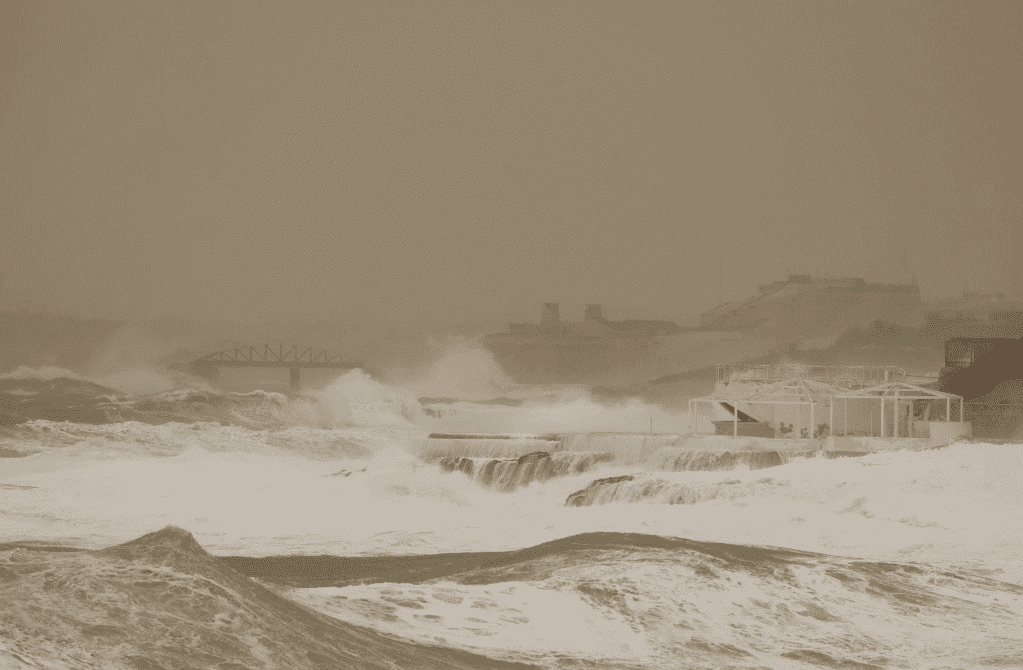
Waves hit the entrance to the Grand Harbour of Valletta as Storm Harry causes widespread damage in Malta, 20 January 2026 | Photo: Darrin Zammit Lupi / Reuters
Suzeuk Dubouï: The presence of non-governmental sea rescue organisations at sea decreases during winter. A fleet of civilian sailing boats is moored in Lampedusa and patrols only during the summer, and can sail only in good weather. Sailing at sea during storms is extremely dangerous for them.
Has tighter surveillance in the central Mediterranean affected migration routes and the risks migrants face?
Arno Pagnoux: People are increasingly travelling longer distances to reach Europe. The traditional route from western Tripoli [the towns of Zuwara or Zawiya, editor's note] towards the Italian island of Lampedusa is under close surveillance. Departures now take place east of Tripoli, towards Benghazi, or even east of Tobruk.
The Tobruk route, which connects the eastern Libyan city to the island of Crete, has seen a notable increase in traffic in recent months. More than 18,000 people entered Crete irregularly in 2025, compared with just over 5,000 in 2024, according to figures from the Greek authorities. This represents an increase of 200%.
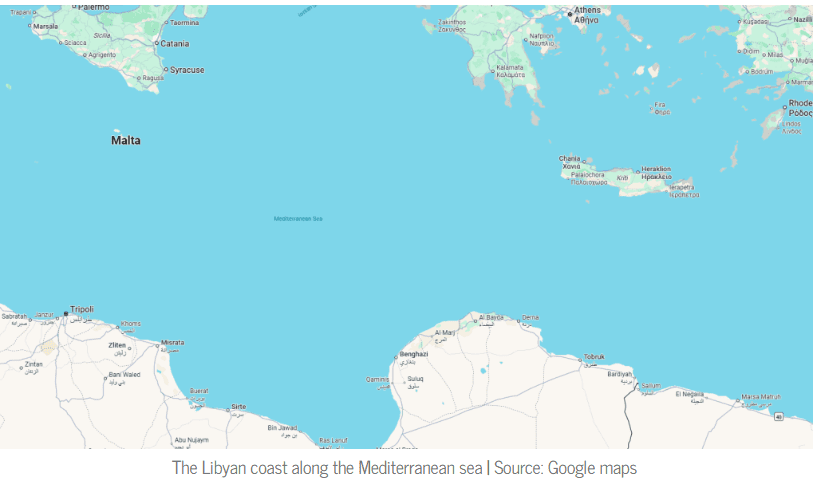
The Libyan coast on the Mediterranean | Source: Google Maps
The route is now three or even four times longer than before. Migrants depart from Tobruk and cross the entire central Mediterranean to reach Europe. There are no rescue ships patrolling this area.
Ships that find themselves lost after leaving Tobruk have no chance of being rescued.
Are Italian laws also a cause of the rising death toll at sea?
Suzeuk Dubouï: There is no doubt that the Piantedosi decree has made our activities more difficult. We have lost 591 days of sea operations over 10 years. Any pretext is enough to remove us from the search and rescue zone.
The Piantedosi decree, named after Interior Minister Matteo Piantedosi, introduced a series of new measures at the end of 2022 to restrict the activities of rescue ships in the Mediterranean. The decree requires NGOs to head "without delay" to the port of disembarkation designated by the Italian authorities immediately after completing a first rescue. This means that ships are not permitted to carry out any other rescue operation unless Rome grants them an exceptional authorisation to do so.
Although the decree was issued three years ago, its rules have been applied gradually. Several relief ships have suspended their activities at sea since the decree was issued, or have begun using smaller boats.
In December 2024, Médecins Sans Frontières announced that it would end rescue operations in the central Mediterranean after three years of work aboard the ship "Geo Barents". According to aid workers, restrictions imposed by the Italian authorities prevented them from making optimal use of their ship's capabilities. The organisation decided to resume its activities at sea a year later by chartering a new rescue ship: "Aurora". In a press release at the time, the organisation said that this vessel, smaller and faster than "Geo Barents", was "a strategic response to the restrictive and obstructive laws and practices imposed by the Italian government".
The presence of the "Ocean Viking" [chartered by SOS Méditerranée] has become almost symbolic. Our ship can accommodate 400 people, but we never reach that number. It usually carries only around 60 migrants, and we are forced to leave the area to reach a distant port hundreds of kilometres away.
The ports designated by Rome are usually very far from the search and rescue zone, forcing ships to sail long distances at sea and move away from the central Mediterranean for several days.
Before the decree was issued in 2021, humanitarian rescue ships were patrolling the area almost permanently. Now, the waters of the Mediterranean have been almost emptied of their civilian fleet.
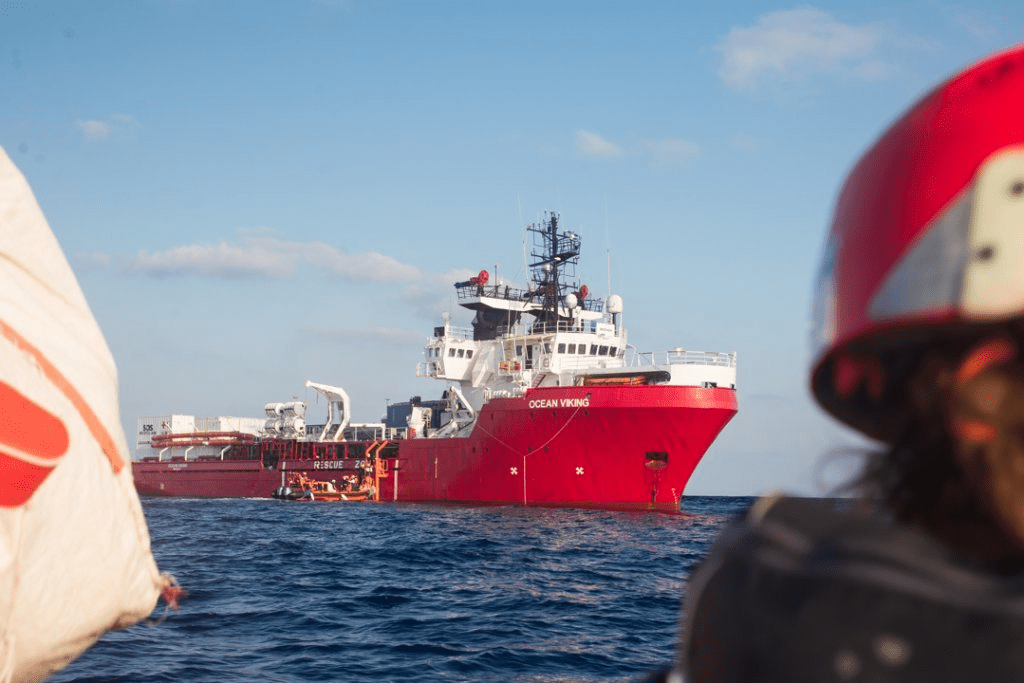
The "Ocean Viking" during an operation in the Mediterranean. Photo: Alicia Fayya / SOS Méditerranée
Arno Pagnoux: The current situation is very different from 2021 and 2022, when a fleet of civilian ships was present throughout the Libyan and Tunisian search and rescue zones. Italy has now imposed restrictions on rescue capacities.
Suzeuk Dubouï: It is clear that the European Union gives priority to border protection over rescue operations. The goal is no longer hidden: the goal is no longer to respect maritime law by rescuing people in distress.
This policy has inevitably led to more shipwrecks.
Nevertheless, the European Union took part in establishing a Libyan and Tunisian search and rescue zone in the central Mediterranean with a declared aim of "saving lives".
Arno Pagnoux: The European Union asks countries on the other side of the Mediterranean to monitor borders and militarise maritime rescue operations.
European authorities have set up interception forces. Tunisians and Libyans are not seafarers; they do not carry out rescues. Any interception at sea involves risks, as it is impossible to intercept a ship without resorting to force. The manoeuvres of Libyans and Tunisians can be dangerous when boats are crowded with passengers and people panic.
Many interceptions result in deaths that we are not always aware of.
Under this policy, Italian ships remain in their territorial waters and no longer patrol their own search and rescue zone.
As a result, rescue operations are delayed. Nor do the Italians do anything unless there is pressure from civil society organisations to launch a rescue operation for a boat in distress. The European Union has completely abandoned its responsibility for this task, leaving it to other parties, such as the Libyans or Tunisians.
When we contact the Libyan authorities, either they do not respond or they speak to us in Arabic. This makes communication difficult, if not impossible.
The responsibility of states is a matter of the utmost importance. When an alarm is raised after a ship sinks and nothing happens, who is responsible? Who is responsible when we provide the Libyans with millions of euros to manage this area?
Arno Pagnoux: Operational responses differ depending on who is on board the ship. Significant resources are allocated when Europeans are in danger at sea, whereas the same level of resources is not allocated when migrants are involved.
Suzeuk Dubouï: The increase in the number of shipwrecks is due to policies that consider these people unworthy of rescue.
InfoMigrants


