

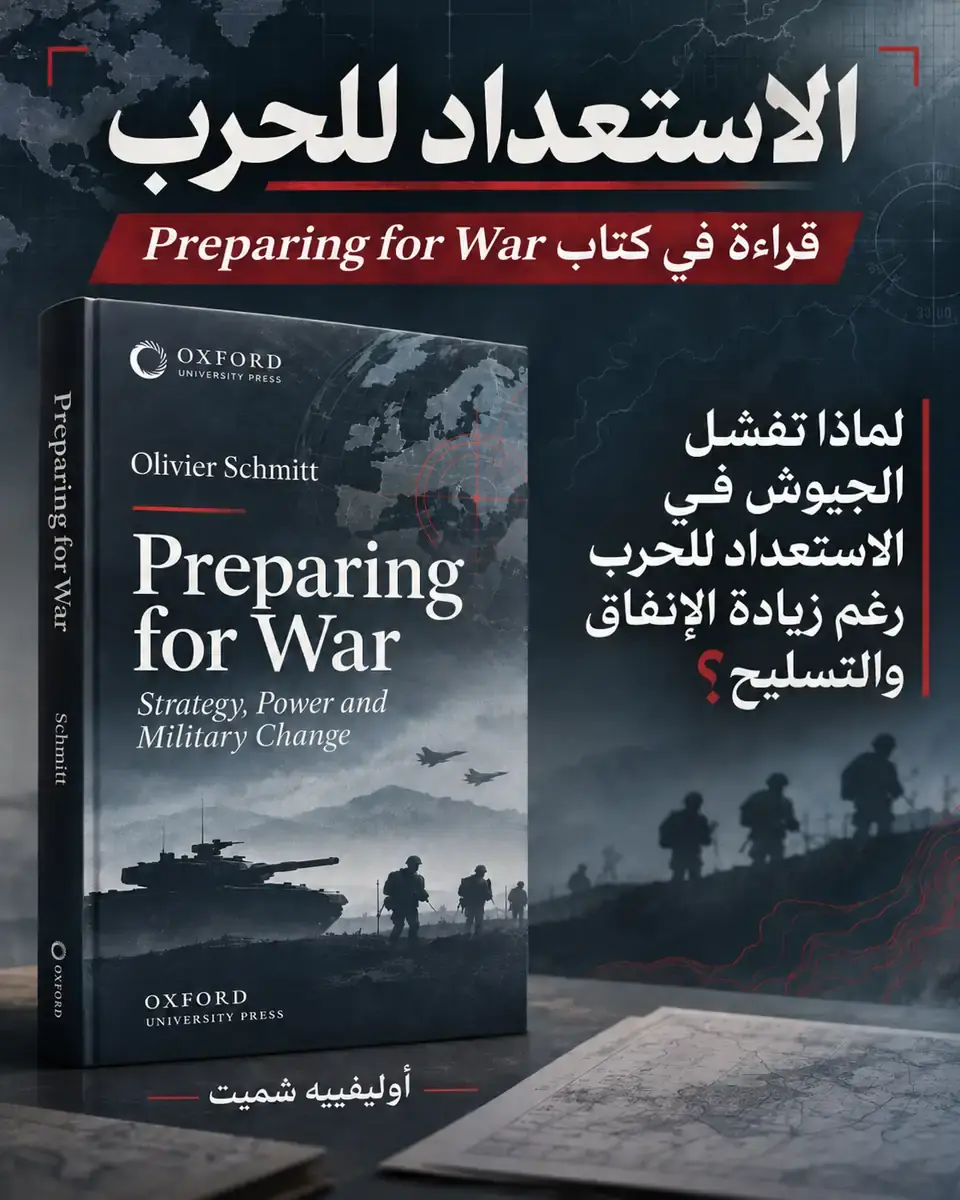
An Analytical Reading of Olivier Schmitt's "Preparing for War: Strategy, Power and Military Change"
States seek to strengthen their security by spending billions of dollars on modern fighter jets, tanks, missiles and drones. Yet wars sometimes reveal that possessing advanced weapons does not necessarily mean possessing an army capable of using them effectively.
A state may hold a vast military arsenal yet fail to achieve its objectives on the battlefield, while forces that are less well equipped manage to endure or inflict heavy losses on an adversary that surpasses them technically.
What makes one army adapt quickly to the nature of war, while another remains a prisoner of military doctrines and fighting methods that have been overtaken by time?
French researcher Olivier Schmitt addresses this question in his book «Preparing for War: Strategy, Power and Military Change», published by Oxford University Press in August 2026, in which he examines the factors that drive military institutions to change or hinder their capacity to do so.
The book starts from a basic dilemma facing armies: how do they prepare for the wars of the future, whose nature is not known with certainty, without losing their ability to carry out their current missions?
Modern Weapons Do Not Make a Modern Army
Among the key issues the book raises is that military modernisation cannot be reduced to buying new equipment.
An advanced fighter jet needs qualified pilots, maintenance crews, reconnaissance and communications systems, and a command capable of integrating them into operations. Likewise, tanks, drones and long-range missiles depend for their effectiveness on an integrated system of training, intelligence, supply and coordination.
For this reason, a state may spend enormous sums on armament without achieving a corresponding increase in its actual combat strength, if its military doctrine and organisational structures remain unable to absorb new technologies.
This problem is evident in the gap between material modernisation and institutional modernisation. The former can be measured by the number of tanks and aircraft purchased, whereas the latter requires changing ways of thinking, training and command, processes that are more complex and take longer.
An analysis published by the Royal United Services Institute (RUSI) in November 2026 affirmed that receiving equipment is not equivalent to possessing a ready combat capability, citing Hungary's experience in building new armoured units and what that required in redeveloping training, military doctrine and logistics.
Ukraine: The War That Forced Armies to Rethink
The Russian-Ukrainian war offers a prominent example of the importance of military adaptation.
Since the full-scale Russian invasion in February 2022, the battlefield has witnessed rapid changes in the use of drones, electronic warfare, reconnaissance and precision targeting.
Some methods that achieved results at the start of the war have not retained the same effectiveness months later, after the other side developed countermeasures.
The ability to detect targets, maintain contact with forces, and protect equipment from drones and jamming has become an essential factor in military operations, alongside artillery, armour and ground forces.
RUSI reports show that Russian and Ukrainian forces have entered a continuous process of adaptation, as each side's development of a new combat method pushes the other to devise ways of countering it.
Yet the experience has also revealed the limits of technical innovation. Drones, despite their growing importance, cannot on their own seize and hold ground, and they do not replace infantry, artillery, military engineering or supply.
Here one of the most important rules of preparing for war becomes apparent: new technology becomes a real force when it is integrated into a complete combat system, not when it is treated as a substitute for the other elements of the army.
China: Broad Modernisation and Limited Combat Testing
China represents a different case in the study of military change.
Beijing has invested enormous resources in developing its armed forces and has carried out sweeping reforms of the People's Liberation Army's structure, including reorganising command and strengthening joint operations among the ground, naval, air and rocket forces.
These reforms aim to move beyond the traditional army model in which military branches operate with considerable independence, toward a command able to coordinate operations across different domains.
The Chinese challenge, however, is not confined to acquiring technology. It concerns the extent to which the military institution can apply new doctrines under the conditions of actual war.
China has not fought a large-scale war for decades, so the real effectiveness of all its military reforms is difficult to test through manoeuvres and exercises alone.
In a study published by the Center for Strategic and International Studies (CSIS) in October 2026, researchers examined how China is benefiting from the Ukrainian war to study the use of drones and the means of countering them, and to turn some of the lessons into training, armament and institutional development programmes.
The study also pointed to an important distinction: armies can learn from the wars of others, but they cannot replicate all the pressures and experiences that soldiers and commanders gain during actual combat.
China thus provides an example of the challenge facing major military powers: how do modernisation plans and training experiments turn into a proven capacity to manage a complex war?
Organisational Culture: The Obstacle Budgets Do Not Solve
An important theme in Schmitt's book is the role of the internal culture of military institutions in either facilitating or resisting change.
Armies are hierarchical institutions built on discipline, tradition and accumulated experience. These characteristics are essential to their work, but they can become obstacles when established methods are placed beyond criticism and review.
Commanders may reject new weapons or tactics because they threaten their units' traditional standing, require redistributing resources and authority, or expose shortcomings in previous training programmes.
Excessive centralisation may also slow the flow of information from the battlefield to senior levels, delaying the decisions needed to adjust plans and combat methods.
By contrast, a military institution capable of learning needs mechanisms that allow realistic assessment of performance, the detection of errors, the testing of alternatives, and the dissemination of successful experiences without waiting for heavy losses to occur.
The aim is not to weaken military discipline, but to build a system in which detecting and correcting error becomes part of that discipline itself.
Politics and Military Doctrine: Who Defines the Nature of the Next War?
Schmitt also links military change to the relationship between political leaderships and military institutions.
Decisions on spending, armament and the definition of threats are not purely technical; they are shaped by political, economic priorities and international alliances.
A state may invest in costly weapons because they confer international prestige or serve political goals, while allocating insufficient resources to less visible areas, such as ammunition stocks, reserve training or equipment maintenance.
The problem becomes more dangerous when leaderships assume that the next war will be short and decisive, and base their preparations on that assumption without planning for the possibility that it becomes a prolonged war of attrition.
Likewise, a military doctrine that succeeded in an earlier conflict may become less suitable for a different one if the operational environment, the nature of the adversary and the means of fighting change.
Effective military planning therefore does not stop at identifying the most likely scenario; it includes preparing for alternative scenarios and testing the assumptions on which plans rest.
When Does Military Spending Become Real Strength?
The ideas discussed in the book, together with the experience of modern wars, allow a set of criteria to be identified for assessing the strength of armies.
The first is the actual readiness of forces, including training, maintenance, the availability of munitions and the ability to conduct joint operations.
The second is the flexibility of command and its capacity to use information coming from field units and turn it into rapid decisions.
The third is logistical and industrial sustainability, which makes it possible to replace losses, repair equipment and continue operations if the war extends for months or years.
The fourth criterion is the institutional capacity to learn, that is, to turn field experience into adjustments in doctrine, organisation, training and armament.
These elements are no less important than the size of the budget or the number of weapons, because an army is not tested only by what it holds in its stores, but by what it can operate, protect, replace and use to achieve specific objectives.
Conclusion: Preparing for War Begins Before Buying Weapons
The importance of the book "Preparing for War" lies in shifting the debate from the size of an arsenal to the nature of the institution that manages it.
Military strength is not an arithmetic sum of weapons, personnel and budgets, but the outcome of a complex interaction between leadership, training, doctrine, technology, politics and the capacity to adapt.
Contemporary experience shows that possessing advanced weapons may grant a temporary advantage, but sustaining that advantage requires an institution able to learn faster than its opponent and to adjust its plans when the conditions of battle change.
In this sense, the most dangerous weakness of an army may not be a shortage of equipment, but the belief that it is ready for war simply because it has spent enough on armament.
True readiness is not measured by the amount of money spent before the war, but by the military institution's ability to turn that money into an organised force that can be used, adapted and sustained once the war has actually begun.


