


By Ruwaida Amer
9 June 2026
In early May, Mohammed Suleiman set out to visit his parents, as he does every month. Suleiman, 42, lives in the Nuseirat refugee camp in central Gaza, while his parents live in the south, in Khan Younis. He chose the shortest route: driving along Salah al-Din Street, Gaza's main traffic artery connecting the north of the Strip with the south. That day, however, his journey was cut short in a way that nearly cost him his life.
He told +972 magazine: "I was near Bani Suheila on Salah al-Din Street when a bullet suddenly hit my hand, fired by the Israeli army."
Mohammed was evacuated to Nasser Medical Complex, where he received treatment for his injury, which fortunately was minor. He said: "I survived this time, but I don't know what will happen to me or to anyone else next time. It is not enough that we are bombed again and again; now people are being shot at while walking."
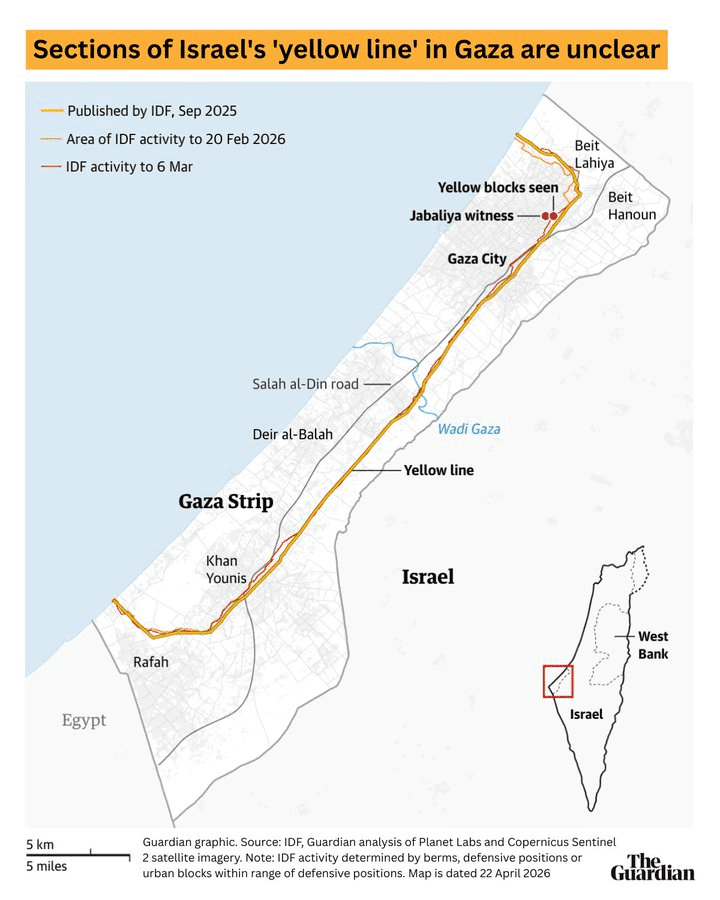
The so-called "ceasefire" agreed upon last October between Israel and Hamas has given rise to a phenomenon that continues to haunt Gaza's residents: the "Yellow Line." This line was supposed to demarcate the limits of Israel's occupation of the Gaza Strip, before a gradual withdrawal as the ceasefire progressed. Instead of withdrawing, Israeli forces have been advancing.
Initially, Israel retained direct control over around 53% of the Gaza Strip, from which it forcibly displaced its residents to the other side of the Strip. Over the past six months, during which the Israeli army killed nearly 1,000 Palestinians in Gaza, the soldiers continued advancing westward and seized more than 60% of the territory. Two weeks ago, Prime Minister Benjamin Netanyahu disclosed that he had ordered the army to raise this proportion to 70%, a process carried out in full coordination with the White House.
In recent days, Palestinian residents have witnessed an escalation of Israeli military operations in areas adjacent to the current position of the Yellow Line, heightening their fears about their fate. No one feels this more acutely than those on Salah al-Din Street.
Khalil al-Sayed, a driver in his fifties, depends on this road to earn his living. "I have been a driver since I was 18 years old, and it is the only profession I know well," he explained.
While access to Salah al-Din was generally available to drivers like al-Sayed during the first months of the ceasefire, the situation has begun to change. "For about two months, we have felt an increasing danger on the road because of the approach of the yellow lines," he said, referring to the Israeli army's mechanism for demarcating the Yellow Line. "Every morning, we drivers contact one another to ask about the condition of the road: Is it passable? Has there been shooting? Are there tanks?"
"We set out to work not knowing what will happen to us," he continued. "Random gunfire is terrifying. Often, tanks come out from the Zeitoun area to the north and force us to change our route toward the sea to escape them. It is a truly tragic situation, and we do not know what the future holds for us."
"Nothing Has Changed Since the Ceasefire"
In Khan Younis, the Yellow Line is gradually approaching the city centre. While the eastern parts of the city have remained under Israeli army control since before the "ceasefire" and have been largely destroyed, the centre has seen a revival of commercial activity in recent months. This activity now also appears to be under threat.
In recent days, Palestinians in al-Bayouk neighbourhood, just east of the city centre, reported the appearance of new yellow concrete blocks placed by the Israeli army. In response, residents began fleeing westward to escape the military incursion.
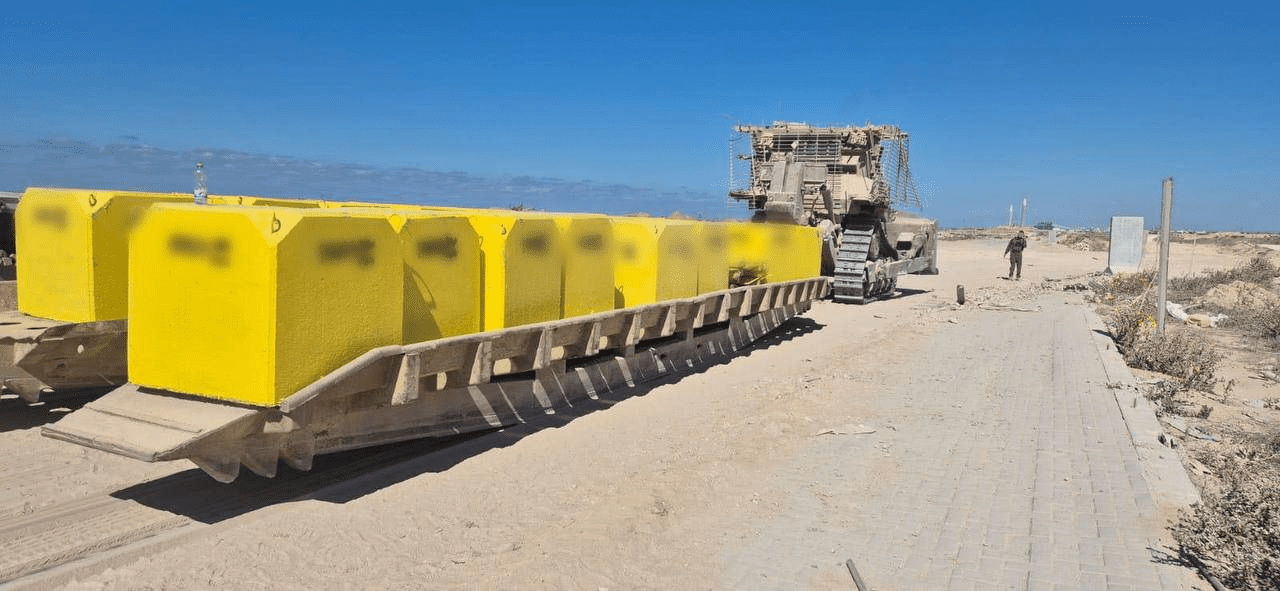
The Israeli occupation army installs concrete blocks to mark the Yellow Line, which demarcates the boundaries of the Gaza Strip that it occupies on the ground, October 2025. (Israeli army spokesperson)
Mohammed al-Bayouk (who shares the name of the neighbourhood) is currently searching for a place for his family in the al-Mawasi area on the Gaza coast. The father of three returned to al-Bayouk after the "ceasefire" to find his home destroyed, so he pitched a tent among the rubble to remain on his land. Now, however, he is preparing to flee once more.
He told +972 magazine: "I am shocked by these yellow blocks."
"They are turning my life into hell. I have a small family to support, including my mother, my brother and my sisters, whom I have been looking after since our father died a year before the war. I don't know how I can stay in the area with this looming danger. I am trying to find a place for us in al-Mawasi, but it is overcrowded with displaced people."
Earlier this month, Israeli forces shelled his neighbourhood, which al-Bayouk believes was intended to terrorise residents and push them to flee. "It was terrifying," he recounted. "The most shocking thing is that we are being displaced during a ceasefire period. I don't know what the mediators are doing about this huge expansion of the yellow zone."
Salem Awad, a 45-year-old father of six from Rafah who is currently living in a tent in al-Mawasi, described the Israeli army's daily movements of the Yellow Line as akin to a game of chess. He told +972: "I have not been able to enter Rafah for almost three years, and I feel as if I am dying because of it. I pitched my tent as close as I could to breathe some of my city's air, only to find the yellow blocks approaching us [last week]. Now we are right next to them, which means we are in a dangerous area."
Awad continued: "I cannot stay where I am and ignore those blocks, because the Israeli army has withdrawn and could target us at any moment, claiming that we pose a threat to its forces. I sent my children and family to their grandfather's tent until I find a place to pitch my own tent and move away from here."
He added: "We are living under severe injustice. Nothing has changed at all [since the ceasefire]. We hear the continuous sounds of explosions, and they are terrifying. We hear tanks moving and see lights east of Rafah and in the surrounding areas. We are here waiting for any solution."
+972 Magazine


