


Words used in news bulletins are not neutral containers that merely carry facts. A single word can lead the reader to view an armed group as a resistance force, a militia serving a foreign agenda, a politically armed faction, or a group loyal to a foreign power. For this reason, the most dangerous form of media bias may lie not in the information that is removed from a report, but in the words an editor chooses to describe its actors.
Iraq offers a clear example. In earlier years, Al Jazeera used the term "sectarian militias" when speaking of Shiite armed groups in Iraq. In September 2014 it published a report titled: "Political immunity protects sectarian militias in Iraq", discussing the armed factions and the role of elements within them in the sectarian tension that Iraq had witnessed since the mid-first decade of this century. In April 2015, the programme "The Opposite Direction" posed a question titled: "Which is more dangerous to Iraq: sectarian militias or the state?", referring to the Islamic State group and the Shiite Popular Mobilisation Forces factions.
However, after the outbreak of the Gaza war in October 2023, a new name entered news discourse: "the Islamic Resistance in Iraq". This is the name adopted by a group of Iraqi armed factions when announcing their operations against US forces and what is called "Israel". Over time, the term began to appear directly in headlines: "The Islamic Resistance in Iraq announces shelling of a target in Haifa", and "The Islamic Resistance in Iraq attacks a military target in Israel", among others.
We do not deny that Al Jazeera explains in its explanatory material that the "Islamic Resistance in Iraq" is "a coalition of Iraqi armed factions backed by Iran", and that in some reports it uses more cautious phrasing such as "the so-called Islamic Resistance in Iraq". The problem, therefore, is not in transmitting the name itself, which is a normal part of journalistic work, but in the moment when a group's self-chosen name becomes the dominant news description that the public receives without constant reminder of the formation's nature, history and affiliations.
The contradiction becomes sharper when we look at the components of this umbrella. Al Jazeera itself mentions, within the "Islamic Resistance in Iraq", Kata'ib Hezbollah, Asa'ib Ahl al-Haq, Harakat al-Nujaba, and Kata'ib Sayyid al-Shuhada, alongside other Shiite formations, and notes that several of them have received Iranian support and that some fought in Syria alongside the forces of the ousted Nusayri regime. In other words, we are not speaking of a phenomenon that emerged from nothing after the Gaza war, but of factions with a long history predating the new name, operating within the framework of Iran's axis project of the Guardianship of the Jurist.
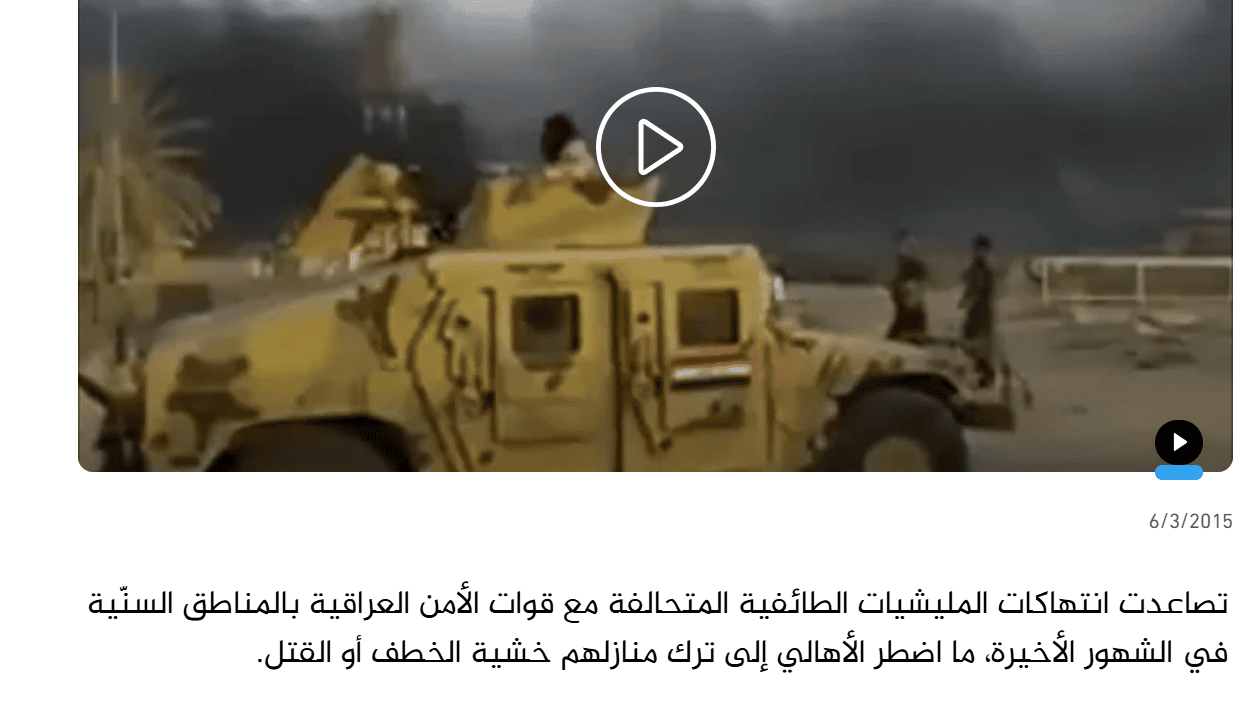
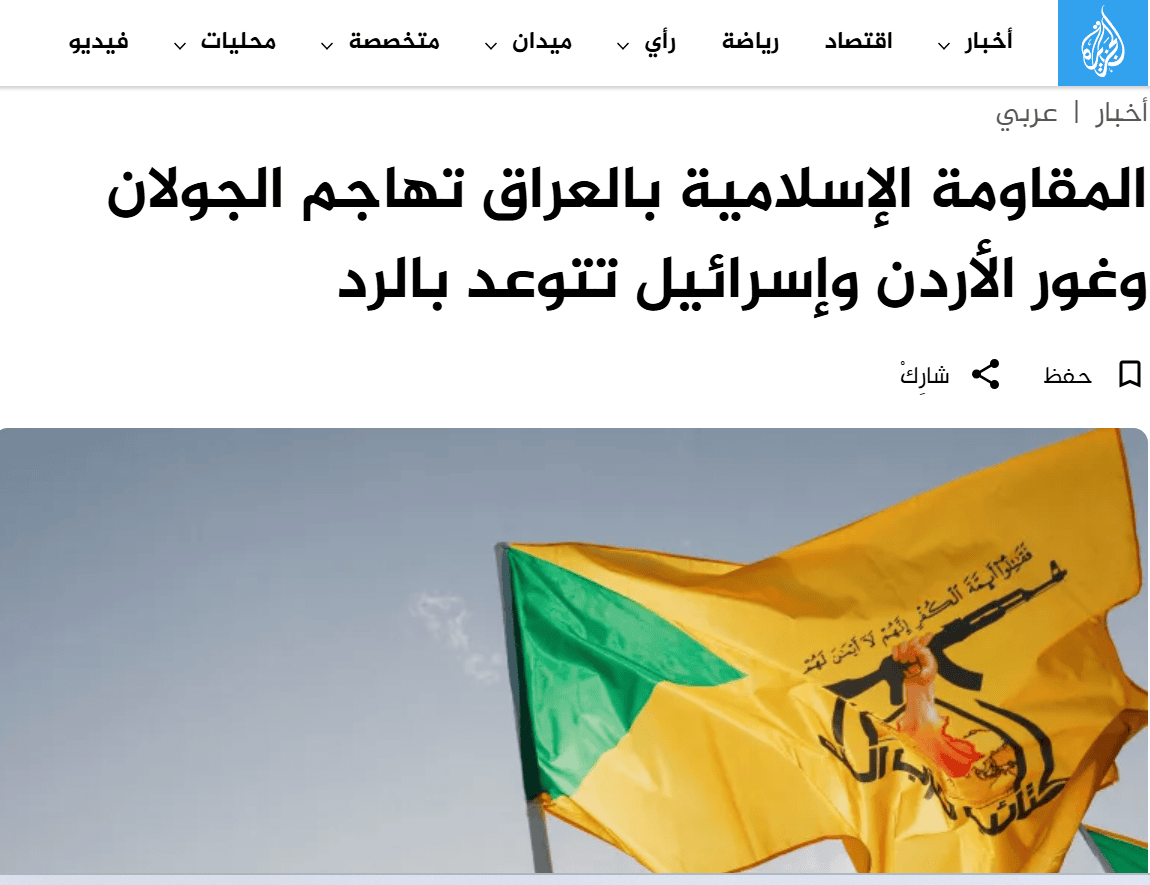
Here arises the most important media question: when these groups or their armed milieu were discussed in the context of sectarian fighting in Iraq or the Syrian war, the description "sectarian militias" was strongly present. When they began launching rockets and drones toward the Israeli occupation and US bases, the name "Islamic Resistance" became more prominent.
This is not a problem for Al Jazeera alone. Arab and international media are full of examples of actors being renamed according to political position. An armed group may be "rebels" for one outlet and "revolutionaries" for another, "resistance" in one country and "proxies" in another, "popular forces" when it aligns with a particular political direction and "militias" when it opposes it. Often the rifle, the leadership and the sources of funding do not change; what changes is the vocabulary.
The terms have a profound effect here. The word "resistance" is not merely an organisational definition; in the Arab consciousness it carries a positive meaning linked to defending land and confronting occupation. The word "militia", by contrast, carries a negative connotation associated with weapons linked to chaos. The phrase "sectarian militia" adds another judgement related to identity and violations. The shift between these words therefore cannot be treated as a minor linguistic detail.
Journalistic professionalism does not require the journalist to prevent a group from using the name it has chosen for itself, but it does require that the name be clearly attributed to it. There is a large difference between saying "The Islamic Resistance in Iraq attacked a base" and saying "Iraqi armed factions loyal to Iran, operating under the name 'the Islamic Resistance in Iraq', announced an attack on a base". The second sentence gives the reader the name the group uses, but does not allow the propaganda name to replace the journalistic definition.
The standards must also remain consistent. If a faction's relationship with Iran is important when discussing it in Iraq and Syria, it should not disappear from its definition when it confronts the Israeli occupation. If its past violations are part of its history, a change of front does not erase them. Conversely, if it carries out a military action against an occupying force or a foreign base, that action can be described accurately without automatically turning it into a comprehensive moral endorsement of the faction's entire history.
Media that change their terminology along with shifting alliances risk moving from conveying reality to participating in reshaping memory. What was yesterday a "sectarian militia" does not automatically become today an "Islamic resistance" in the moral sense merely because its military target has changed. Nor does applying a negative description to a group exempt the journalist from acknowledging what it actually does if its conduct or role changes.
The more precise standard is for the media to name things consistently, and to separate the name a group chooses for itself from the description the outlet presents to its audience. Credibility is measured not only by the accuracy of a report, but also by the stability of the standards with which it is written.
When words change faster than events, it becomes necessary not only to read the report, but also to read the language in which it was made.


