

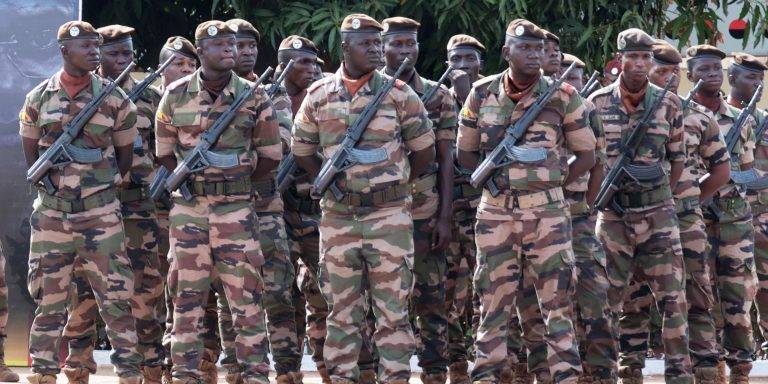
More than five months after Malian government forces and the Russian mercenary group Africa Corps were forced to withdraw from the city of Kidal in Mali's northern desert region by anti-junta forces — a mix of Tuareg separatists and jihadists affiliated with al-Qaeda — a joint government force entered the historic northern rebel stronghold and retook the city without a fight on 6 October.
This military manoeuvre, backed by Africa Corps, was not a surprise, for two main reasons.
Politically, the Malian government cannot afford to give up the remote city of Kidal, as it is central to its narrative of uniting Mali and restoring stability there.
The military council denounced the "Algiers Accords" (the Peace and Reconciliation Agreement) that the previous Malian government signed in 2015 with local rebel factions. These factions formed the Azawad Liberation Front, which later allied with the main jihadist force, Jama'at Nusrat al-Islam wal-Muslimin, the al-Qaeda affiliate in the Sahel.
The military campaign to retake Kidal was not the responsibility of Malian government forces alone. Africa Corps, which withdrew from Kidal and Tessalit after an agreement with Jama'at Nusrat al-Islam wal-Muslimin and the Azawad Liberation Front, took control of the military installations in both Ighelhok and Anefis, west of Kidal, to support the operation.
The Malian armed forces reinforced these two installations throughout the summer, and sources from both the Azawad Liberation Front and Jama'at Nusrat al-Islam wal-Muslimin confirmed that they had attempted to storm them without success.
In July, Anefis largely fell to Jama'at Nusrat al-Islam wal-Muslimin, but the military barracks remained out of reach. Accordingly, the real military success lies in government forces' control of the military installations in Ighelhok and Anefis.
Sources from the Azawad Liberation Front confirmed that the decision to evacuate Kidal was taken and implemented on the night of 5 October. The Front justified its decision by the impossibility of defending the city militarily in the face of Russian and Malian air power, which consists mainly of Turkish- and Russian-made drones.
According to one source, "90% of the city's infrastructure was destroyed: government buildings, schools, even water tanks. We had to bring water from outside the city. None of our commanders has spent a single night in Kidal since April, and recently we had no more than forty vehicles in the city."
A senior source from Jama'at Nusrat al-Islam wal-Muslimin also stated that "Jama'at Nusrat al-Islam wal-Muslimin does not seek to control territory; rather, it is waging a war of attrition against the Malian military council, and a battle it did not choose will not deter it from achieving its goal."
The group has long sought to exhaust Malian forces by launching simultaneous operations on multiple fronts. For example, it has combined attacks in the north, centre and west with economic warfare and media work aimed at undermining the military council's legitimacy.
It appears that both the rebel and jihadist groups decided that the "deserted city" was not worth defending, and by withdrawing before the confrontation, they denied Bamako and Africa Corps the resounding military victory they sought.
Nevertheless, this latest development shows the importance of narrative and perception for Bamako and Moscow, even though Kidal has no strategic value. Forces have been deployed in the northern desert while the highest level of jihadist activity and threat is concentrated in the centre of the country and around the capital.
While the loss of Kidal represents a significant moral blow to the Azawad Liberation Front, it is only a minor strategic setback for Jama'at Nusrat al-Islam wal-Muslimin, which is shifting its focus to other major regional targets.
Meanwhile, Jama'at Nusrat al-Islam wal-Muslimin is carrying out complex and sustained attacks in Mali, Burkina Faso and Niger. Small-scale attacks continue in Burkina Faso across a wide area of its territory.
In Mali, as the rainy season draws to a close, attacks have intensified in the centre of the country. The attack on the Diora military barracks in central Mali on 10 September killed at least 150 soldiers, and according to some claims, 95 soldiers were abducted. The attack was followed by an assault on Gène on 24 September.
Night-time attacks with mortars and rockets, guided by drones, on Sévaré airport, also in central Mali, underline the military capability of Jama'at Nusrat al-Islam wal-Muslimin, as shown by the simultaneous and complex attacks carried out on Malian territory on 25 April.
The Diora attack represents the most significant reported military engagement within the current series of attacks. Jama'at Nusrat al-Islam wal-Muslimin inflicted heavy loss of life and seized large quantities of military equipment. The equipment seized included 19 122mm rockets, large quantities of assault rifles, heavy machine guns, rocket launchers, mortars, vehicles and ammunition.
The seizure of this military equipment is of considerable operational importance, as Jama'at Nusrat al-Islam wal-Muslimin is redeploying it, strengthening its short-term capabilities against its adversaries. The militants were encamped a few kilometres from the military installations before and after the attack, which reduced logistical complexity and effort. Reports also indicated that a number of Africa Corps personnel were killed during or after the attack.
On 18 September, reports indicated that Jama'at Nusrat al-Islam wal-Muslimin continued its operations against positions in Kouna and Sévaré. Sévaré is of particular importance given its military and air infrastructure. Repeated attacks in the area may limit the ability of the Malian armed forces and Africa Corps to carry out reconnaissance, reinforcement, resupply and other operations in central Mali.
Unlike the recent attack, this one took place at night, although mortar fire was directed using drone imagery. According to Jama'at Nusrat al-Islam wal-Muslimin, it damaged four Bayraktar TB2 drones and helicopters.
The failed attack on Niamey airport on 18 June was intended to be a complex operation carried out simultaneously against the airport and the presidential palace in the capital. According to local sources, "a team of five jihadists from Jama'at Nusrat al-Islam wal-Muslimin was arrested in the capital while preparing an attack on the presidential palace, and this arrest enabled security forces to understand the planned method of attack, which involved using taxis to enter the airport."
Most notably, the attack, as planned, had implications for the ruling military council in Niger and for the Islamic State's Sahel Province, with which Jama'at Nusrat al-Islam wal-Muslimin is still engaged in fierce fighting.
It was believed that the visit of the military council's leader, General Abdourahamane Tiani, to Algiers in February 2026 and the signing of important economic agreements would protect Niamey from Jama'at Nusrat al-Islam wal-Muslimin. However, four months later, the group was preparing to strike the presidential palace itself, meaning that it is not bound by the policies imposed in Algiers, as many in the Sahel believe.
In an unusual step, Algeria sent four Sukhoi Su-30 aircraft to Niamey one day after the end of the coup attempt to topple Tiani on 28 August.
This display of force has not yet translated into a permanent deployment, but it must be viewed within the broader context of competition in the Sahel between Algeria and Morocco, as well as the renewed role of Libya in the region under Saddam Haftar.
The latter, the son of Khalifa Haftar, the de facto ruler of eastern Libya, played a pivotal role in the release of the American hostage, the missionary Kevin Raidout, and an Austrian woman and a Swiss woman, whom the Islamic State held in Niamey and Agadez.
For the Islamic State's Sahel branch, which carried out a complex night attack on the same airport on 28 January, the failure of Jama'at Nusrat al-Islam wal-Muslimin's attack on Niamey airport was interpreted as a decisive step in the ongoing bloody conflict between the two groups.
Indeed, since early September, clashes between Jama'at Nusrat al-Islam wal-Muslimin and the Islamic State in the Sahel have resumed on the Burkina Faso–Mali border. A confrontation took place near Ndaki on Malian territory on 2 September, resulting in the deaths of dozens of fighters on both sides.
According to sources within Jama'at Nusrat al-Islam wal-Muslimin, which acknowledged losses, "the figures are exaggerated, and none of the leaders was killed," as the Islamic State claimed. According to the same source, "the ambush occurred while a Jama'at Nusrat al-Islam wal-Muslimin convoy had stopped for prayer," while the Islamic State claims the ambush targeted a withdrawing Jama'at Nusrat al-Islam wal-Muslimin force that had attacked their positions first.
Sporadic attacks between the two groups continued until 8 October, when a major battle took place near Tessit. The outcome of the battle has not yet been determined. It is clear, however, that both groups are committing substantial human and material resources to this conflict.
According to sources from Jama'at Nusrat al-Islam wal-Muslimin in Burkina Faso, "the priority is not fighting the Islamic State in the Sahel," but the current rivalry between the two groups is in fact a matter of survival for both.
Nevertheless, it is noteworthy that Jama'at Nusrat al-Islam wal-Muslimin's activity against government forces in the Sahel continues, while the Islamic State's activity against these same forces persists in Niger, is almost non-existent in Burkina Faso, and is very limited in Mali.
"Mutual non-engagement" — an undeclared and informal truce — appears to be the prevailing strategy currently adopted by the military councils in Mali and Burkina Faso toward the Islamic State in the Sahel. The Islamic State's vital area of expansion in the Sahel lies in territory controlled by Jama'at Nusrat al-Islam wal-Muslimin, not in areas under government control, while the greatest threat to the governments comes from Jama'at Nusrat al-Islam wal-Muslimin, not from the Islamic State in the Sahel.
For the three military councils in the Sahel, Jama'at Nusrat al-Islam wal-Muslimin poses a major security and political threat. While the Islamic State in the Sahel presents a real security challenge, it offers no viable or encouraging political horizon.
Local military councils and their backers, and even some decision-makers, may see in this a means of weakening Jama'at Nusrat al-Islam wal-Muslimin in order to confront the Islamic State in the Sahel later. However, this is a highly dangerous strategy [for those regimes], given the rapidly changing dynamics of the Sahel, which are largely dictated by the two warring principal jihadist groups.
------------------------------------------------------
Editorial note: This piece was published in Arabic as a translation of the original English article on The Soufan Center's website, by Wassim Nasr, titled "What Kidal Portends: JNIM, Islamic State, and the Sahelian Security Landscape", dated 28 October 2026.


