


When Mohammed Saeed's children call their father to the dinner table, he sometimes tells them he has eaten, even though he has not eaten anything.
Mohammed, who has not received his salary for years, has been displaced three or four times since the war began. Today he lives with his wife and five children in one room in the city of Taiz, while rent on his home has accumulated for more than a year.
His family's hunger did not begin with the latest round of fighting, but the new escalation that erupted at the beginning of September 2026 made the situation harsher, forcing about 134,000 people to flee their homes, including an estimated 73,000 children, according to the United Nations Children's Fund (UNICEF).
As the fighting spreads, front lines shift, and roads and ports are disrupted, thousands of families now face a simple and cruel daily question: which meal can be skipped?
A war redrawing lines of control
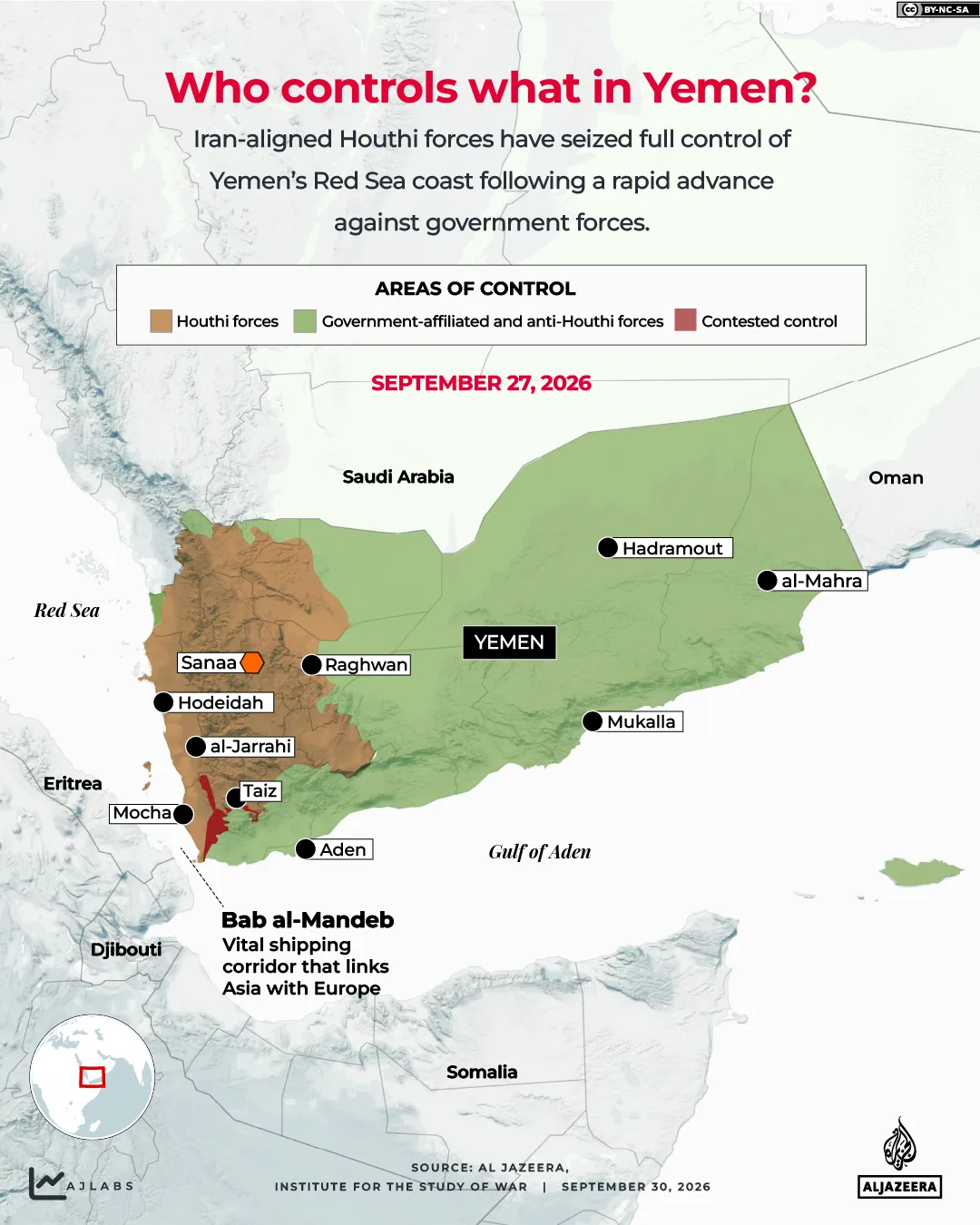
The new humanitarian crisis has coincided with major changes on the ground in the Yemeni war, which has continued for more than a decade.
Since the Iranian-backed Houthis seized Sanaa and several governorates in 2014, Yemen has been effectively divided between areas controlled by the Houthis in the north and west, where most of the population lives, and areas controlled mainly by the Saudi-backed Yemeni government in the south and east.
On 3 September, a new round of fighting broke out when the Houthis launched a broad offensive west of Taiz governorate.
Within days, Houthi fighters entered the city of Al-Mukha, and according to a report by Al Jazeera, in subsequent operations they took control of most of Yemen's Red Sea coast up to the Bab al-Mandab area, one of the most important maritime trade passages in the world.
Saudi Arabia responded with hundreds of airstrikes, while the Houthis fired missiles and drones toward Saudi territory.
The escalation's consequences have not been limited to the military map.
According to the World Health Organization, 838 people have been killed and more than 3,600 others injured since the beginning of August, when the Houthis began attacking government forces.
Most of these casualties were recorded after the ground offensive began on 3 September, while the week ending 26 September alone saw 164 people killed.
UNICEF has also verified the deaths of at least 15 children and the injury of 14 others since 3 September, while three other children have been reported missing.
"We left everything behind"
In the Al-Shaqadef camp near Taiz city, another story begins at the place where a whole family's life was upended in their home.
Ruqayya Saeed, 25 years old and mother of eight children, fled from Zaghar in the Muqbil district west of Taiz, where the Houthi offensive began.
Ruqayya describes the moment of flight as one of being surrounded by missiles and shells while also fearing landmines.
She says:
But reaching the camp did not mark the end of their suffering.
Ruqayya says no food assistance has reached her family from any relief organisation, and that she relies on what charitable people give her.
She was forced to borrow money to buy a plastic sheet to use as a shelter for the family, but rainwater has already seeped through it twice and soaked their clothes.
Most alarming is her children's health.
"The children have diarrhoea, colds and dysentery. We have no water for them, not even clean water," Ruqayya says.
Dysentery is an intestinal infection that can spread through contaminated water and poor sanitation, and it can become very dangerous for children due to dehydration.
"There are no blankets for warmth. We only treat them at home with water, salt and sugar," the mother adds.
According to Ruqayya, there are no toilets in the camp, so women wait until nightfall before going to the foot of the mountain or looking for a secluded spot.
More than 18 million Yemenis face food insecurity
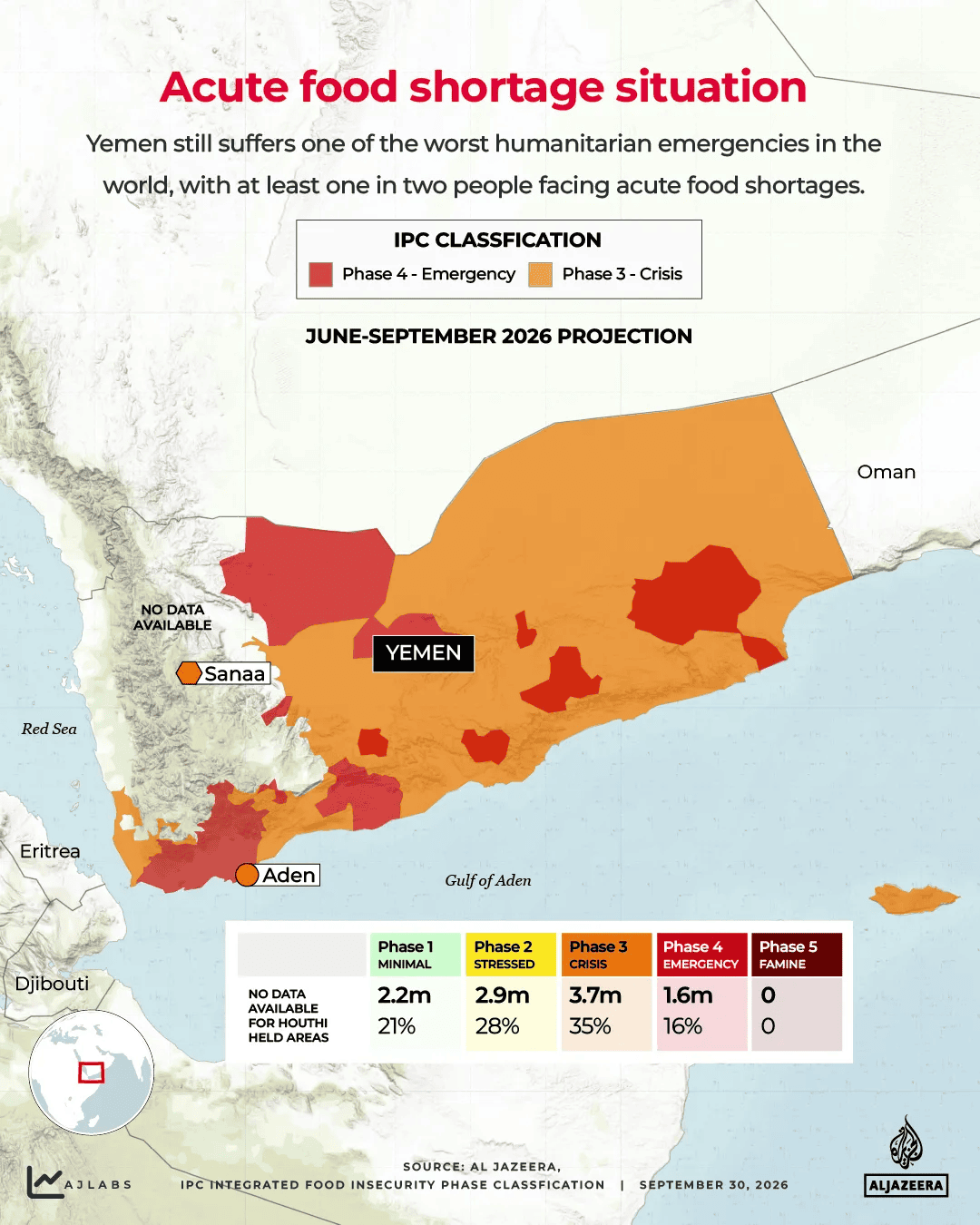
These individual cases are part of a food crisis affecting nearly half of Yemen's population.
Out of about 43 million people, more than 18.3 million face acute food insecurity during 2026, according to the United Nations.
Children are among the most vulnerable groups.
Even before the latest round of fighting, more than 2.2 million children under five were expected to suffer from acute malnutrition during the current year.
Among them are more than half a million children facing severe acute malnutrition, the most dangerous form of malnutrition, according to Louise Wateridge of UNICEF, speaking to Al Jazeera.
The organisation warns that war and hunger feed into one another: conflict pushes more people toward hunger, and hunger in turn makes children more vulnerable to the effects of war.
The crisis deepens in government-held areas
Data from the Integrated Food Security Phase Classification (IPC) show that the crisis is also severe in areas controlled by the government.
Between March and May, about five million people, nearly half the population in those areas, faced crisis-level food insecurity or worse, including 1.4 million people living in conditions classified as Emergency (Phase 4).
Projections indicated the situation would worsen during the lean season between June and September, bringing the number of people facing "Crisis" or worse to 5.3 million, including 1.6 million in Emergency.
Even after the harvest season, no significant improvement is expected; estimates suggest 5.4 million people will remain at crisis level or higher from October to December.
"When the shells reached the houses, we had to leave"
Enas Abdullah Abdo, 23 years old, is one of tens of thousands whose lives were upended by the fighting within weeks.
Enas fled Hazran with her three children on the second day of the battles.
She says the shelling and clashes grew more intense by the hour.
"Every hour the shelling and clashes on us grew worse, and when the shells finally reached the houses, we had to leave."
Cars could no longer reach them, so the family began walking until they found a means of transport.
They left their home with almost nothing.
No kitchen utensils, no bedding, no blankets, no batteries for lighting.
For about a month, nearly 15 people from five families, Enas's siblings, their spouses and children, have been living in a small, damaged house in Al-Nashmah.
"If it rains, it rains on us, on the children and on our clothes," she says.
If the family cannot find a larger place, they may have to return to live in a displacement camp.
One form of aid is not enough
The family received assistance from one organisation worth 270,000 Yemeni rials, about $170, but the money was quickly spent on basic needs, including cooking gas cylinders and a limited number of blankets.
The family still lacks food, bedding and medicine.
When the children fall ill, health centres are not always able to provide full treatment, while the cost of the remaining medicines is beyond the family's means.
Enas says:
"Sometimes we go to the health centres and don't find the full treatment, so we have to go home and give them ordinary painkillers."
War reaches the schools
Displacement carries another cost that does not appear in the figures of the dead and wounded: education.
Of the five or six children in Enas's extended family who attended school before displacement, only three or four have been able to return to their studies.
The others could not even bring their school records with them while fleeing.
For Enas, this is not the first loss caused by the war: she lost a brother during an earlier round of fighting, and she lost her parents to illness.
Today she is trying to protect her children from a war that forced her to leave her home without knowing when, or whether, she will return.
Hunger was already there; war has made it worse
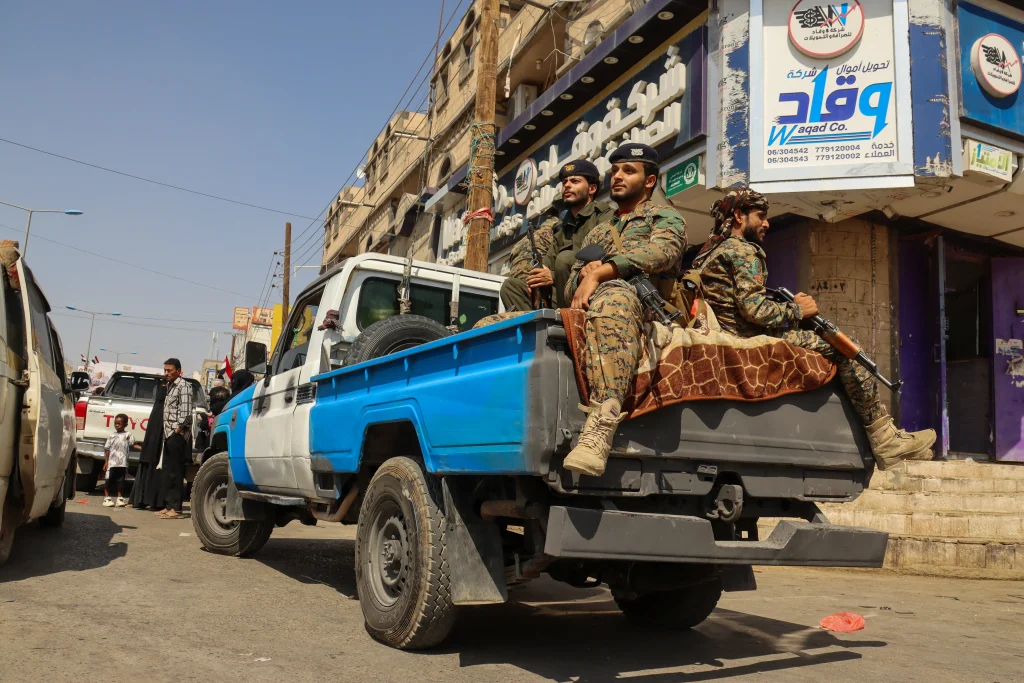
The testimonies of Mohammed, Ruqayya and Enas show that the current crisis does not begin at the front lines and does not end at the camps.
Yemen entered the latest escalation already suffering from years of economic collapse, unpaid salaries, displacement, food insecurity, and weak health, water and sanitation services.
As tens of thousands moved out of their homes within weeks, pressure intensified on host communities, camps, and sources of food, water and medical services.
For Mohammed Saeed, these international figures take a much simpler form when his children sit down at the table.
He is a teacher, but he has not received his salary for years. He has been displaced several times, has been more than a year behind on rent, and seven members of his family live in one room.
When food is insufficient for everyone, the solution sometimes becomes for the father to pretend he is not hungry.
His children call to him: "Come on, Dad, eat with us."
He answers that he has had enough.
But the truth, he says, is that his family no longer knows three meals a day.
In Yemen today, the effects of the new round of war are measured not only by the number of places whose control has changed or the number of missiles and airstrikes, but also by the number of families who have left their homes, the children cut off from their schools, the patients who cannot find medicine, and the parents who give up their own meals so their children have something to eat.
Source: Al Jazeera, adapted.


