

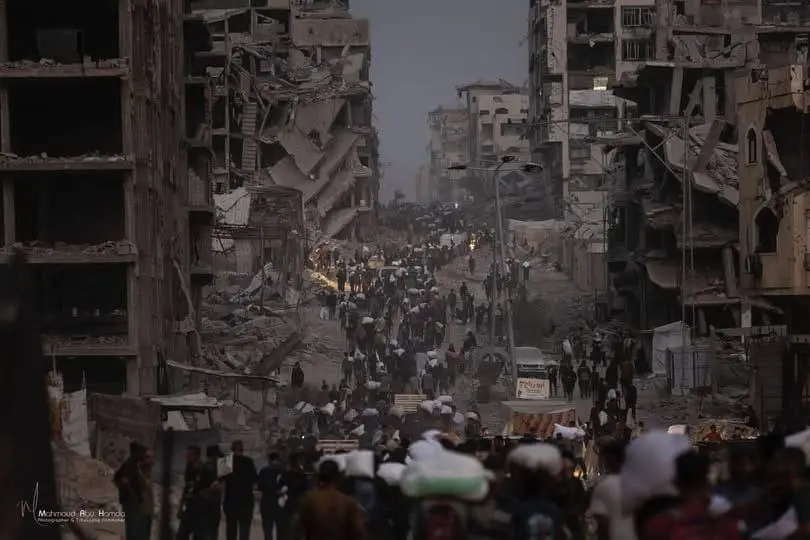
This week's highlights in the Muslim world, from Saturday 8 Safar to Saturday 15 Safar 1447 AH, are summarised below.
Palestine
Gaza Strip
The Palestinian Ministry of Health publishes its daily statistical report on the victims of the ongoing genocidal war on the Gaza Strip:
- The Strip's hospitals received 39 martyrs and 491 wounded in the past 24 hours.
- The toll of the Israeli aggression has risen to 61,369 martyrs and 152,850 wounded since 7 October 2023.
- 9,862 martyrs and 40,809 wounded since 18 March 2025.
Government Media Office in Gaza: Yesterday, 83 aid trucks entered the Strip, most of which were looted and robbed amid deliberate security chaos created by the Israeli occupation as part of its policy of "engineering starvation and chaos." The total number of aid trucks that entered the Gaza Strip over (13 days) was only 1,115 out of an assumed 7,800 trucks, meaning that what entered amounts to roughly 14% of actual needs.
The director of medical relief in Gaza said:
- 17,000 children suffer from severe malnutrition, further straining the medical system.
- Only small quantities of aid reach the Strip, and they are stolen by gangs.
- Medicines for diabetic patients are not entering, and many pregnant women are suffering from malnutrition.
The health authorities in Gaza said:
- Bed occupancy rates reached 240% at Al-Shifa Hospital, 210% at Al-Rantisi Hospital, and 180% at Nasser Hospital, while at the Arab Hospital (Al-Ahli) it reached 300%.
- Hospitals are resorting to laying mattresses in corridors and on floors to accommodate the increase in the number of patients and wounded.
- We renew our urgent appeal to the international community and to UN and humanitarian organisations to provide immediate and effective support to the health sector in Gaza.
Occupation of Gaza City
Axios quoted an Israeli official as saying: The political and security cabinet approved Netanyahu's proposal to occupy Gaza City.
He said: The operation the army is currently preparing is limited to Gaza City. The aim is to evacuate all civilians from Gaza City to the central camps and other areas by 7 October.
According to Channel 12 Hebrew: At a meeting discussing the plan to take control of Gaza City, the Chief of Staff proposed removing the goal of returning the captives from the war objectives, and stressed that there is no humanitarian solution for moving one million people out of the city and that everything will be complicated.
Declassified website cited a British army report stating that:
- "Israel" is bombing Gaza's hospitals in ways Germany did not employ during the Second World War.
- The army's concern about "Israel's" conduct contradicts the government's defence of arms exports to it.
- "Israel's" attacks on Gaza's hospitals resemble Russia's attacks in Ukraine. Military personnel speak more candidly than ministers about "Israel's" war crimes in Gaza.
- A member of the British army: The report contradicts the government's position, which holds that "Israel" is not committing crimes in Gaza.
The Gaza Ministry of Health announced three deaths from Guillain-Barré syndrome, two of them children aged under (15 years), after attempts to save them failed due to the unavailability of the necessary treatment because of the siege.
A Gazan child manages to pick up a bag of flour from aid dropped by air and tries hard to carry it to his family despite the bag's weight.
A child walks a long distance every day to provide food for his family in Khan Younis amid the ongoing famine and the suffocating siege on the Gaza Strip.
Hamas responded to what media outlets reported about Witkoff, saying: It denies what media outlets reported about the US envoy Witkoff, that the movement expressed readiness to disarm.
We reaffirm that the resistance and its weapons are a national and legal right as long as the occupation persists, and this has been recognised by international covenants and norms. Resistance and its weapons can be relinquished only upon the full restoration of our national rights, foremost among them the establishment of a fully sovereign independent Palestinian state with Jerusalem as its capital.
The occupation restructures its intelligence after the Hamas attack: a return to language and culture
After what it described as an "intelligence humiliation" following Hamas's surprise attack on 7 October 2023, Israel's military intelligence agency (Aman) began implementing a radical reform plan aimed at addressing the deep gaps in understanding the Arab environment, especially within the Gaza Strip.
A report published by Bloomberg revealed that the agency is reviving an Arabic-language recruitment programme, requiring soldiers and specialists to learn local dialects, such as Gazan, Yemeni and Iraqi, along with a broad understanding of culture and Islamic discourse, particularly its extremist strand.
An officer in the agency, who declined to be named, said that "Aman suffered from a fundamental misunderstanding of Hamas's ideology," affirming that a major internal cultural shift is underway, reflected in reduced reliance on technology and greater emphasis on human personnel capable of thinking like their adversary.
These measures aim to build an intelligence cadre closer to the field reality, capable of picking up early signals through linguistic and cultural knowledge, rather than relying excessively on technology and electronic surveillance.
"It is very difficult to explain what is happening here." An American doctor volunteering in Gaza issues a direct appeal to the US Special Envoy for the Middle East, Steve Witkoff, urging him to enter the Strip to see the humanitarian catastrophe for himself.
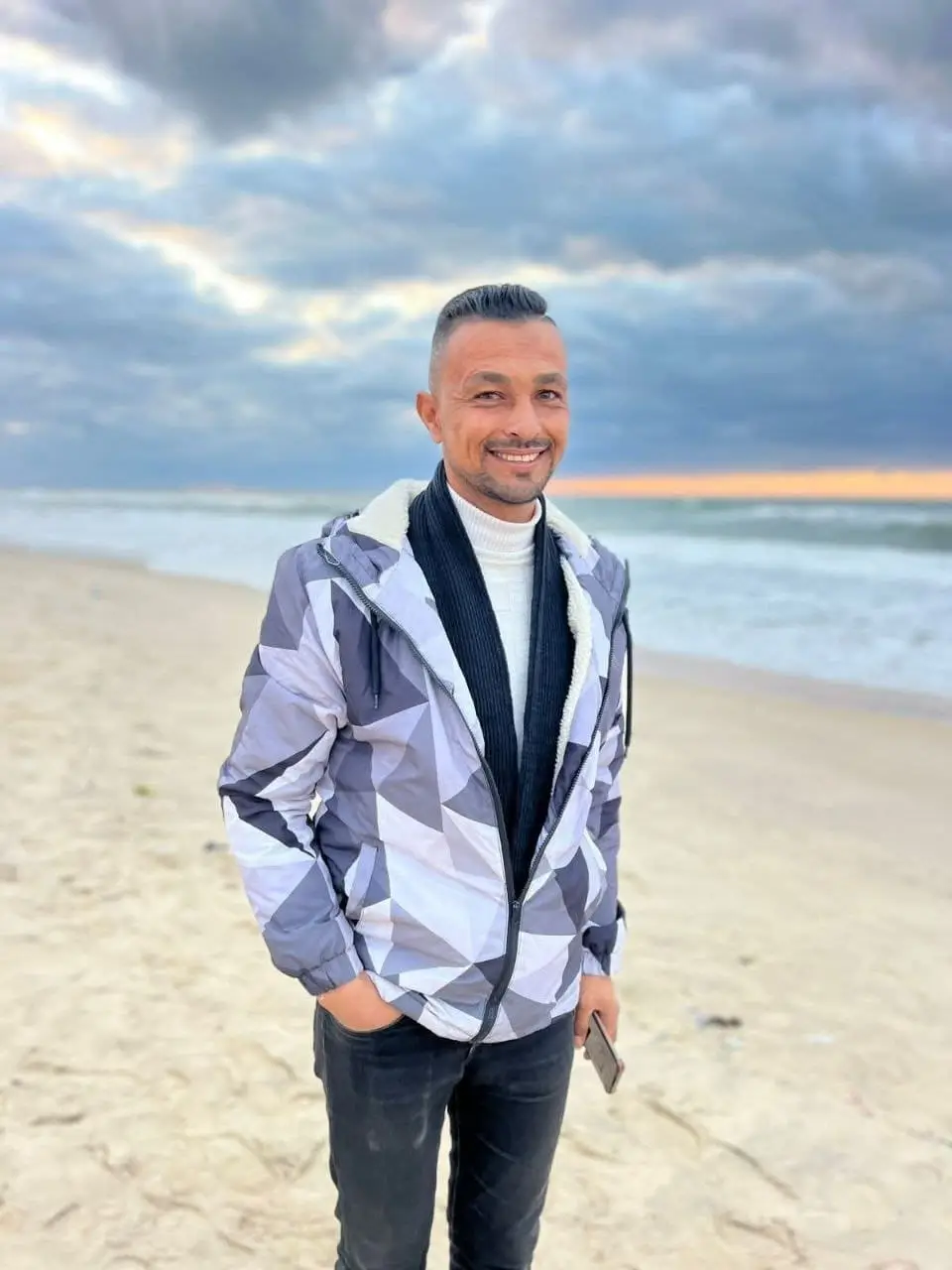
Nurse Adi Nahid, at Al-Aqsa Martyrs Hospital, was killed, as we understand it, when an aid box fell directly on him during an airdrop operation in the Zawayda area in central Gaza.
A moving video documents the final moments of the young martyr Ahmad Hamdiya, as we understand it, from the Shujaiya neighbourhood in eastern Gaza, reciting verses of the Holy Quran before his martyrdom following an Israeli occupation bombardment.
The Civil Defence in Gaza announced that 60% of its vehicles have stopped operating in all governorates of the Strip due to insufficient fuel supplies and the spare parts needed for their repair.
Extensive destruction left by the Israeli occupation army during its recent incursion into the Al-Zeitoun neighbourhood south-east of Gaza City.
54 missing, fates unknown: rise in reports of disappearances near aid distribution centres
The Al-Dameer Association for Human Rights said there has been a rise in reports of people missing at aid distribution centres in the Gaza Strip. The rights organisation explained that occupation forces do not allow the recovery of the bodies of those targeted near aid distribution centres.
It noted that the absence of a secure mechanism for distributing aid would increase the number of missing persons due to the targeting of people waiting for aid. It added: "We have documented arrests that targeted people waiting for aid, including children."
It stated that 54 people missing near aid distribution centres have not had their fates disclosed by occupation forces. It pointed out that the accumulation of bodies near the aid distribution centres prompts the occupation to bulldoze them without allowing access to them.
The occupation has continued to prevent the entry of humanitarian aid, medical supplies and fuel into the Gaza Strip since last March, after Netanyahu reneged on the ceasefire agreement.
A masked soldier, a perpetrator of genocide, was provoked by a picture of the Dome of the Rock in a house in the Gaza Strip, after its residents had been displaced; he covered it with an image of the alleged Temple and vowed to build it soon.
The resistance continues…
Israeli journalist Nahum Barnea said: The number of Israeli soldiers who took part in Operation "Gideon's Chariots" in Gaza exceeds the number who defeated the Egyptian army in the "Yom Kippur War"; indeed, the gap in firepower is even greater.
West Bank and Jerusalem
A group of settlers gathers around an open Torah scroll in a public ritual near Bab al-Maghariba, one of the gates of the Al-Aqsa Mosque, before storming the compound on Sunday morning to commemorate the alleged destruction of the Temple.
The use of Torah scrolls on this anniversary and at this location is considered a signal of reviving the dream of building the Temple on the ruins of Al-Aqsa Mosque | Al-Quds Al-Bawsala.
From the heart of Al-Aqsa Mosque, the extremist minister Ben-Gvir, on Sunday morning, renewed his support for the genocide, starvation, displacement and settlement in the Gaza Strip.
The occupation assassinates a wanted young man and wounds another in Qabatiya
A special force from the Israeli occupation army stormed an agricultural shed and besieged it for several hours before dawn on 4 August in the town of Qabatiya, south of Jenin in the northern West Bank.
During the siege, an armed clash took place and the army shelled the agricultural shed with Energa grenades, which set it on fire. The Palestinian Ministry of Health announced that Qusai Amin Suleiman al-Saadi (21 years old) was wounded by occupation gunfire in Qabatiya and arrested.
The Ministry also confirmed that the martyr whose body was found under the rubble of the destroyed agricultural facility in Qabatiya is Youssef Imad al-Amer (33 years old), and that he was taken to Jenin Government Hospital.
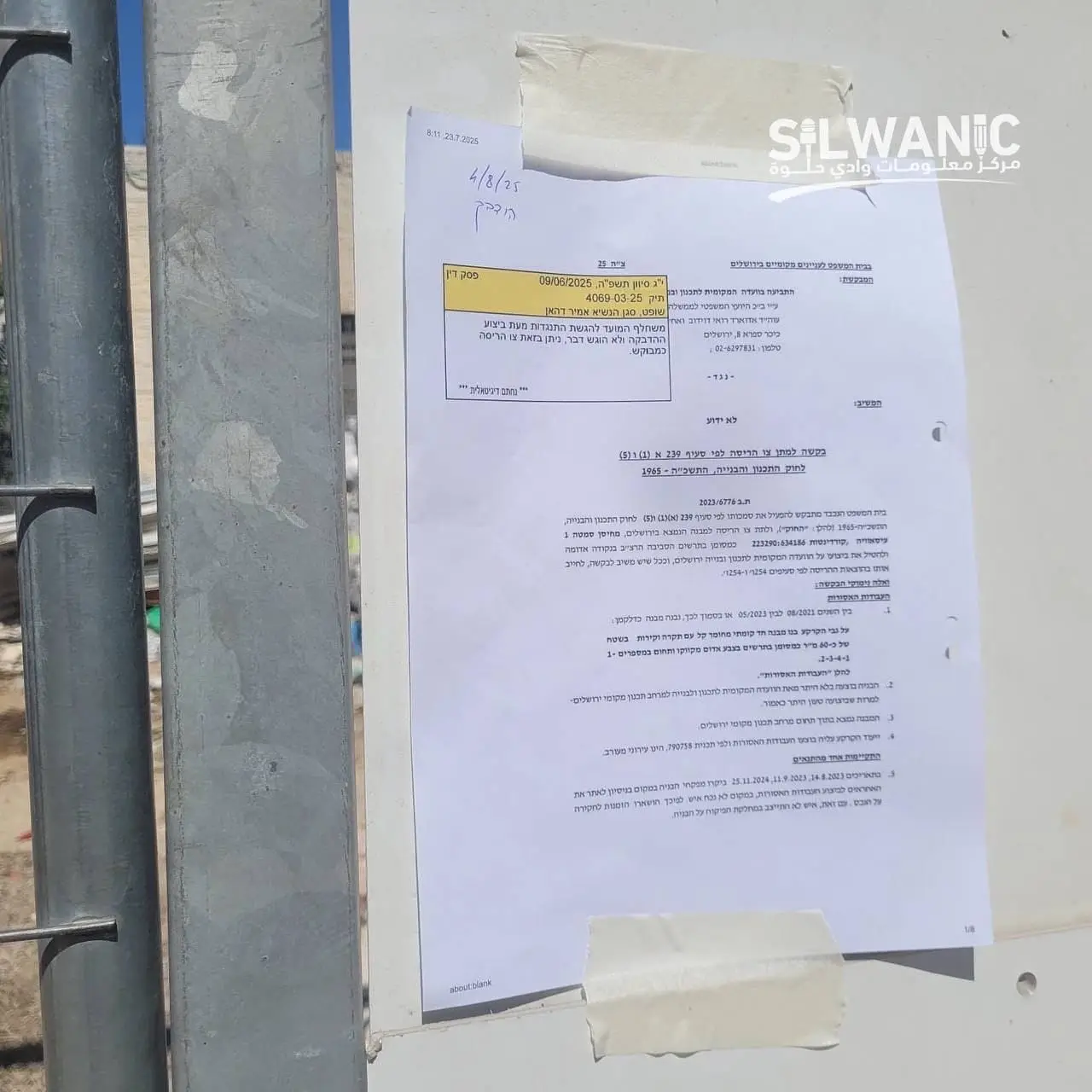
Occupation forces have suspended demolition orders on residents' homes in the village of Al-Issawiya in occupied Jerusalem.
Home to around 650 people: the occupation notifies residents to evacuate their lands in the village of Beit Iskariya south of Bethlehem
The Al-Baidar Association for the Defence of Bedouin Rights said that Israeli occupation forces on Wednesday notified residents of the village of Beit Iskariya south of Bethlehem in the occupied West Bank that they must evacuate their agricultural lands within 10 days.
The association explained that occupation forces stormed the village, which lies in the middle of the "Gush Etzion" settlement bloc, and delivered an oral notice to one resident requesting the evacuation of a 20-dunam plot planted with grapevines, belonging to him and his brothers.
Al-Baidar affirmed that this step comes within a continuing pattern of restricting residents and farmers in the area and attempting to empty the land of its rightful owners in favour of settlement expansion. It noted that the village of Beit Iskariya comprises five residential clusters: Beit Iskariya, Khallet al-Balouta, Wadi Shukhait, Khallet Affana and the Al-Shifa area, and is home to around 650 people in 97 houses, amid continuous attempts to reduce the space available for them to remain and live.
The Popular Committee against the Wall and Settlements said that the occupation demolished 588 structures in the West Bank and issued notices against another 556 during the first half of this year.
The prisoners file
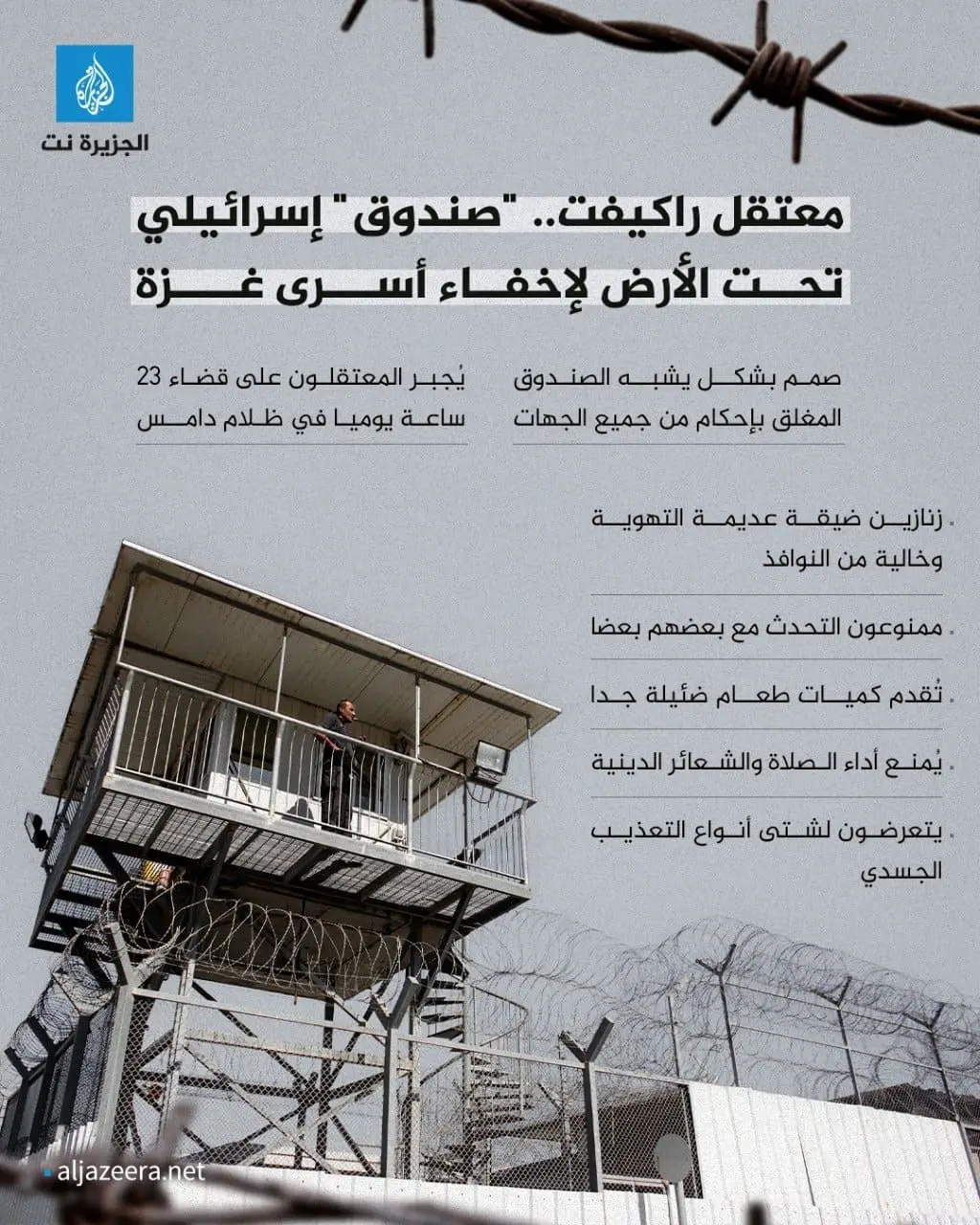
Described as one of the most dangerous and harshest security wings of the Israeli occupation, the "Ketziot"/"Rakefet" prison was built in a deep pit underground, covered by dense layers of reinforced concrete beneath Ayalon Prison in the city of Ramla.
Hamas leader Abdul Rahman Shadid said: The forms of brutal torture to which our prisoners are subjected in occupation prisons, particularly the recent reports coming from Gilboa Prison, confirm the use of electric shocks as a tool of revenge and humiliation, in flagrant violation of all international and humanitarian laws and norms, and confirm the extent of this occupation's brutality and fascism.
The occupation forces released prisoner Haneen Jaber (50 years old) from the Nur Shams camp east of Tulkarm in the West Bank after she completed her sentence of 8 months, and paid a fine estimated at 8,000 shekels.
Haneen is the mother of the martyrs, as we understand them, Mahmoud and Mohammed Jaber (Abu Shuja), commander of the Tulkarm battalion. During her detention she suffered difficult health conditions, as she was found to have cancer while in occupation prisons, which worsened her suffering and raised the concern of her family and human rights organisations.

The Commission of Detainees' Affairs and the Palestinian Prisoners' Club: the martyrdom of prisoner Ahmad Tazazaa, as we understand it, from the governorate of Jenin in the northern West Bank, in Israeli occupation prisons.
The Palestinian Center for the Defence of Prisoners stated: We condemn the Israeli Knesset's adoption of a law permitting the detention of Palestinian citizens from the Gaza Strip without an indictment, without a time limit on detention, and without allowing them to meet lawyers, under the label of "unlawful combatant."
The adoption of this law is further tightening of the penalties imposed on prisoners, in clear violation of all international and humanitarian laws. We call on all parliaments, international bodies, and legal and human rights frameworks to denounce the legislation of this law, which amounts to a clear crime against international law. The adoption of the law comes amid unprecedented humanitarian conditions and circumstances suffered by Gaza Strip prisoners, where assaults involving torture, beating and abuse continue against them, up to killing and death.
Syria
Arrest of Amer Jadia' al-Sheikh: one of the most dangerous drug traffickers linked to the Assad regime
Security sources announced the arrest of Amer Jadia' al-Sheikh, one of the most prominent and dangerous drug traffickers in Syria and the region, in a major operation targeting a large international smuggling network.
Amer al-Sheikh is a central figure in the manufacture and distribution of narcotics, especially captagon. Reports indicated his links to influential figures during the era of the Syrian regime, including Maher al-Assad, brother of Bashar al-Assad, who is accused of overseeing drug manufacturing networks inside Syrian territory.
According to informed sources, al-Sheikh oversaw the smuggling of huge quantities of drugs to neighbouring countries, the Gulf and Europe, through smuggling channels protected and supported by security elements.
The Israeli occupation army published details of its operation in southern Syria:
- In an operation involving four targeted points simultaneously, soldiers found and seized weapons in southern Syria.
- On Saturday night, soldiers of the 210th Division, together with field investigators, interrogated suspects at the scene and persons involved in arms smuggling in the Hadar area of southern Syria.
- Soldiers of the 210th Division remain in the area and continue their operations to prevent any terrorist elements from establishing themselves in Syria, with the aim of protecting Israeli civilians, especially the residents of the Golan Heights.
After Hijri militias violated the ceasefire agreement, the Syrian Ministry of Interior issued a statement on the violation of the ceasefire in Suwayda, in which it said:
- Since the start of the ceasefire agreement in Suwayda, the Syrian state, in all its military, security, civilian and service institutions, has continued striving to consolidate this agreement, out of concern to restore stability throughout the governorate.
- Within this effort, the government has worked to secure the lives of civilians and pave the way for the gradual return of services and the restoration of daily life in the governorate.
- In contrast to the government's efforts to safeguard the security and stability of Suwayda, the media and sectarian mobilisation campaigns led by the rebel gangs in the city have not stopped during the past period. These gangs resorted to violating the ceasefire agreement by launching treacherous attacks against security forces on several fronts and shelling some villages with rockets and mortar bombs, resulting in casualties among security personnel.
- We affirm our continued performance of our national and humanitarian duty in Suwayda since the beginning of the crisis, placing the security and stability of citizens at the forefront of our priorities.
- The rebel gangs continue attempts to drag the governorate into tension and chaos for the personal motives of their leaders, through the theft of relief aid and internal fighting.
- These groups also use the violation of truce agreements to cover up their arbitrary practices, including illegal arrests within the city. The ministry will continue its efforts and duties in Suwayda in line with national duty and the requirements of protecting residents and securing relief convoys and aid for them.
Local sources announced: the body of media activist Kindi al-Adai was found strangled inside his apartment in the Al-Joura neighbourhood of the city of Deir ez-Zor, with signs of beating and torture on him. It is noted that he had recently returned to Syria from Germany.
Pentagon announces withdrawal of US forces from three main bases in Syria
The US Department of Defense (the Pentagon) announced today, Tuesday, the start of the withdrawal of US forces from three main military bases in Syria, a step described as part of a "strategic repositioning" of forces in the region. A Pentagon spokesperson said in an official statement that forces had begun withdrawing from Conoco base in the eastern countryside of Deir ez-Zor, and the Omar oil field, in addition to a third base whose location was not disclosed for security reasons. He confirmed that "part of the withdrawing forces will be redeployed to US bases inside Iraq and northeast Syria, while another part will return to the United States."
The statement noted that this step comes within a comprehensive review of the US military deployment in the Middle East, aimed at "enhancing readiness and achieving greater flexibility in facing regional challenges." This development comes at a time when US policy towards Syria is the subject of growing internal debate, particularly after criticism directed by former US National Security Advisor John Bolton at US Envoy Tom Barrack, accusing him of being "lenient" in his stance towards the Syrian regime, especially regarding the issue of normalisation with Israel.
The withdrawal decision has raised wide questions in political and military circles, amid concerns that reduced US presence could create a security vacuum that regional and international powers, including Iran and Russia, as well as extremist groups active in some areas of eastern Syria, may exploit.
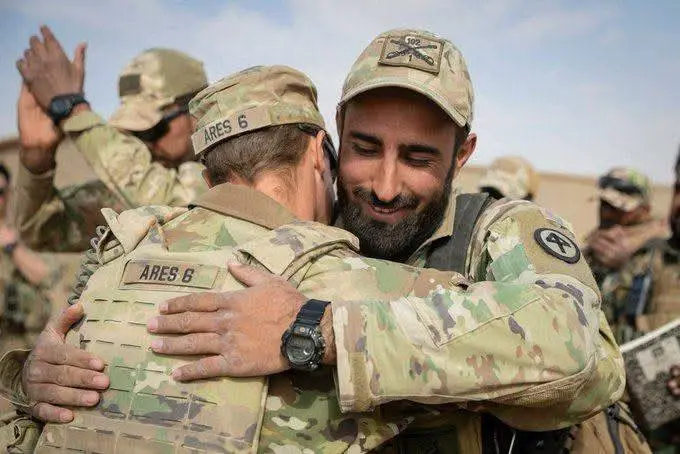
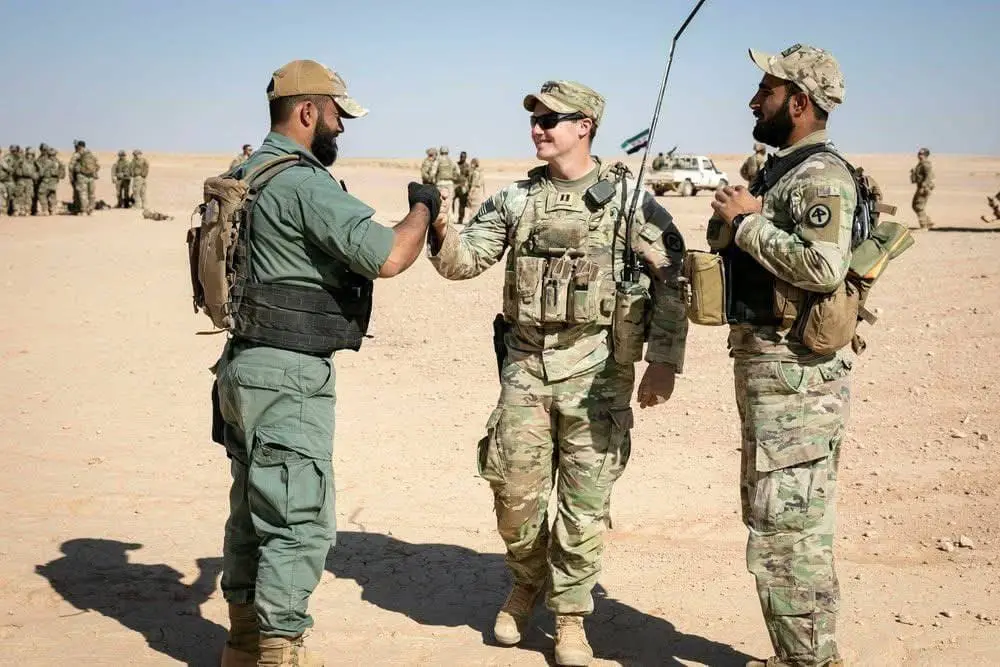
Joint military exercises between US forces and the 70th Division.
US forces stationed at Al-Tanf base conducted joint military exercises with members of the 70th Division, affiliated with the Syrian Ministry of Defence, within the Syrian desert area. This military manoeuvre comes within the framework of joint field coordination between the two sides, amid rapidly developing security developments in the desert and eastern Syria areas | Source: Al-Sharqiya correspondent.
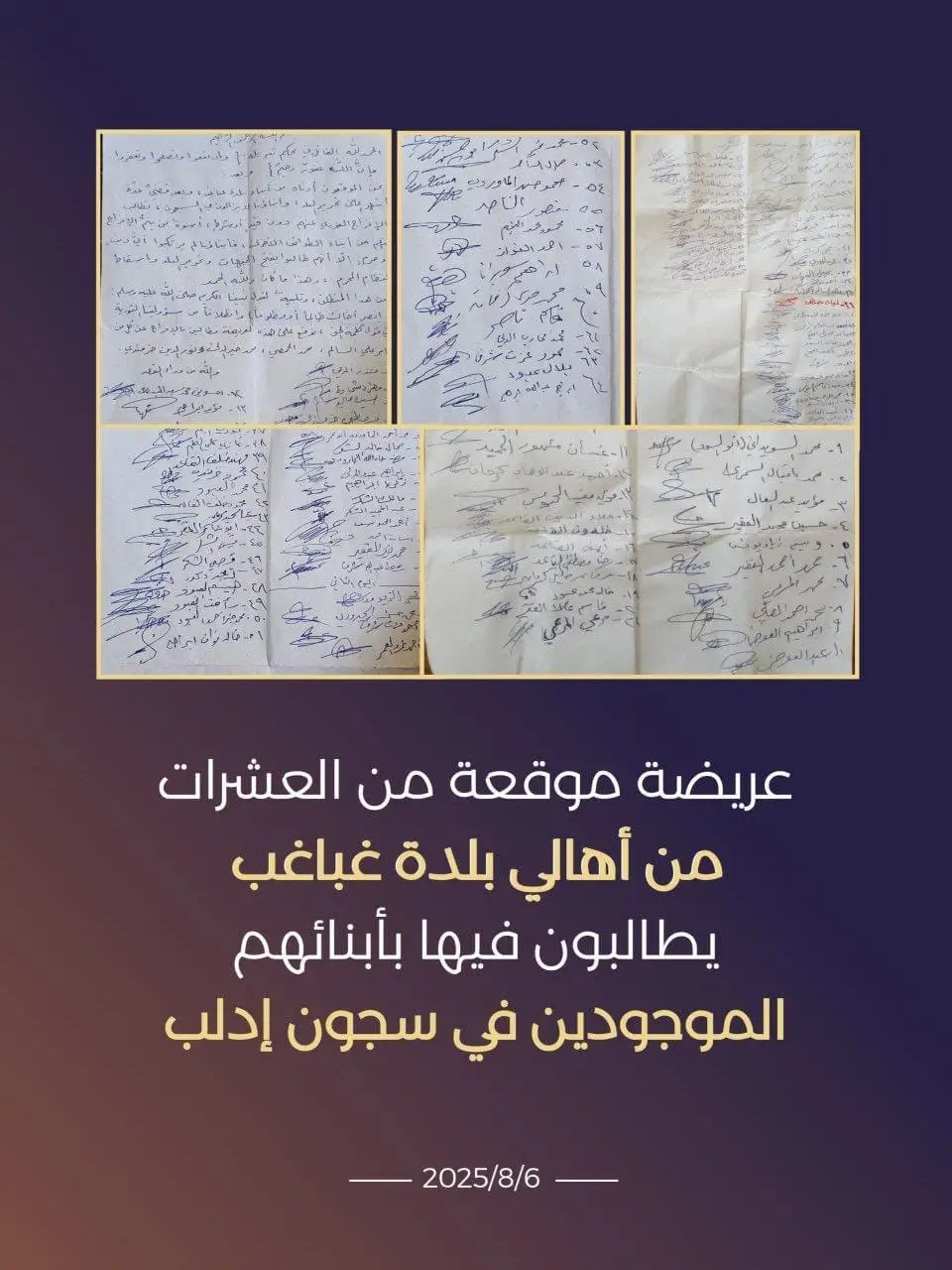
A petition signed by residents of the town of Ghabaghib calling for the release of their sons detained in Idlib prisons.
Egypt
Egyptian activist Anas Habib: In the leaked video, National Security Major Majed Othman, head of the National Security office in the Tenth (formerly, of course), speaks because his fate is now unknown for several months after the National Security leadership ended his service, and they tortured him and forcibly disappeared him. Major Majed Othman, although inside the system, could not bear the torture, oppression and siege our brothers in Gaza are subjected to.
Part two of the leak: "We will all die, and I want to go to my Lord clean."
Sudan
The emergency room of Dar Hamar in the state of West Kordofan announced the death of 15 people and the infection of more than 250 others with cholera, in shelter centres spread across villages in the Al-Nuhoud locality, western the country.
The Coordination of Displaced and Refugees said: The rise in cholera infections in Darfur, especially in the "Tawila, Jabal Marra and Nyala" camps, with the cumulative daily number of cases since the outbreak of the disease reaching (2,796) cases, including (52) deaths. There are currently (242) cases in the health isolation centre.
The Minister of Health in the Sudanese Darfur region said: We have a serious shortage of capabilities to confront the epidemic, and the siege prevents their entry.
According to UNICEF: the total number of cholera infections up to 30 July reaches about 2,140 cases in the 5 Darfur states, with at least 80 deaths recorded.
The Dar Hamar emergency room announces the death of between 25 and 30 people daily in the Al-Nuhoud locality of West Kordofan state, as a result of the cholera outbreak, and says the number of confirmed infections has exceeded 280 cases.
El-Fasher under siege: famine on the horizon
The city of El-Fasher, capital of North Darfur, is experiencing catastrophic humanitarian conditions as a result of a suffocating siege imposed by the Rapid Support Forces for more than a year, leading to a complete paralysis of food and medicine supplies. Local sources reported an unprecedented rise in the prices of basic commodities, with the price of a sack of flour exceeding 100,000 Sudanese pounds, amid circulating reports, unconfirmed, indicating that in some areas it has reached 6 million pounds (about 2,000 dollars).
The halt of charitable communal kitchens ("takiyas") has aggravated the crisis, forcing some residents to eat animal fodder (al-ambaz) to stay alive. Meanwhile, health facilities suffer a severe shortage of medicines and supplies, while deaths from hunger and malnutrition are increasing. According to UN reports, at least 782 civilians have been killed and more than 1,100 others injured since the siege began, amid warnings of crimes against humanity.
Sudan's Emergency Lawyers announced: the killing of 14 civilians and the injury of dozens as a result of a horrific massacre carried out by the Rapid Support Forces on 2 August in the village of "Qarni" northwest of the city of El-Fasher.
The Dar Hamar emergency room also said: Rapid Support militias killed 12 citizens after they refused to leave Al-Nuhoud Teaching Hospital, and they were buried inside the hospital, which was closed and designated for their wounded.
Yemen
"Hael Saeed" group calls for realistic measures to control prices and warns against improvised decisions
The Hael Saeed Anam and Partners group called for a studied and gradual approach to the price file, ensuring a balance between consumer protection and market stability, warning against taking improvised decisions that do not take into account the actual costs faced by manufacturers and importers in light of the absence of real stability in the exchange rate.
In a statement issued by it, the group expressed its full understanding of citizens' demands for lower prices following the recovery of the Yemeni rial, while affirming that solutions cannot be achieved by imposing unrealistic pricing without coordination with the competent authorities and ensuring the availability of hard currency at a suitable rate.
It pointed out that the absence of government remittances from revenues to the Central Bank, and traders' and manufacturers' coverage of their foreign currency obligations, makes any ill-considered decision a risk to market stability and may lead many economic actors to withdraw, harming consumers and increasing the cost of goods.
Security campaigns began several days ago in a number of governorates under the control of the legitimate government, most notably (Al-Mahra, Hadramout, Marib, Taiz, Aden and Lahj), by going down to markets to monitor price reductions, following the noticeable recovery of the Yemeni rial against foreign currencies | Yemen Monitor.
Security forces in Hadramout toured the markets to control prices and verify that traders are not raising them.
Intensive campaign to control price violators in Marib
The Office of Industry and Commerce in the Marib directorate carried out a broad campaign on shops, targeting violators of pricing rules. The campaign resulted in the seizure of 62 commercial shops, including wholesale and retail shops, found to be involved in raising prices and manipulating price lists.
The office pointed out that the owners of the violating shops had been referred to prison to take the necessary legal measures against them. The Office of Industry and Commerce in the directorate confirmed that the campaign is ongoing and will not stop, noting that it will deal strictly with anyone who dares to manipulate citizens' sustenance.
The office called on traders to abide by the set prices with the improvement of the local currency and to avoid fraud and monopoly, warning that penalties will be strict against every violator. The list of violating shops included 62 commercial shops, among them Al-Salahi and Al-Mahdi commercial shops, the Amin Qasim establishment, Al-Jabri shops, Hunt Market, and others | Yemen Monitor.
League of Mothers of the Abducted launches broad advocacy campaign to save abductees from neglect inside prisons
The League of Mothers of the Abducted is preparing to launch an advocacy campaign under the hashtag #انقذوا_المختطفين (#SaveTheAbductees), aimed at moving the file of the abductees and highlighting their intensifying suffering inside prisons, where their lives and health are endangered by continuous neglect and the long-standing disregard of their cause.
In an official statement, the League called on all families of abductees and survivors of prisons, as well as activists and influencers in the media and social networks, to actively participate in the campaign to carry the voice of the abductees to the world and express popular anger at the shameful silence towards their continuing suffering.
The League stressed the need to support the abductees and sustained advocacy until they are released and their dignity restored, emphasising the importance of engaging with and widely sharing the campaign materials on digital platforms, using the hashtags #انقذوا_المختطفين and #حرية_ولدي_أولا.
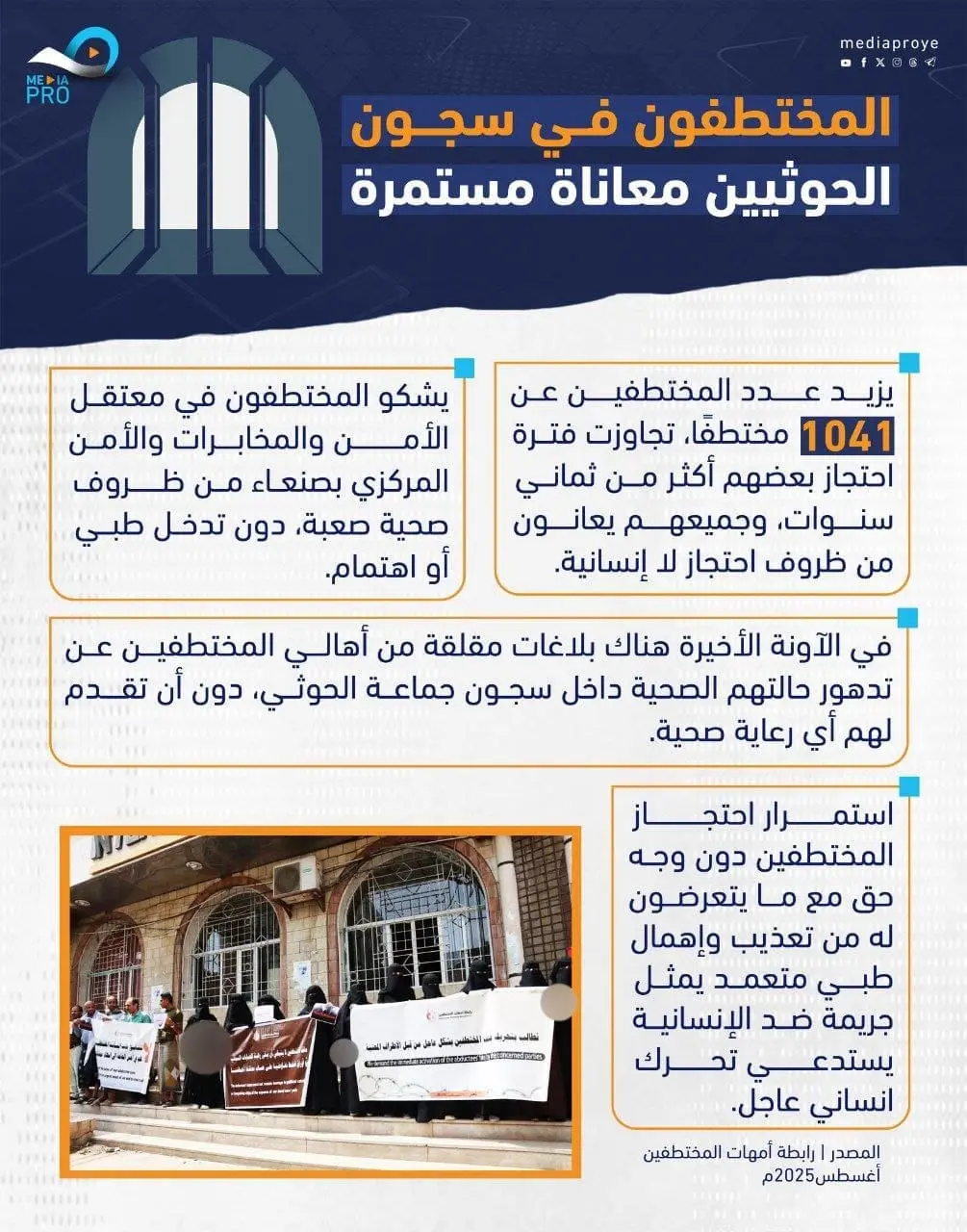
The abductees in Houthi prisons: continuing suffering.
More than 65 refugees and migrants die in boat capsizing off Yemen's coast
At least 68 African refugees and migrants have died, while 74 others remain missing after a boat capsized off the coast of Yemen, according to the International Organization for Migration. The head of the International Organization for Migration in Yemen, Abdelsattar Esawiyef, told the Associated Press on Sunday that the boat, which was carrying 154 Ethiopians, capsized off Yemen's Abyan governorate.
He added that 12 people survived the sinking, noting that the bodies of 54 refugees and migrants were washed ashore in the Khanfar area, while 14 other dead were found elsewhere and taken to a hospital morgue.
Yemeni health authorities had earlier said the death toll had reached 54 people. The waterways between Yemen and the Horn of Africa are a common, if dangerous, route for refugees and migrants travelling in both directions. The area has seen a sharp rise in the number of Yemenis fleeing the country since the outbreak of war in 2014.
The Houthis and government forces reached a truce agreement in April 2022, which led to a decline in violence and a slight easing of the ongoing humanitarian crisis in Yemen. Meanwhile, some people fleeing conflicts in Africa, especially in Somalia and Ethiopia, have sought refuge in Yemen or tried to travel through it to the more prosperous Gulf states. This route remains one of the busiest and most dangerous migration routes in the world, according to the International Organization for Migration.
According to the International Organization for Migration, more than 60,000 refugees and migrants arrived in Yemen in 2024, a significant decline from the previous year's total of 97,200 | Yemen Monitor.
Also on Monday, Spanish police announced the dismantling of a criminal network involved in smuggling migrants, most of them from Yemen, to Britain and Canada using forged passports.
The police said in a statement that the migrants first obtained refugee status in Greece, before heading to European airports, where they received forged documents from members of the network that helped them reach their final destinations. The network carried out more than 40 smuggling operations for sums of up to 3,000 euros per person.
Iraq
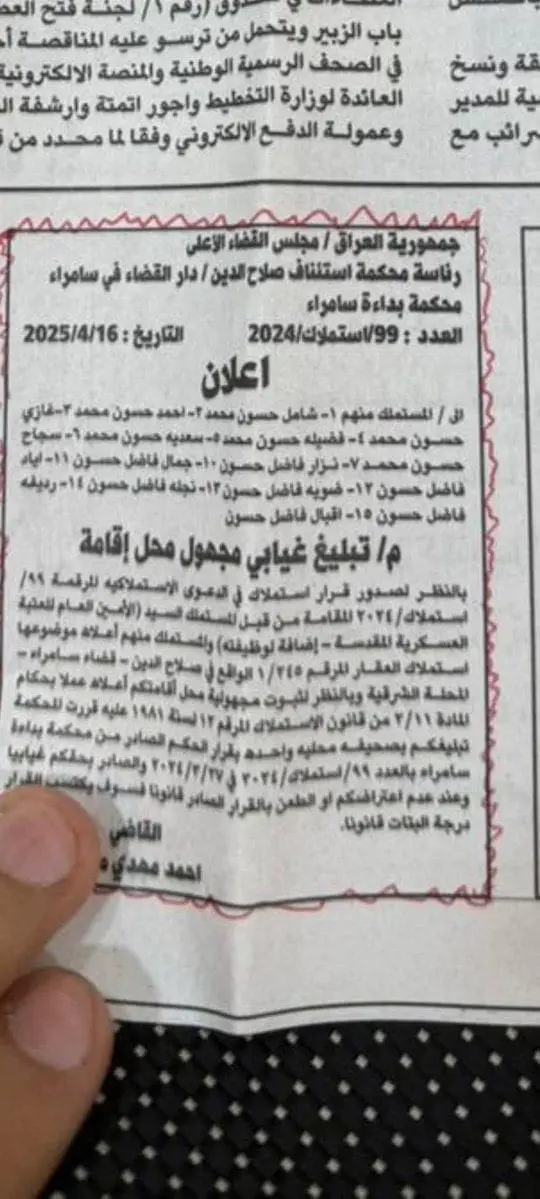
Quoting journalist Othman al-Mukhtar: An example of the current crimes of seizing the property of the people of Samarra by multiple methods and styles. A property owned by one of Samarra's most prominent families, which the so-called "Military Shrine" decided to seize; when its owners refused to sell it, a lawsuit was filed against them on the pretext of expansion and serving visitors, and the judiciary responded to them.
Although the family's place of residence is known to all the people of Samarra, their residence was deemed unknown, and an advertisement was published in a newspaper, so the house was seized by force. In this way, dozens of properties were seized in this manner during the current year 2025.
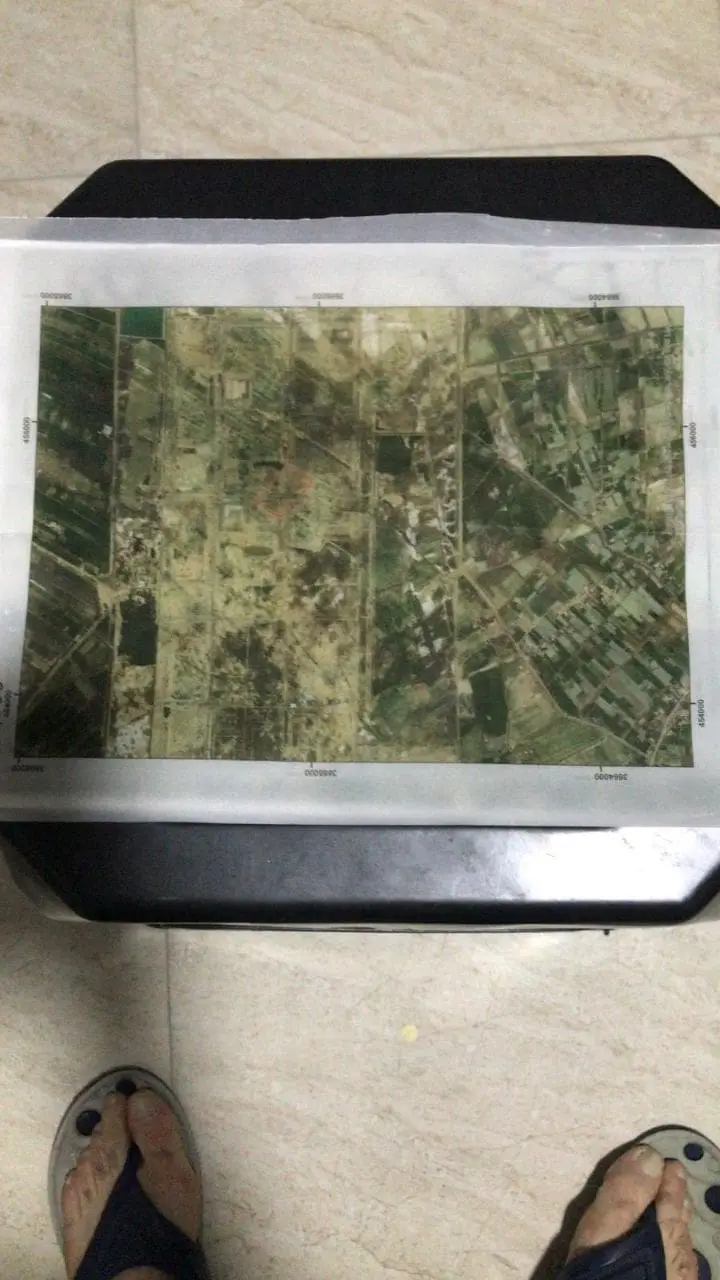
Iraqi journalist Othman al-Mukhtar: ("Your son is weak, your guarantor Al-Abbas cannot bear your detention for a quarter of an hour. Take him and leave.")
With these words, Mohammed Jarnan al-Janabi was threatened by a person called (Abu Karrar Amniyah), one of the leaders of the "Imam Ali" militia, to give up his land in Al-Mada'in last February.
He died of grief, may God have mercy on him, a few weeks after being displaced and leaving his land out of fear for his son.
What the militias are doing in terms of systematic displacement of Sunnis in the Baghdad belt must be internationalised and exposed. People still keep maps of their lands, just like the Palestinians.
New demolition operations of dozens of homes in the Latifiya area south of Baghdad.
These villages have existed since the beginning of the last century, while the oil pipeline was laid in 1977. But, under a new pretext, homes are being demolished and residents displaced today. The project to change the composition of Baghdad is nearly complete, and now it is the turn of the Baghdad belt. For the record, the same pipeline passes through the Iskandariya and Musayyib areas, without their homes being touched, in overt sectarian discrimination.
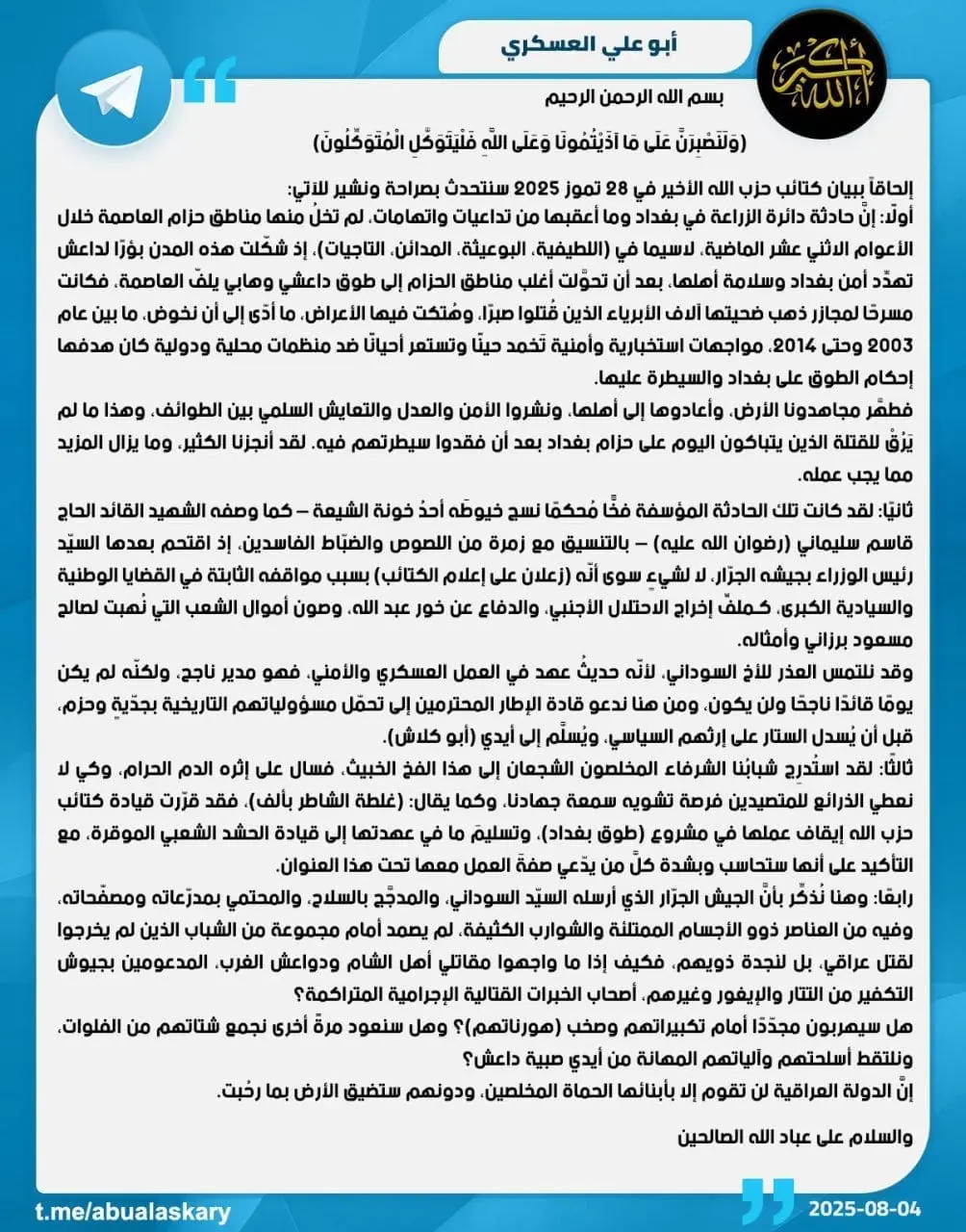
Iraqi journalist Othman al-Mukhtar: The "Kataib Hezbollah" militia acknowledges the operations of displacing Sunni Iraqis from the Baghdad belt in a statement issued by the militia's security official.
What I possess of information is that some 4,000 families have been displaced and their lands seized since last year, after their contracts were cancelled (117 contracts), under the pretext of a terrorism charge against a family member, or "remnants of the Baath Party", or by threats and pressure, carried out by what is known as "Hashd security", in cooperation with the Ministry of Agriculture. The most prominent were Al-Bu Eitha, Al-Dawra, East Latifiya, Al-Mada'in, Abu Ghraib and Al-Radwaniya.
Kataib Hezbollah, Al-Asaib and Imam Ali are effectively in charge of the process of displacement and land seizure. There have been more than 30 cases of enforced disappearance during the same period in the Baghdad belt areas, and no one knows where the victims are.
For those who do not know, there are informal housing settlements in the Zankora area in Anbar and another on the outskirts of Al-Hosa east of Fallujah, for families displaced by militias from their lands after they were seized; all of them are Iraqi Sunnis. All of this is happening with the knowledge of Prime Minister Mohammed Shia' al-Sudani and National Security Adviser Qasim al-Araji.
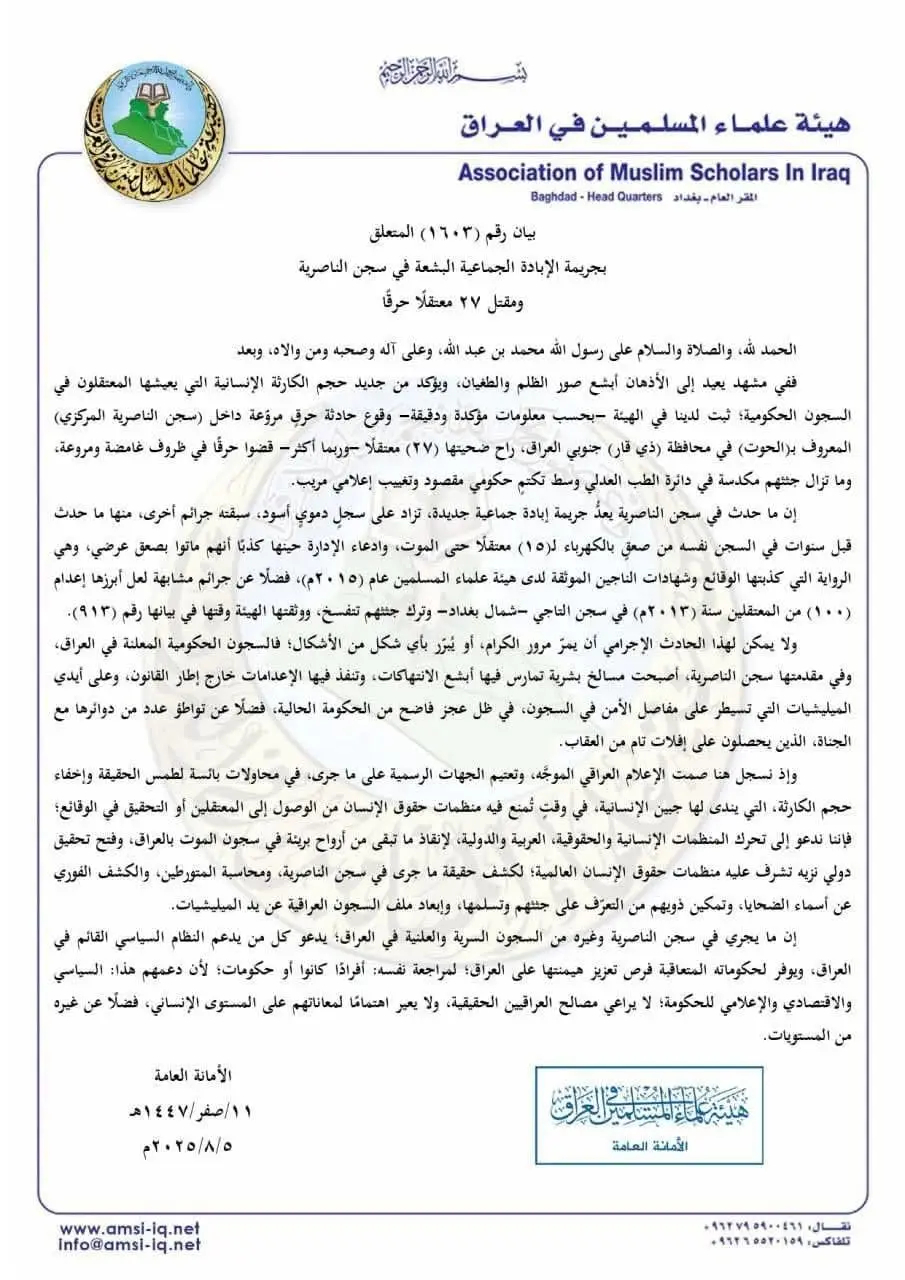
A statement from the "Association of Muslim Scholars in Iraq" regarding the genocide and crimes to which Sunni detainees are subjected in Nasiriyah prison.
Iranian orders to militias to take control of Baghdad
A political source close to the "Coordination Framework" revealed Iranian orders to Shiite militias in Iraq to take control of Baghdad immediately upon receiving notice. The source told "Al-Madaen" that Ismail Qaani, during his last visit to Baghdad, in which he met a number of Shiite militia leaders and some Coordination Framework leaders, informed them of Iran's rejection of dissolving the Popular Mobilization Forces and the other Shiite factions, contrary to a previous position attributed to him that the decision to dissolve the Shiite militias rests with the Iraqi government.
The source said that Qaani asked militia leaders to remain watchful and cautious, and to take security measures to protect senior leaders and the headquarters of those militias for fear of an Israeli strike, and he also demanded full readiness to take control of the government in Baghdad whenever Tehran requests it.
Rohingya
Official from Bangladesh: one in every 5 Rohingya adults has hepatitis C
A senior medical official in Bangladesh stated that the prevalence rate of hepatitis C among Rohingya refugees in the "Cox's Bazar" camps in Bangladesh has reached one infected person in every five adults. The medical coordinator at the office of the Refugee Relief and Repatriation Commissioner, Dr. "Sarwar Jahan", explained that the infection rate among Rohingya refugees is highly alarming, noting that there are currently around 100,000 infected adults, which raises concern about the spread of the disease among the local population, according to the Bangladeshi newspaper "The Daily Star", on Monday.
The newspaper added that more than 70% of nearly half a million adult Rohingya refugees in the camps have been tested so far, and that preliminary data show that 30% of them carry the virus, and 20% have been confirmed with active infection, adding that a project is being implemented to treat one hundred thousand infected people, with the aim of reaching 50,000 of them by 2026.
Hasina, a Rohingya refugee who fled to Bangladesh ten months ago with her husband and four children, told the newspaper that she was diagnosed with the disease during childbirth in 2020. She believes the virus was transmitted to her through unsafe medical practices in Myanmar, including the transfusion of untested blood and the use of contaminated syringes. Recent tests conducted by Médecins Sans Frontières (MSF) showed that she and her two sons are infected | Arakan News Agency.
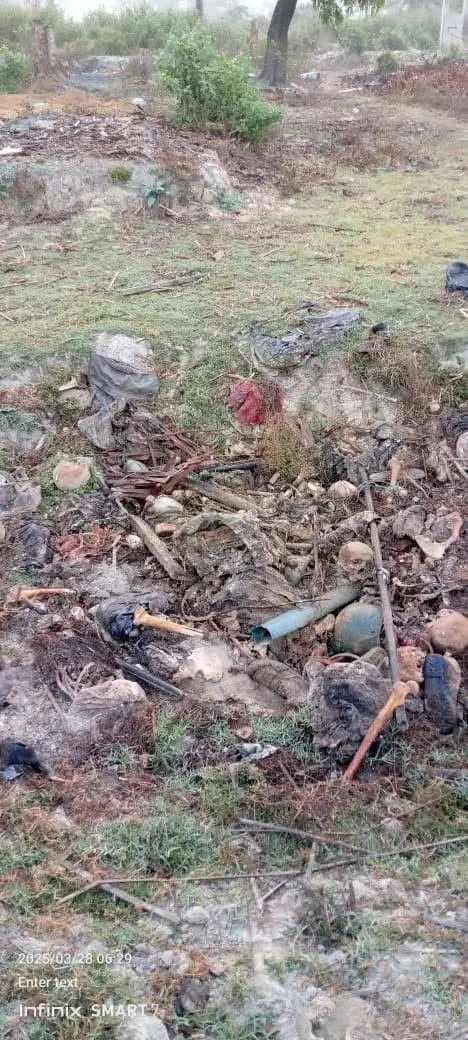
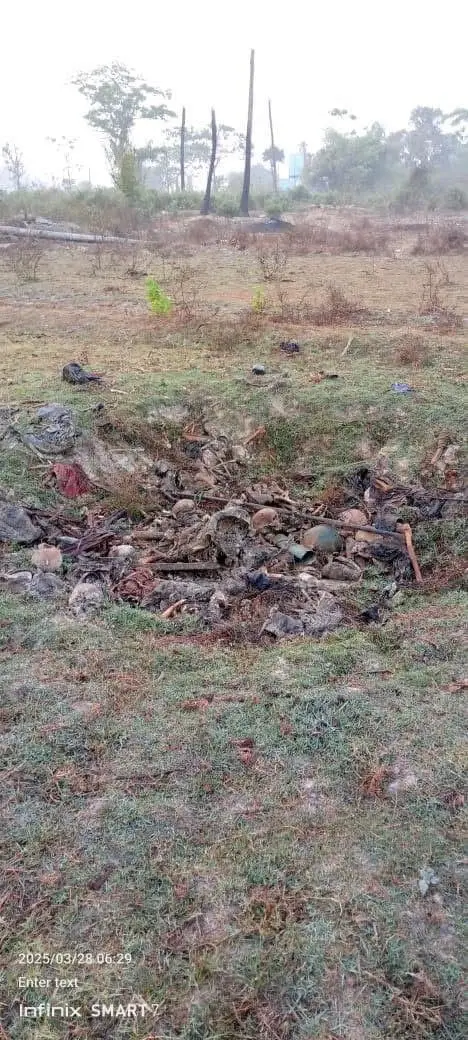
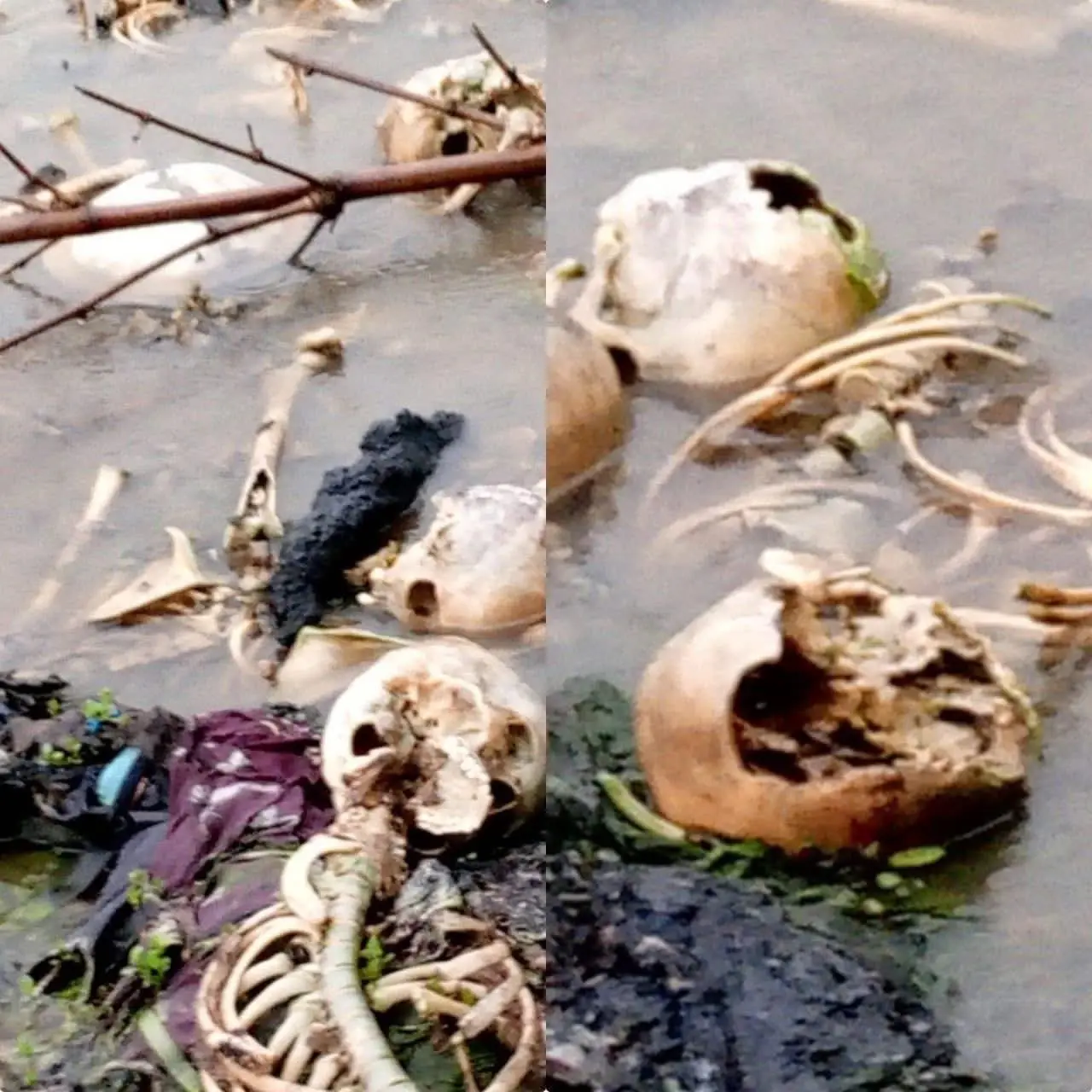
Arakanese activist Abdullah: The ongoing genocide against the Rohingya: massacre in Hathan Shu Kan, Buthidaung. Arakan Now | 3 August 2025.
On 2 May 2024, Arakan Army forces killed some 600 Rohingya civilians in the village of Hathan Shu Kan (Hounia Sayi) in Buthidaung, according to survivor testimonies, underscoring that the genocide against the Rohingya did not end in 2017.
The victims included women, children, the elderly, pregnant women and people with disabilities. Survivors said the killings were carried out without warning or cause. Eyewitnesses reported that some of the bodies were burned with petrol in an attempt to conceal the crime.
This atrocity is part of the ongoing genocide in Arakan, showing that the Rohingya continue to face systematic violence years after the mass atrocities of 2017.
More than a year later, horrific images emerged showing human remains left to rot, partly submerged in water and covered with wild vegetation. A local leader said: "There is no escape from justice; the dead are crying out for accountability, and those responsible must be held to account."
The United States should not ignore the suffering of the starving Rohingya in Myanmar
In Myanmar's troubled Rakhine State, a new tragedy is unfolding far from the world's eyes. The Rohingya, who have long suffered persecution, find themselves trapped in the fire of the ongoing civil war, and today they are being deliberately starved.
Recent reports from inside the largely closed country, including one from the Burmese Rohingya Organisation UK, indicate that the ruling military council has imposed a total blockade, cutting off all vital supplies to 145,000 Rohingya held in crowded and miserable camps. According to the reports, at least 25 Rohingya adults have died of starvation this year, in addition to seven others who died from being denied medical care. Children are suffering from malnutrition.
Rohingya men are being forcibly conscripted into the Myanmar army, while others join voluntarily in exchange for promises to feed their families instead of paying salaries. Women, many of them widowed, move between the camps in search of food.
The Rohingya Peace and Humanitarian Society reported that the Rohingya face daily abuses by the Arakan Army, including killings and rape, pushing growing numbers of them to flee towards Bangladesh. Reports indicate that more than 118,000 Rohingya refugees crossed into Bangladesh over the past year. International pressure is mounting to involve Rohingya and other ethnic representatives in the administration of the Arakan Army. It has also been reported that the Arakan Army recently began holding meetings with Rohingya in the areas under its control, offering assurances of their safety, but the results of these efforts have not yet become visible on the ground.
"If we die, we die": Rakhine residents in Myanmar pushed to the brink
"If the withholding of food supplies continues, the Rakhine and Rohingya Muslim communities may face famine in the coming months."
The Rohingya Muslims of Rakhine State in Myanmar have for decades suffered a long series of abuses, including restrictions on movement, arbitrary arrest, forced labour, extrajudicial killings and denial of citizenship. Today they are also being deprived of food.
Unlike other areas of Myanmar torn by civil war, Rakhine State, on the country's western coast, lives in near-total isolation from local and international relief networks. Long-standing restrictions on movement, the army's continued withholding of aid, the Arakan Army's tightening grip on the region, and the ongoing clashes between it and the military council have together trapped large numbers of civilians, both Rohingya and Rakhine, who struggle to obtain food, medical care or safe passage.
The grassroots support networks that formed the backbone of resistance and survival in places such as Sagaing and Karenni are far weaker here. Although food insecurity is widespread across Myanmar, Rakhine is the only region where the United Nations has warned that a "severe famine" is imminent, with more than two million people at risk of starvation.
The funding crisis in the Rohingya camps in Bangladesh
Urgent additional humanitarian support is needed. New arrivals rely heavily on the solidarity of camp residents, which places a strain on extremely limited resources. The biometric identification system has enabled humanitarian partners in Bangladesh to provide essential services to new arrivals, including food, medical care, education and basic relief items.
However, these resources will soon be depleted unless immediate funds are injected. Access to shelter and other basic necessities is also insufficient given limited resources. Amid the acute global funding crisis, the critical needs of new refugees and of those already present will not be met, and essential services for all Rohingya refugees risk collapse.
Unless additional funds are secured, health services will be severely disrupted by September, and essential cooking fuel (liquefied petroleum gas) will run out. By December, food assistance will stop. Some 230,000 children, including 63,000 new arrivals, risk losing access to education.
Refugees in the camps have already felt the impact of these cuts and fear further imminent reductions. This fuels a sense of despair and anxiety, and pushes some to undertake risky sea journeys to other countries in search of safety and a more dignified life for their families. UNHCR
Bangladesh
UNHCR: Bangladesh has received 150,000 Rohingya refugees over the past eighteen months
Violence and targeted persecution in Rakhine State, in addition to the ongoing conflict in Myanmar, have continued to force thousands of Rohingya to seek protection in Bangladesh. This movement of Rohingya refugees into Bangladesh, spanning several months, is the largest from Myanmar since 1438 AH (2017 CE), when some 750,000 fled the bloody violence in Rakhine State, their homeland.
In Cox's Bazar, these new arrivals join nearly one million Rohingya refugees crammed into an area of no more than 24 square kilometres, making these camps among the most densely populated places in the world.
Of the new arrivals, some 121,000 had been biometrically registered by the end of June, and more are believed to be living informally in the already overcrowded refugee camps. The vast majority are women and children.
Uyghurs
The World Uyghur Congress (WUC) welcomed the United States Senate's introduction of three new bills aimed at countering the growing abuses committed by China against the Uyghur minority, particularly with regard to the forced return of Uyghur refugees. The bills include:
- Uyghur Forced Return Prevention Act 2025: prohibits the entry into the United States of Chinese officials involved in the forced return of Uyghurs, and imposes sanctions on them, such as asset freezes and bans on financial transactions.
- Transnational Repression Countering Act 2025: aims to counter the harassment of dissidents abroad by authoritarian regimes, foremost China, by establishing a joint government task force, imposing sanctions and protecting targeted communities.
- Taiwan Diplomatic Support Bill: to strengthen US-Taiwan relations and encourage Latin American and Caribbean countries to cooperate with Taipei in the face of growing Chinese pressure. These bills came amid escalating Chinese repression of Uyghurs abroad, including surveillance, threats and pressure on countries to deport Uyghur refugees, which the WUC described as a flagrant violation of human rights and of the principle of non-refoulement in international law.
- The World Uyghur Congress called for the swift adoption of these bills and urged other democratic countries to take similar measures to deter China from its transnational repression campaigns | ANI.
A Muslim Uyghur girl asks about a fatwa permitting suicide because she is, or may be, subjected to assault under the tyranny of the Chinese communist regime and its occupation of East Turkestan.
Afghanistan
The United Nations High Commissioner for Refugees reported that more than 1.2 million Afghan refugees left Pakistan and returned to their country between 15 September 2023 and 30 June 2025, as a result of increasing political and security pressure from neighbouring countries. The returns included both voluntary and forced cases, with at least 51,000 people deported forcibly in 2025 alone.
The Afghan Ministry of Justice said: The Islamic Emirate is recovering more than 510,000 jeribs of usurped land within three months.
Pakistan
Pakistan accelerates the deportation of Afghans
Pakistan has renewed its call on Afghans to leave its territory, accelerating its deportation campaign, according to officials in both countries who spoke to Agence France-Presse yesterday, Friday. Millions of Afghans have sought refuge in Pakistan over past decades, fleeing conflicts and humanitarian crises, a movement that intensified with the return of the Taliban to power in summer 2021.
Islamabad, which accuses Afghans of involvement in "terrorism" and of supporting opposition movements, launched a sweeping expulsion campaign in 2023. On 1 April, Islamabad cancelled the residence permits of 800,000 Afghans, some of whom were born on its territory or have lived there for decades.
The senior government official in Quetta, capital of Balochistan province bordering Afghanistan, Mehr Allah, said: "We have received instructions from the Interior Ministry to begin a new operation aimed at deporting all Afghans, including holders of residence permits and refugee cards, in an organised and respectful manner" | The Independent.
Iran
Afghan departures paralyse Iranian factories
Iranian officials said that a number of important economic and construction projects have come to an almost complete halt following an unprecedented deportation of Afghan workers from the country. Ramin Goran, director of an association in Iran, told the media that Iranian workers cannot replace Afghan workers, and that this situation leads to wasted time and rising costs.
Goran added that most Iranians currently working cannot be a permanent replacement for the Afghan workers who had regularly and continuously taken part in implementing projects.
This comes at a time when a number of Iranian craftsmen had previously warned that the deportation of Afghan workers had caused the collapse of many factories.
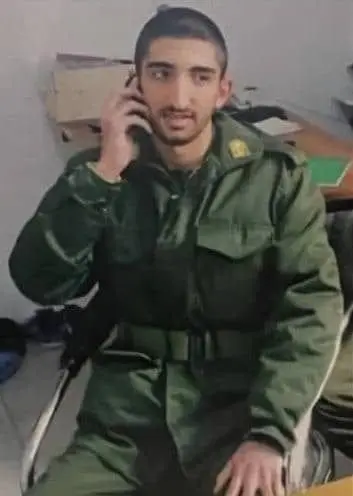
Researcher Majed Al-Abbasi: The killing of the young Arab Sunni Iranian Ahmed Khaled Abdullahzadeh in an attack by the armed opposition group Jaish al-Adl Baloch on the court in the city of Zahedan, the centre of Sistan and Baluchestan province in Iran, a few days ago!
The brother was serving his compulsory military service. The incident killed several civilians, including children and women, and the attackers were neutralised by Iranian security forces.
Morocco
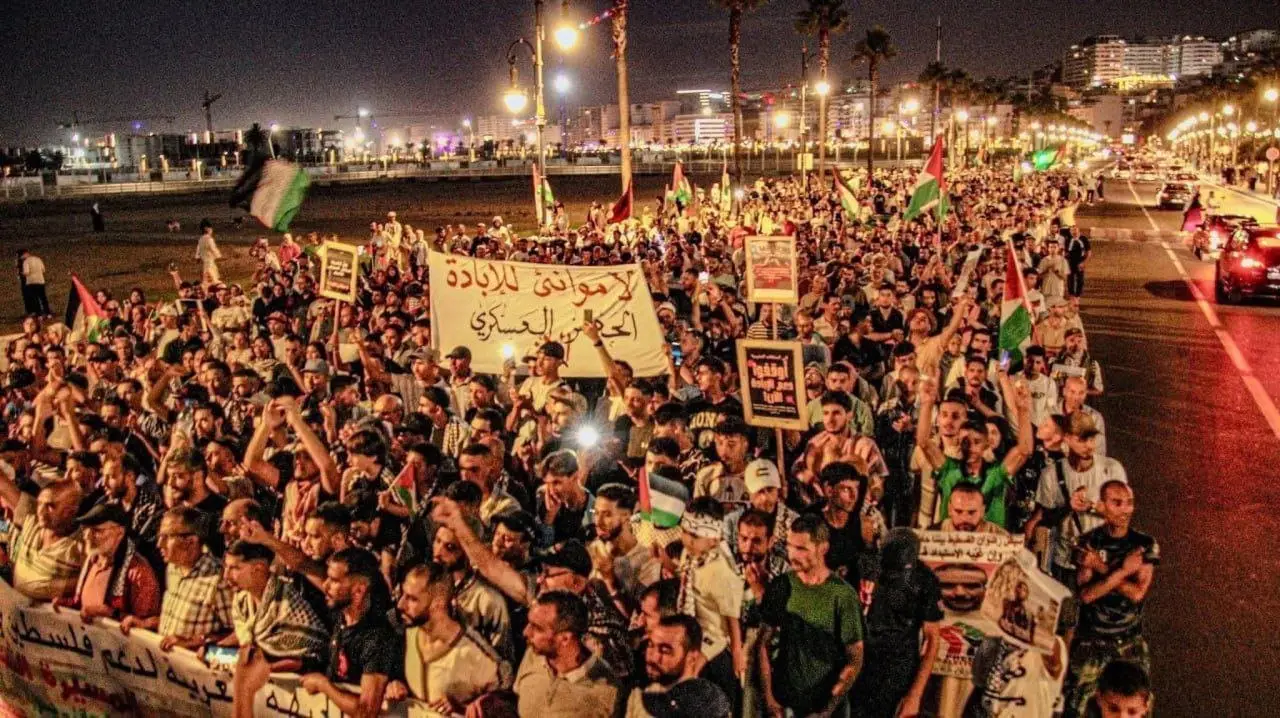
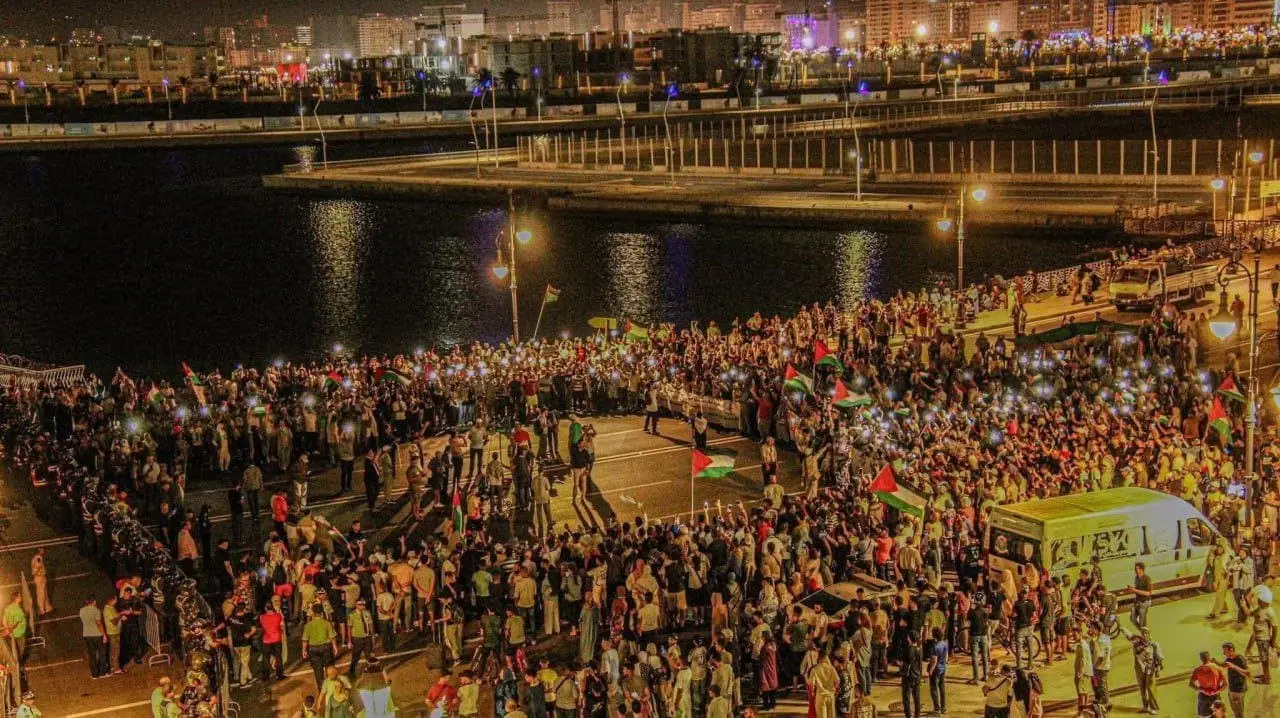
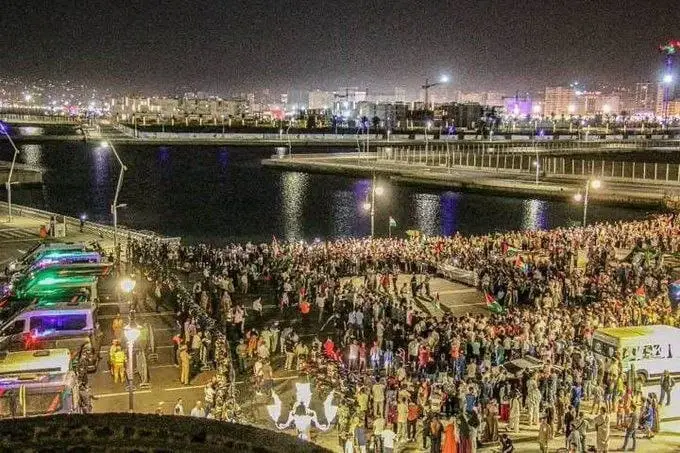
Thousands of Moroccans gathered near the port of Tangier in protest against the docking of ships carrying weapons destined for the occupation.
Muslim minorities
India
In India's recent deportation drive, Muslim men describe how they were thrown into the sea
This campaign, which targeted the Muslim minority, was marked by home demolitions, arbitrary arrests, torture and the absence of due legal process. Authorities ordered raids on poor neighbourhoods inhabited by Muslim workers, and described most of those detained as illegal immigrants from Bangladesh who pose a threat to the country's security.
Although some of those targeted had no legal status, many of them, according to their relatives, were Indian citizens or lawful residents who had spent decades in the country.
Sectarian violence in Yavat – saffron flag raised on a mosque and 16 people arrested
Sectarian violence broke out in the village of Yavat in the Daund area near the city of Pune in Maharashtra state, after a young man posted an offensive message via the WhatsApp application.
A group of extremist Hindus raised a saffron flag on the minaret of a mosque in the area, which led to violent clashes, including the burning of motorcycles and the vandalism of property belonging to Muslims in the village. Police then intervened, using tear gas and batons to disperse the crowds, imposed temporary curfew orders, and arrested 16 people.
Embassy closures
A protester blocks the door of the Jordanian embassy in The Hague, the Netherlands, in protest against the continuation of the war of starvation and genocide in the Gaza Strip, amid clear silence and complicity, and the continued export of food from Jordan to the occupation, and the failure to press for the opening of crossings and an end to the war on Gaza.
Britain
Horrific murder in Cambridge, with the victim a Saudi student
In a horrific crime that shook local circles in the English city of Cambridge, a Saudi student died on the evening of last Friday after being stabbed in the neck while in a park south of the city.
British police announced that they received a report of the incident at 11:27 pm, stating that the 20-year-old young man had been violently attacked, but attempts to save him failed, and he died at the scene at 12:01 after midnight.
In a notable development, the authorities revealed the arrest of two suspects: one, aged 21, is suspected of committing the crime, while the second, aged 50, is believed to have assisted him. Both are residents of the city.
Investigations are ongoing to determine the motives and circumstances of the crime, amid appeals from the police to citizens to provide any information that could help uncover the truth, and the police confirmed they would issue a statement within the coming hours.
For its part, the "EF" International Language School in Cambridge, at which the victim was a student, expressed deep sorrow and described the incident as "a lone attack carried out by a member of the public."


