


This week's report summarises the main events that took place from Saturday, 9 Jumada al-Thani, to Friday, 14 Jumada al-Thani 1447 AH, in the Islamic world.
Palestine
Gaza Strip
In the latest tally, the Ministry of Health in Gaza published on Thursday:
- Since the ceasefire (11 October 2025):
• Total killed: 366
• Total injured: 938
• Total recovered: 619 - The death toll from the Israeli aggression has risen to 70,125 killed and 171,015 injured since 7 October 2023.
Israel announced on Wednesday that it would begin allowing some Palestinians to leave the Gaza Strip for Egypt "in the coming days" via the Rafah crossing. The Israeli military's Coordinator of Government Activities in the Territories, known by the acronym COGAT, said the crossing would open in one direction only, allowing Palestinians to leave Gaza without returning, and that it would be partially supervised by the European Union in cooperation with Egypt and Israel.
However, the Egyptian government denied on Wednesday that there was any coordination with Israel to reopen the Rafah crossing.
Massacres continue in Gaza despite the "ceasefire"
- The Ministry of Health (MoH), as cited by OCHA, reported that since the ceasefire, 347 Palestinians have been killed, 889 injured, and 596 bodies recovered from under the rubble.
- On 24 November 2025, a UNRWA school that had been turned into a shelter in the Jabalia camp was reportedly affected by a quadcopter strike by Israeli forces. No injuries were reported, although the facility sustained minor damage.
- Severe destruction and the suffering faced by women, particularly the more than 57,000 women now heading their households, amid rising prices and loss of income, are described. The UN Women Chief of Humanitarian Action stated that women face hunger, fear, repeated displacement, and winter conditions in temporary shelters that offer little protection.
- According to the Shelter Cluster, collective efforts to prepare for the winter season are under strain due to new winter storms, driving a cycle of renewed emergency needs. Most residents of Gaza still live in inadequate types of shelter that do not meet basic emergency standards, including tents, temporary tents, and partially or severely damaged buildings.
UNRWA says the Israeli occupation is holding around 6,000 trucks loaded with food and relief supplies, enough for three months. UNRWA's media adviser, Adnan Abu Hasna, said that the entry of trucks at present is "formally exceeding" the rate of the ceasefire. However, the numbers are far from meeting the enormous needs after two years of war and siege.
The occupation is preventing the entry of hundreds of vital items: health supplies, water and sanitation materials, and basic foodstuffs.
Most residents of Gaza have lost purchasing power, and total dependence on aid has become the only solution.
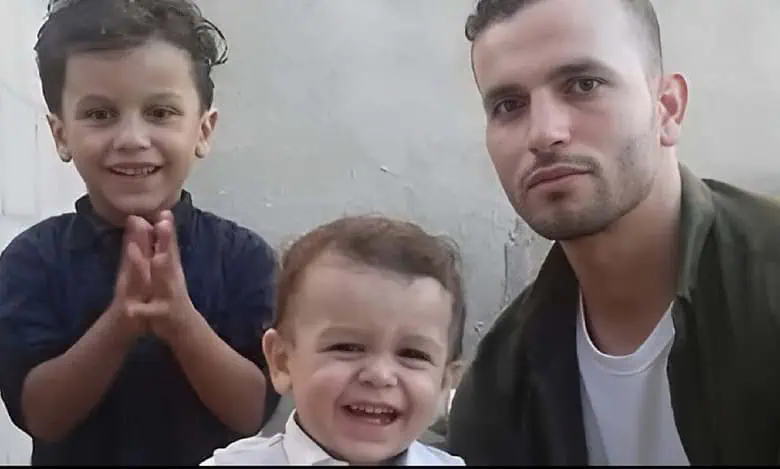
A Gazan family was burned alive in its entirety in an Israeli strike on the so-called "safe zone" on Thursday, 4 December. Israel burned a Palestinian family inside its tent while shelling a displacement camp and a nearby hospital in southern Gaza. Among the victims were a father and his two children, aged eight and ten.
The Director-General of the Ministry of Health in Gaza said:
- 28% of cerebral palsy cases are children.
- 22% of all amputation cases are children.
The spokesman for the Civil Defence in Gaza, Mahmoud Basal, said: "We confirm that reaching bombing sites has become a daily, extremely dangerous challenge, due to the direct targeting of civilians and our inability to reach them immediately to rescue them at critical moments, in addition to repeated appeals from citizens trapped inside the areas of bombardment and incursion."
The acute shortage of fuel and equipment further hampers our humanitarian work. Our teams continue to work in extremely dangerous conditions to save lives, recover victims, and provide assistance to citizens without pause.
Displaced people burned inside their tents as a result of Israeli shelling of the Mawasi area west of Khan Younis in southern Gaza Strip.
Killing of the collaborator Yasser Abu Shabab, leader of an Israeli-backed militia, in Gaza
A collaborator with an Israeli-backed militia in Gaza was killed. It is believed that Yasser Abu Shabab, a leader of a Bedouin tribe residing in the area controlled by Israel in the destroyed zone, died of wounds sustained in a violent clash with strong, well-armed local families, according to local media and sources in Gaza.
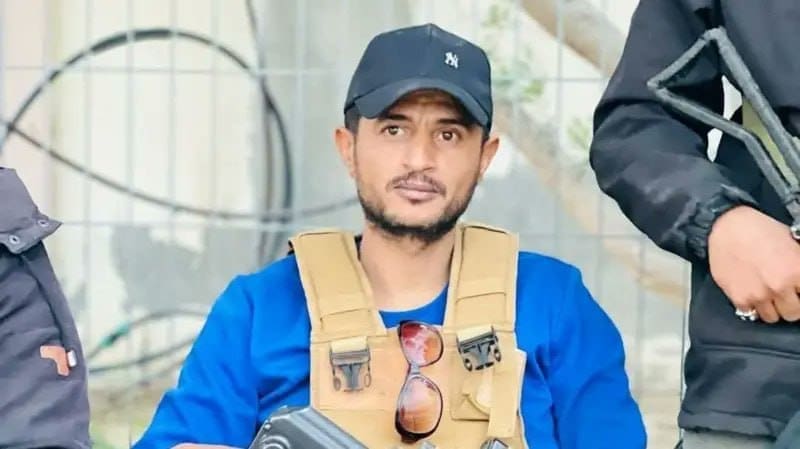
The radio, citing a senior security source, said Abu Shabab's death was "a bad development for Israel," while the Israeli Channel 12 quoted a security official as saying that "Abu Shabab died at Soroka Hospital of wounds sustained in an internal family dispute."
Abu Shabab was present in the Rafah area in southern Gaza Strip and was cooperating with the Israeli occupation army, which had placed great hopes in him and relied on him to establish a model in Rafah for administering the Gaza Strip away from entities affiliated with the Hamas movement, against considerable rejection at the level of the Palestinian street; the occupation forces, however, provided him with cover and protection.
Yasser Abu Shabab is a Palestinian born in 1990 in Rafah in southern Gaza Strip. He had been detained before 7 October 2023 on criminal charges by the security services, and was released following the occupation's bombing of the security services' headquarters.
The Resistance Security Apparatus in Gaza announced, today, Friday, 5 December 2025, the opening of a period of repentance for what it calls "collaborators affiliated with militias backed by the occupation," for only 10 days, calling on all those involved to surrender themselves starting from 5 December 2025.
The Gaza Ministry of Interior said:
- The killing of the criminal Yasser Abu Shabab is an inevitable fate for every traitor.
- We appreciate the position of the families and clans that, from the first day, announced the withdrawal of cover from all criminals involved with criminal gangs.
- The occupation's protective umbrella for traitors will not last long, and the occupation has failed to undermine the unity of our people and their national cohesion.
- We call on everyone involved in criminal groups to surrender themselves to the security services immediately, and we will process the files of those who surrender and work to ease the procedures of their trials.
A doctor in Gaza is developing a kidney device to treat patients with platelet disorders, amid a shortage of medical equipment.
Fighters trapped in Rafah
Regarding the fighters trapped in Rafah, Hamas leader Suhail al-Hindi said:
- We presented initiatives to resolve the file of the fighters trapped in Rafah, but the occupation rejected them.
- We call on the mediators to intervene to resolve the file of those trapped in Rafah, to ensure the continuation of the ceasefire.
Abdullah Hamad, son of Hamas leader and member of its negotiating delegation Ghazi Hamad, was martyred after being besieged with a group of fighters for months in Rafah in southern Gaza Strip.
The activist Handala from Gaza said: The Israeli army claims to have eliminated all the fighters trapped in the tunnels of Rafah. Forty fighters have either been martyred or captured, including the commander of the eastern Rafah battalion.
The Israeli Channel 14 reported: a cell of three Hamas fighters emerged from a tunnel opening and fired an anti-armour missile at the Israeli army. One of the Hamas fighters attached a mine to a Namer armoured vehicle and returned to the tunnel.
West Bank and Jerusalem
- The OCHA documented 1,680 attacks carried out by Israeli settlers in more than 270 communities across the West Bank so far in 2025, an average of five incidents per day.
- Olive harvesting continues to be marked by widespread settler violence, with 178 attacks documented in October and November across 88 communities.
- On 26 November, Israeli forces launched a large-scale operation in Tubas governorate, known as Operation "Five Stones." The operation has so far involved the use of advanced weapons and military tactics, and Israeli forces entered the Far'a camp early on 28 November.
- Israeli forces issued a new demolition order against the Jenin camp on 25 November. This is the latest in a series of demolitions that have rendered parts of the abandoned camp uninhabitable.
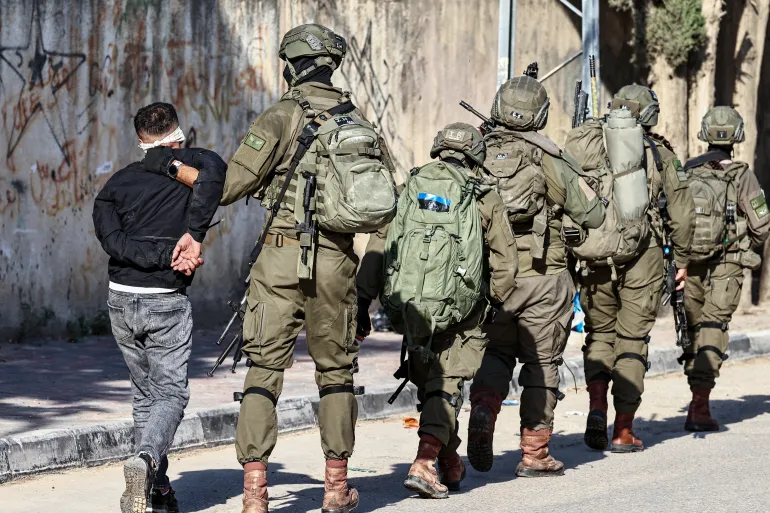
Israeli soldiers detain a Palestinian man during a military operation in the town of Qalqilya in the occupied West Bank on 4 December 2025 [AFP].
Israeli forces escalated their attacks across the occupied northern West Bank through new raids on the city of Qalqilya.
The Israeli army stormed the eastern entrance of Qalqilya city at dawn on Thursday before deploying its soldiers across several neighbourhoods and establishing what local reports described as a tight cordon around one of them, Kafr Saba. According to the Palestinian news agency WAFA, Israeli forces raided a number of homes in the neighbourhood, including some belonging to families of Palestinians who had previously been arrested or killed by Israeli forces. One of the homes raided belongs to the family of Muhammad Barahmeh, who was shot and killed last year by Israeli forces.
Violence intensified in several towns in the northern West Bank last week, following the launch of a new Israeli military operation. The attack began in Tubas and Tammun in late November and later expanded to al-Qatatiya and al-Masliya, bringing curfews, raids, mass arrests, and significant damage to local infrastructure.
The Israeli army said the goal of its operations in the occupied West Bank is "to arrest Palestinian fighters." Israel has carried out near-daily raids in the area since 2022, which escalated after it began its genocidal war in Gaza in October 2023. These raids have made daily life for Palestinians in the West Bank more difficult and forced tens of thousands to leave their homes. | Quoted from Al Jazeera.
According to the human rights organisation Al-Bidar: settlers have begun establishing a new settlement outpost north-east of Jerusalem, as part of settlement expansion attempts that threaten the agricultural land and population communities in the area.
Residents of the villages of Kafr Qaddum east of Qalqilya and Bayt Lid in Tulkarm in the northern West Bank confront settlers' attack on their lands.
The media committee of the Jenin camp said: "Continuous demolition operations in the Jenin camp and demolition notices in several areas. The occupation army distributed demolition notices to a number of homes in the town of Silat al-Dhahr and forced a number of citizens to evacuate their homes in the al-Jabriyat neighbourhood around the Jenin camp.
Occupation forces have begun demolishing 24 additional residential buildings in the Jenin camp, after the destruction of more than 700 homes and facilities, partially or fully.
Since the beginning of the Israeli aggression on Jenin, the occupation has forced 4,000 Palestinian families to displace from the camp in harsh humanitarian conditions. Occupation forces have escalated acts of abuse against citizens in the towns of al-Mahfaza, storming their homes and vandalising their contents, where infantry units were deployed and a number of citizens were detained and interrogated.
Since the beginning of the aggression, more than 69 martyrs have been recorded in Jenin, its camp and its towns, including 4 by gunfire and assaults by Palestinian Authority security services."
- Haaretz reported: National Security Minister Itamar Ben-Gvir informed the commander of the Border Police undercover unit (Mista'arvim) in the West Bank that he would be promoted, one day after his personnel executed Palestinians. According to several sources, Ben-Gvir arrived yesterday at the unit's base to inform its commander, personally, of his decision to approve the Commissioner General and the Police High Command's decision to promote him.
- Israel's Channel 12 reported: a cargo plane carrying a large quantity of military equipment landed at Ben Gurion Airport, arriving in Israel from the UAE.
Operations this week

The martyr, as we reckon him, Muhannad Tariq Muhammad Zughayyar (17 years old), who was killed by occupation gunfire in the city of Hebron after carrying out a ramming attack that injured a settler woman.
A view of the vehicle in which the perpetrator of the ramming attack in Hebron was martyred.
Two settlers were also injured in a stabbing attack north of Ramallah in the West Bank. Hebrew sources said that "the two injured in the attack at the Atirot settlement were two soldiers from the Paratroopers Brigade."
The moment the martyr, as we reckon him, Muhammad Ruslan Asmar carried out a stabbing attack after being stopped by occupation soldiers near the towns of Umm Safa and Attara north of Ramallah.
The Palestinian Campaign to Retrieve the Bodies of the Martyrs announced:
- Occupation forces are holding the bodies of two martyrs from Hebron and the town of Beit Rima north of Ramallah.
- The number of martyrs' bodies held by the occupation has risen to 761, including 74 children, 89 prisoners, and 10 female martyrs.
The prisoners file
The "Rekevet" section, located underground
According to a briefing issued by the Commission for Detainees and Ex-Detainees Affairs and the Palestinian Prisoners' Club, based on dozens of visits during November 2025, the general conditions inside the section are:
- Testimonies from Gaza detainees are the harshest and most brutal since the beginning of the war.
- Food: three meals consisting of very small morsels.
- Mattresses: distributed only from 11 pm until 4 am.
- During the day, detainees sit on iron bars above the beds.
- Collective prayer is prohibited and permitted only individually.
- Possession of the Holy Quran is prohibited.
- Continued daily repression and beatings.
- During the "fura" (raid): handcuffing, and prohibition of raising the head.
- Insults, humiliation, and constant threats.
- Before visits: detainees are forced not to speak about what happens inside the section.
- Prevention of any information reaching them about what is happening outside the prison.
In the "Gilad" camp, part of Ofer prison, detainees face harsh detention conditions and systematic abuse, the most severe of which is electric shocks, which have become a main tool of torture and repression. One detainee in the "Gilad" camp said that a prisoner was subjected to electric shocks after prison guards saw him leading detainees in prayer inside the room.
Other detainees reported being subjected to repression, electric shocks, and abuse for standing at the iron windows inside the cells in an attempt to breathe some air.
According to the Prisoners' Media Office: the report issued by the Public Defender's Office in Israel, which reveals what goes on in the occupation's prisons, constitutes direct acknowledgement of a serious deterioration in the conditions of prisoners.
The document reveals acute hunger, weight loss, and a shortage of drinking water, resulting from the adoption of a poor food list and deliberate neglect. The report confirms catastrophic overcrowding inside the cells, collective sleeping on the floor, and confinement of up to 23 hours a day in conditions described as "unfit for habitation."
The report recorded an epidemic spread of scabies and other skin diseases, along with systematic physical assaults by guards against prisoners without justification.
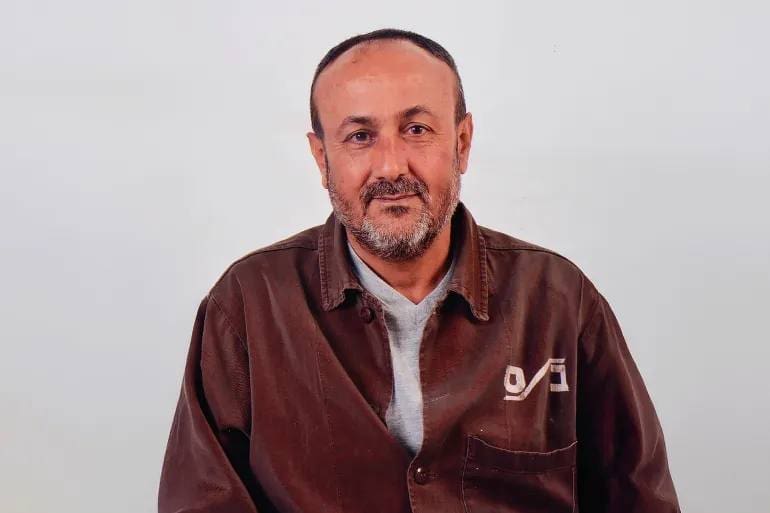
Qassam, son of the prisoner leader Marwan Barghouti, wrote: A freed prisoner informed me this morning that occupation forces smashed my father's body, broke his teeth, ribs and fingers, and cut off part of his ear inside prison, and that they broke his fingers in stages for amusement.
Testimonies of Palestinian women prisoners in occupation prisons: isolation, repression, and torture without limit
- Farah Abu Ayash
- Violent restraint, dragging, beating, a heavy chain on the shoulders.
- Interrogation she described as a "horror film."
- Repeated fainting due to the cold in the Moscobiya.
- Transferred to an underground cell full of insects.
- Tasneem Barakat Odeh
- Dragged down the stairs while handcuffed, causing chronic chest pain.
- Kicked with boots, continuous insults.
- Sleeping on the floor in an overcrowded room.
- Amani al-Najjar
- Degrading searches, confiscation of all personal necessities.
- Basic hygiene items such as a comb are not allowed.
- Relies on spiritual strength and memorising the Quran inside the cell.
- Ibaa Maaroof Aghbar
- Clean underwear and clothing are banned entirely.
- Daily suppression and detention in deteriorating health conditions.
- Walaa Tanja
- Daily isolation for 12 hours while handcuffed.
- Stepping on the neck during suppression.
- Deep marks from the "integrated handcuffing".
- She describes this as the "hardest imprisonment" but says she grows stronger.
- Tasneem al-Himes (freed)
- Witnessed violations against 50 female prisoners.
- Beating, gas and serious injuries.
- Prohibition of the hijab and the jilbab.
- Denial of treatment for long periods.
The Prisoners' Media Office said:
- The number of prisoners sentenced to life imprisonment is 114, from various governorates: Hebron 28 – Nablus 21 – Ramallah 17 – occupied territories 16 – Jenin 9 – Tulkarm 7 – Bethlehem 4 – Jericho 3 – Qalqilya 2 – Salfit 2 – Jerusalem 3 – Gaza 2.
- Life-sentence prisoners face harsh conditions and escalating abuse as the state of emergency inside the prisons continues.
- The original number before 7 October 2023 was 608 prisoners serving life sentences; 503 of them were released through the Tufan al-Ahrar exchange deal, leaving 114 as of December 2025.
Israeli occupation forces also blew up the home of a Palestinian prisoner detained in the town of Zawata, northwest of Nablus in the West Bank.
Prisoners' institutions announced the death of three prisoners held in occupation prisons from among the Gaza detainees: 1. Tayseer Saeed Sabbaha, 60 years old. 2. Khamis Shukri Ashour, 44 years old. 3. Khalil Ahmad Hanieh, 35 years old.
The occupation releases prisoner Murad Hassan Diab Abu Zeitoun from the village of Zabuba west of Jenin. The freed prisoner spent 22 years in occupation prisons since 2003.
Israeli Prime Minister Benjamin Netanyahu requested an official pardon from President Isaac Herzog in his long-running corruption cases, in the name of "national unity". Israeli opposition parties say Netanyahu should admit guilt and resign.
Syria
According to Syrian sources, Israeli enemy military forces penetrated the southern countryside of Quneitra and raided citizens' homes more than once this week.
The Israeli occupation prime minister said: We are determined to prevent the positioning of terrorists and hostile acts near our border. We expect Syria to work toward establishing a weapons-free zone, from Damascus to the buffer zone, especially Mount Hermon.
- We insist on defending our Druze allies, and on keeping Israel safe from any ground attack from the border areas.
- We can reach an agreement with the Syrians through understanding and good will, but we hold firmly to our principles.
Syria's representative to the Security Council, Ibrahim Olabi, said:
- Our talks with Israel were conducted under the follow-up of President Trump to address the security concerns of both sides.
- Syria places peaceful and diplomatic means at the top of its priorities.
- These talks with Israel do not in any way address the fate of the occupied Syrian Golan.
- The occupied Syrian Golan is Syrian Arab land, and our country has every right to recover it in full.
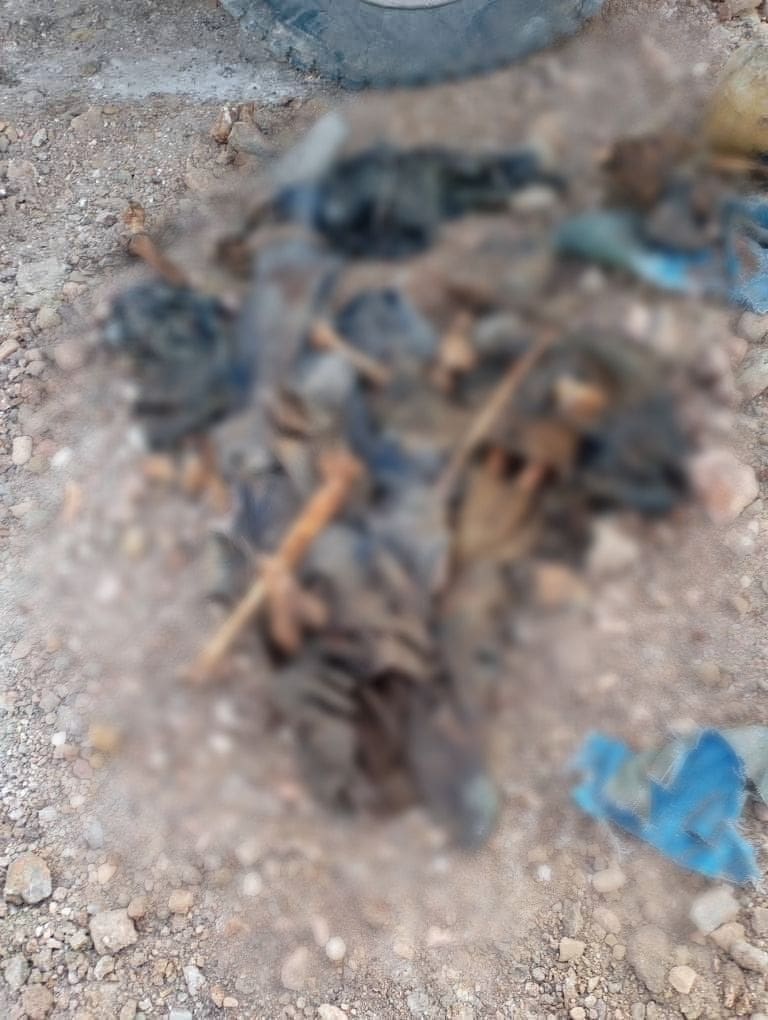
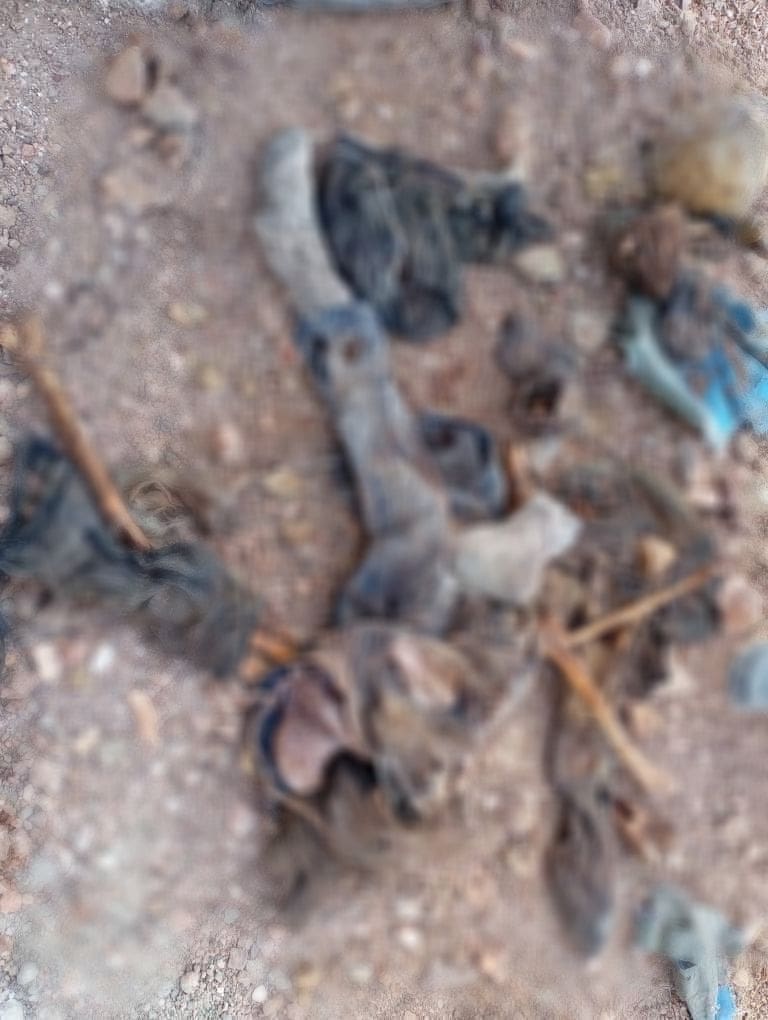
Remains of a number of people killed during the former regime were found in a mass grave in the Mazraa area on the Tripoli road in Homs.
The child Mohammed Ahmad al-Bakour, aged 12, was killed, and two other children of the same age who were with him were injured, when a cluster bomb left over from shelling by the Assad regime and its allies exploded while they were playing in farmland in the town of Talmanes in the countryside of Idlib.
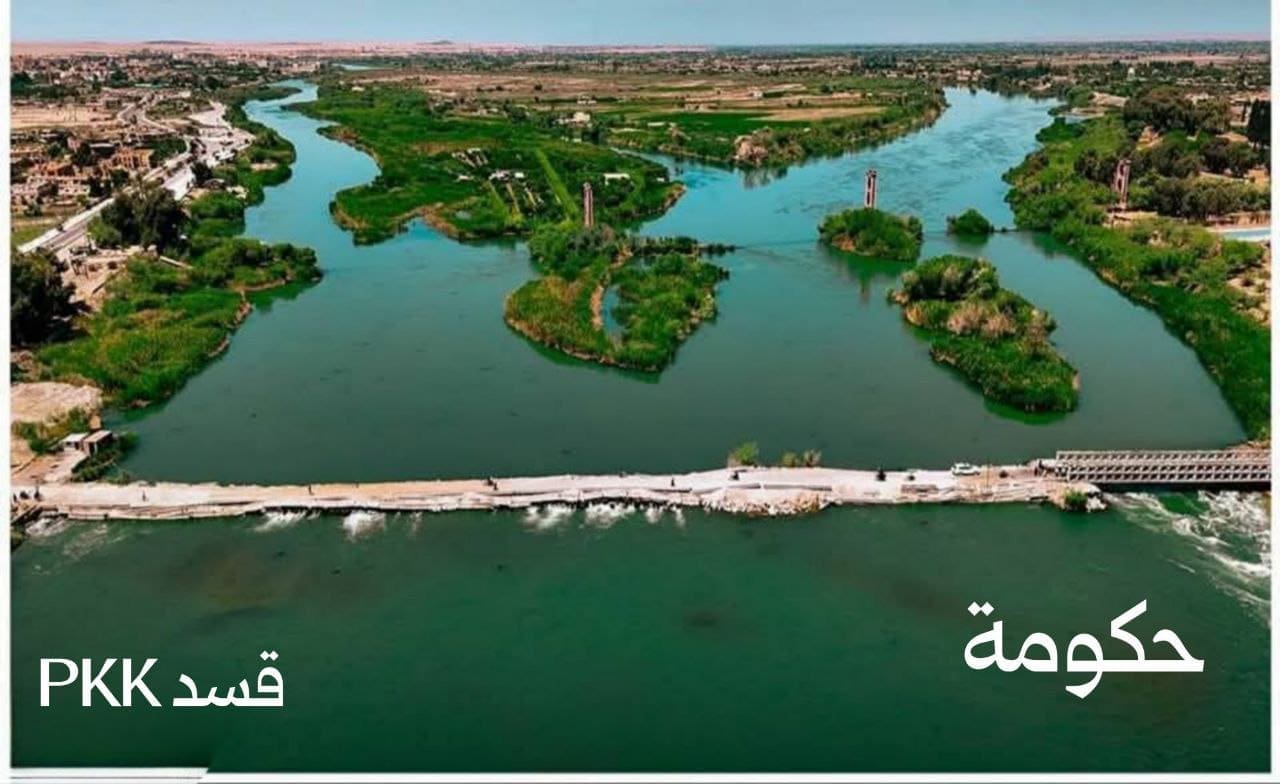
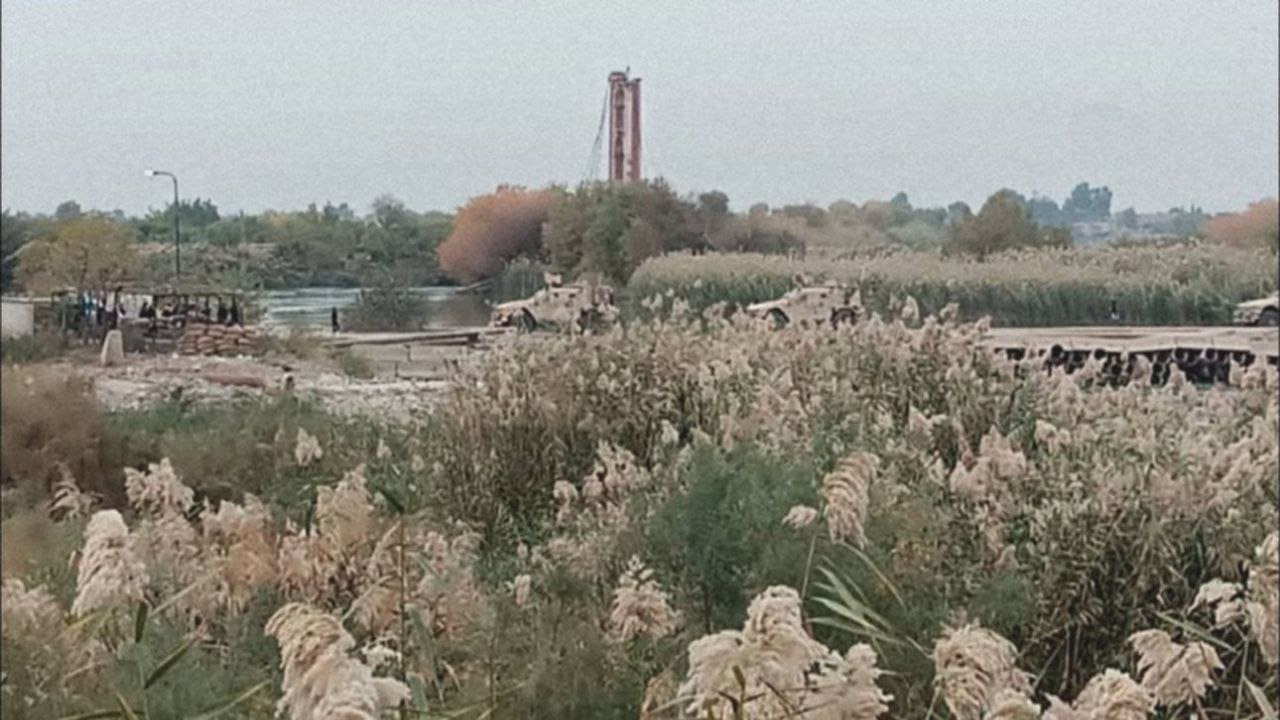
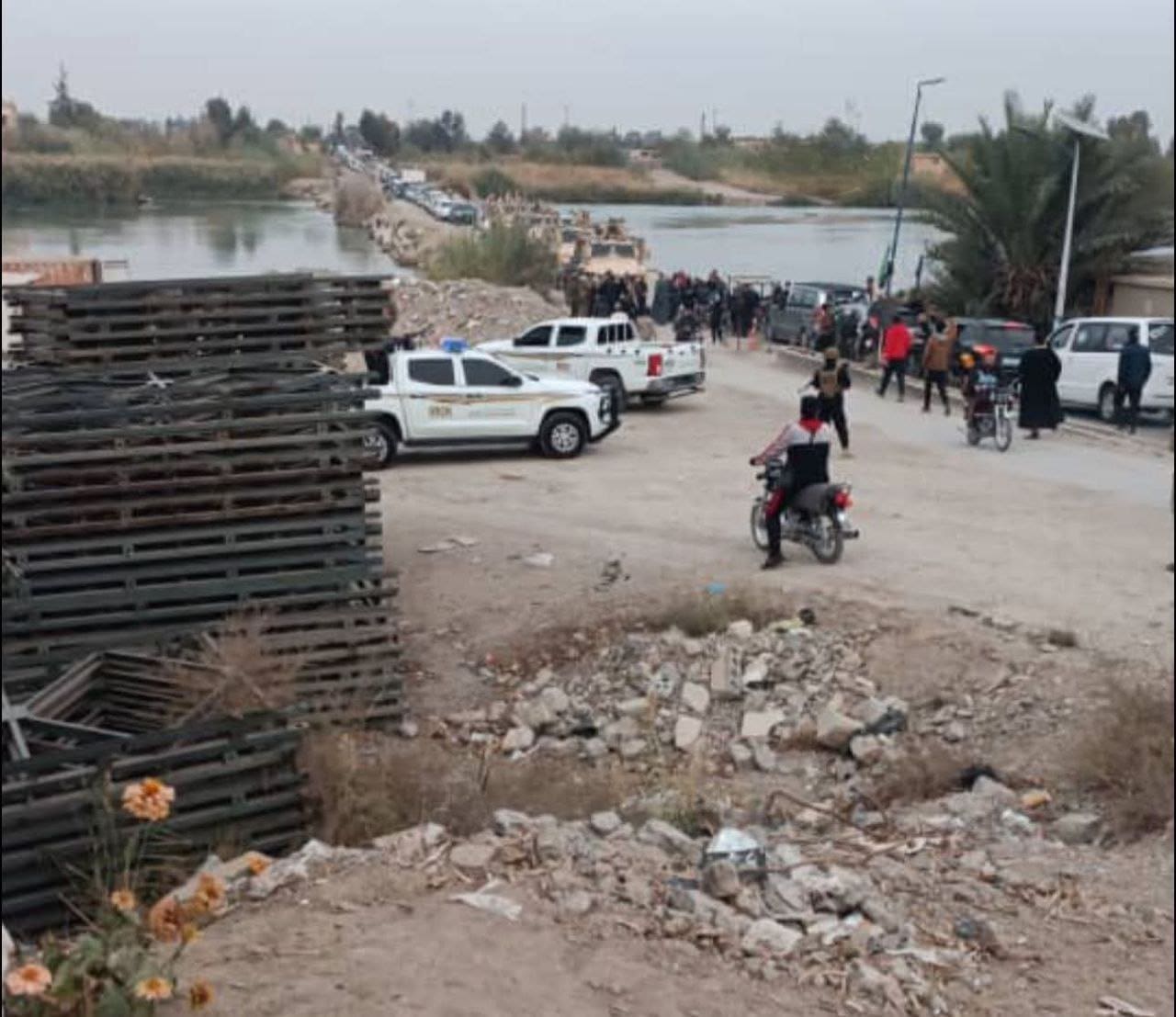
Journalist Zein al-Abidin published on Saturday: For the first time ever, a convoy of the International Coalition crossed the earthen bridge and entered the city of Deir ez-Zor, accompanied by helicopter aircraft, amid drones flying overhead, and a force of Syrian security was waiting for it.
Coalition officers within the convoy - they have now headed into the city, escorted by General Security, amid a major security mobilisation in Deir ez-Zor city - there are drones in the air.
The earthen bridge is the one linking the two banks of Deir ez-Zor across the Euphrates River.
A military force belonging to Syrian Security then reached the bridge and asked the International Coalition convoy to return and leave the area. Reports said the reason for the return was the lack of coordination with the regional command in the governorate. The convoy returned.
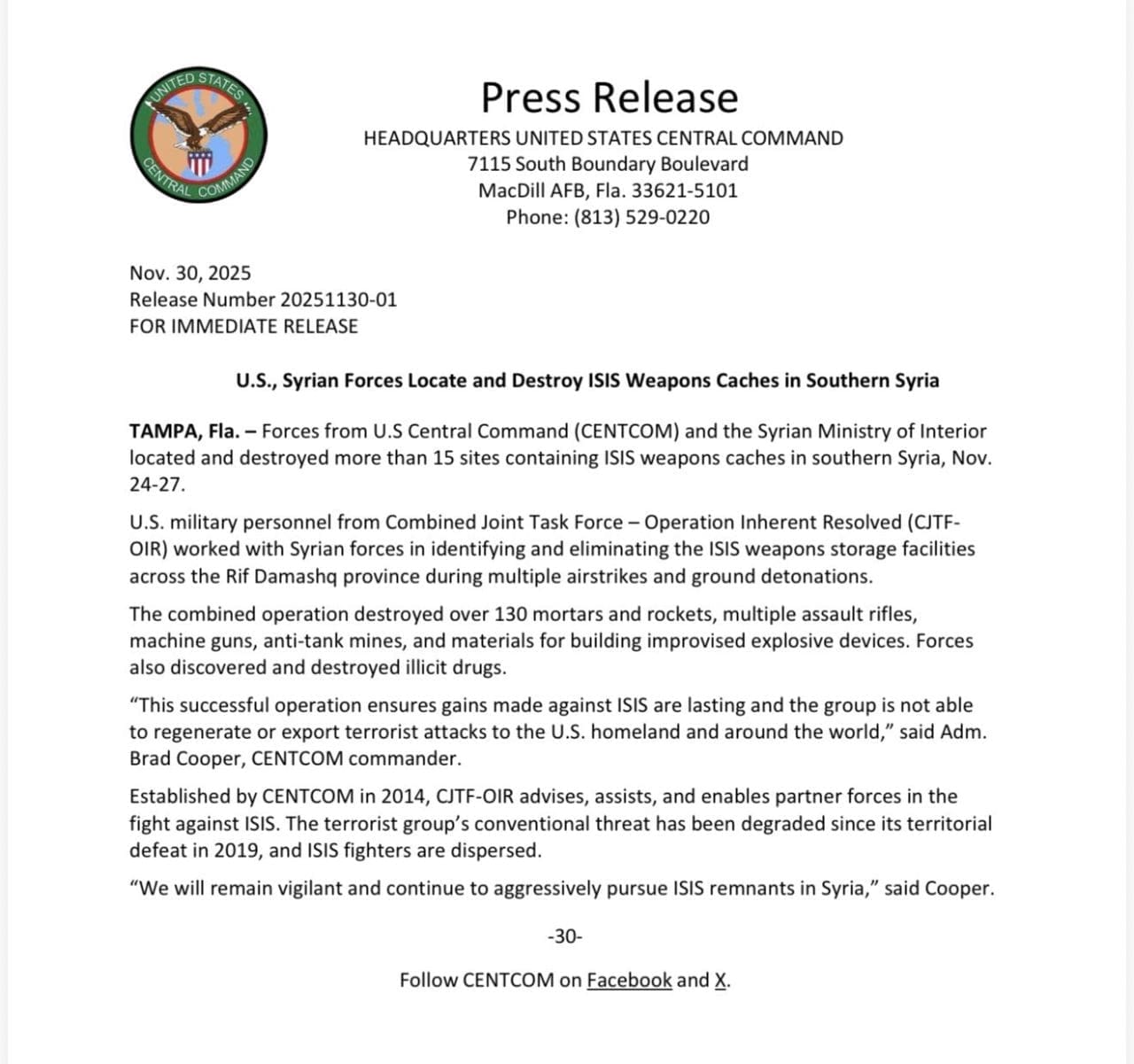
The US Central Command (CENTCOM) published: In cooperation with the Syrian Ministry of Interior, we destroyed more than 15 Islamic State (ISIS) sites in the Rif Dimashq governorate between 24 and 27 November of this month. We also destroyed more than 130 mortar shells and rockets, a number of assault rifles and machine guns, anti-tank mines and explosive materials. We found illegal narcotics at some sites and destroyed them.
US Central Command commander Admiral Brad Cooper said: "This successful operation ensures the continuation of the gains achieved against ISIS and the group's inability to regenerate or export terrorist attacks to American territory and around the world." Cooper added: "We will remain vigilant and will continue to pursue ISIS remnants in Syria forcefully."
According to Al-Majalla, Hebrew media reported that Israel sent strongly worded messages to Syrian President Ahmed al-Sharaa following the exceptional incident in which six Israeli soldiers were wounded. According to security sources cited by the newspaper, the message stressed that Tel Aviv cannot withdraw from the areas it has taken control of, so that they do not become a staging ground for hostile parties, adding that "no agreement with Damascus is currently on the horizon".
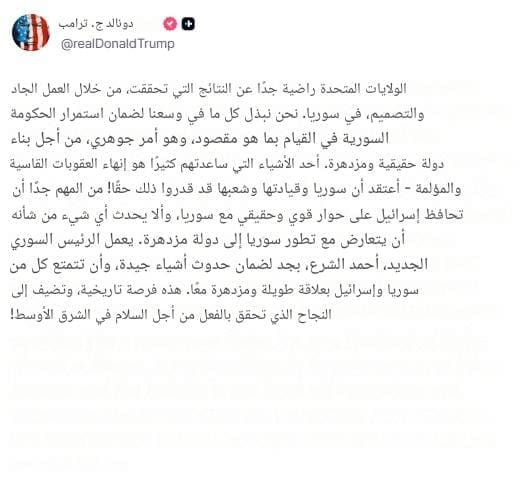
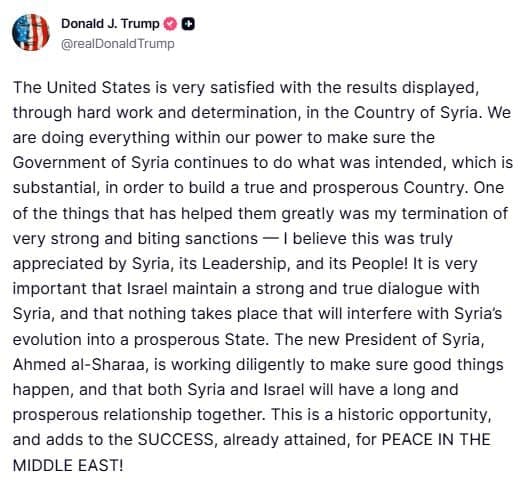
Trump: Syria's new president, Ahmed al-Sharaa, is working hard to ensure good things happen, and that Syria and Israel enjoy a long and successful relationship together.
Ahmed al-Sharaa received from the US envoy to Syria, Tom Barrack, a message from Trump: "Ahmed, you will be a great leader, and the United States will help!"
The SDF file
Information Minister Hamza Mustafa said regarding the Al Jazeera issue and the SDF militia:
- Mazloum Abdi's call to the Druze and Alawites is ridiculous. At times the SDF militia behaves as if it were an empire; it is an empire on a chicken's leg. Does Abdi not know that the people of al-Jazira regard him as an occupying force! The people of al-Jazira today complain against the state because they see it as lenient in its rhetoric toward the SDF.
- The SDF is playing for time, and this is a major risk in an environment that rejects its presence and drives it out.
- The SDF has been governing al-Jazira as an occupying force since 2015. What has it done? It has not paved a single road. What model will Mazloum Abdi offer? Al-Jazira has two rivers, the Tigris and the Euphrates, and its people are thirsty. - What the SDF offers is only a set of empty slogans.
Interior Ministry spokesman Nour al-Din al-Baba, regarding the crime committed east of Homs last week which resulted in the killing of a man and his wife, said: It has been established that the killer in the Zaidal town crime is a man called Mohammed al-Hamid bin Khalifa, born in 1999. He was found to be a user of narcotics, specifically the highly dangerous crystal meth, and he is a direct relative of the victim, being the son of the victim's sister.
The perpetrator committed the act for the purpose of robbery, exploiting his kinship and his familiar entry into the victims' home. After they discovered his identity, he killed them in cold blood, then wrote sectarian phrases in the victim's blood in an attempt to mislead justice, and set fire to the place to destroy evidence.
The father of Mohammed al-Hamid disowned his son, the perpetrator of the Zaidal crime in Homs.
Lebanon
The Syrian prisoner from Daraa governorate, Mohammed Mahmoud al-Hussein, aged 71, died while breathing his last in the Qobbeh prison in Tripoli, Lebanon, as a result of the poor conditions in Lebanese prisons.
Naim Qassem affirmed that the deceased Haytham al-Tabtabai was in charge of Hezbollah operations in Syria from 2012 until 2015.
In his speech on 28 November, Naim Qassem acknowledged that the deceased Haytham Ali Tabtabai spent 9 years in Yemen from 2015 to 2024 to assist the Houthis.
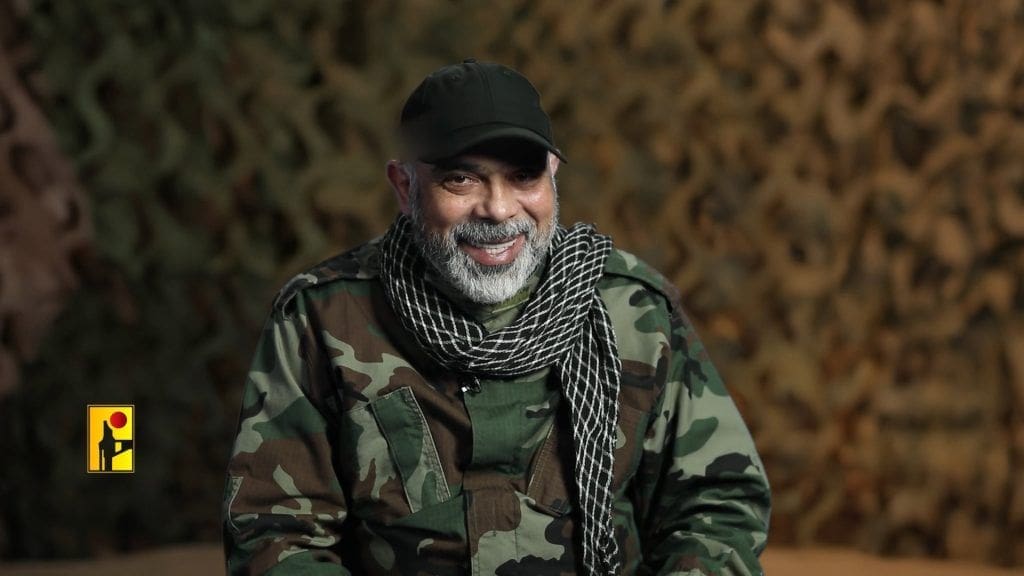
In a statement on Sunday, Hezbollah mourned the prominent military leader Haytham Ali al-Tabtabai, who was killed in an Israeli strike that targeted him in the southern suburb of Beirut.
Tabtabai was the former commander of the Radwan Force, which is regarded as Hezbollah's strike force and which was completely destroyed in the recent war, and he led the party's operations in Syria and Yemen.
A Lebanese security source told Reuters that Tabtabai was quickly promoted after the killing of other senior Hezbollah officials, and was appointed military commander last year.
The United States demanded that Lebanon return an advanced missile used by the occupation in the assassination of Hezbollah's chief of staff Ali Tabtabai, which did not explode due to a technical error, fearing it could fall into hostile hands, according to sources cited by the Israeli newspaper Maariv.
Sudan
The Sudan Doctors Network announced: The Rapid Support Forces kill 4 people, including a child, in the Darja neighbourhood of al-Fashir, and these violations threaten the lives of civilians.
The Sudan Doctors Network said in a statement that "9 people, including 4 children and two women, were killed and 7 others were injured as a result of deliberate targeting with suicide drones by the Rapid Support Forces and the Sudan People's Liberation Movement of a kindergarten and a number of civilian facilities in the city of Kalogi in the state of South Kordofan".
The Guardian: Satellite images reveal that the massacres by the Rapid Support Forces have turned one Sudanese city into what resembles a "human slaughterhouse"
While the final death toll of the massacre remains unclear, members of the British Parliament were informed that at least sixty thousand people have been killed in al-Fashir.
Sarah Champion, chair of the International Development Committee of the House of Commons, said: "Members received a special briefing on Sudan, in which one academic stated: our minimum estimate is that sixty thousand people have been killed there over the past three weeks."
As many as one hundred and fifty thousand residents of al-Fashir remain missing since the city fell to the Rapid Support Forces. They are not believed to have left the city, and this horrifying development comes amid growing grim speculation about their fate. No expert or agency has been able to explain where the tens of thousands of residents who have disappeared since the Rapid Support Forces (RSF) overran al-Fashir, the army's last major stronghold in the region, on 26 October, after a brutal 500-day siege by famine, have gone.
The UN warns of a new wave of atrocities in Sudan's Kordofan region
The UN's senior human rights official issued a stark new warning on Thursday about Sudan, saying he fears "a new wave of atrocities" amid escalating violent fighting in the Kordofan region.
According to the UN, the conflict in Sudan has killed 40,000 people — although some human rights groups say the death toll is far higher — and created the world's worst humanitarian crisis, with more than 14 million displaced.
The United States is considering a much broader set of sanctions against the warring parties in Sudan's war, in tacit acknowledgement of US envoy Massad Boulos's inability to persuade the parties to accept a ceasefire.
Last week, Donald Trump announced that work to end the war began after a personal request for direct intervention from Saudi Crown Prince Mohammed bin Salman.
"Sudan Doctors": Rapid Support Forces turned a hospital in Kordofan into a military barracks
The Sudan Doctors Network reported on Friday last that the Rapid Support Forces had turned the hospital in the city of En Nahud in West Kordofan state, in southern Sudan, into a military barracks. The independent committee added in its statement: "The Rapid Support Forces have converted a large part of En Nahud hospital into a military command centre and barracks for the forces since they overran the city more than five months ago," and confirmed that "the RSF has prevented the hospital from performing its basic role of providing health care to the population".
Doctors Without Borders: Rising maternal mortality rate in West Darfur is alarming
A Doctors Without Borders official revealed on Tuesday an alarming rise in the maternal mortality rate in West Darfur, amid deteriorating health conditions caused by a shortage of funding. The number of hospitals and health centres in Darfur has shrunk to less than 40% compared with the number of facilities operating before the war, according to a report published by the International Organization for Migration on 25 October, leaving most of the population without medical care.
Operations director of Doctors Without Borders Kenneth Lavel said in a video clip: "The maternal mortality rate in West Darfur is alarmingly high, reaching more than one death per month this year." He reported that safe delivery services are unavailable, which has forced many women to give birth at home with the help of traditional midwives who are often untrained and lack adequate supplies, putting both mother and child at severe risk.
Also on Saturday, the Sudan People's Liberation Movement-North, led by Abdelaziz al-Hilu, accused the Sudanese army of killing 45 civilians, most of them school students, in a drone strike on a village in South Kordofan.
The Sudan People's Liberation Movement-North said in a statement that the army "committed a massacre against students in the Kumo area of the Nuba Mountains", adding that the attack left more than eight people seriously injured, including women and children.
The Sudanese army has not issued any comment on the incident. However, media platforms loyal to the army reported that the air force targeted training camps and supply depots belonging to the Sudan People's Liberation Movement-North in the Kauda area. The attack is the first bombing targeting the movement's positions inside the Nuba Mountains since the ousting of President Omar al-Bashir in April 2019. Source: Sudan Tribune.
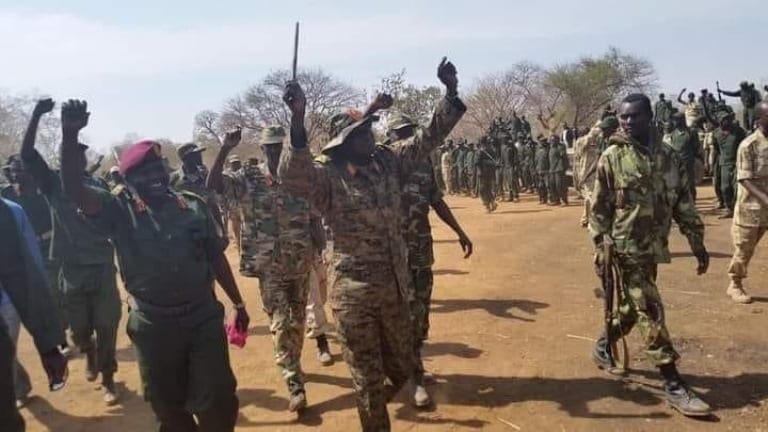
On Thursday, the Sudan People's Liberation Army led by Abdelaziz al-Hilu also announced the "recapture" of a key area in South Kordofan state, days after the Sudanese army took control of it.
Yemen
Southern Yemeni separatists expand: Hadramawt and al-Mahra under the "Transitional" council's control
The Southern Transitional Council in Yemen has taken over the governorates of Hadramawt and al-Mahra, extending its control over Yemeni territory, in an operation that began more like a handover by the Presidential Leadership Council, which ordered its forces to hand over their positions and camps to the "Transitional Council" without clashes. While observers doubt that the Transitional Council's move took place without a green light from the UAE, its main backer, whose influence in Yemen grows with this expansion, many questions are being raised about the future of the secession project the Transitional Council has pursued since its founding, and whether these developments mean an attempt to impose this project as a fait accompli, while the battle with the Houthis appears remote from current priorities.
The Southern Transitional Council's control of Hadramawt in eastern Yemen, on Wednesday before last, marks a turning point in the council's campaign for the secession of southern Yemen and the declaration of a southern state within the geographic borders of the "People's Democratic Republic of Yemen," or what was known as South Yemen, which united with North Yemen (the Yemen Arab Republic) on 22 May 1990, whereupon the Republic of Yemen was declared under this unity.
The Southern Transitional Council's takeover of Hadramawt proceeded rapidly, in an operation named "Promising Future," after a large military mobilisation of its forces from the governorates of Aden, Shabwa, Abyan, Lahj and al-Dhale, all of which are under its control. The mobilisation coincided with a military parade the council held for southern forces at the Parade Ground in Aden on 30 November, the 58th anniversary of independence. Notably, however, the parade featured several ministers of the legitimate government, most prominently the Ministers of Defence, Mohsen al-Daari, and of Foreign Affairs, Shae al-Zindani. This participation outlines the role the Presidential Leadership Council played in the handover of Hadramawt governorate to the Transitional Council, a scene completed when the First Military Region issued orders to its soldiers to hand over the camps and positions, despite the massive stockpile of weapons within the military region, including heavy weapons such as hundreds of tanks and armoured vehicles, and dozens of helicopters and other equipment. Yet the scene was surprising: within a single day the Transitional Council took full control of the city of Seiyun, capital of Wadi Hadramawt, seizing the military region's headquarters, the camps, the presidential palace, Seiyun airport and the administrative offices complex.
In a statement, the Transitional Council affirmed that the "Promising Future" operation "comes after exhausting all the options put forward over the past years to restore stability to Wadi Hadramawt, end the state of security chaos, and stop the exploitation of the area by forces foreign to the wadi and the governorate." The council stressed that "the forces that were removed were, regrettably, the lung through which the Houthis, the Muslim Brotherhood and other terrorist organisations breathe, exploiting their positions for influence and profit far from the interests of the homeland and the citizen," adding that "Hadramawt was and will remain a fundamental pillar of the project of the southern state, and we will not accept that it remain hostage to projects of terrorism, domination or smuggling." Simultaneously, a Saudi security delegation led by Major General Mohammed Obaid al-Qahtani visited the city of Mukalla, capital of Hadramawt, met with official and military leaders as well as tribal and social figures in Mukalla, and the Saudi official demanded "the withdrawal of any military forces or security formations that arrived from outside the governorate."
The local authority in Hadramawt announced an agreement on a truce between the local authority in Hadramawt governorate and the Hadramawt Tribal Alliance led by Amr bin Habrish (a tribal alliance that controls oil fields and demands self-rule for Hadramawt), brokered locally with Saudi support, to contain the military tensions that broke out near strategic oil facilities in the governorate. However, this announcement did not stop the Transitional Council from continuing its military movements: it moved east to take control of the governorate of al-Mahra on the Omani border. Early on Thursday, the Southern Transitional Council announced that its forces had taken over the duties of protecting and securing the presidential palace in the city of al-Ghaydah, capital of the governorate, as well as the port of Nishtun, the al-Ghaydah axis command, the 137th Infantry Brigade, and all military sites and security checkpoints. Source: Al-Araby Al-Jadeed.
Officially: "Petromesila" announces gradual resumption of operations
The Mesila Petroleum Exploration and Production Company, "Petromesila," announced on Thursday the gradual return to operations in the Mesila oil sectors, a few hours after the local authority in Hadramawt confirmed the success of the mediation.
The company said in a statement that the top priority would be providing the fuel needed to generate electricity. The national company operating the oil sectors confirmed that the decision to resume operations came in step with "improved security conditions and securing the oil fields and facilities."
Houthi militia shells residential neighbourhoods north of Taiz city with artillery shells
The Houthi militia shelled residential neighbourhoods north of Taiz city with artillery shells on Monday, with no information about human casualties. According to a correspondent for "Al-Masdar Online," mortar shells targeted residential neighbourhoods in Jabal Jarra, Wadi al-Qadi and Wadi al-Zunuj north of Taiz city.
Activists on social media shared images showing traces of smoke from the shelling in the centre of the city. A local source told "Al-Masdar Online" that this shelling coincided with the sound of mutual clashes between the forces of the legitimate government and the Houthi militia on the eastern front of Taiz city.
Over the past ten years, hundreds of civilians have been killed by the indiscriminate Houthi shelling that periodically rains down on residential neighbourhoods, while others have been killed by Houthi snipers. Cited from Al-Masdar Online.
UN report: Yemen among the worst countries for food insecurity
The World Food Programme affirmed that the situation in Yemen remains highly fragile, explaining that the decline in humanitarian funding over the past two years has led to the reduction of food and nutrition programmes, raising the risks of malnutrition and pushing more families into levels of acute hunger.
The World Food Programme revealed in its report this year that Yemen remains among the countries most affected by acute hunger worldwide, as a result of the continuing effects of the conflict, economic deterioration and climate shocks that have affected food security in the country.
The report noted that Yemen will be among only six countries to record catastrophic levels of food insecurity (Phase 5) this year, with some 41,000 people facing a food crisis that threatens their lives and requires urgent humanitarian intervention to save them.
This comes within broader estimates that 318 million people in 68 countries will suffer acute hunger during 1445/1446 AH (2025 CE), while 41.1 million people worldwide were classified within emergency or worse levels (Phase 4 and above).
Indonesia
The Indonesian army has intensified its relief efforts in three provinces on the island of Sumatra, devastated by deadly floods and landslides, and many residents remain stranded without access to government aid.
Floods have swept through entire villages and carried them away, destroying homes, roads and bridges, while rescue teams struggle to reach isolated areas. Dozens remain missing, raising fears that the death toll may rise.
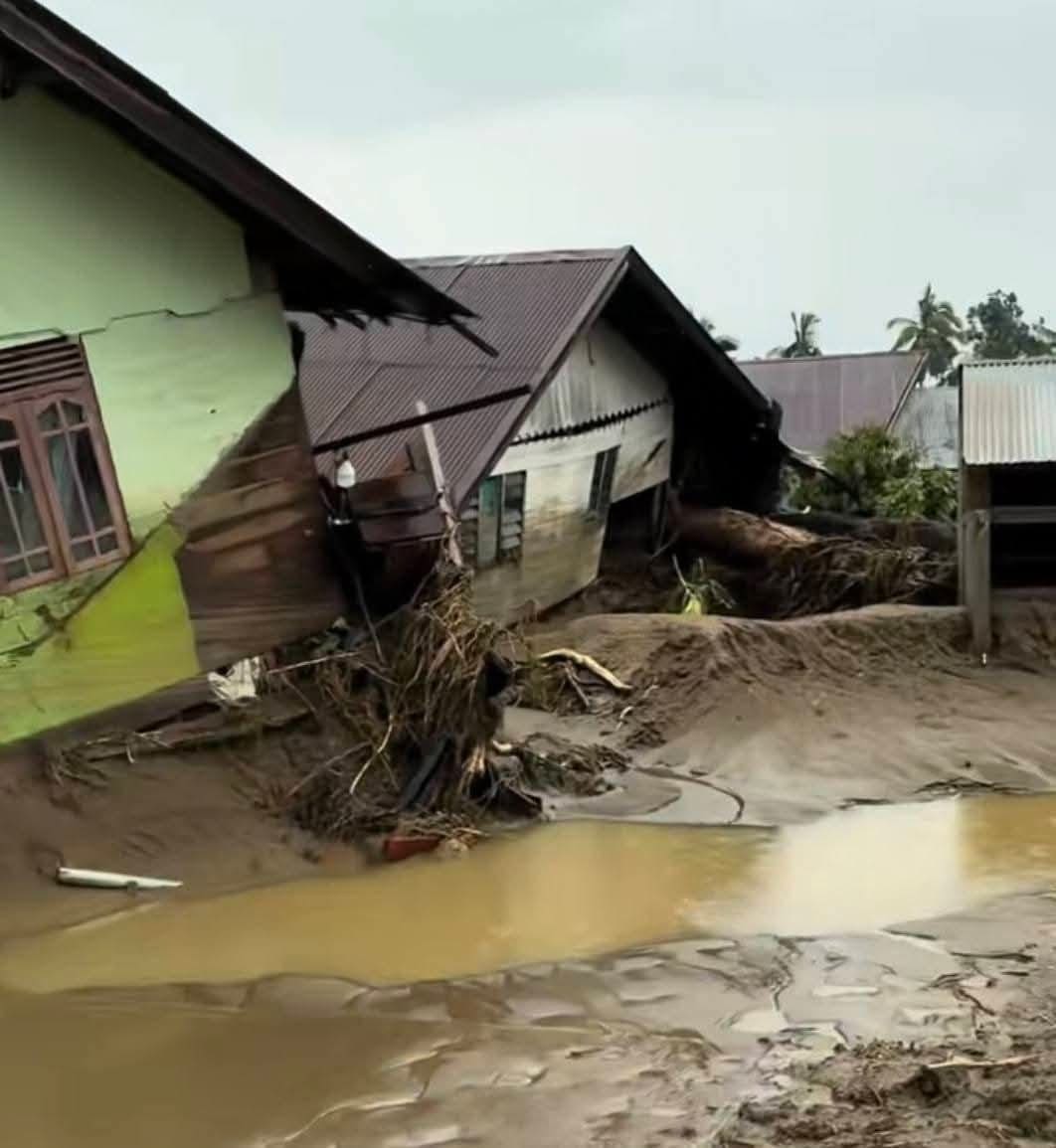
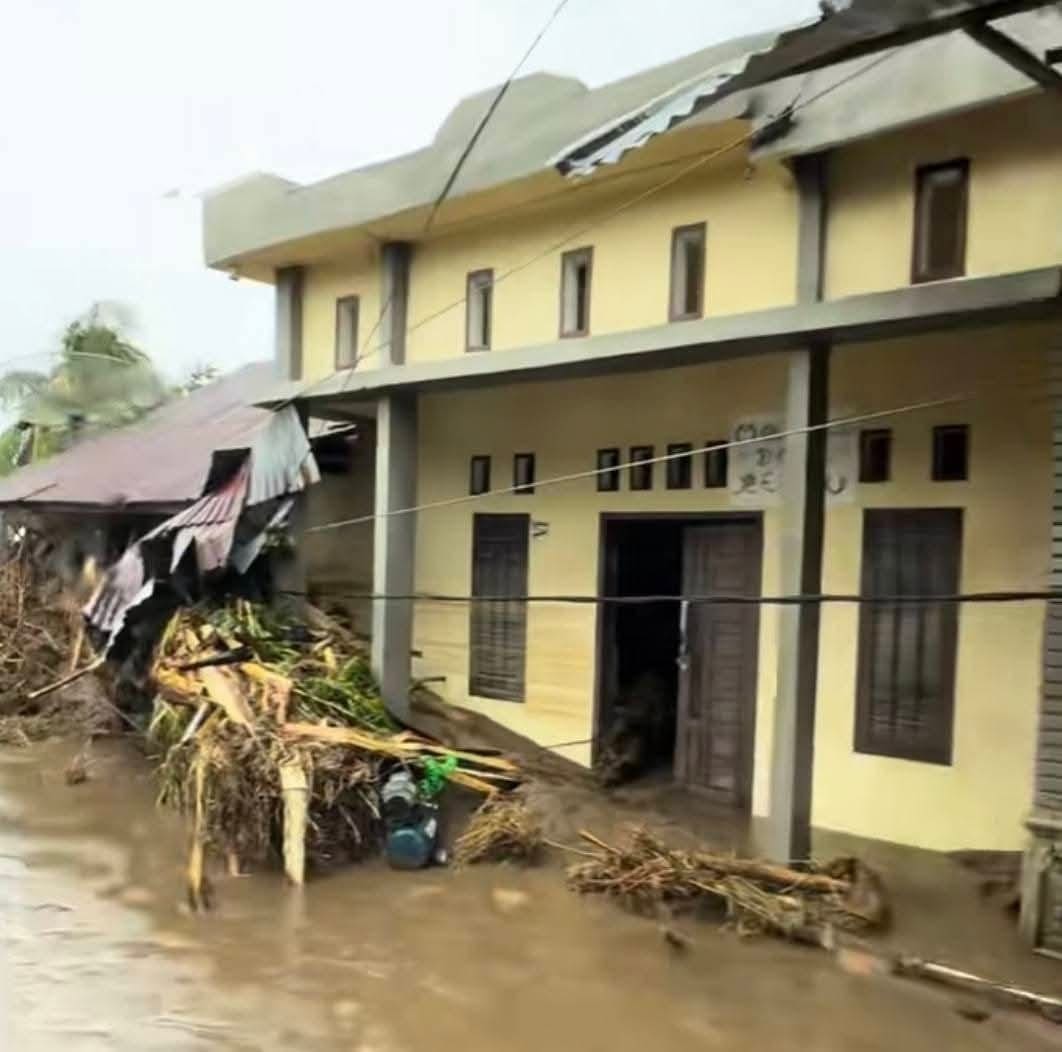

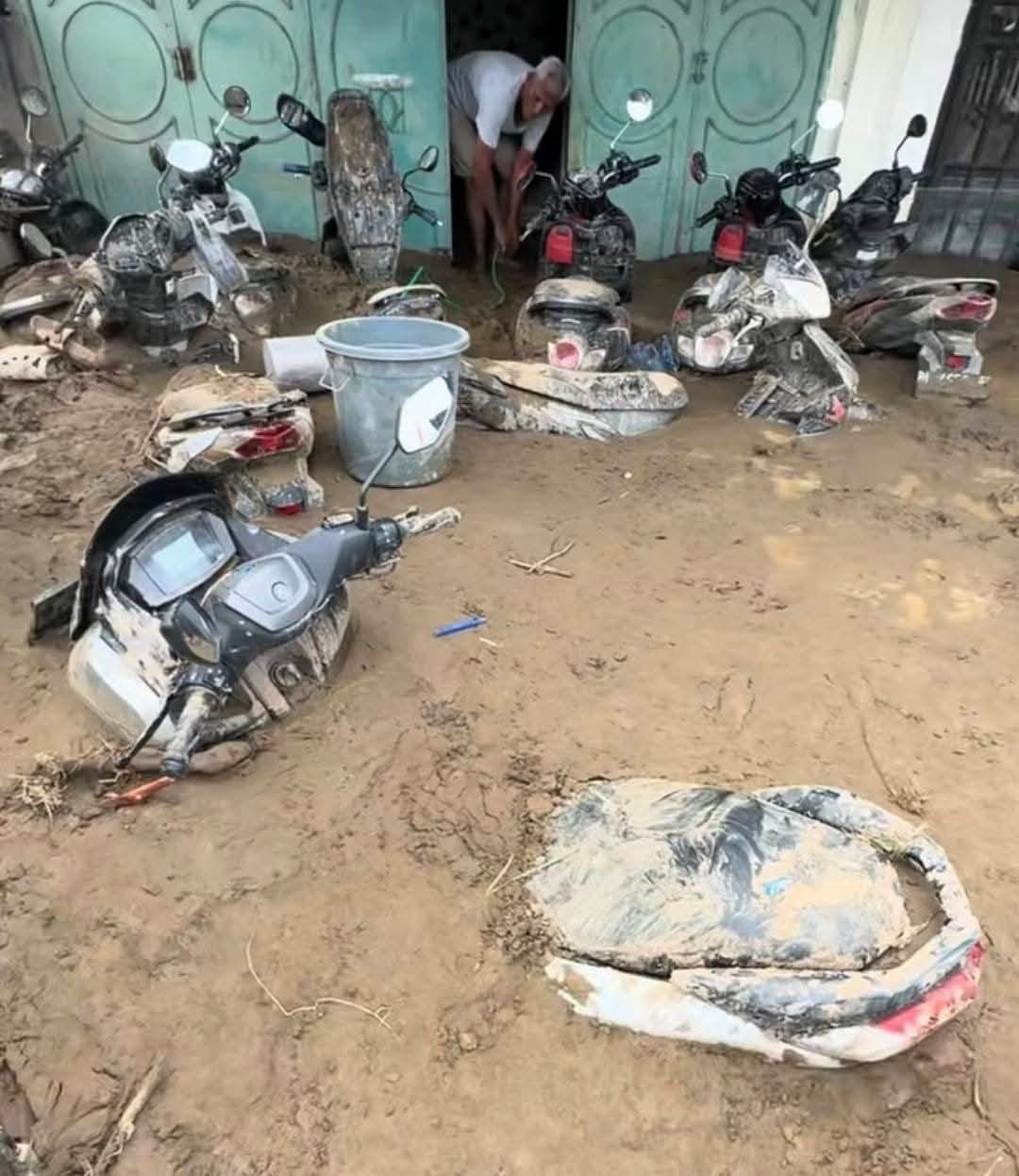
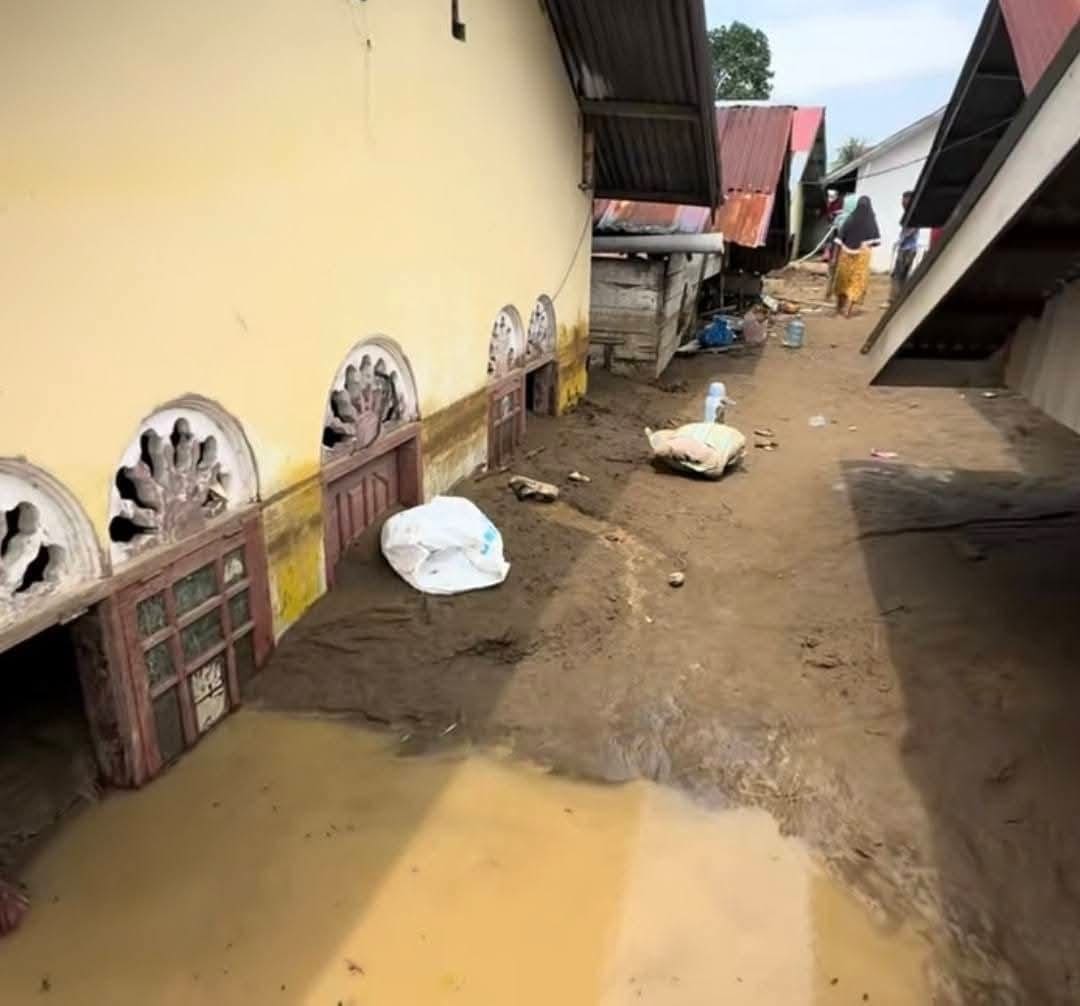
Testimony from residents of isolated areas in central Aceh: "The stock of basic necessities will not last more than two or three days" (this testimony was given on 3 December)
Residents said, six days after the floods that struck several areas of Aceh, North Sumatra and West Sumatra on 26 November 2025, that the central Aceh region remains cut off from the surrounding areas.
The disruption of road access to the region spanning central Aceh province has increasingly depleted stocks of basic goods.
Amid this turmoil, several incidents of looting occurred in central Aceh. A brawl also broke out among residents queuing to buy rice in the market of Takengon city. The journalist Ivan Bahagia, a correspondent for BBC News Indonesia, said that four batches of aid had been distributed to disaster victims in central Aceh through Rembele airport, located in the neighbouring Bener Meriah district.
Ivan, a resident of central Aceh, expressed concern that the situation could worsen "if there are no government assurances about the availability of food for two or three days." He said, "Stocks of basic necessities are limited and will only last another two or three days." The journalist Ivan Bahagia, a correspondent for the central Aceh newspaper, said fuel had become increasingly scarce, with long queues stretching for several kilometres.
He said that of the three public fuel stations in Takengon city, only one still had fuel stock. Even then, as Saka explained, there were long queues stretching up to five kilometres.
Saka told BBC News Indonesia: "Earlier, a person went mad because of the queue."
The problem is compounded because the price of fuel sold at roadside retail outlets has risen several times. Saka said: "Prices in small shops can range between 45,000 and 50,000 rupiah. At Pertamina fuel stations, the price is normal." BBC Indonesia.
The moment a road collapsed in Aceh province, Indonesia, after the major floods.
The road in central Aceh, Sumatra, Indonesia, after the province was swept by torrential floods and destructive landslides.
Trending: Sumatra, Indonesia... a man spent 8 hours swimming in the floodwaters until he managed to rescue his entire family, then felt extreme exhaustion and hunger, and saw a refrigerator floating on the water, so he opened it and began eating what was inside in order to survive. He later said: God sent me this provision, praise and thanks be to Him.
The Rohingya refugee community in Indonesia, residing in the city of Pekanbaru in Riau province, announced in a statement its full solidarity with Indonesian citizens affected by the recent floods in the area. The Rohingya refugees in Indonesia collected donations worth 9 million Indonesian rupiah, which were handed over to the National Zakat Agency of Riau Province (BAZNAS Provinsi Riau), a trusted government body specialising in humanitarian work.
They affirmed that this donation reflects their gratitude to the Indonesian people, who provided them with protection and support during their stay as refugees.
Iraq
The suffering of Iraqi Sunnis in displacement camps. Iraqi journalist Othman al-Mukhtar posted on X:
These are extremely severe humanitarian cases observed [on Thursday] in the displacement camp for Iraqi Sunnis from the residents of Jurf al-Sakhar and al-Uwaisat, al-Saadiyah and Aziz Balad, and al-Qaim, located in the desert south-east of Anbar, "the Bzaibiz camps."
Children who do not know breakfast, others without shoes, and women ill and weakened. Whoever has the ability to provide treatment, food or new tents, do not delay. Bzaibiz camp, Fourth Sector.
Displaced since 2014 from Jurf al-Sakhar.. the suffering of residents in displacement camps in the desert south-east of Anbar, "the Bzaibiz camps."
The Iraqi News Agency (INA) announced on Thursday that the authorities in Baghdad intend to amend the list of entities subject to asset freezes, after the previous issue of the official gazette of the Ministry of Justice mistakenly included the Lebanese Hezbollah and the Iran-backed Houthis on the list.
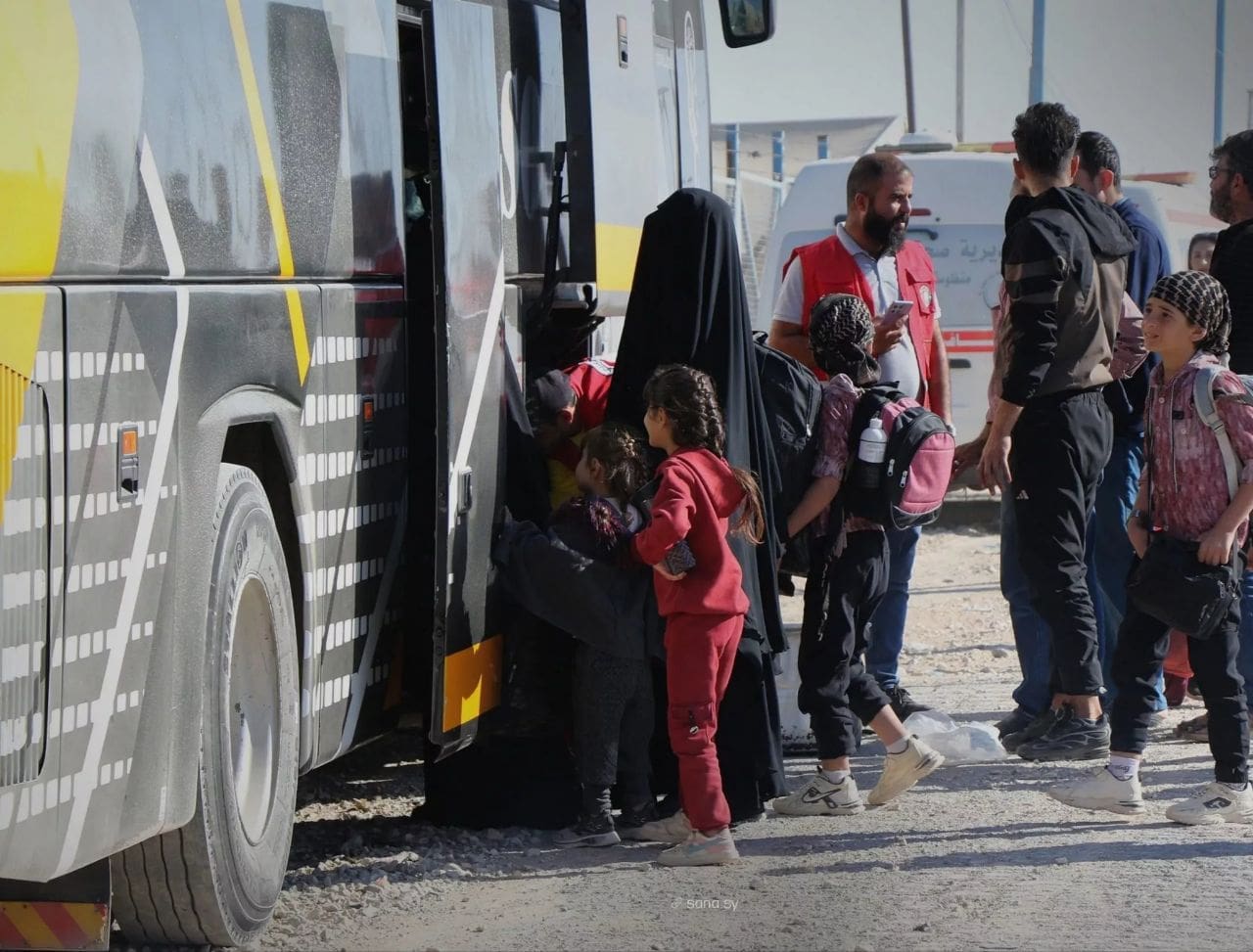
Iraq continues to evacuate its citizens from "al-Hol camp" south of Hasakah, and is effectively nearing their complete withdrawal. Yesterday 240 families, comprising 859 people, left. Some 3,500 people remain, who are expected to be repatriated over the next two or three months.
The camp currently holds more than 30,000 people, including foreign nationals suspected of affiliation with the organisation, and their family members. Most of the detainees at al-Hol are women, and it is estimated that 60% of the total population of these facilities are under 18 years of age, most of them under 12. The number of foreign nationals is about 8,500 people from more than 62 countries. Cited from journalist Zain al-Abidin.
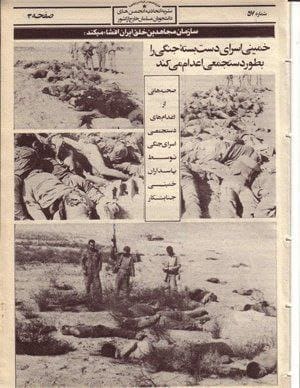
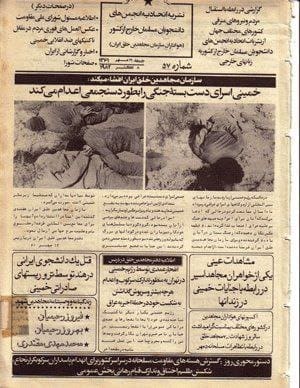
Iraqi journalist Othman al-Mukhtar: A Paris-based Iranian journalist sent me a filmed document of Khomeini's execution of hundreds of Iraqi prisoners and the fatwa permitting the mutilation of their bodies.
General description: hands shackled; Iraqi prisoners were starved for days. Most Iraqi prisoners refused to chant slogans in favour of Khomeini or to pray before his portrait.
Executions by dragging them through two intersecting trucks, each pulling in the opposite direction of the other until their bodies were torn apart; others were burned with petrol, and others shot at point-blank range.
The Revolutionary Guard carried out the operation and dug deep pits with bulldozers and threw them into them.
On Saturday Iranian sources denied all reports of missiles being launched from Iran toward Iraqi territory. They said that routine movements of missile platforms were recorded "as part of the preparations of the Iranian Armed Forces and the Revolutionary Guard to repel any aggression against Iran."
According to Tzvi Yehezkeli: Reports indicate that Iran is attacking Kurdish targets for the second time this week.
Let us recall that Iran is regaining strength, and it is now trying to test the patience of the Americans. In northern Iraq and Kurdistan there are American bases, and the Kurds are considered allies of the United States and have interests with Israel.
Iran is attacking American allies without a US response, and this is the second time. Is Trump aware of this? Is this how deterrence in the Middle East is eroding? It is easy for the Iranians to attack the Kurds without cause, but in this way Iran is recovering some of its prestige after the 12-day war. Translation by the Hebrew translator Moamen Meqdad.
Muslim minorities
Rohingya
Rohingya account for 74% of dengue cases and 90% of deaths in Bangladesh camps
Data from the office of the civil surgeon of Cox's Bazar district in Bangladesh, Mohammad Ul Haque, showed that more than 74% of all dengue fever cases recorded this year were among Rohingya refugees, while more than 90% of fever-related deaths were recorded inside the camps.
A total of 7,717 fever cases were recorded in the district, of which 5,720 were Rohingya, equivalent to 74.12% of all cases, during the period from January to 24 November. Eleven people died of dengue during the same period, including 10 Rohingya and one Bangladeshi local resident, placing the mortality rate among the Rohingya at 90.90%.
The civil surgeon of Cox's Bazar district, Mohammad Ul Haque, told The Business Standard that the necessary medical supplies had been provided to the district hospital, health complexes and field hospitals operating inside the Rohingya camps, and that doctors and nurses had received training to manage cases effectively. Source: Arakan News Agency.
Arakan Army Detains Dozens of Rohingya After Raid on Village in Maungdaw
The Arakan Army, a Buddhist militia, has detained dozens of Rohingya men after launching a campaign targeting the village of "Kyauk Chaung" north of Maungdaw town in Rakhine State, which has raised fear among families for their relatives. Local sources, as announced by the website "Arakan Now," said the militia took around 40 men aged between 20 and 45 from their homes during an operation that began on 29 November at approximately 1:00 p.m.
By 2 December, some 26 to 27 of the detainees had been released, while nine men remain missing, including prominent figures and village elders. Families fear they may face harsher treatment in unknown locations.
Survivors showed clear signs of trauma, with some suffering serious injuries and others struggling to walk or speak as a result of severe beatings, while families continue searching for the missing men amid ongoing anxiety and fear in the village, according to the Arakan News Agency.
Bangladesh: Government Will Not Grant Permanent Residence to New Rohingya Refugees in Cox's Bazar
The Bangladeshi government has announced that it will not provide permanent shelter to new Rohingya refugees arriving at the Cox's Bazar camps, noting that efforts will focus on ensuring their rapid and safe return.
According to the "Times of Bangladesh" website, the Commissioner for Relief and Refugee Repatriation, "Mohammad Mizanur Rahman," said: "The Bangladeshi government will not provide permanent housing for the new refugees, and the focus now is on the safe and rapid return of the Rohingya to their homeland as soon as possible."
Of roughly 150,000 refugees who have recently arrived in Bangladesh, about 130,000 have been registered under procedures similar to those followed in 2017, which included recording fingerprint and facial data and entering it into a database of FDMN (Forcibly Displaced Myanmar Nationals), according to officials who did not give their names.
The officials described this system as limited-access registration aimed solely at facilitating the distribution of food, medical services and basic services, without granting any rights or long-term recognition to the refugees.
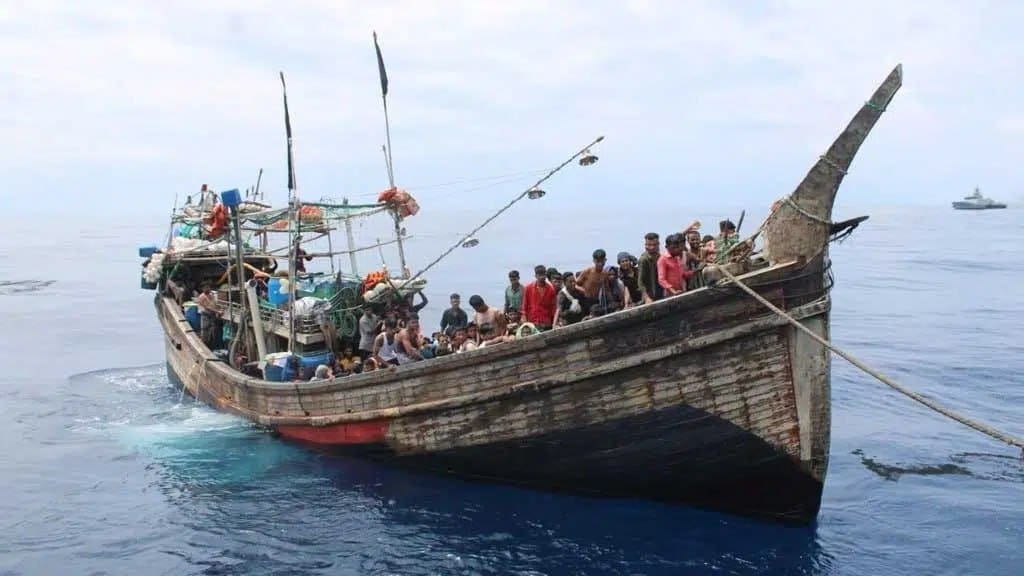
281 Rohingya Children Released in Sittwe After Weeks of Detention
The Myanmar army on Tuesday released 281 Rohingya children under the age of 18 in Sittwe, the capital of Rakhine State, according to a senior Rohingya community leader. He added that all the detainees had fled northern Rakhine State due to severe violence, forced recruitment and mistreatment at the hands of the Arakan Army, a Buddhist militia, in an attempt to leave for Malaysia when they were intercepted.
The children released today are currently staying in two separate houses in Booyi ward (Ward 9) in Sittwe, where local community leaders are providing food and basic support. However, there remains an urgent need for children's shoes, clothing, blankets, mosquito nets, mats, and general financial assistance. Some of the children expressed a wish to return to their homes, while others said they hope to be reunited with relatives living in Sittwe. | Arakan News Agency.
Uyghurs
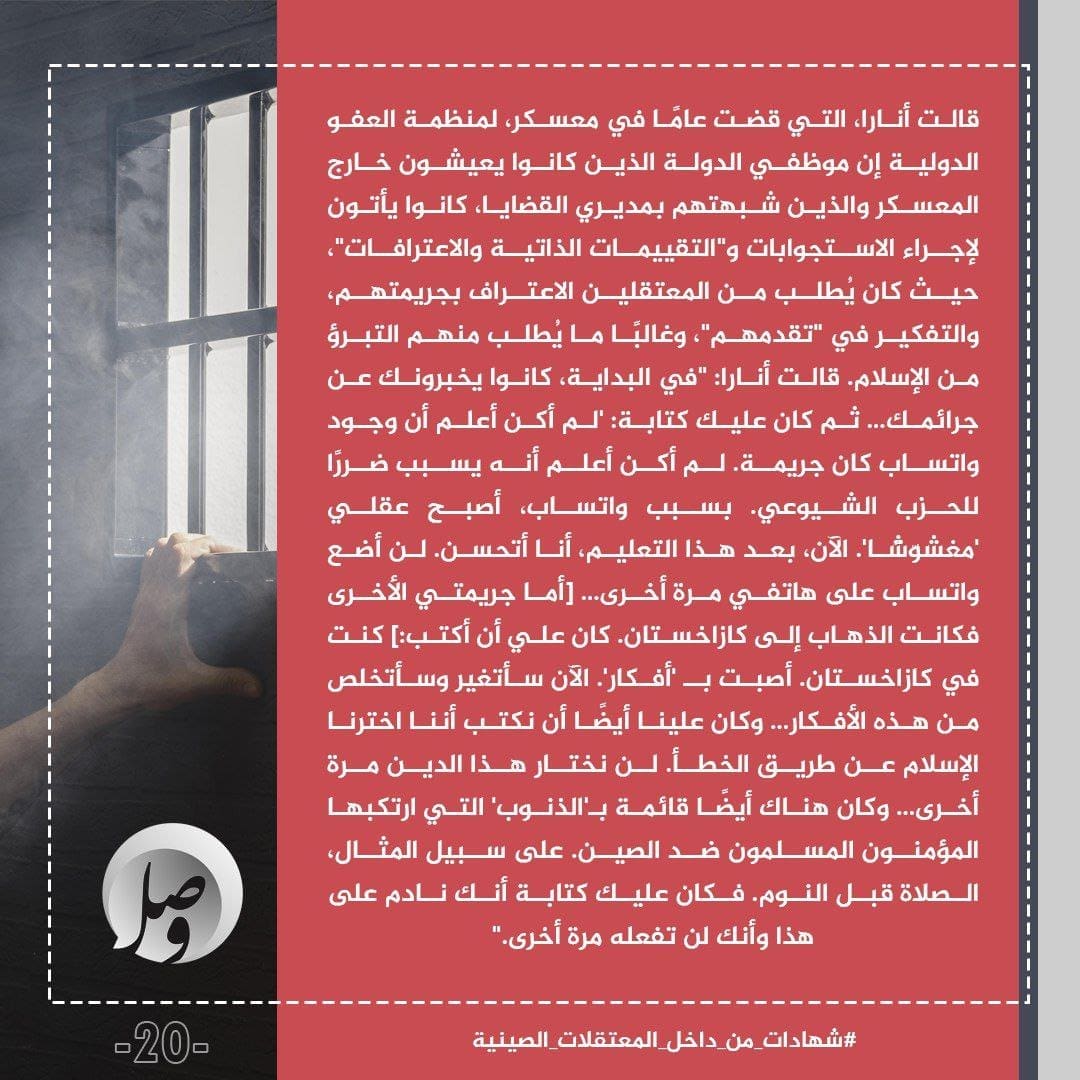
"At first, they would tell you about your crimes… then you had to write: 'I did not know that having WhatsApp was a crime. I did not know that it causes harm to the Communist Party. Because of WhatsApp, my mind became "confused." Now, after this education, I am improving. I will not put WhatsApp on my phone again…
We also had to write that we chose Islam by mistake. We will not choose this religion again… There was also a list of "sins" committed by Muslim believers against China. For example, praying before sleeping. You had to write that you regret this and that you will not do it again."
United States
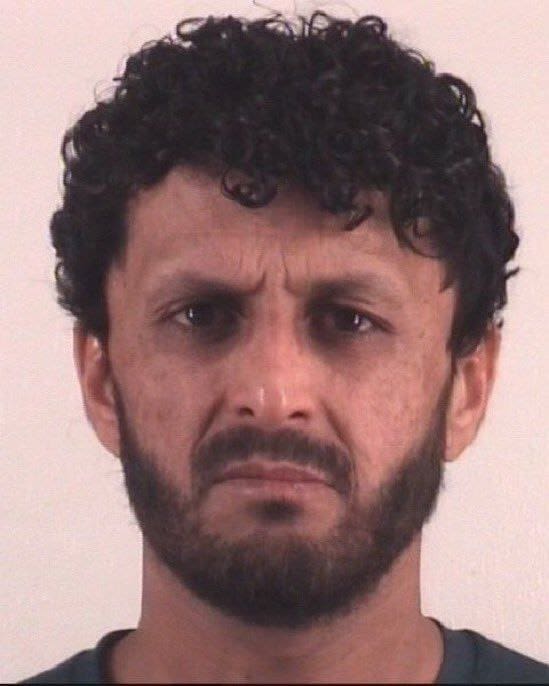
An Afghan immigrant who filmed himself on TikTok claiming he was making a bomb targeting the Fort Worth military base in Texas has been arrested.
The immigrant has been charged with threatening terrorism. The immigrant entered America during the Biden administration through the "Operation Allies Welcome" programme, meaning this immigrant had previously worked with the US military.
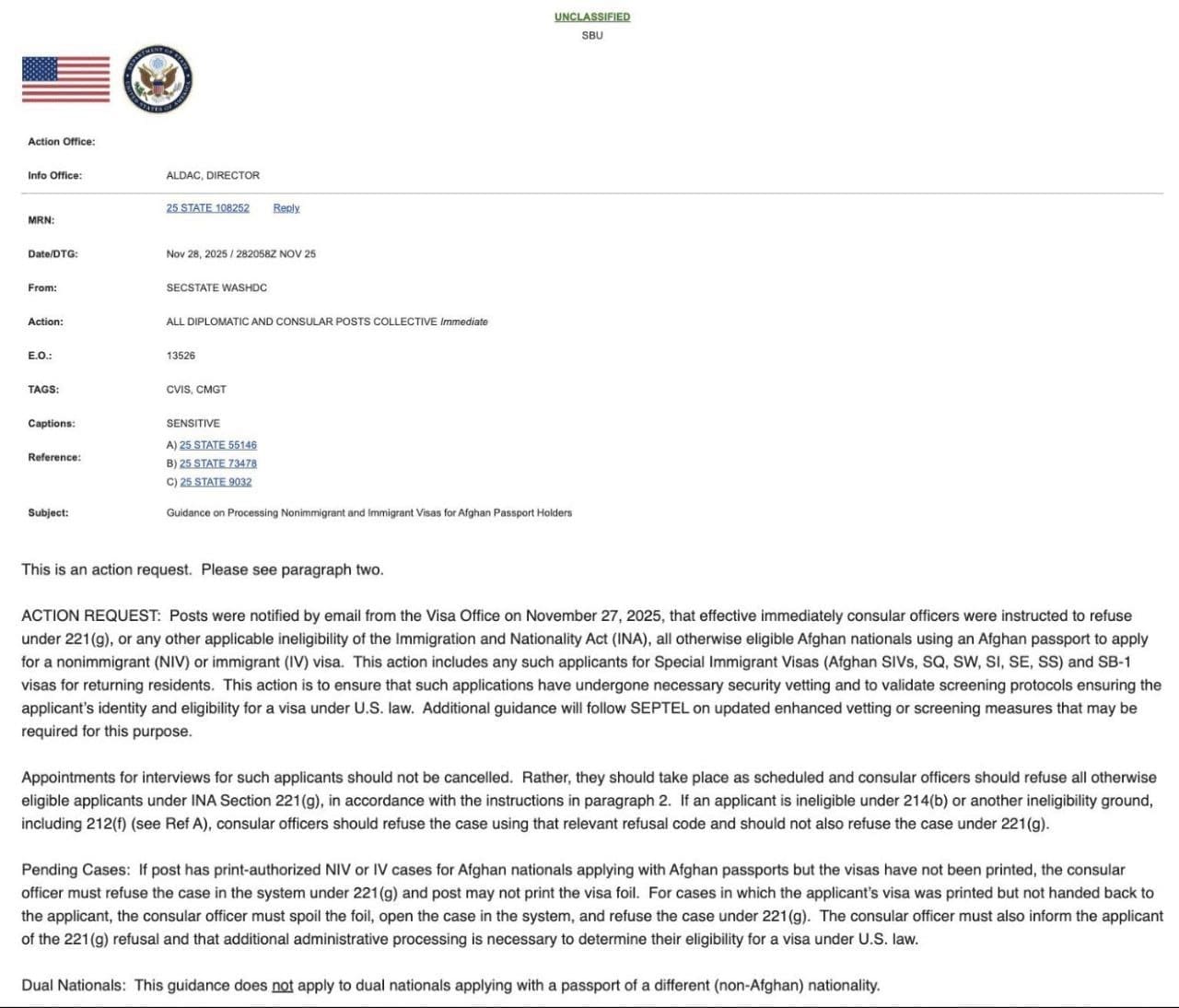
The US State Department issued an immediate order to all diplomatic missions and consulates to halt the processing of visas for holders of Afghan nationality.
Trump published the text of Section 212(f) of the US Immigration and Nationality Act: "Whenever the President finds that the entry of any alien or of any class of aliens into the United States would be detrimental to the interests of the United States, he may, by proclamation, and for such period as he shall deem necessary, suspend the entry of all aliens or any class of aliens as immigrants or nonimmigrants, or impose on the entry of aliens any restrictions he may deem to be appropriate."
The White House spokeswoman said: "President Trump is considering expanding the list of countries whose citizens are barred from entering the United States. Asylum visas have been suspended.
We have raised the difficulty of requirements and strengthened vetting and security screening procedures for visas in general. We have already revoked several visas for people who entered the country legally but pose a threat to national security.
I would like to remind everyone around the world that entry into the United States is a privilege and not a right. If you abuse this privilege, if you do not align with the values of the United States, and do not respect our country, our culture, our laws and our people, then you are not welcome here."
France

A proposal put forward in the French parliament to prevent "children" under the age of 16 from fasting during Ramadan and from wearing the khimar..


