


Each time a new war erupts, the world's attention turns to tanks, missiles and military maps. But beyond the front lines, another battle unfolds, quieter and far more profitable: the battle over military contracts, defence investments and arms company shares whose value rises as the conflict widens.
In the United States, which has the largest defence budget in the world, wars are no longer merely a tool of foreign policy or national security. They have become a vast economic sector in which the interests of giant corporations are intertwined with centres of political influence, in a scene that raises growing questions about the boundaries between power and money. With Donald Trump's return to the White House, new questions have emerged about the role played by the president's associates, foremost among them his sons, within the American military economy, which is estimated to be worth hundreds of billions of dollars annually.
Trump's sons enter the war market
Amid the wars the United States is waging in various parts of the world, especially in the Middle East, the names Donald Trump Jr. and Eric Trump have appeared among the investors in Powerus, an emerging American company specialising in the manufacture and development of unmanned aerial vehicle systems. At first glance, this may seem an ordinary investment in a promising technology sector, but its timing and context open a wide door of questions. The company was founded by former members of US special operations forces and works in one of the sectors that benefit most from contemporary wars. It seeks to expand through government military markets, at a time when the US Department of Defense is pumping billions of dollars into developing the domestic drone industry and reducing dependence on Chinese imports.
Among these companies: (Anduril Industries), specialising in uncrewed combat systems.
– (Unusual Machines), for the manufacture of drones.
– (Extend), the Israeli company that won contracts worth millions of dollars to develop AI-powered attack aircraft.
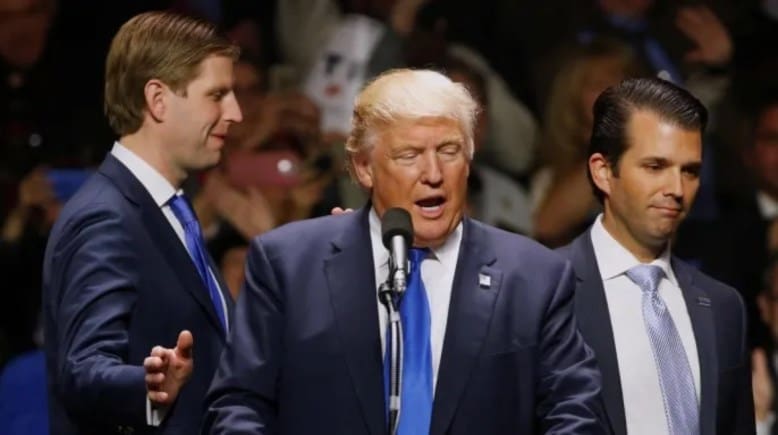
Here the real controversy begins, because when the president's family invests in companies that depend directly or indirectly on government defence contracts, the separation between political decision-making and economic interest becomes far more complicated.
The Pentagon: the world's largest money vault
Grasping the scale of the financial temptations is difficult without looking at the size of US military spending itself. The budget of the US Department of Defense has exceeded 886 billion dollars annually, a figure that surpasses the military spending of most countries of the world combined. This giant budget has turned the Pentagon into the largest buyer of weapons and military services on earth. With every new armament project, companies compete for their share of the defence "pie." The competition is not only about product quality or technical efficiency; it is often intertwined with networks of political influence, legislative lobbying and interest groups that constitute one of the most powerful sectors in Washington.
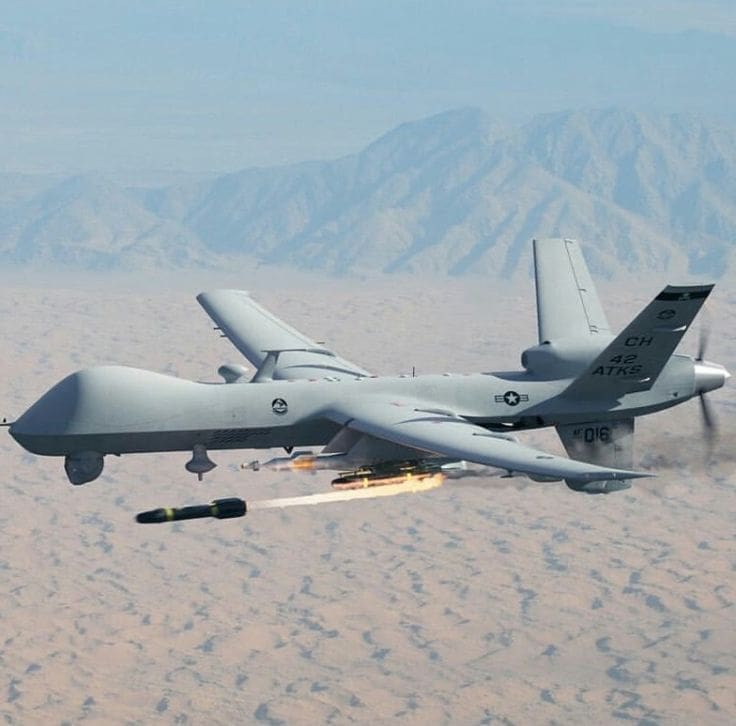
This is why the term "military-industrial complex," which the former US president Dwight Eisenhower warned against decades ago, is more present today than at any time before.
Drones: the new gold of modern wars
If tanks and fighter jets were the symbols of conventional wars, unmanned aerial vehicles have become the new currency of contemporary conflicts.
The war in Ukraine revealed that a small aircraft costing no more than a few hundred dollars can destroy military equipment worth millions of dollars. This shift has pushed major armies to completely reformulate their combat doctrines. Defence research centres expect the value of the global military drone market to exceed tens of billions of dollars in the coming years.
For investors, this represents not merely a technological development but an exceptional financial opportunity. For critics, it is further evidence that the continuation of wars has become tied to growing economic interests that are difficult to ignore.
A long history of scandals
The controversy surrounding the investments of Trump's sons did not arise from nothing. The American arms industry has a long history of corruption, manipulation and fraud.
In another case, US authorities charged defence contractors with paying bribes to military officials in exchange for facilitating the award of government contracts, while artificially inflating costs to conceal the money paid out.
US Department of Justice files have also revealed dozens of cases involving manipulation of military contracts, fraud in cybersecurity programmes and the submission of misleading financial claims to the government. The problem has not been limited to private companies: US oversight bodies themselves have repeatedly acknowledged that the Department of Defense suffers from chronic problems in financial auditing and control of spending.
The Pentagon that cannot account for its money
One of the most striking paradoxes in Washington is that the institution that manages the largest government budget in the world has repeatedly failed to pass comprehensive financial audits. Over consecutive years, the Department of Defense has faced criticism for its inability to track all its assets and expenditures accurately.
Governance experts believe these gaps do not necessarily mean that corruption exists in every file, but they create an ideal environment for wasted funds, cost inflation and difficulty in holding anyone to account. In a sector into which hundreds of billions of dollars flow annually, any small loophole can swallow billions of dollars of taxpayers' money.
From Iran-Contra to the digital-age scandals
When American military corruption is mentioned, it is difficult to overlook one of the most famous political cases in modern history.
The case was not merely a breach of the law; it revealed how foreign policy, weapons and money can become intertwined within state institutions in complex ways. Although decades have passed since that scandal, many critics argue that the core of the problem has not changed but has shifted from secret operations to the more sophisticated networks of investment and political pressure.
Conflicts of interest: the grey zone
To be clear, there is so far no evidence that Trump's sons have committed legal violations with regard to their defence investments. However, the fundamental problem raised by government ethics experts in America is different. The issue is not only the existence of a violation but the appearance of a conflict of interest. When the family closest to the president invests in companies that could benefit from government defence policies, it becomes difficult to convince public opinion that decisions are made in complete isolation from economic interests. For this reason, such investments attract exceptional sensitivity within democratic systems.
The war economy: who is the real beneficiary?
Modern wars reveal a truth that has become clearer than ever. Every missile fired means a new order, every long war means additional contracts, and every arms race opens new markets for defence companies.
The United States has a long legacy of profiteering. During the Second World War, US military industrial production rose by 96 per cent between 1940 and 1944, and companies such as Boeing, Lockheed Martin and General Dynamics became industrial giants thanks to military contracts.
For this reason, critics of the military-industrial complex argue that the danger lies not only in direct corruption but in the existence of an entire economic structure that objectively benefits from the continuation of global tensions.
Perhaps the real crisis does not lie in Trump's sons' investment in a particular company or fund. The deeper crisis concerns the model itself: a model in which the largest military economy in the world is increasingly intertwined with political and financial elites and centres of influence.


