


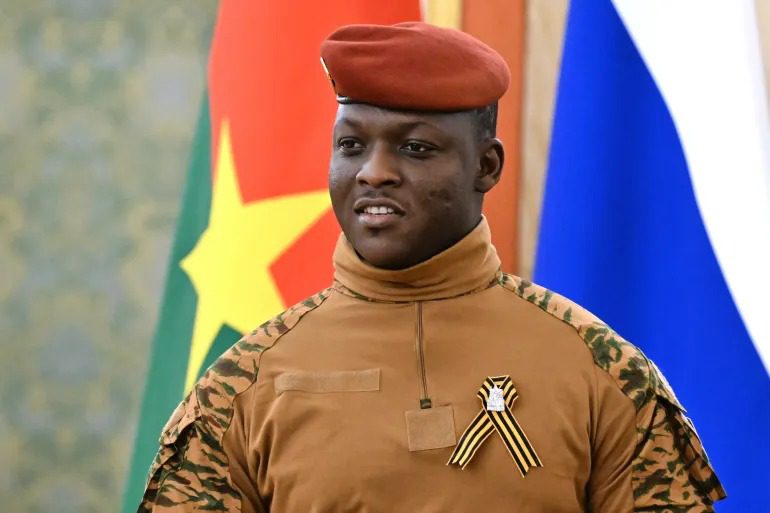
The words uttered by the transitional head of state of Burkina Faso, Captain Ibrahim Traoré, were not mere passing remarks in a political speech. They announced a profound shift in how the authorities approach religion, education, historical memory and foreign relations all at once.
Within a few days, Burkina Faso moved from a country regarded as one of the West African states most closely tied to traditional Islamic institutions to a stage of wide controversy, after its president accused some Arab countries of preparing hundreds of Burkinabe students to study Islamic law in preparation for its application inside the country. He then added a more sensitive accusation, saying Africa had suffered more than 1,000 years of slavery at the hands of the Arabs.
The remarks provoked wide anger in Arab and Islamic circles, but inside Burkina Faso they appeared to be part of a political project that places religion and external education under state oversight.
From a security discourse to a battle of identity
In recent years Burkina Faso has become one of the Sahel states most exposed to attacks by armed groups, with the government losing control over wide areas of the country, while military coups have become the defining feature of its political landscape.
But what began as a military project to confront armed groups gradually took a different course, expanding to include a reorganisation of the religious sphere itself. The Burkinabe president directed his criticism at the system of religious education abroad, considering that the hundreds of students studying Islamic law in Arab countries do not return home with scientific or technical skills, but with ideas that, in his view, could be used to establish a religious system incompatible with the nature of the state.
This outlook reflects a notable shift in how sources of threat are defined. Armed groups are no longer the sole concern of the authorities; foreign educational institutions themselves have become part of security calculations.
Students at the heart of the confrontation
What stands out in Traoré's speech is that he did not discuss the content of religious education from an intellectual standpoint, but from the standpoint of development priorities. The president openly questioned the value of sending young people abroad to study jurisprudence and Islamic law at a time when the country needs engineers, doctors, technology experts and technicians.
In parallel with this rhetoric, the government tightened procedures for study abroad, issuing directives requiring those wishing to study outside the country to obtain prior approval from the Ministry of Higher Education, to ensure that fields of study match the needs of the state.
With this decision, the issue of scholarships moved from an academic file to a sovereign one, subject to security considerations that restrict freedom of education and scientific openness.
A new law redefining the relationship between state and religion
Traoré's remarks did not come in isolation from a series of legislative measures the authorities had taken over the preceding months. In Dhu al-Hijjah 1446 AH / June 2025, the transitional parliament unanimously passed a new law on religious freedom, which the government said aims to protect the secular character of the state and confront practices that exploit religion for political or financial gain.
The law includes penalties for practices the authorities described as abuses, such as exploiting children for begging in the name of religious institutions, and the absence of financial transparency among some religious bodies.
But opponents of the law saw in it the beginning of a new phase of restrictions on Islamic institutions, especially after a number of imams and scholars objected to it.
From disagreement to arrests
The dispute quickly moved from the realm of legal debate to field confrontation. After Imam Mohamed Ischaac Kindo criticised the draft law, the authorities arrested him in Dhu al-Qadah 1446 AH / May 2025, an act that provoked protests among his supporters.
Reports also said dozens of protesters had been subjected to what the government described as "civic training" programmes, while the fate of some religious figures remained a subject of questions for research organisations and observers.
Weeks earlier, Imam Mahmoud Barro had been arrested in the city of Bobo-Dioulasso in similar circumstances, reinforcing the impression that relations between the authorities and some Islamic circles had entered an unprecedented phase of tension.
Has Traoré lost his allies?
The paradox is that Ibrahim Traoré was initially viewed as close to many conservative Islamic circles, which saw in him a leader who adopted a discourse opposing foreign influence and defending national sovereignty. But this rapprochement began to erode gradually as state intervention in religious affairs expanded.
Although the government had relied on something resembling an "unwritten agreement" with Islamic institutions, based on mutual support and stability, this balance began to collapse as power moved into a more rigid phase of controlling the religious sphere.
If Ibrahim Traoré's remarks about Sharia students provoked wide controversy, his talk of history opened a more contentious door, after he described Africa as having lived through "more than a thousand years of slavery at the hands of the Arabs."
This claim was not merely a recall of a historical page; it appeared to be an attempt to reshape collective memory within a new political project, making the past a tool for interpreting the present, and history a means of building a sovereign discourse around which the domestic public could rally.
This narrative drew wide criticism from historians and researchers who considered it inaccurate and a deliberate distortion of the civilisational, cultural and religious dimensions of the relationship.
Was history reduced to a collective accusation?
The Arab-African relationship cannot be read through a black-and-white lens. History did witness the slave trade, in which several parties took part, Arab, African and European. But the history of Islam on the continent is full of bright chapters: it reached wide areas of West Africa through trade caravans and scholars centuries before European colonisation, and cities such as Timbuktu, Djenné and Gao became scholarly centres attracting students of knowledge from across the continent. African scholars themselves contributed to spreading Islamic culture and authored hundreds of books in jurisprudence, language and the sciences.
Accordingly, portraying the relationship as a history of enslavement alone turns history into a tool for producing a new civilisational antagonism, rather than reading it within its complex context.
Security first, even if it clashes with religion
Beyond the historical debate, Traoré's remarks appear linked above all to a new security doctrine taking shape within the Burkinabe state. For years the country has been waging an open war against armed groups, and in this climate the government has come to view every file through a security lens, including education, da'wa activity, foreign missions and the preaching of imams.
The paradox is that the model Traoré proposes, which gives priority to applied sciences, does not in essence contradict the historical experience of Islamic civilisation itself.
It suffices to consider the legacy of Ibn al-Haytham in optics, Ibn Sina in medicine, al-Khwarizmi in mathematics and Ibn Rushd in philosophy and jurisprudence to see that the building of Islamic civilisation rested on the integration of religious knowledge and applied sciences, not on their opposition.
The real challenge, therefore, lies not in reducing the study of the Sharia sciences, but in building a balanced educational system that produces a jurist aware of the challenges of his age, an engineer who carries an ethical framework, and a physician who combines professional competence with human responsibility.
A Jewish thread in the picture
As the crisis with religious institutions escalated domestically, Burkina Faso's foreign policy saw a notable development with the reception of a new Israeli ambassador and the formal presentation of his credentials, after a period of postponement and ambiguity.
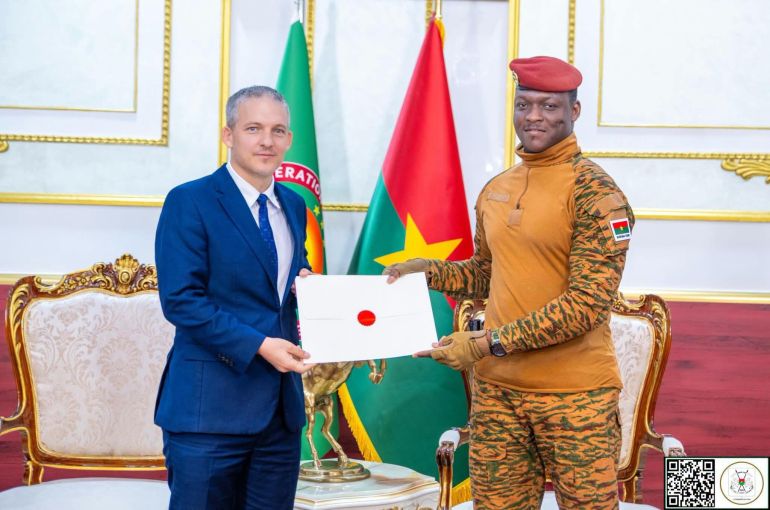
This step coincided with growing Israeli activity in the Sahel region, where Israel seeks to expand its diplomatic and security presence in West Africa, benefiting from the political shifts that followed a series of military coups in the region.
Although Burkinabe authorities did not officially link this rapprochement to their domestic policies, the timing of the event raised questions about the nature of the changes the country is undergoing, particularly as the government seeks to diversify its security and military partnerships beyond traditional frameworks.
The youngest leader, and the greatest test
Ibrahim Traoré was born in Shaban 1408 AH / March 1988 and is described as the youngest head of state in the world. He joined the army in 1430 AH / 2009, then served within the United Nations mission in Mali, before his name rose to prominence during military operations against armed groups, culminating in his leadership of the coup that brought him to power.
Since then he has reshaped his country's regional alliances, strengthening cooperation with Mali and Niger within the Alliance of Sahel States, in a course that reflects a desire to free itself from traditional regional influence and redraw Burkina Faso's place in the region's equations.
Traoré's remarks thus reveal that the battle in Burkina Faso no longer takes place on the battlefield alone, but has moved into university halls, mosque pulpits, history books and even the collective memory of the African nation.


