


The situation of Uyghur Muslims in East Turkestan has returned to the international spotlight in recent hours, with Uyghur protesters taking to the streets of Washington to coincide with the visit of Chinese President Xi Jinping to the United States, and calling on the US administration to raise the issue of abuses and the rights of Muslims during his visit. Meanwhile, a new investigation by Reuters has revealed that cotton products continue to reach the US market from factories in Vietnam linked to a Chinese group subject to US sanctions over allegations related to forced labour of Uyghurs.
These developments come amid continued international pressure on Beijing over its policies in East Turkestan, where human rights organisations say arrests, imprisonment, mass surveillance and restrictions on religious and cultural practices continue. China denies the accusations against it, saying its policies aim to combat extremism and achieve development and stability.
Reuters investigation traces cotton from China to Vietnam and then the United States
The most prominent development in the file came in an investigation published by Reuters on Friday, 25 September 2026 (14 Rabi al-Akhir 1448 AH), which tracked the movement of cotton and garments between China, Vietnam and the United States after Washington imposed sanctions on the Chinese textile giant Esquel Group.
US authorities had placed the group on a list in November 2024 that effectively prevents it from selling its products to American customers, over allegations of links to forced labour programmes in East Turkestan.
The Chinese group denies these allegations.
However, Reuters' analysis of shipping data and trade records showed that three garment manufacturers in Vietnam closely linked to Esquel Group have exported cotton products worth no less than five million dollars to the United States since the Chinese group was added to the US blacklist.
The three companies are An Loi Apparel, Tessellation Binh Duong and Tessellation Hoa Binh.
According to the investigation, the links between the Vietnamese companies and the Chinese group go beyond a supplier-buyer relationship. The three companies previously bore names derived from "Esquel Garment Manufacturing Vietnam" before changing their names in October 2022.
Company documents also showed that Edgar Tong, who served as chief executive of Esquel between 2021 and 2022, was registered as a representative of the owners of the three Vietnamese companies.
Records further showed that the companies remained owned by the same three foreign companies both before and after the name changes.
70% of Esquel's Chinese cotton exports went to its linked factories
Shipping data analysed by Reuters revealed another important detail: after the US sanctions were imposed, 70% of Esquel's cotton exports from China went to the three Vietnamese companies.
At the same time, those factories continued to export cotton garments to the US market.
The investigation showed that brands including Muji and Rodd & Gunn imported cotton garments into the United States from these Vietnamese factories.
The two companies said they were not aware of the links between the factories and Esquel that the investigation uncovered.
The findings raise questions about the ability of US supply chain tracing systems to prevent the entry of products that may be linked to companies subject to restrictions over forced labour.
But Reuters did not prove the garments contained cotton from East Turkestan
A significant limitation of the investigation's findings should be noted here.
Reuters stressed that it was unable to prove that the garments exported by the Vietnamese companies to the United States actually contain cotton produced by Esquel or cotton originating in East Turkestan.
The three factories also purchase cotton from other sources, not only from Esquel.
However, supply chain experts and trade lawyers who spoke to the agency explained that blending cotton from different sources is a common practice in the textile industry, which makes determining the final origin of the fibres within a garment a complex process.
Therefore, what the investigation establishes is a close commercial and institutional relationship and a continued flow of cotton between Esquel and the Vietnamese factories, at the same time as those factories export to the United States, rather than proof that garments sold in America are made from cotton linked to forced labour of Uyghurs.
Uyghur protests during Xi Jinping's visit to Washington
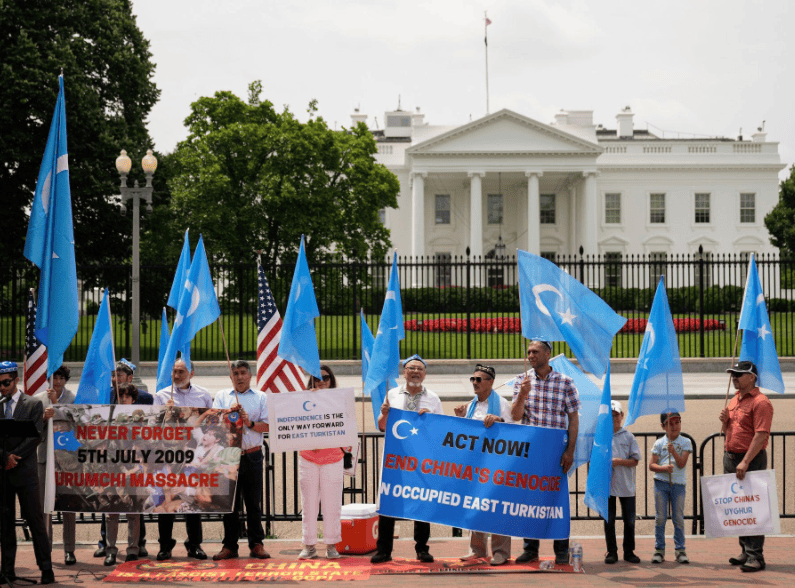
In parallel with the publication of the investigation, Washington witnessed a broad mobilisation by Uyghurs and other groups during the visit of Chinese President Xi Jinping to the United States.
Uyghurs, Tibetans, Hong Kongers, Chinese dissidents and human rights groups gathered in the US capital on 24 and 25 September to protest against Chinese government policies, while US President Donald Trump was hosting Xi during a state visit.
Activists and Uyghur organisations, including the Uyghur American Association, the Uyghur Human Rights Project and the Campaign for Uyghurs, took part in the demonstrations, which extended to the vicinity of the White House and Congress.
Protesters called on the US administration to raise the issue of the Uyghurs and human rights directly with the Chinese president, to release prisoners, and to press Beijing over its policies in East Turkestan.
According to reports on the wider protests, more than three thousand people from different groups took part in the demonstrations against Beijing's policies, including Uyghurs, Tibetans, Hong Kongers and Chinese dissidents, while other coverage referred to about 2,500 people at a separate rally on Capitol Hill.
Accordingly, these figures should not be taken as an estimate of Uyghur protesters alone, but of participants from various groups.
Candles outside the White House and messages about detainees
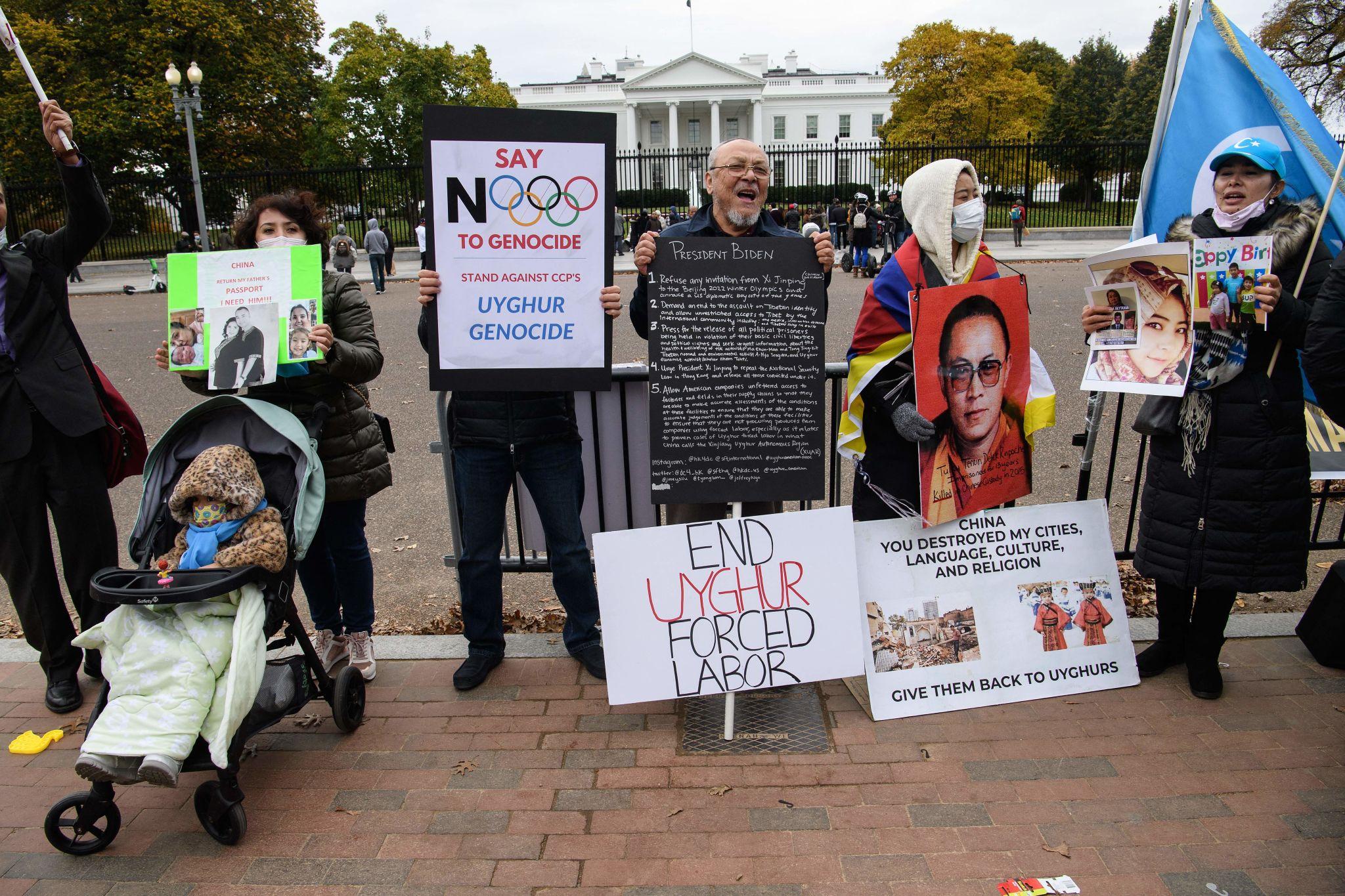
At one of Thursday's events, members of the Uyghur community and activists marched towards the White House, after which participants lit candles following sunset.
Speeches delivered during the protest focused on the fate of detainees, the missing, and family members whose whereabouts are unknown inside East Turkestan.
Omer Kanat, executive director of the Uyghur Human Rights Project, said many members of the community live in a constant state of grief because they do not know the fate of their relatives, or whether they are safe or still alive.
US Representative Jim McGovern, the senior Democrat on the Congressional-Executive Commission on China, also took part in one of the events, calling for human rights to be made part of the handling of Xi's visit.
The "ethnic unity" law returns under criticism
Protesters also drew attention to China's new Law on Ethnic Unity and Progress, which took effect on 1 July 2026.
Uyghur activists believe the law reinforces policies of integrating minorities into a national identity defined by the state, and fear it could be used to expand pressure on Uyghur language, culture and religious identity.
Beijing presents the law from a different perspective, as a framework for strengthening unity among ethnic groups, stability and national development.
The law has become one of the issues that Uyghur organisations have called on the US administration to raise with the Chinese president during his visit.
Calls preceding the visit to pressure Xi
The mobilisation did not begin with Xi's arrival in Washington.
On 22 September, the "Government of East Turkestan in Exile" called on the US president to raise the cause of the Uyghurs and other Turkic Muslims during any talks with the Chinese president.
The call was part of a broader campaign launched by Uyghur and human rights organisations ahead of Xi's visit, aimed at keeping human rights on the agenda of US-Chinese meetings.
This movement predates the last two days, but it represents the direct background to the protests that Washington witnessed on 24 and 25 September.
Repression inside East Turkestan continues, according to human rights organisations
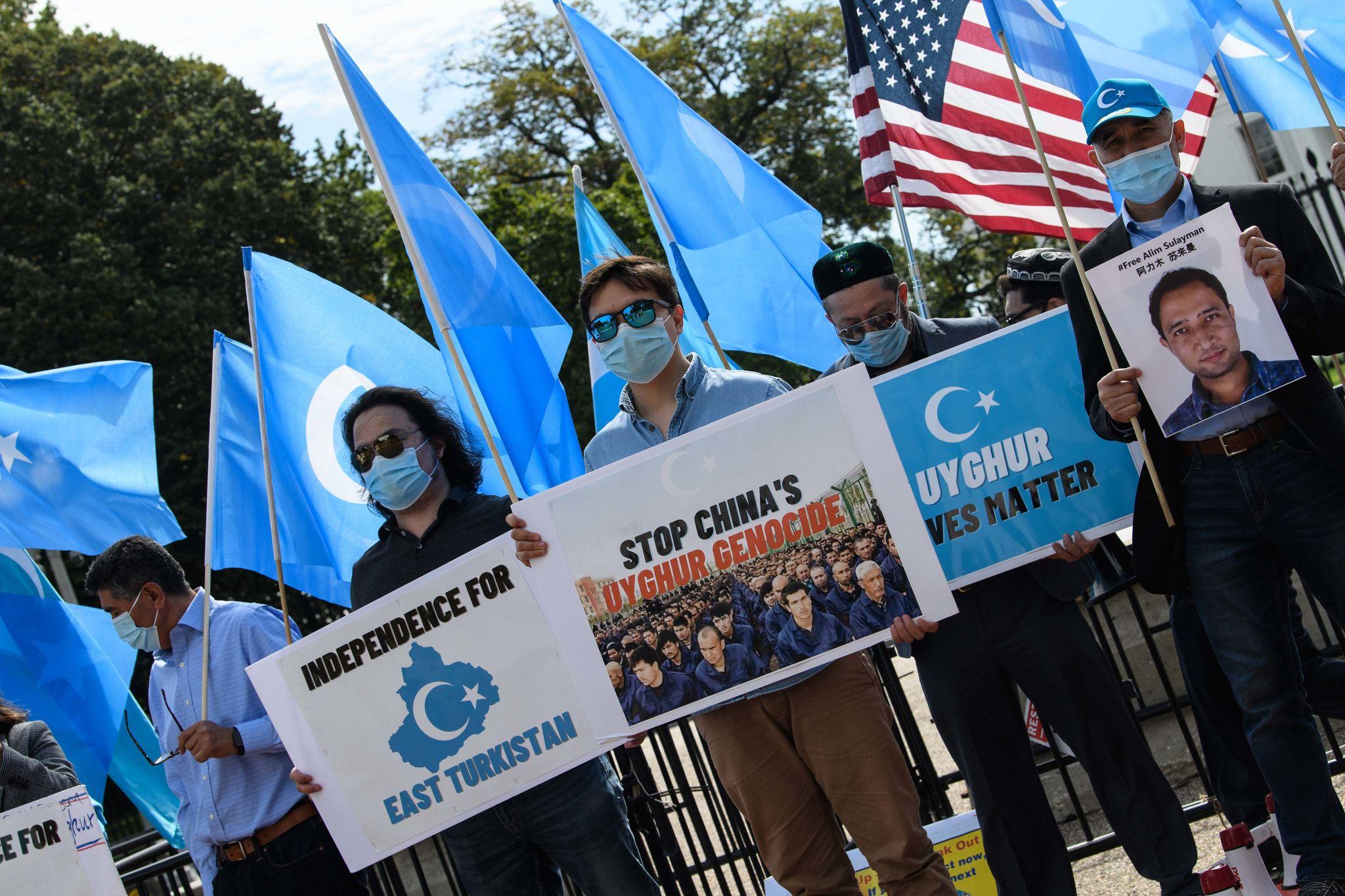
Although the most recent news over the past two days occurred outside China, it is linked to a continuing human rights situation inside East Turkestan.
Human Rights Watch, in its latest broad assessment published in August, said available evidence indicates the continuation of mass arbitrary detention, imprisonment under unfair sentences, extensive surveillance, the erasure of cultural and religious expressions, restrictions on travel and communications, and pressure on Uyghurs living abroad.
The organisation considers the abuses suffered by Uyghurs and other Turkic Muslims to amount to crimes against humanity.
Chinese authorities reject these allegations, denying the practice of forced labour or the targeting of Uyghurs on the basis of their religion or ethnicity, and saying that the policies they implement in the region are linked to counter-terrorism, combating extremism and economic development.
From cotton factories to the streets of Washington
The developments of 25 and 26 September reveal two parallel tracks in the Uyghur issue.
The first is economic and commercial: the Reuters investigation shows how difficult it is to trace cotton through supply chains that run from China to factories in third countries and then to Western markets, even after sanctions linked to forced labour allegations have been imposed.
The second is political and human rights-related: Uyghurs have seized on the visit of the Chinese president to Washington to bring the file of East Turkestan back to the forefront and to demand that the US administration not separate its trade and diplomatic relations with Beijing from the human rights file.
Accordingly, the developments of the two days centre on the new investigation into cotton supply chains and the Uyghur mobilisation in Washington, while the file of abuses inside East Turkestan remains the essential background to these movements rather than a new event that should be presented as having happened yesterday or today.


