


When I began working on this report, gathering documents and testimonies on one of the most sensitive and complex files in the world, it was not the vast figures that held my attention, but two small scenes that seemed fleeting at first glance, yet were enough to capture the tragedy of an entire people.
In a village in the Tarim Basin, on the edge of the Taklamakan Desert, an elderly Uyghur man embraced a copy of the Holy Quran and wept. His tears were not only those of devotion; they were the tears of a man who had finally found something he had been deprived of for many years. He turned the pages with trembling hands, like someone recovering a part of his soul that had been absent for a long time.
In another city, a young Uyghur man roamed the streets searching for a copy of the Quran, not to read it alone, but to offer it as the dowry for the young woman he wished to marry. He owned no gold and no money, but he saw in the Quran the most precious thing he could offer as a partner for his life.
Between these two scenes stretches the story of an entire people: a people who lived for decades far from the lenses of cameras and the attention of the world, and then suddenly found themselves at the heart of one of the most controversial issues of the twenty-first century. A people who went from being a Muslim minority living on the fringes of the Chinese empire to a permanent headline in human rights reports, a subject of fierce political confrontation between East and West, and a card used by major powers in the escalating struggle for influence between Washington and Beijing.
But behind the political noise, behind the official statements exchanged, and behind the accusations and counter-accusations, lies the most important and simplest truth: there are millions of Uyghurs living a story that did not begin with the camps, nor with Western sanctions, nor with the new Cold War between the United States and China, but began decades ago with a struggle over identity, memory and belonging.
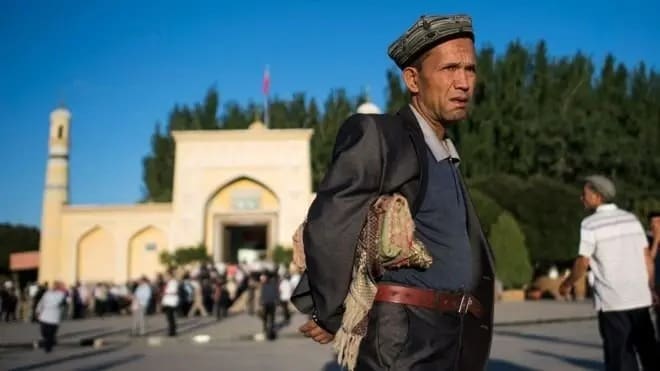
The Uyghurs Are Not a Passing News Story
The Uyghur question did not emerge with the rising tension between Washington and Beijing, and their suffering did not begin when Western media discovered their cause, or when the name "Xinjiang" became a permanent fixture in international human rights reports. The story is much older: the story of a Muslim people who settled on the western frontiers of China for centuries and considered themselves a cultural and civilisational extension of the Central Asian sphere more than a part of the Chinese centre.
Today, as politicians and diplomats argue over how to characterise what is happening there, whether as "counter-terrorism," "crimes against humanity," or "cultural genocide," nearly 15 million Uyghurs face an existential question: can a people lose its language, memory, customs and religion gradually without disappearing physically?
From the Silk Road to Digital Surveillance
Islam reached the lands inhabited by the Uyghurs more than a thousand years ago. It first arrived through the caravans that crossed the Silk Road from Persia and Central Asia, and was then carried by Arab merchants from Hadramawt and southern Arabia through the southern Chinese ports. For the Uyghurs, Islam was not merely a religion; it became the backbone of their identity. Even today, some religious terms of Persian origin remain in use among them: prayer is called "namaz," and ablution is known by terms influenced by Persian, reflecting the historical path Islam took into those lands.
Yet over time, this religious and cultural identity became a growing source of concern for the Chinese state, especially after Beijing began to view the region as a sensitive point in security and geopolitical terms rather than a distant border area. The region that the Uyghurs call "East Turkestan" and China calls "Xinjiang" is not merely a vast geographical area accounting for about one-sixth of the country's territory. It is China's gateway to Central Asia, the Middle East and Europe, and the heart of the "Belt and Road" initiative on which the Chinese president is betting to reshape global trade routes. Beyond all that, beneath its sands and natural resources lies another reason why Beijing views it as a region that does not tolerate risk: oil, gas, coal, uranium and rare earth metals, which have become the lifeblood of the modern global economy.
2016: When Xinjiang Became the World's Largest Security Laboratory
After the violence that struck Urumqi in 2009, and the deadly attacks that hit various parts of China in the following years, Beijing adopted a tougher security approach. However, the real shift came with the appointment of Chen Quanguo as Communist Party Secretary of the region in 2016.
The matter was no longer about pursuing a person who had committed a crime or was suspected of planning an attack. Rather, according to many researchers, the aim became predicting who might pose a future threat. In this way, the region entered an era of "pre-emptive security": smartphones became a source of security intelligence, surveillance programmes became capable of analysing individual behaviour, and DNA, fingerprint and voice recordings of millions of people were collected.
When Fasting Becomes a Security Indicator
The most dangerous aspect of the new Chinese experience is that it no longer focuses only on actions, but on identity itself. Several human rights reports have described the inclusion of ordinary religious practices among indicators of security suspicion: a long beard, abstaining from smoking or alcohol, insisting on halal food, contacting relatives abroad, installing banned applications such as WhatsApp, or choosing Islamic names for children. All of these have at certain periods been listed among indicators warranting surveillance, interrogation or security re-evaluation. Beijing says these measures are necessary for "countering extremism," while its critics see them as a gradual criminalisation of Islamic identity itself.
The Camps: Between the Chinese Narrative and the Other Narrative
When images of the massive facilities, walls and heavy guard began leaking out, China initially denied the existence of large-scale detention camps, and the official discourse later changed.
These facilities came to be described as "vocational training centres" aimed at what was termed "countering extremism," providing employment and improving living standards. However, testimonies from former detainees, United Nations reports and journalistic investigations painted a different picture, describing compulsory detention, political re-education, the separation of family members, and intense psychological pressure aimed at reshaping convictions and loyalties.
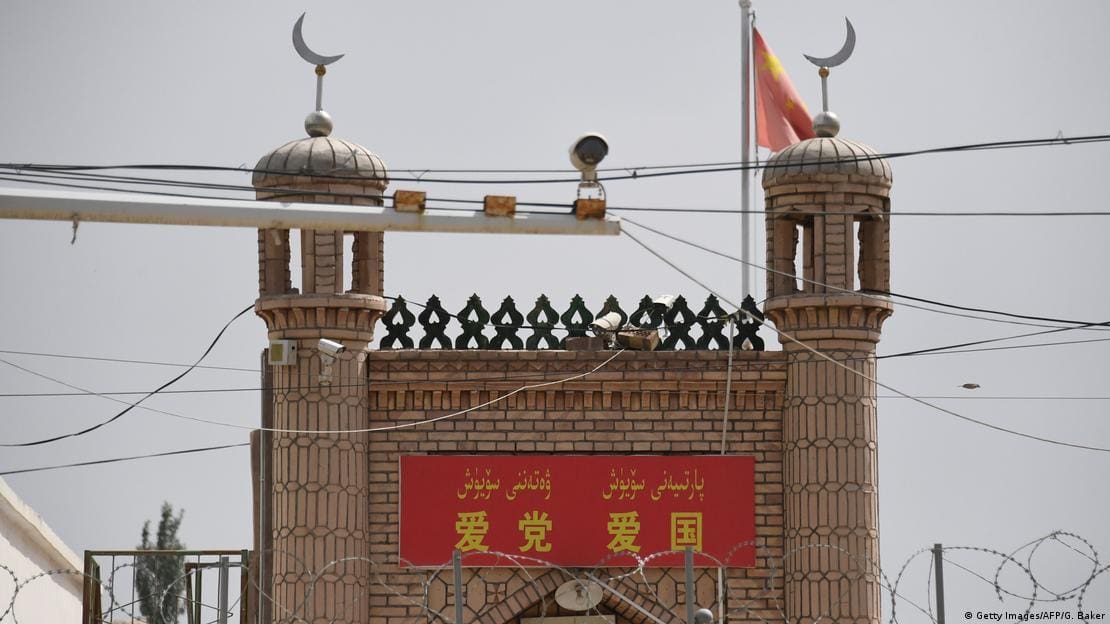
A prominent UN assessment concluded that some of the documented abuses may amount to crimes against humanity, a characterisation Beijing continues to reject entirely.
As 2026 begins, the battle over the narrative has not ended. China continues to deny the accusations and describes them as lies driven by hostile agendas, while human rights organisations and UN bodies continue to speak of ongoing patterns of repression, restrictions and forced labour.
The Question No One Wants to Answer
Yet amid all this debate lies a shocking paradox: why has the voice of the Uyghurs become louder in the US Congress and European parliaments than in many Islamic capitals? And why has the tragedy of a Muslim people become a permanent item in the American-Chinese rivalry, while being absent from the agendas of many in the Islamic world? This is where the grey area begins.
The United States, which today leads a broad international campaign on the Uyghurs, is itself a state whose foreign relations are governed by interests above all else. European states that speak of Uyghur rights do not hesitate at times to overlook other humanitarian tragedies when they conflict with their economic and political calculations.
In other words, the suffering of the Uyghurs is real, but its political instrumentalisation is also real, and this is the harshest aspect of the whole story: a people suffering persecution on one side, and at times used as a pressure card in a struggle between giants on the other.
From the Xinjiang Camps to the Corridors of Congress: How the Uyghur Tragedy Became a Weapon in the New Cold War
In international politics, no humanitarian issue is entirely isolated from interests, and this may be one of the harshest lessons in the Uyghur story. For decades, news about Muslims in East Turkestan passed in near total silence. Western television screens did not devote long hours to discussing them, European parliaments did not convene special sessions to debate their situation, and global companies did not face significant pressure over their economic dealings with the region.
The issue became part of broader files concerning technology, trade, artificial intelligence, semiconductors and global influence, and the name Xinjiang came to be repeated in Western politicians' speeches to the same extent as the names Taiwan, the South China Sea and Hong Kong.
This did not necessarily mean that the Uyghurs' suffering was fabricated. On the contrary, but what happened is that a genuine humanitarian cause suddenly entered the heart of the greatest geopolitical confrontation of the twenty-first century. Here the difficult questions began: would the West have spoken with the same intensity if the alleged abuses had occurred in a state allied to it? And would Western governments have imposed the same sanctions if China were not the greatest strategic challenge to their global influence? These questions do not exonerate Beijing, but they reveal another dimension of the picture.
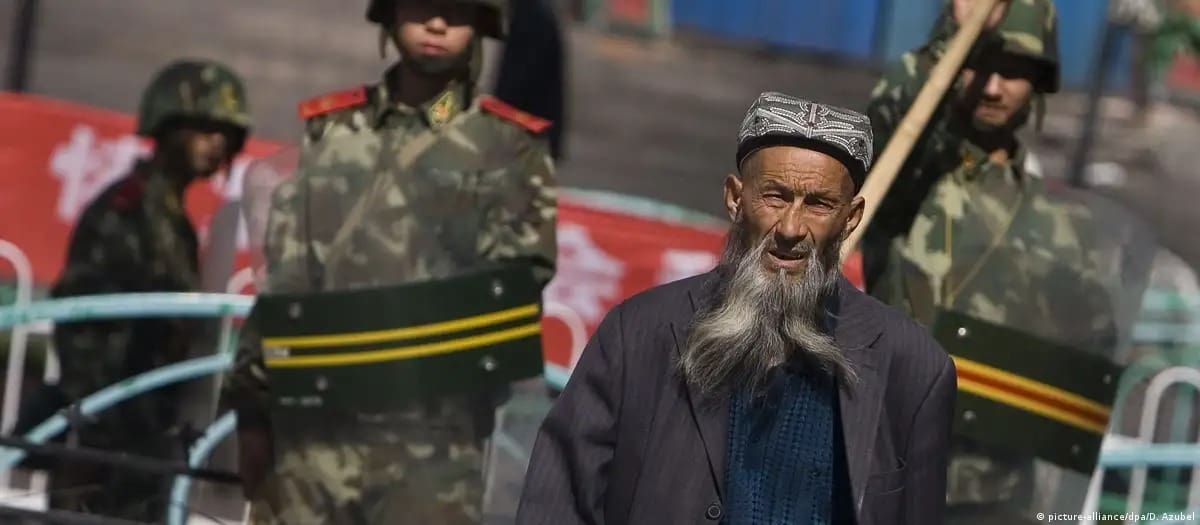
The Selectivity of the International Conscience
When it comes to human rights, the political memory of major powers appears short and selective, because many states now leading the condemnation campaigns against China have long records of silence or hesitation regarding abuses committed elsewhere in the world when economic or military interests required it.
For its part, Beijing has used this contradiction as an effective propaganda weapon. Whenever it faces criticism over the Uyghurs, it points to Western wars, mistakes and human rights records, accusing its opponents of exploiting the issue for political ends. Between these two competing narratives, a simple truth is lost: human rights should not become hostages to the equations of power. The victim is not concerned with the identity of the party defending them, but with ending the injustice inflicted upon them. Yet the world of politics does not operate with such simplicity.
Why Is the Islamic World Silent?
If the Western voice has sometimes been loud, silence elsewhere has been more striking. China has become the leading trading partner of dozens of Islamic countries. Billions of dollars in investment, loans and infrastructure projects have tied many economies to the Belt and Road initiative, and amid this vast economic interdependence, the Uyghur question has receded in many official forums.
While international human rights organisations issued successive reports on camps and religious restrictions, official delegations from various countries visited Beijing and signed economic agreements worth billions of dollars. This is not only about China; it is an old global test: to what extent can principles endure when they collide with interests?
Forced Labour: The Thread That Connected Xinjiang to the World
Many global companies may not have initially realised that the Uyghur issue would reach their factories, stores and markets. But that is what happened. As reports mounting about programmes transferring Uyghur workers to factories inside and outside the region, discussion began of the possibility that products entering global markets were linked to supply chains involving forced labour. Suddenly the matter was no longer merely a local human rights issue; it became connected to cotton, solar energy, clothing, electronics and automobiles, and major companies found themselves required to prove that their products did not rely on raw materials or labour linked to possible abuses in Xinjiang.
While Western governments saw this as justification for trade restrictions and sanctions, Beijing regarded the matter as part of a broader attempt to slow its economic rise. Thus the battle extended from the camps to global markets.
The Uyghur Diaspora: A Nation Seeking a Voice
Outside China, hundreds of thousands of Uyghurs live scattered across Turkey, Central Asia, Europe and North America. For many of them, the issue is no longer about politics or geography; it is about families who have lost contact. Parents who do not know the fate of their children, and children who do not know whether their parents are alive.
Whatever the variations in accounts of this phenomenon's scale, the prevailing feeling among a large part of the Uyghur diaspora is that they are fighting a battle to preserve memory more than anything else: the memory of language, the memory of faith, the memory of place, and the memory of names they fear will dissolve in a sea of the majority.
What Does Beijing Really Want?
The most important question in the entire file is not what China's opponents say, but what China itself seeks. From the viewpoint of the Chinese state, what is happening in Xinjiang is, in its own words, a project to produce stability. Beijing justifies its actions against the Uyghurs by viewing the twentieth century as an era of chaos, divisions and foreign occupations that nearly destroyed the country, and it holds that the unity of the state is above all other considerations. From this standpoint, any separatist, religious or nationalist tendency that threatens national cohesion is regarded as a strategic danger that must be contained. What exposes these intentions, however, is Beijing's effort to reshape human beings themselves, and herein lies the core of the criticism directed at Chinese policies.
Stability becomes problematic when a person is asked to renounce part of their identity in order to prove loyalty to the state. Between the Chinese narrative and the Western narrative lies a broad space of truth that remains obscured. China asserts that it has succeeded in "eliminating terrorism" and has prevented large-scale attacks for years; its critics reply that security was achieved at the expense of the fundamental rights of millions of people. China speaks of vocational training, economic development and improved living standards; human rights organisations speak of mass surveillance, widespread arrests and cultural re-engineering.
The region may indeed be witnessing enormous economic development, and there may also be serious violations of rights and freedoms. But what happens to the Uyghurs and the persecution they face, and their reduction to a security file, strips them of their humanity. And when the West reduces them to a pressure card against China, their humanity is lost as well. They are not merely a figure in a UN report, nor merely a tool in a trade war, nor merely a headline in an election speech. They are an entire people with a history stretching back centuries, a culture shaped at the crossroads of civilisations, and a faith that has remained part of their identity despite the great political upheavals that swept the region.
When Defending the Uyghurs Becomes a Test of Ethics Rather Than Politics
The tragedy of the Uyghurs may be one of the cases that most clearly reveals the nature of our contemporary world. It shows how a powerful state can use technology and surveillance to tighten control over an entire society, and at the same time how other international powers can turn human suffering into a card in a struggle for influence.
Yet amid all this political noise, one truth cannot be escaped. The Uyghurs do not need anyone to use them against China, nor anyone to justify what is happening to them in the name of security, development or counter-extremism. They need only what any human being on earth needs: to be seen as human beings before being numbers, and as holders of rights before being the subject of bargaining. When the day comes that the world defends the Uyghurs because they are wronged, not because they are useful in the contest with Beijing, only then can it be said that humanity has prevailed over politics.


