

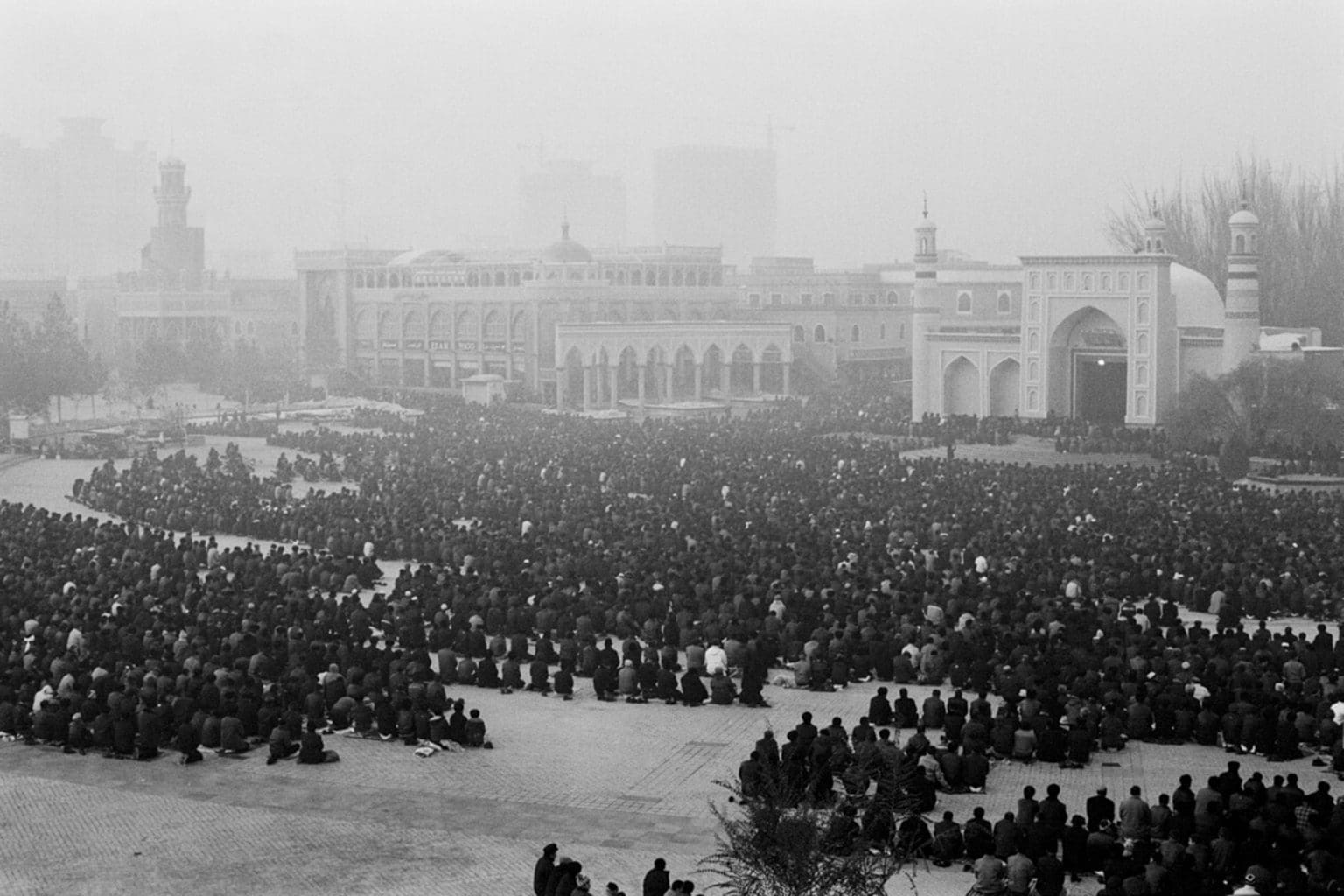
Across the world, Muslims welcome the month of Ramadan with joy and longing. They wake before dawn for suhoor, set spiritual goals, draw close to the Holy Qur'an, stand together in the Tarawih prayers, observe i'tikaf in the mosques, and end the month with Eid al-Fitr alongside their families in brightly lit, crowded mosques.
For Uyghurs in the diaspora, however, Ramadan evokes a very different reality. Their hearts turn to their people in East Turkestan (Xinjiang), under Chinese occupation, where suffering remains largely forgotten. Islam has been rooted in that land since the 4th century AH (the 10th century CE), yet today Uyghurs are deprived of practising their rites freely, amid a cultural and religious genocide.
How many years have passed since Uyghurs last heard the call to prayer ring out in their neighbourhoods? How many of them have been forced to eat suhoor in the dark, for fear that light would be taken as evidence of "extremism", an accusation that can lead to years behind prison walls, where there is torture and death?
How many students have been forced to eat during the daytime of Ramadan under teachers' watchful eyes to prove that they are not fasting? How many have been humiliated and forced to drink alcohol or eat pork during the blessed month to show "loyalty" to a state that criminalises Islam itself?
What does Eid look like when a family member is in prison? When parents are separated from their children and forcibly sent to state orphanages? When thousands of mosques are closed, demolished or converted into propaganda centres? How is Eid celebrated under the criminalisation of gatherings, although family visits and communal celebrations are an authentic part of Uyghur culture?
What is the scale of the trauma endured by someone imprisoned for praying, or for naming his son Muhammad, or for owning a copy of the Qur'an, and then subjected to torture and forced indoctrination to make him abandon his faith?
Consider the testimony of the Uyghur prisoner Abdulghapur Abdulla (Adil Abdulghapur), who spent 18 years in Chinese prisons. His interview was conducted in 1437 AH (2016 CE), one year before the wide-scale wave of arrests that began in 1438 AH (2017 CE), which included more than a million Uyghurs and other Turkic Muslims, who were placed in internment camps and prisons.
Adil recounts that in 1423–1424 AH (2002–2003 CE) he was accused of calling the adhan in his sleep. Even saying "Bismillah" was forbidden, and prayer was considered a crime. On a winter night in January, he was dragged from his bed naked and pulled across the floor until his skin was torn and blood flowed. He was beaten severely until he lost all sensation of pain, then his hands and feet were shackled, and a 25-kilogram cement slab was hung around his neck, inscribed with: "For stubborn prisoners who refuse to submit to Chinese rule."
He also spoke of questionnaires distributed to prisoners every March, containing doctrinal and political questions beginning with: "Is there a God or not?" They were compelled to answer with a single word: yes or no, without explanation.
The following questions would then be posed:
Did God create the heavens and the earth, or nature?
Can the Holy Qur'an save humanity?
Is East Turkestan part of China, or is it an independent state?
Do you pray in prison?
Will you pray in the future?
What will you do after your release?
What kind of person is Osama bin Laden?
If Chinese and Uyghurs live together, will society flourish?
Prisoners were classified into four categories by coloured cards: red for the compliant who deny the existence of God and affirm that East Turkestan is part of China;
yellow, whose holders are forced to walk with their hands behind their heads;
black, whose holders are forced to bow;
and green, the category to which Adil belonged, who were not permitted to walk at all and were forced to crawl.
In 1423 AH (2002 CE), his mother was permitted to visit him for the first time after four or five years.
The distance to the visiting centre was nearly a full mile, and he was told that he would not see her unless he crawled. He agreed, and crawled to see her.
According to estimates from the East Turkestan Victims Database, the number of people imprisoned exceeds 500,000, many of them for ordinary religious practices, and on vague charges such as "extremism" and "inciting religious hatred".
Uyghurs are denied the freedom to make their voices heard, as their suffering is stifled by walls of fear, propaganda and strict censorship, while Ramadan continues to be, for them, a season of pain rather than joy.


