


From the demolition of a Muslim activist's house in Bulandshahr after protests in 2022 CE (1443 AH), to the removal of mosques and religious schools in Sambhal during 2025 CE (1446 AH) and 2026 CE (1447 AH), and up to the demolition of a mosque inside the local administration complex in Saharanpur in September 2026 CE (Rabi al-Awwal 1448 AH), scenes of bulldozers tearing down buildings associated with Muslims have become a recurring sight in Uttar Pradesh, India's most populous state.
The state government says what is taking place is not religious targeting, but the enforcement of building laws, the recovery of government land, and the removal of encroachments and unlicensed structures. But human rights organisations, opponents and lawyers have for years spoken of a different phenomenon, known in India as "bulldozer justice", arguing that urban planning and encroachment-removal tools have in some cases been used as punishment outside the judicial process, with Muslims among the most affected.
The dispute reached the Supreme Court of India, which intervened in November 2024 CE (Jumada al-Ula and Jumada al-Akhirah 1446 AH) and set controls on demolitions, affirming that the state cannot demolish a person's house merely because they are accused or even convicted of a crime, and that determining punishment is the responsibility of the judiciary, not the executive.
So why do demolitions recur specifically in Uttar Pradesh? And how did the bulldozer move from a tool for removing unlawful buildings to one of the most prominent symbols of politics in the state?
Uttar Pradesh: a state with tens of millions of Muslims
To understand the issue, one must first understand the nature of Uttar Pradesh itself.
The state lies in northern India and has a population exceeding 200 million, making it India's largest state by population. According to the most recent completed Indian census, published in 2011 CE (1432 AH), Muslims made up about 19% of its population, meaning tens of millions of people.
In western parts of the state their proportion is considerably higher, particularly in cities and districts such as Rampur, Moradabad, Saharanpur, Bijnor, Amroha and Sambhal.
Accordingly, any policy concerning mosques, religious endowments (awqaf), old neighbourhoods or land disputes directly affects a large number of Muslims.
But demographics alone do not explain the phenomenon.
Over the past years, Uttar Pradesh has also become one of the most important laboratories of Hindu nationalist politics in India.
The rise of Yogi Adityanath
Since 2017 CE (1438 AH), the chief minister of Uttar Pradesh has been Yogi Adityanath, a leader of the Bharatiya Janata Party and a Hindu priest known for his Hindu nationalist rhetoric.
Under his leadership, the bulldozer became a clear political symbol.
The government began using demolitions on a wide scale as part of its announced campaigns against illegal construction and the seizure of land and property belonging to people the authorities describe as criminals and gangsters.
Over time, Adityanath himself acquired the nickname "Bulldozer Baba" in Indian media, and bulldozers sometimes appeared at political gatherings as symbols of resolve and law enforcement.
But the problem began when demolitions also took place following protests or unrest, with those targeted being people whom the police accuse of taking part in them.
Bulandshahr 2022: the case that became a symbol
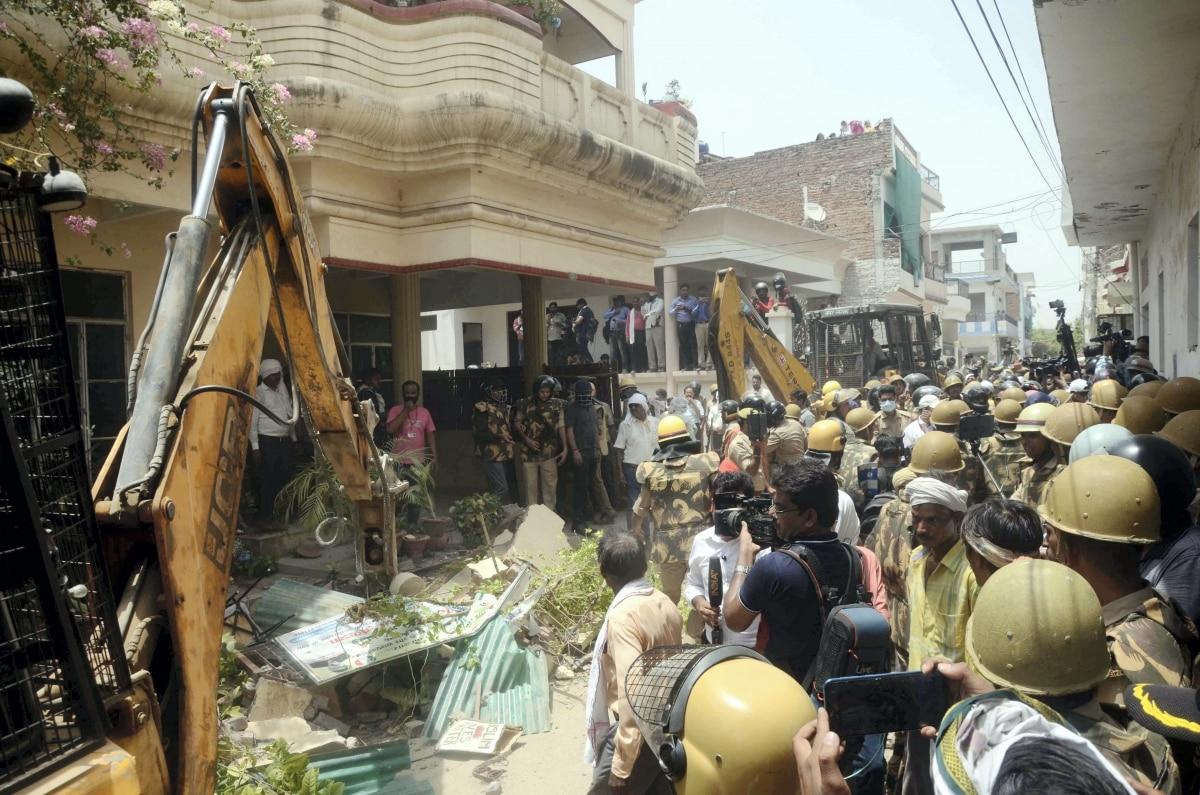
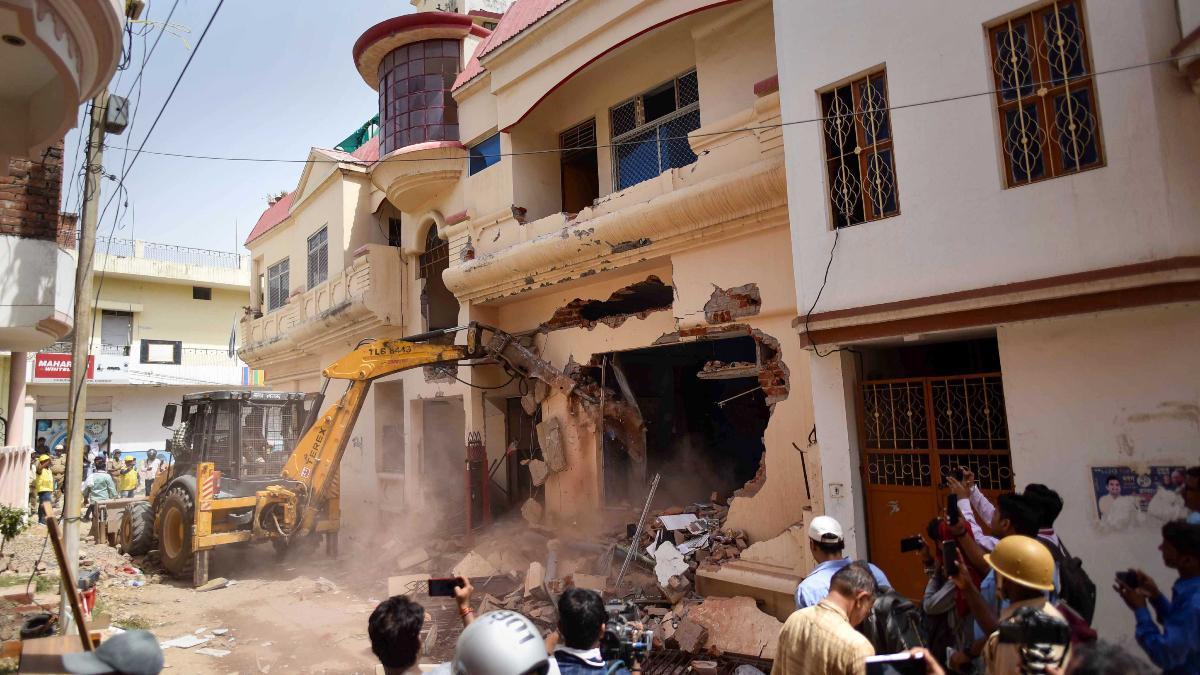
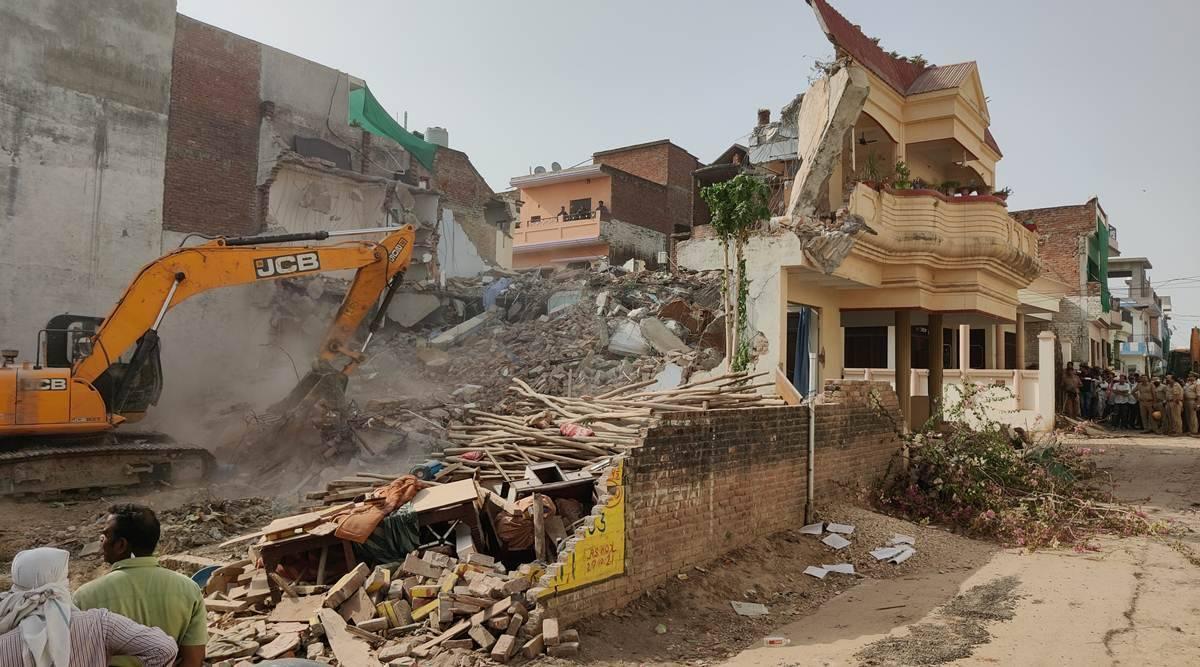
Among the most prominent examples of this is what happened in June 2022 CE (Dhu al-Qadah and Dhu al-Hijjah 1443 AH).
Indian cities witnessed protests by Muslims following offensive remarks about the Prophet Muhammad ﷺ made by Nupur Sharma, who at the time was an official of the Bharatiya Janata Party.
In Bulandshahr, Uttar Pradesh, violence broke out during the protests, and the authorities accused the Muslim activist Javed Mohammad of being among its organisers.
Almost the day after the case became a major political and security matter, bulldozers reached the house in which his family lived, and the authorities demolished it, saying the building violated construction regulations.
The Uttar Pradesh government later submitted a statement before the courts saying that the demolition was an independent measure against an unlawful building and had no connection to the protests, and that the development authorities had followed the law. Javed's family, however, accused the authorities of not following the necessary legal procedures.
The case became one of the most widely cited examples of what has come to be called "bulldozer justice".
The reason is simple: even if the house had construction violations, the timing of the demolition, after a member of the family had been accused in the protests, raised questions as to whether building laws were being used to impose a penalty that had not been ordered by a court.
What did Amnesty International find?
In 2024 CE (1445–1446 AH), Amnesty International published an extensive investigation into demolitions in India.
The organisation examined the demolition of 128 properties in five areas and states, namely Uttar Pradesh, Assam, Gujarat, Madhya Pradesh and Delhi, following protests and sectarian violence that occurred between April and June 2022 CE (Ramadan to Dhu al-Qadah 1443 AH).
It said the operations affected at least 617 people.
The organisation concluded that properties belonging to Muslims, including homes, shops and places of worship, were subjected to what it described as punitive and arbitrary demolitions. It said that in cases it documented, the authorities used building violations and encroachment as justification for demolition, but did not observe the necessary legal safeguards in a number of cases.
The report also spoke of the targeting of neighbourhoods with a dense Muslim population, and of cases in which, the organisation said, Muslim-owned properties were targeted while other neighbouring properties were left intact.
The Indian government and the governments of the states concerned have generally rejected describing the demolitions as punishment of Muslims, and the authorities say the measures target unlawful structures regardless of their owners' identity.
This is an important point for understanding the issue: the existence of a building violation in some cases does not on its own settle the debate over the legality or motives of a demolition. The dispute also concerns selectivity, timing, notice, the right to object, and whether residents are given sufficient time to go to court.
Why do so many land disputes exist in the first place?
There is another aspect of the issue that is less visible in circulated images.
Many cities in Uttar Pradesh are very old, and contain neighbourhoods, mosques, religious schools, graveyards and structures that are decades old, some built at times when modern land records and licences did not exist in their current form.
When the authorities begin reviewing land ownership, a dispute may arise between several types of records: government revenue records, municipal data, mosque committee documents, endowment records, and residents' testimony about the historical use of the site.
Therefore, it should not be assumed that every mosque demolished in Uttar Pradesh has the same legal status.
Some cases genuinely concern buildings that courts or authorities have said stand on government land, some concern a part of a building that exceeds permitted boundaries, and some concern ownership disputes, while other cases have drawn judicial and human rights objections because of the manner in which demolitions were carried out or the absence of adequate legal procedures.
Sambhal: a new centre of demolitions
The district of Sambhal stood out in particular during 2025 CE and 2026 CE (1446–1447 AH).
In October 2025 CE (Rabi al-Akhir and Jumada al-Ula 1447 AH), residents and a mosque committee in the village of Rawa Bujurg demolished a mosque themselves after the administration considered it to be built on public land, and after they failed to obtain the protection they had sought before the Allahabad High Court.
Campaigns to remove encroachments then expanded.
In April 2026 CE (Shawwal and Dhu al-Qadah 1447 AH), the Sambhal administration announced the removal of religious structures which it said had been built unlawfully on public land in two villages, including a mosque, religious schools, an imambara and structures associated with an Eid prayer ground. The administration said the measures came under government directives to clear public land of encroachments.
In June, another case drew greater controversy, when the authorities demolished the Mustafa Qadri Mosque in the village of Kasiroa.
The administration said the mosque had been built on government land designated as a graveyard, and that legal challenges submitted by the mosque committee had been rejected before the removal was carried out. Politicians from the opposition Samajwadi Party, however, said the committee and residents had sought legally to halt the demolition and that the authorities had not given them sufficient opportunity.
Demolitions in Sambhal have therefore ceased to be isolated events, and have become part of a broader campaign which the government says targets encroachments on public land.
Muslims in India under Modi's rule: rising concerns over rights and freedoms\
Saharanpur: a mosque demolished inside a government compound
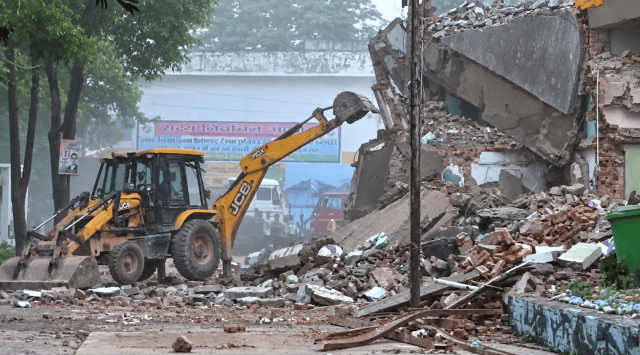
On 5 September 2026 CE (23 Rabi al-Awwal 1448 AH), the case returned to the spotlight in force.
Bulldozers entered the compound of the Saharanpur district administration headquarters, amid a heavy security presence, and demolished a mosque standing inside the compound.
The authorities said the mosque was an unlicensed structure built on about 315 square metres of government land, and that the city magistrate had issued an order in July 2026 CE (Dhu al-Hijjah 1447 AH) to vacate the site, before the district court rejected an appeal submitted by the mosque committee on 2 September 2026 CE (20 Rabi al-Awwal 1448 AH). Three days later, the demolition was carried out on 5 September 2026 CE (23 Rabi al-Awwal 1448 AH).
The mosque committee, however, objected to the administration's account.
The mosque's custodian, Tanweer Ahmad, said the mosque was old and that legal procedures had not been completed, and that the court's latest decision rejected the appeal but did not explicitly order the demolition of the mosque. The committee announced its intention to appeal to a higher court.
This case is significant because it illustrates the complexity of the phenomenon: the administration relies on a legal decision that treats the occupation of the land as unauthorised, while the dispute concerns whether that permits the manner and timing in which the demolition was carried out.
The Supreme Court intervenes: the bulldozer is not a court
As the phenomenon spread across several Indian states, the matter reached the Supreme Court.
On 13 November 2024 CE (11 Jumada al-Ula 1446 AH), the court issued an important ruling in which it set uniform rules for demolitions.
The court affirmed that merely accusing a person of committing a crime does not give the executive authority the right to demolish their home, and that the state cannot substitute itself for the judiciary and determine punishment on its own.
In cases covered by the guidelines, it required the authorities to issue advance notice before demolition, give the property owner an opportunity to object, video-record the demolition, and comply with legal procedures.
The core of the ruling was that demolishing an entire family's home because one of its members is accused cannot become a means of collective punishment.
However, the court exempted certain cases from some of these safeguards, namely clear encroachments on public spaces such as roads, streets, pavements, railway lines and water bodies, as well as cases in which the demolition is ordered by a court.
The door therefore remains open to lawful encroachment-removal operations, but within clearer limits and procedures.
The court condemns authorities in Uttar Pradesh itself
The judiciary's warnings have not remained theoretical.
In November 2024 CE (Jumada al-Ula 1446 AH), the Supreme Court criticised Uttar Pradesh authorities in a case concerning the demolition of a house in the Maharajganj area for road widening without following the necessary procedures, described what had happened as a "departure from the law", and ordered the payment of compensation of 2.5 million rupees to the house owner.
Then came a case of greater significance in April 2025 CE (Shawwal and Dhu al-Qadah 1446 AH).
The court considered the demolition of six houses in Bulandshahr, deeming the manner of implementation "inhuman and illegal" and saying that it "shocks our conscience", after finding that the residents had not been given a reasonable opportunity to defend their position.
It ordered the Bulandshahr Development Authority to pay one million rupees to each of the six affected persons, six million rupees in total, affirming that the right to shelter is part of the right to life protected by Article 21 of the Indian Constitution.
These rulings are significant because they show that the debate over demolitions is not merely political or media-driven: India's highest court itself found, in certain cases, that the authorities of Uttar Pradesh had exceeded the law.
This does not mean, on the other hand, that every demolition carried out in the state is unlawful; there are cases in which the administration relied on court decisions or on established disputes over government land.
Why, then, does the phenomenon recur?
The causes can be summarised as an overlap of several factors.
The first is that the Uttar Pradesh government has made the removal of encroachments and unlawful construction a prominent part of its security and political discourse, and the bulldozer has become an openly declared symbol of resolve.
The second is that the state has tens of millions of Muslims, including large communities in old cities where issues of ownership, planning, endowments and government land intersect.
The third is that the authorities use a broad range of urban planning, land and public property laws to carry out removals. For example, the Uttar Pradesh Urban Planning and Development Act permits action against construction carried out without permission, but it also stipulates procedures, notices, time limits and a right of appeal.
The fourth and most contentious factor is the coincidence of some demolitions with criminal accusations, protests or sectarian tensions.
It is this which has transformed the matter from a municipal building issue into a human rights and political question at the level of India as a whole.
The mosque, the house and the same question
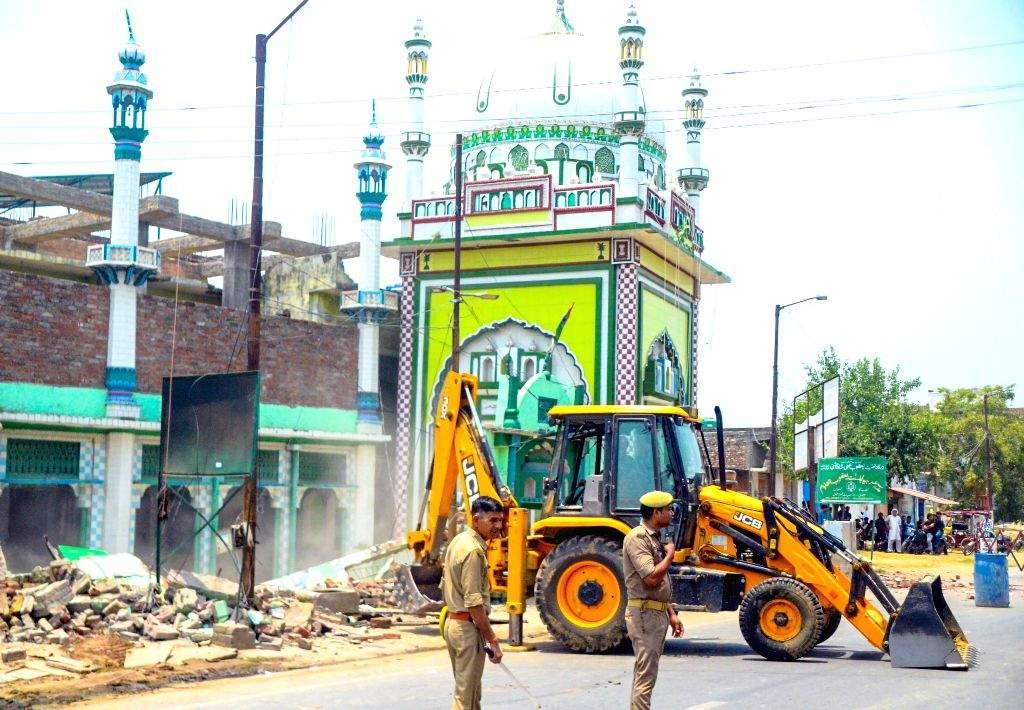
At first glance, demolishing a mosque over a dispute about government land may seem entirely different from demolishing the house of a person accused of taking part in a protest.
Legally, they are indeed two different matters. But their being brought together under one heading in Uttar Pradesh returns to the question critics constantly raise:
Are building and land laws applied in the same way to everyone, or are they applied selectively and more strictly when it concerns Muslims or opponents of the government?
The government says the law is one and the same, and that religious affiliation has nothing to do with the procedures.
Amnesty International, opponents and human rights groups, however, say that the pattern they have documented, the political timing of some operations, and the rhetoric of some officials point to the use of demolitions in a discriminatory or punitive manner in certain cases.
Between these two positions, the courts have become the decisive arena for ruling on each case individually.
More than buildings
Demolitions leave an impact that goes beyond the loss of walls.
When a house is demolished, a family may lose in minutes the place where it has lived for years, and with it documents, belongings and a source of livelihood. When a shop is demolished, a family can lose its income. When a mosque or religious school is involved, the dispute shifts from a property matter to a religious and social issue of great sensitivity.
This is why the Supreme Court of India, in its rulings, focused on the concept of the "right to shelter" and human dignity, not only on land ownership.
This also explains the symbolic power of the bulldozer in contemporary India: for supporters of the Uttar Pradesh government it is a symbol of state authority confronting violations and crime; for its critics it has become a symbol of swift punishment that can precede the courts.
From Bulandshahr to Saharanpur
What happened in Saharanpur in September 2026 (Rabi al-Awwal 1448 AH) is therefore not an incident that emerged out of nothing.
It comes after years in which demolitions have become one of the most controversial tools of administration in Uttar Pradesh, following repeated interventions by the courts, human rights reports, and disputes over mosques, endowments (awqaf) and public land.
But the broader picture remains more complex.
The question that hangs over the "bulldozer policy" in Uttar Pradesh is not whether the state has the right to remove illegal construction. Rather, the question is: Who is targeted? When? Why? And does the owner of a home or a mosque receive the notice, the time, and the right to object and to a hearing that the law guarantees?
Accordingly, the debate over the demolition of mosques and homes in Uttar Pradesh is, at its core, a debate about the limits of the state's own power: Does the bulldozer remain a tool for enforcing the rule of law, or does it become a punishment that precedes the verdict? A punishment for being a Muslim in India!


