

Modern wars are no longer fought with tanks, aircraft and missiles alone. Financial sanctions, restrictions on the export of technology, control over supply chains, and access to energy and raw materials have become tools that states use to weaken their rivals, reduce their capacity to sustain fighting, and impose strategic costs on them without the need for direct military confrontation.
Amid the growing rivalry between the United States and China, and the Russian-Ukrainian war, military and security institutions are increasingly aware that a state's strength is measured not only by its military arsenal, but also by its ability to protect its economy, secure its industrial and technological needs, and deny its rivals the resources needed to strengthen their own power.
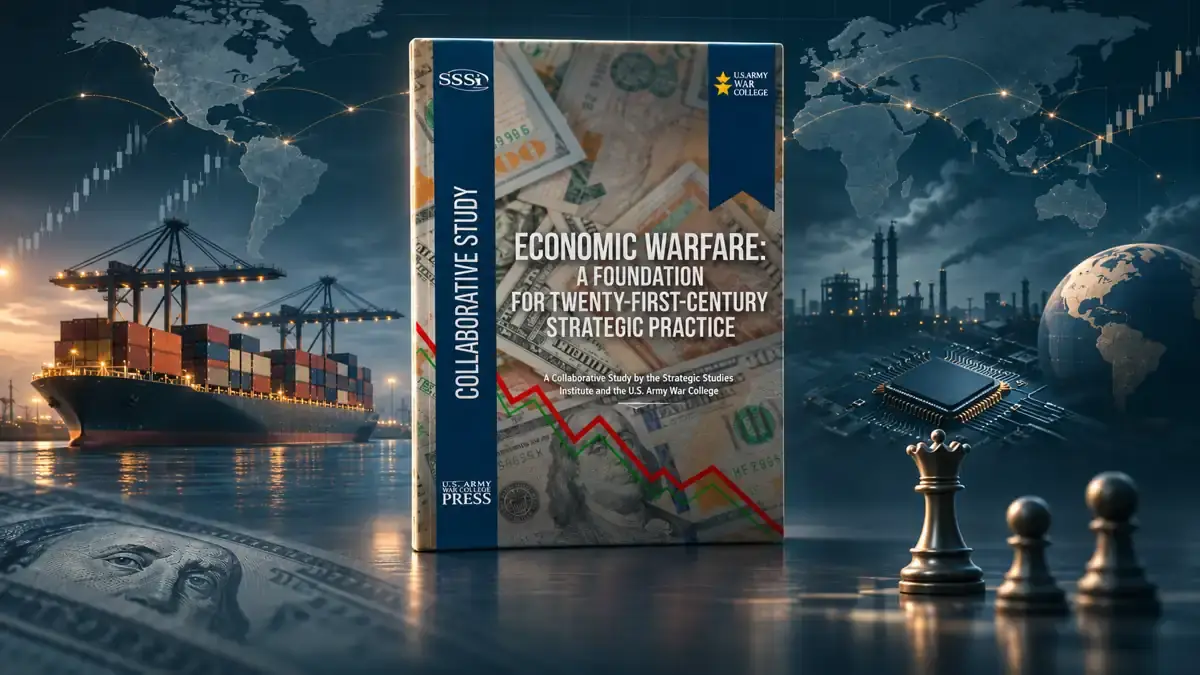
These developments are addressed in a U.S. military study titled "Economic Warfare: A Foundation for Twenty-First-Century Strategic Practice" (Economic Warfare: A Foundation for Twenty-First-Century Strategic Practice), published by the War College Press of the U.S. Army on July 24, 2026, edited by Greg Kennedy, Antulio J. Echevarria II, and Anna Brinkmann Schwartz.
The study starts from the premise that economic warfare is no longer a marginal activity or a diplomatic tool separate from military planning, but has become an element intertwined with national security and the management of conflict between major powers.
Most importantly, it calls for a reconsideration of who is responsible for managing this type of conflict. Economic decisions that affect the outcomes of wars are not issued by military institutions alone, but are shaped through a broad network of ministries, companies, and financial, industrial, technological and research institutions.
First: How Did the Economy Become a Battlefield?
The study's core idea is that competition between major powers has, for years, gone beyond the limits of traditional military superiority and now includes continuous attempts to shift the balance of economic power.
A state may seek to weaken its rival without attacking it militarily, by restricting its access to advanced technology, reducing its ability to benefit from global markets, or imposing sanctions on its financial institutions and strategic companies.
It may also use its economic power defensively, securing alternative sources of raw materials, reducing its dependence on foreign suppliers, and protecting its sensitive industries from disruption during a crisis.
In this sense, economic warfare is not limited to harming the economy of the opponent, but also includes protecting the elements of national power that allow a state to endure and compete.
The study describes this relationship through two complementary concepts: economic weapon and economic shield.
The economic weapon consists of the pressure tools a state can use against its adversaries, while the economic shield refers to its ability to protect its productive, financial and technological base from external pressure.
The importance of this distinction lies in the fact that a state may possess powerful tools to harm another state's economy, while at the same time being vulnerable to countermeasures because it depends on exports, materials or markets that it cannot easily do without.
Hence, studying a state's economic vulnerabilities becomes part of security planning, not merely a matter for financial institutions.
Second: The Russian-Ukrainian War, When the Economy Entered the Battle
The study places the Russian-Ukrainian war, which broke out in February 2022, at an important point for understanding the shift in the use of economic power.
The war highlighted the direct link between financial and trade measures and the ability to conduct and sustain military operations.
Western sanctions imposed on Russia included restrictions on the banking sector, trade, advanced technology and energy, alongside measures targeting individuals, institutions and sectors linked to the Russian economy.
According to the European Council, European economic measures aimed to reduce the resources and industrial and technological capacities that Russia could use to finance its war and sustain its military operations.
This experience shows that the purpose of sanctions is not limited to causing direct financial losses, but may also include weakening the targeted state's ability to obtain the industrial and technological components necessary to produce, maintain and replenish its weapons.
However, the impact of these measures cannot be measured simply by announcing them, as it depends on multiple factors, including the targeted state's ability to find alternative markets, redirect its trade, develop domestic production, and circumvent the restrictions imposed.
Here lies one of the most important strategic problems: inflicting damage on an economy does not necessarily compel a political leadership to change its decision, nor does it mean that the military impact of sanctions will be immediate.
A state may continue fighting despite severe economic pressure, if it is able to redistribute its resources, obtain external support, or bear long-term costs.
This is why evaluating economic warfare depends on its ability to achieve specific political and military objectives, not solely on the scale of the sanctions announced.
Third: China and the United States, the Battle over Technology and Supply Chains
US-China competition is one of the most prominent contexts the study addresses, as a model of the use of economic tools in conflict between major powers even in the absence of direct military war between them.
Advanced technology, especially semiconductors and electronic chips, has become a key arena of this competition.
In October 2022, the U.S. Department of Commerce imposed restrictions on the export to China of advanced technologies and equipment related to supercomputing and semiconductor manufacturing, and then reinforced these restrictions with additional measures in the following years.
Washington justified this policy with concerns related to national security and the possibility that advanced technologies could be used to develop Chinese military capabilities.
These measures reveal how civilian technology with potential military applications can be turned into a tool of strategic pressure.
A state that controls essential components of a particular industry does not merely possess a commercial advantage, but may have the capacity to affect the pace of technological and military development among its competitors.
However, this type of pressure carries mutual risks; export restrictions may also affect the revenues of exporting companies, and push the targeted state to accelerate technological self-sufficiency projects and reshape its relations with suppliers.
Thus, competition in technology becomes a prolonged struggle over the capacity to innovate and produce, rather than merely a confrontation between companies selling similar products.
Fourth: Supply Chains, the Weak Point That Can Disrupt Armies
Among the most important dimensions of modern economic warfare is the importance of supply chains: the networks that move raw materials, industrial components and products between countries, companies and factories.
Manufacturing a fighter jet, an air defense system or an advanced missile does not depend on a single factory, but on a chain of suppliers, technologies, materials and services that may be spread across multiple countries.
If the supply of a critically important component is interrupted, production may stop or maintenance may be delayed, even if the remaining components are available in large quantities.
This problem becomes more dangerous when sensitive industries depend on a limited supplier, a single geographic region, or a sea lane exposed to disruption.
For this reason, industrial capacity does not mean owning factories alone, but also the ability to keep them operating during crises.
From a strategic perspective, disrupting a decisive supplier can weaken an opponent's ability to compensate for its military losses or increase its production, without the need to directly destroy its facilities.
Conversely, diversifying sources of supply, developing strategic reserves, protecting transport routes, and strengthening domestic industries become important defensive measures.
This relationship reveals that military planning for a long war must account for more than the number of troops and weapons available at the start of fighting; it must also include the capacity to produce equipment and munitions and replace losses while operations continue.
Fifth: Who Runs Economic Warfare, the Army or the Treasury?
The study raises an important institutional question: if economic warfare affects the outcomes of military conflicts, who should define its objectives and lead its implementation?
Financial sanctions may fall within the remit of the treasury, trade restrictions within the powers of economic institutions, while private companies manage a large part of industrial and technological production.
Military institutions, meanwhile, are responsible for assessing threats, preparing for wars, and recommending the appropriate means to achieve security objectives.
The study argues that this overlap requires deeper cooperation between military and civilian institutions, as well as with the industrial, financial, technological and academic sectors.
It does not present economic warfare as a matter that the army should manage alone, but stresses the need for military institutions to take part in assessing the use of economic tools when their objectives are linked to combat operations and national security.
For example, political leadership may need to know the expected military impact of preventing the export of certain equipment to a potential rival: Will the restrictions affect its capacity to produce weapons? When might their effects appear? Are alternatives available to it?
At the same time, military institutions need to understand the costs of these restrictions for the national economy and allied companies, and the likelihood of the state facing countermeasures.
This kind of coordination makes economic warfare a joint planning process that requires combining military expertise with financial, industrial and technological knowledge.
Sixth: The Economy Between Deterrence and Coercion
Among the issues the study highlights is the relationship between economic warfare and the concepts of deterrence and coercion.
Deterrence seeks to prevent an opponent from taking a particular step by persuading it that the cost will be prohibitive.
Coercion, by contrast, seeks to push an opponent to change an existing behavior or to take a decision it does not want, using threats or actual pressure.
A state may use economic sanctions for deterrence before a military confrontation breaks out, threatening to deny the opponent access to markets or financial systems if it takes a certain action.
It may also use them during a war, with the aim of increasing the cost of continuing operations or weakening the resources the other side relies on.
However, the success of economic deterrence or coercion does not depend on the severity of the sanctions alone, but on the extent to which the opponent believes the threat, its political calculations, its ability to bear losses, and the nature of the objective it is being asked to abandon.
This is why the results of sanctions differ from case to case.
A measure that pushes one state toward negotiation may not change the calculations of another state that sees the issue as touching on the survival of its political system or its national security.
This confirms that economic warfare does not operate in isolation from political will and military considerations.
Seventh: Can Sanctions Decide a War?
Here a distinction is needed between the ability to weaken an opponent and the ability to achieve victory.
Sanctions may reduce financial resources, delay access to advanced technology, raise production and transport costs, and weaken certain industrial capacities.
But on their own they do not guarantee the collapse of the targeted military power or the end of a war.
States may adapt to pressure through various means, including redirecting trade, relying on new partners, developing domestic alternatives, or shifting the economic burden onto their populations.
Moreover, states that use sanctions may themselves bear losses resulting from market disruption, rising commodity prices or the breakdown of trade exchanges.
These considerations suggest that the success of economic warfare requires setting measurable objectives, estimating the time needed to achieve them, and reviewing their actual impact on the opponent's behavior and capabilities.
Not every economic decline is a strategic success, and not every continuation of fighting is proof that sanctions have had no effect.
The impact of economic pressure may be gradual, appearing in a state's ability to produce weapons, supply spare parts, or maintain the readiness of its forces in the years that follow.
Eighth: Civilians Also Pay the Price of Economic Warfare
Although the study proceeds from a national security and military strategy perspective, the analysis of economic warfare raises a critically important humanitarian question: who bears the costs of economic pressure?
If financial and trade restrictions disrupt essential services, raise the prices of goods, or reduce access to medicines and medical equipment, civilians who do not take part in political and military decisions may be harmed.
These risks are heightened in poor societies or areas affected by conflict and displacement, where the population's capacity to absorb economic shocks is already limited.
The United Nations has acknowledged the need to protect humanitarian work from the unintended effects of some sanctions regimes, which was reflected in Security Council Resolution 2664 of 2022, which allowed specific humanitarian exemptions from asset-freeze measures imposed under UN sanctions regimes.
This does not mean that all sanctions produce the same effects, or that economic pressure tools are equal in intensity; targeted restrictions on a military institution differ in scope and outcomes from broad measures affecting the economy of an entire country.
Nevertheless, this distinction underlines the need to include humanitarian impact in the assessment of any economic strategy, and not to measure its success solely by the damage inflicted on the targeted state.
From the perspective of countries experiencing wars and humanitarian crises, this issue is not confined to relations between major powers, but extends to the impact of trade and financial restrictions on aid, medicine, food and the capacity for reconstruction.
Ninth: What Does This Study Mean for Less Powerful States?
Although the study focuses on competition between major powers, it offers important lessons for states that lack broad military or economic superiority.
A state that depends on foreign sources for most of its food, fuel or technological needs may be more exposed to pressure during an international crisis or disruption to transport and trade.
Likewise, a state that possesses important natural resources or a location controlling vital trade routes may hold leverage that exceeds the size of its economy or its direct military capabilities.
However, geographic location and natural resources do not automatically translate into strategic power; this requires institutions capable of managing resources, effective infrastructure, stability that allows investment, and the ability to protect national interests from disruption.
This is particularly evident when considering maritime passages that connect energy-producing regions with global markets, such as the Strait of Hormuz and Bab al-Mandab, where security disruptions can produce economic effects extending to countries far from the battlefields.
This is an analytical application of the study's ideas, not a specific conclusion attributed to any of its chapters.
Tenth: What Does the Study Add to Military Thinking?
The study's fundamental value lies in its call to move beyond the traditional separation between military power and economic power.
The economic war is not merely a set of sanctions imposed after a crisis has occurred. It is a domain that requires advance strategic planning, the definition of objectives, means and resources, and coordination among state agencies and the relevant institutions of society.
The study stresses that modern military institutions cannot ignore the economy when examining threats or preparing national security plans, because the ability to fight is linked to the ability to produce, finance, develop technology and sustain supply.
It also draws attention to the dual nature of these instruments. Just as a state can use the economy to weaken its adversary, it needs to build economic capacity that protects it from the same pressures.
This approach, however, calls for caution against exaggerating what can be achieved through sanctions and trade embargoes alone. Economic warfare may be an influential tool, but it is not a guaranteed substitute for political settlement, nor a means that ensures the achievement of military objectives merely by being used.
The true test of any economic strategy lies in its ability to achieve specific objectives, at acceptable costs, and without inflicting disproportionate harm on societies and civilian populations.
Conclusion: A State's Strength Begins Before the Bullet Is Fired
The study "Economic Warfare: A Foundation for Twenty-First-Century Strategic Practice" reveals an important shift in security thinking: preparation for war is no longer limited to training forces and developing weapons, but now includes securing supply chains, protecting the industrial base, and ensuring access to technology, finance and essential resources.
A state that possesses a strong army but is unable to provide its industrial and financial needs over the long term may find itself facing limits that military superiority alone cannot overcome.
Conversely, a state with broad economic and technological capabilities can use these assets to increase pressure on its adversaries or to protect itself from external coercion.
International competition thus becomes an ongoing struggle over resources, markets, technology and the capacity to endure, and its effects may begin years before military conflict erupts and continue after fighting ends.
The most prominent conclusion is that the economy is no longer merely a source of funding for wars; it has become one of the instruments through which wars are managed and through which the balance of power is shaped.
---
References
- Greg Kennedy, Antulio J. Echevarria II, and Anna Brinkman Schwartz (eds.), Economic Warfare: A Foundation for Twenty-First-Century Strategic Practice, U.S. Army War College Press, 24 July 2026. Study page and full book download.
- U.S. Army War College Press – overview of the study and its objectives.
- U.S. Department of Commerce – export controls on semiconductors and advanced computing technology to China.
- Council of the European Union – economic sanctions imposed on Russia.
- United Nations Security Council – Resolution 2664 (2022) on humanitarian exemptions from certain sanctions measures.


