


The scenes of storming the al-Aqsa Mosque during Jewish holiday seasons are no longer a passing event that can be reduced to the number of intruders or to a tour that ends with their exit through Bab al-Silsila. What al-Aqsa witnessed during the Jewish "Festival of Booths" (Sukkot) in September 2026 carries more serious indicators: large numbers, open collective prayers and rituals, the introduction of items linked to religious rites, the participation of Israeli ministers and lawmakers, and statements speaking explicitly of "sovereignty" and "ownership of the place."
For this reason, the Jerusalem Affairs Department described the developments as "unprecedented escalation," warning that the matter goes beyond mere storming to an attempt to change the historical and legal status quo at the al-Aqsa Mosque.
From Visiting to Public Prayer
The danger of what is happening lies in the gradual shift in the nature of the storming.
According to the arrangements known as the historical status quo, non-Muslims may visit the al-Aqsa courtyards at specified times, while Islamic worship remains the only worship permitted in the Haram. Even Israeli media acknowledge that, under the status quo as officially established, Jews are not permitted to pray there.
But the scenes during "Festival of Booths" showed a different reality.
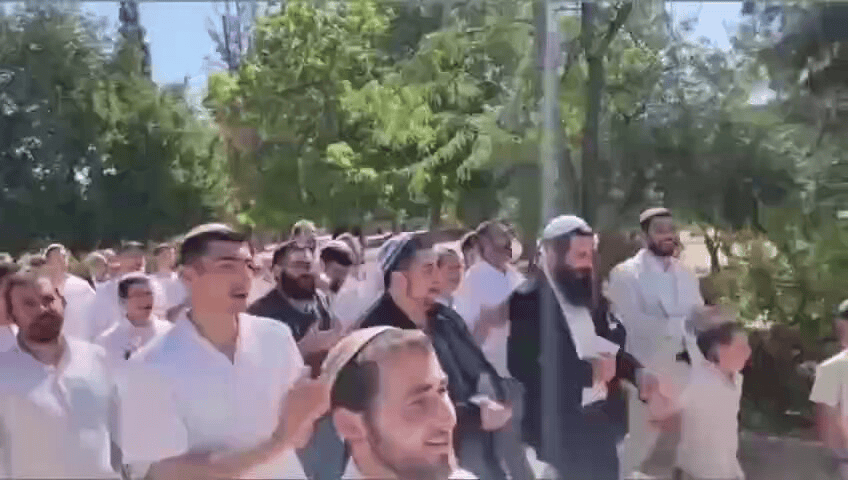
Intruders performed collective prayers openly, practised religious rituals inside the courtyards, and some used what is known as the "Four Species" associated with Sukkot rites. Recordings published by Israeli bodies showed groups praying openly inside the Haram.
The Jerusalem Governorate also documented the introduction of "vegetarian offerings," collective prostration and other religious rituals within the mosque's courtyards. On 28 September alone, the Governorate said 1,792 settlers stormed al-Aqsa during the morning and evening sessions.
This paradox captures an essential aspect of the scene: the expansion of the ability of Jewish groups to practise their rituals inside al-Aqsa, alongside restrictions on access for Palestinians and Muslims.
When Ministers Enter the Scene
More serious still, these practices are no longer confined to the "Temple Mount" groups or marginal religious activists.
Israeli National Security Minister Itamar Ben Gvir stormed the al-Aqsa Mosque during "Festival of Booths" and performed religious rituals there, while Israeli Defence Minister Yisrael Katz entered the vicinity of the mosque at the same time as large numbers of settlers were present.
From inside al-Aqsa, Ben Gvir declared:
He then spoke explicitly about praying in the mosque and described it as "the most important place for the Jewish people."
At this point, it becomes difficult to separate religious practice from the political project.
Ben Gvir is not an activist standing outside the state's institutions, but a minister who oversees the Israeli police itself, the institution that effectively determines who enters the mosque and how storming operations are managed.
Herein lies the significance of the scene: the body that is supposed to enforce the existing restrictions on Jewish prayer is itself politically subordinate to a minister who declares that praying at al-Aqsa has become a right and who takes part in it personally.
Israeli media have even spoken, in August, of allowing Jewish prayer books to be brought into the site for the first time in certain cases, while the office of Prime Minister Benjamin Netanyahu officially maintains that the status quo has not changed.
Between the official discourse and practice on the ground, a gap widens that is difficult to ignore.
It Is Not Only a Matter of "Religious Rituals"
It would be a mistake to read these developments as merely a dispute over freedom of worship.
The real question is: who holds the authority to determine the nature and identity of the mosque and the use of its courtyards?
Change in holy sites does not always happen through a single written decision.
It may begin with small groups entering under police protection, then with individual prayer, then with collective prostration, then with the introduction of religious objects, then with the participation of lawmakers, then with a minister praying inside the place, until what was prohibited yesterday becomes "customary reality" today.
For this reason, the Palestinian Jerusalem Affairs Department warned that the danger lies not in the numbers alone, but in an attempt to impose a new religious and political reality by force, which could pave the way for dividing the mosque by time and space.
Notably, Israeli sources themselves document this change. An Israeli organisation that calls for strengthening the Jewish presence at the site spoke of more than a thousand Jews who went up to it on one day of Sukkot, while the footage showed prayer taking place openly.
In other words, the matter is no longer merely a Palestinian narrative confronting Israeli denial; part of the shift has become documented and publicly announced by the Israeli parties that seek it.
Al-Aqsa and the Ibrahimi Mosque: A Model Not to Be Forgotten
Discussion of changing the status quo acquires particular sensitivity when recalling what happened at the Ibrahimi Mosque in Hebron.
Simultaneously with the storming of al-Aqsa during "Festival of Booths," Israeli authorities closed the Ibrahimi Mosque to Muslim worshippers for three days, after which Ben Gvir stormed it accompanied by settlers and Jewish prayers were held there. Al Ghad News
Here a historical significance emerges that cannot be overlooked: after the 1994 massacre, the Ibrahimi Mosque itself came to be effectively divided between Muslims and Jews, with time and space arrangements and severe security restrictions.
Therefore, the Palestinian warning against dividing al-Aqsa by time and space does not come from a vacuum, but rests on an experience already in place in Hebron.
O Nation of Islam... Where Are the Muslims?
In the face of these scenes, the question imposes itself, not as an emotional slogan, but as a political, moral and religious question:
Where are the Muslims in what is happening at the al-Aqsa Mosque?
Al-Aqsa is not merely a local Palestinian matter.
God Almighty said:
It is one of the three mosques of which the Messenger of God ﷺ said: "Travel is not undertaken except to three mosques," mentioning the Sacred Mosque, his Mosque ﷺ, and the al-Aqsa Mosque.
Yet the world now watches an Israeli minister enter its courtyards, perform his rituals there, and then declare from within: "We are the owners of the place," while the rituals expand year after year.
What of when responsibility relates to the policies of the Israeli government, to the police who protect the storming, and to the movements and organisations that openly work to change the status quo at al-Aqsa.
From "Provocation" to Manufacturing Reality
The word "provocations" is no longer sufficient to describe the scene.
A provocation is a temporary event whose aim is to provoke a reaction. But when the practice is repeated, protected by the police, joined by ministers and lawmakers, and previously forbidden acts become open practices, we are facing a cumulative process of changing reality.
This is precisely what makes this year's "Festival of Booths" a milestone worth pausing at.
The issue is not that 1,000 or 1,700 or 3,000 people entered al-Aqsa.
The issue is: what have they been allowed to do inside it that was not permitted years ago?
That is the most dangerous measure.
Open prayer, collective prostration, the introduction of religious objects, the participation of members of the Knesset and ministers, and statements about "sovereignty": each of these practices, once it becomes habitual, makes the next step easier.
When Silence Becomes Part of the Problem
Palestinian, Arab and Islamic condemnations have been issued, and the Muslim World League condemned the continuing storming and assaults on the al-Aqsa Mosque.
But the question the events pose goes beyond the number of condemnation statements.
If change at al-Aqsa is taking place gradually, through accumulation and the imposition of facts, then reactions that repeat in the same way without preventing the change become less capable of affecting reality.
Hence the question "Where are the Muslims?" is not meant to seek a new rhetorical formulation, but asks about the gap between the status of the al-Aqsa Mosque in the conscience of more than a billion Muslims and the actual political, diplomatic and legal capacity to protect its historical status quo.
The real danger is not only that violations occur.
The danger is that they are repeated until they become familiar.
And that a new generation sees collective Jewish prayer inside al-Aqsa and treats it as an old reality, when it is the result of cumulative steps that took place before the eyes of the world.
Here lies a battle of memory as much as a battle of place: that the exception does not become the rule, that storming does not become an acquired right, and that a reality imposed by force does not become a new "status quo."
O Nation of Islam, the question al-Aqsa poses today is not only: what did the intruders do? It is: what will we say tomorrow if the practices we condemn today become a permanent reality because the world has grown accustomed to seeing them?
Al-Aqsa does not need seasonal anger that ends when the "Festival of Booths" ends, but needs what happens there to remain present in awareness, every step that changes its status to be documented, and all available peaceful political, legal, diplomatic and media means to be used to prevent a new reality from being imposed upon it.
For the most dangerous thing that could happen to the al-Aqsa Mosque is not that it be stormed one day; but that its storming and the change of its identity become an ordinary matter that surprises no one.


