


In the Sheikh Radwan neighbourhood north of Gaza City, a school is no longer a building surrounded by walls, nor classrooms with desks, whiteboards and notebooks.
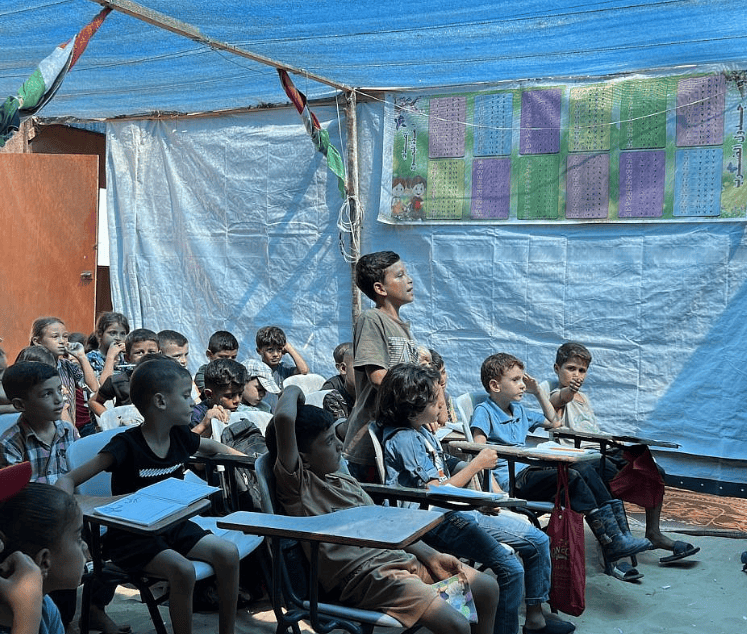
Beneath pieces of cloth stretched between olive trees, on farmland, children aged between four and seventeen sit on the ground to receive lessons in Arabic, English, mathematics and science.
This place is Al-Karama School, one of the grassroots education initiatives that have emerged in the Gaza Strip in recent months in an attempt to fill the void left by the collapse of the education system due to the Israeli war.
In a field report published by Drop Site News on 18 August 2026, corresponding to 5 Rabi' al-Awwal 1448 AH, journalist Rasha Abu Jalal documented the school's experience, offering through it a broader picture of the struggle waged by teachers and families in Gaza to prevent an entire generation from losing its education.
A school without desks, but receiving 200 children
Al-Karama School receives around 200 boys and girls, yet its facilities hardly resemble what is usually known as a school.
There are not enough desks, no notebooks, and no whiteboard, and students receive their lessons inside two tents or in the open air.
The school was founded by Ghadeer Odeh after the ceasefire that took effect in October 2025, following a harsh displacement that she and her family endured. According to the report, she was forced to flee thirteen times during the war before she was able to return to Gaza City.
Odeh says the motivation behind the project was to confront another danger the war left behind: ignorance, which now threatens a new generation of Gaza's children.
The problem is no longer the loss of a single term or a single year.
As for schools part of which remained usable, many were converted during the war into shelters for displaced people.
Education itself has become a war casualty
The figures in the report reveal the extent of the damage to the education community itself.
According to the education director in eastern Gaza, Munir Abu Za'itar, around 20,000 school-age children and more than 530 teachers were killed during the war, while nearly 19,500 students have left the Strip since the war began. These are figures the report attributes to the education official in Gaza.
But educational loss is not measured only by those who were killed or by those whose schools were destroyed.
After years of interruption, UNICEF warns of a decline in children's basic skills in reading, writing and arithmetic; the longer regular education is absent, the harder it becomes for a child to return to the level appropriate for their age.
Here the problem becomes bigger than rebuilding schools.
Even if the buildings were rebuilt tomorrow, children who lived through years of bombardment, displacement and hunger, who lost relatives, friends and homes, and who were cut off from schooling for long periods, would return to them.
For this reason, the new educational initiatives in Gaza are trying to treat the child before the curriculum.
When the classroom becomes a space for healing trauma
Al-Karama School teaches only four core subjects: Arabic, English, mathematics and science.
Physical education, technology and civic education, which were part of study before the war, have been dropped due to a lack of resources.
But the school has added something no less important: activities to help children cope with the psychological trauma accumulated over the years of war.
The school recently organised a summer camp in which children took part in group activities among the olive trees, and they were given space to talk about what they had seen and lived through.
The children's words reveal the weight they carry.
Mais Fayyad, thirteen years old, spoke before her classmates about the war that destroyed schools, homes and dreams, and about how a child sometimes feels guilty simply for still being able to laugh, or for remaining alive while others were lost.
These testimonies explain why restoring education in Gaza is not an optional extra that can be postponed, but an essential part of protecting children and restoring a degree of stability to their lives. In January 2026, UNICEF described returning to learning as an urgent necessity for around 700,000 school-age children.
A child returns from the market to school
But education in Gaza also collides with poverty.
Aseel Shaher, the mother of a twelve-year-old boy who studies at Al-Karama School, says her family was displaced more than seven times, and her husband lost the clothing shop that was their source of livelihood.
With the family's income collapsing, she was forced to send her son Mohammed to work in the markets to help secure food.
The mother did not want her child to work, but she says the family had no other choice.
With the school's opening, Mohammed was able to leave work and return to his studies.
His story sums up another dimension of the crisis: when the school disappears, the child does not necessarily remain at home; he may move into the labour market or onto the street, and the distance between him and education widens the longer he is absent from it.
Mosques and libraries turned into classrooms
Al-Karama School is not an isolated experience.
With educational institutions destroyed, mosques, community centres and public libraries have opened their doors to become temporary teaching spaces.
Much of these initiatives rests on the efforts of hundreds of volunteer teachers who deliver lessons despite a shortage of tools and funding.
Some fundraising campaigns have succeeded in providing tables, whiteboards and chairs, while other initiatives continue to operate with the least possible resources.
According to Abu Za'itar, around 400,000 children are now enrolled in some form of government or community educational programmes, but nearly 130,000 children remain entirely outside the educational process.
Remote learning does not reach everyone
The Ministry of Education has tried to expand e-learning, and teachers have uploaded lessons online and through phone applications. But a solution that seems simple outside Gaza runs into a different reality inside it.
Telecommunications networks have been damaged, electricity is unstable, and smartphones and computers are unavailable to many families, in addition to families who lost all their possessions during displacement.
As a result, according to the education official, only 14% of students were registered for e-learning.
For this reason, the solution has returned to its simplest possible form: a teacher. A group of children. A tent, a mosque or a library. And a pen and paper, if they can be found.
The school is not just the building
Perhaps the experience of Al-Karama reveals one of the most important truths of the war on Gaza: destroying a school does not only mean losing its walls.
The school is where a child learns, but it is also the place where they regain the routine of their life, meet their peers, and step out for a few hours from the world of displacement, tents, bombardment and fear.
This is why parents' insistence on sending their children to these centres, despite their simplicity, can be understood.
Yet fear has not disappeared.
With casualties continuing to occur even after the ceasefire, teachers say some parents still fear sending their children to places of study for fear of shelling or gunfire.
Temporary solutions for a generation that cannot wait
Grassroots efforts are returning children to education, but they cannot be a lasting substitute for a complete education system.
Abu Za'itar warns that temporary schools are not a solution that can be relied upon for years, and he stresses the need to bring in construction materials, equipment and school supplies to rehabilitate Gaza's educational infrastructure.
UNICEF's figures underline the scale of the task: nearly all school buildings in the Strip have been damaged, and more than nine in every ten need large-scale reconstruction or rehabilitation.
But waiting for reconstruction means something different to a child than it does to a politician or an international donor. A year that passes cannot be returned to a child.
A seven-year-old today will be ten in three years, whether or not their school has been rebuilt.
This is why Gaza's temporary schools appear to be more than grassroots initiatives filling a temporary gap.
They are an attempt to stop the war from inflicting another long-term loss: destroying the future of a generation after it has destroyed their cities, schools and homes.
Among the olive trees in Sheikh Radwan, Mais Fayyad said what may sum up the whole issue. She and the children of Gaza, having been deprived of their schools and dreams, are not asking for an exceptional privilege, but for a right that seems self-evident anywhere else in the world:
to learn, to live in a safe place, and to sleep without fear.
In Gaza today, rebuilding a school may be a matter of cement and steel.
But returning a child to a school desk is an attempt to restore some of the childhood that the war has taken.


