


The United Arab Emirates has transferred $100 million to the so-called "Board of Peace" in recent days to fund a contract to train a new Palestinian police force for Gaza, according to a US official and a Middle Eastern diplomat who spoke to The Times of Israel this week.
This is the largest transfer the Board of Peace has received so far, after it announced pledges of $17 billion at a donor conference hosted by US President Donald Trump in February.
Although less than one percent of that sum has been transferred, the Board of Peace denied that it faces any funding problems. A source familiar with the matter said the international body, led by the United States and tasked with overseeing the administration of Gaza after the war, does not seek to collect all pledges immediately, but wants to disburse them as needed.
Establishing a Palestinian police force is a top priority for the Board of Peace, which seeks to form new administrative and security bodies to gradually remove Hamas and Israeli Defense Forces from Gaza.
The police force is to be placed under the National Committee for the Administration of Gaza, a body of Palestinian experts tasked with running the Strip after the war.
The National Committee for the Administration of Gaza (NCAG) has not entered the Gaza Strip three months after its establishment, as the Board of Peace appears determined to first persuade Hamas to accept a framework for dismantling its weapons.
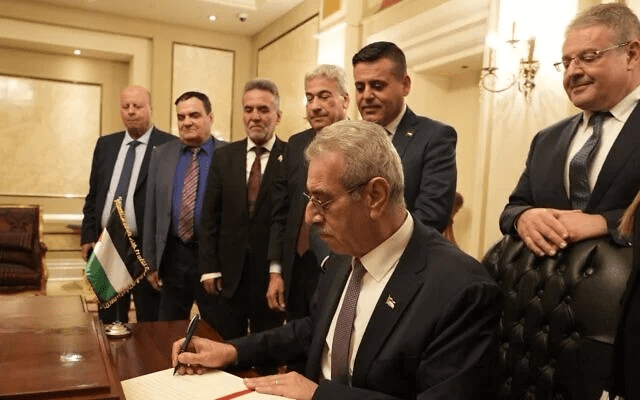
Ali Shaath, a senior official in the National Committee for the Administration of Gaza, signs the committee's mission statement in a photo published on his X account on January 17, 2026. (Ali Shaath/X)
The proposal provides for the new Gaza police force to take part in collecting weapons in the Strip. However, talks on this matter are stalled, as Hamas insists that Israel must abide by the terms of the first phase of the ceasefire that ended two years of war in the Strip.
In February, the National Committee for the Administration of Gaza began the recruitment process for the new police force, and Nickolay Mladenov, the Board of Peace's envoy to Gaza, said thousands of Palestinians had quickly submitted applications.
An Arab diplomat told The Times of Israel in March that Palestinians who had previously worked in Hamas's ranks were allowed to apply to join the new police force, but would have to undergo security vetting by the General Security Service (Shin Bet) before their applications could be approved.
A US official and a Middle Eastern diplomat said recruits would be trained in Egypt and Jordan, with an Emirati security company tasked with building a force of some 27,000 officers.
Read more: Board of Peace will not require Israel to meet truce conditions if Hamas does not accept the disarmament proposal
The Board of Peace declined to comment officially.
Abu Dhabi's decision to proceed with the transfer indicates its continued commitment to participating in the administration of post-war Gaza, even as its national priorities are likely to shift in light of the recent Iran war, during which most of Tehran's attacks on Israel and its Gulf neighbours were borne.
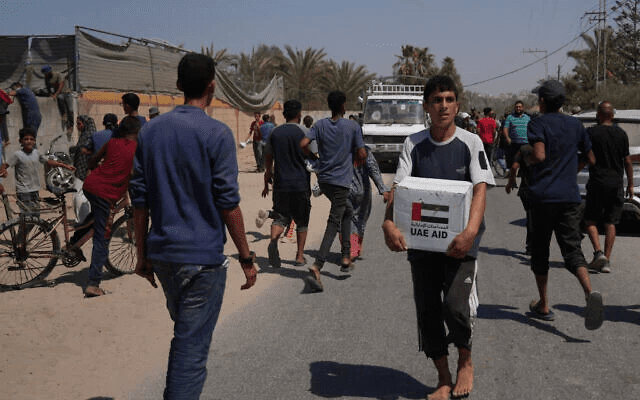
Palestinians receive aid parcels from the United Arab Emirates after they were airdropped in Zawaida, central Gaza Strip, on July 30, 2025. (Associated Press photo)
The UAE, Qatar, Saudi Arabia and Kuwait pledged at least $1 billion each to the Board of Peace. Apart from Abu Dhabi, Morocco is the only country that has fulfilled its pledge, sending several million dollars to the Board of Peace, according to a US official and a Middle Eastern diplomat.
The UAE was the largest foreign donor of humanitarian aid to Gaza during the war, covering nearly half of the aid that entered the Strip.
Another body the Board of Peace is working to establish is the International Stabilisation Force, tasked with gradually removing the Israeli army from Gaza and securing the Strip.
Indonesia, Albania, Kazakhstan and Kosovo have pledged to send troops to the mission, but so far none have been deployed, not even to begin training.
Nevertheless, the United States still appears committed to the initiative, as Trump recently signed an order supporting the sale of US-manufactured "defence materiel and defence services" to the Board of Peace, weapons that are supposed to go to arming Israeli security forces.
The Times of Israel


