


An analytical report by British journalist Andy Worthington paints a bleak picture of Gaza's future, arguing that the options before Palestinians come down to two paths, both of which entrench Israeli control. The first is the continuation of war, starvation and humanitarian collapse. The second is the creation of closed zones under security surveillance, under the name "humanitarian shelters," which the report describes as a model of modern detention camps.
A Worsening Humanitarian Crisis
The report notes that Gaza's residents continue to live through an acute humanitarian crisis despite the ceasefire agreement, which stipulated the entry of 600 aid trucks per day. The author says Israel has not complied with this, resulting in persistent shortages of food, water, fuel and medicine.
The report cites data from the United Nations Relief and Works Agency for Palestine Refugees (UNRWA), which runs 116 shelter centres housing around 76,000 displaced people. During the second half of June, UNRWA was able to distribute about 79 million litres of water per day to more than 860,000 people, in addition to removing thousands of tonnes of waste and carrying out more than 1,250 cleaning campaigns that benefited more than 1.4 million displaced people.
The report also affirms that UNRWA, which employs around 11,000 Palestinian staff, faces Israeli restrictions that have prevented it since March 2025 from bringing aid and humanitarian personnel directly into the Strip, despite holding food and relief stocks outside Gaza sufficient for hundreds of thousands of residents.
Spread of Disease and Collapse of Health Services
The report quotes the United Nations Office for the Coordination of Humanitarian Affairs (OCHA) as saying that overcrowding, water shortages and the lack of medical services have led to the spread of infectious diseases. More than 243,000 medical consultations were recorded in a single week, more than a fifth of which were linked to infectious diseases. Respiratory illnesses, skin diseases and waterborne diseases continued to rise, and more than 18,000 cases of chickenpox and other skin conditions were recorded.
The Fuel Crisis Threatens Hospitals
The report addresses the consequences of restrictions on fuel, noting that the destruction of around 90% of electricity lines forced hospitals to rely on electrical generators. However, shortages of fuel and oils have caused them to break down repeatedly, affecting ventilators, infant incubators, operating theatres and intensive care units.
The report quotes doctors at Al-Aqsa Martyrs Hospital in Deir al-Balah as saying that medical teams have become struggling to provide essential services because of continuous power cuts, warning that any shutdown of these departments could endanger patients' lives, especially newborn infants.
Israel Controls Around 70% of Gaza
The report affirms that Israel has continued to expand its ground control within the Strip. It explains that after the ceasefire agreement, Israeli forces controlled about half of Gaza's area, but gradually extended that control until it reached nearly 70% of the Strip's territory, through the establishment of new military zones.
According to the report, this expansion has led to aid organisations halting their work in some areas and has forced ambulances to obtain prior Israeli approval to enter. Residents speak of repeated shelling that keeps them inside their homes out of fear of being targeted.
Plan for a "Humanitarian City" in Rafah
One of the report's central themes is what it describes as an Israeli plan to create closed zones in Rafah under the name "humanitarian city," based on Israeli media reports.
According to the report, the plan calls for moving hundreds of thousands of Palestinians into prefabricated housing compounds surrounded by barbed wire and subject to security guards and international forces, with those entering subjected to security screening and later prevented from leaving. The author notes that the initial aim is to move around 600,000 Palestinians, with the project later expected to include all of the Strip's residents.
The report argues that these zones would not be intended for the reconstruction of Gaza, as they would receive aid and caravans only, without the entry of building materials needed to rebuild the destroyed cities, thereby turning them into communities under permanent security surveillance.
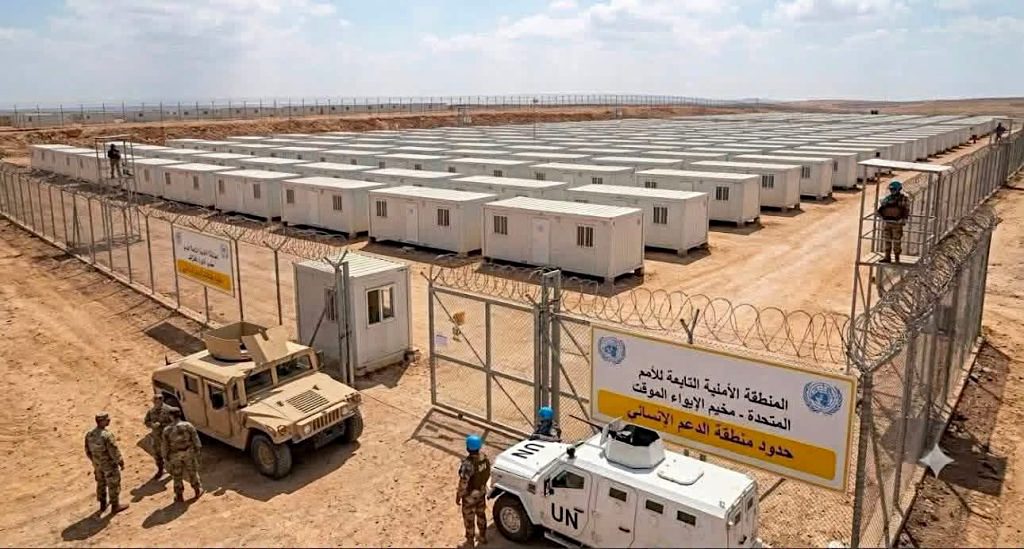
The "detention camp" option for Gaza's future: an image published by Palestinian journalist Tamer Nahed on X on 1 July.
Legal Criticism
The report quotes Israeli human rights lawyer Michael Sfard as describing the plan as potentially amounting to a "crime against humanity," arguing that it effectively amounts to forcibly transferring the population in preparation for their removal from the Gaza Strip, even if officially described as "voluntary emigration."
It also notes that a body known as the "Board of Peace" has launched a campaign against UNRWA, declaring that it has "no place in the new Gaza," which drew criticism from Human Rights Watch, which stressed that the International Court of Justice affirmed Israel's obligation to allow UNRWA to continue its humanitarian work inside the Strip.
Hamas Dissolves Its Government Committee
The report also addresses the announcement by the government media office of the Hamas movement, on 6 July, of the dissolution of the Government Emergency Committee that had been administering the Strip, in preparation for transferring powers to the Palestinian National Committee for the Administration of Gaza (NCAG), a civilian committee provided for under the arrangements of the peace plan.
The statement affirmed that all technical and administrative arrangements for the handover had been completed, calling for the committee to be allowed to enter Gaza to begin its work. The "Board of Peace" welcomed the announcement cautiously, stating that its assessment would remain tied to practical implementation, and reaffirming its principle of "one authority, one law, one weapon."
Conclusion of the Report
The author concludes that, according to current indicators, Gaza's future lies between the continuation of war, starvation and Israeli military expansion, or the transfer of residents to closed zones under strict security control. He argues that both options ignore the political and national rights of Palestinians and threaten to reshape the Strip on security foundations imposed by what is called "Israel," amid continuing disagreement over the disarmament of the resistance and the future of Palestinian administration of the Strip.


