

Turkish Drones in Somalia: When Strategic Interests Are Served at the Expense of Innocent Blood
When Mohamed Ahmed Nur, 50, left his home in the town of Qarakhle in Somalia's Hiraan region on 30 January 2023, he remembered seeing drones flying over the area, but he did not pay much attention. Drones had become a common sight in the town, which is controlled by al-Shabaab.
Nur was attending a funeral in a nearby area when news of the strike reached him later that day. He rushed back to a horrific scene.
Nur told Foreign Policy in March: "I saw the remains of my children and other young men burned to ashes. Their remains were scattered around the tree."
He said: "I could not even wash the bodies of my children according to Islamic law when dealing with the dead, because the bodies of my children were torn to pieces."
Seven young men were killed in the drone strike; five of them were minors. Among the dead were three of Nur's sons: Ahmed Mohamed Nur, 20, Abdulkadir Mohamed Nur, 18, and Qays Mohamed Nur, 8. Also killed in the strike was Mohamed's nephew, 17, and others aged thirteen, fourteen and eleven.
Turkey is waging a drone war against al-Shabaab in Somalia, under a joint command with the Somali intelligence service. (The United States and the United Arab Emirates also take part in Somali drone operations.)
Turkey carries out drone strikes at the request of Somalia's National Intelligence and Security Agency (NISA), which provides Turkey with intelligence on targets, after which Turkey carries out the strikes.
According to two senior Somali intelligence officials in Mogadishu, the strike on the Qarakhle air base followed these steps. (The two officials spoke on condition of anonymity because they were not authorised to speak to the press.)
Since the Qarakhle strike, local residents say the Turkish government has carried out more air strikes in Somalia, resulting in civilian casualties.
The use of Turkish drones, whether by the Turkish government or by states supported by Ankara, has spread across Africa, reaching the Sahel, Libya and even Ethiopia.
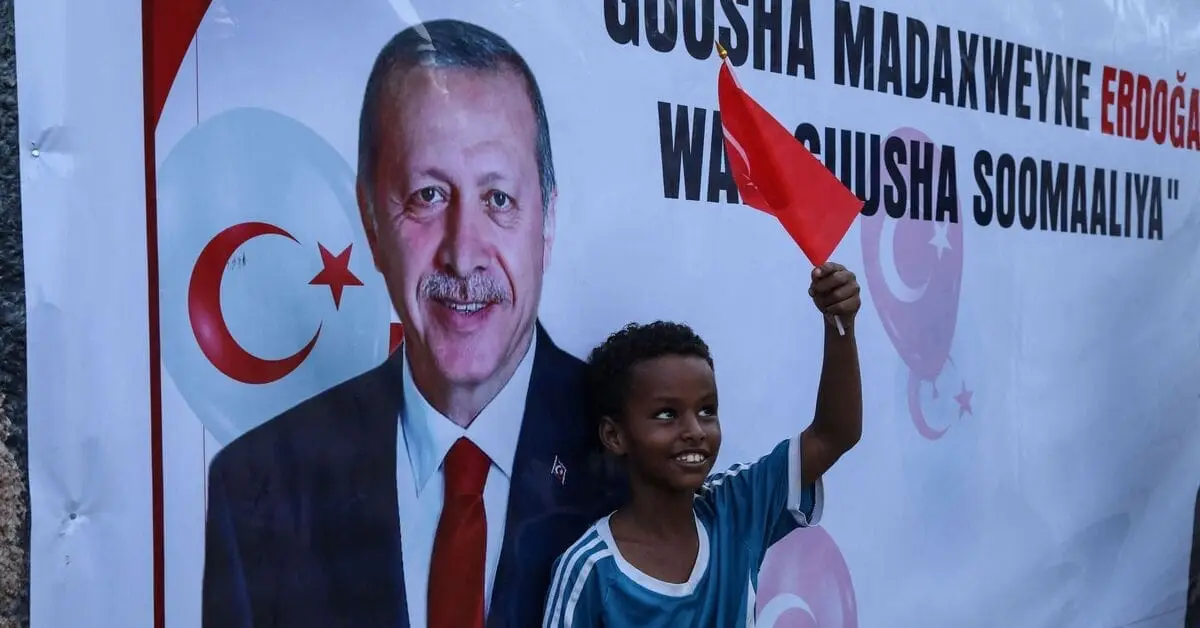
In Somalia, what began in 2011 as a life-saving intervention during a famine has since seen Turkey deeply entrench itself in the country's security infrastructure.
For Turkey, the famine that struck Somalia in 2011, which claimed the lives of some 250,000 people, was a gateway to the strategically important Horn of Africa region, and relief organisations and Turkish companies soon flowed into the country.
Jethro Norman, a researcher at the Danish Institute for International Studies, said: "What began as genuine soft power has undoubtedly evolved into something more strategic."
"Somalia clearly constitutes a node in Ankara's larger geopolitical ambitions — its so-called neo-Ottoman aspirations to reassert Turkish influence in the Horn of Africa and the Red Sea region."
As Turkey began supporting the government in Mogadishu, it found itself increasingly engaged in the Somali government's war effort against al-Shabaab.
Turkey sees groups such as al-Shabaab as a threat not only to its interests in the country but also to its government allies in Mogadishu, where an internationally recognised but fragile government has been fighting insurgents for nearly two decades.
Al-Shabaab responded fiercely to Turkey's alignment with the Somali government, with a spokesperson declaring that "NATO is the greatest enemy of Muslims, and Turkey is part of it. NATO is a union of Christians."
Turkey considers the survival of the government in Mogadishu essential to securing its interests in the country and the region.
In April of this year, as fears grew that the Mogadishu government could fall as al-Shabaab advanced towards the capital, Ankara responded by deploying nearly 500 soldiers in the city.
They were tasked with protecting Turkish assets in the country, such as its largest military base abroad, located at Mogadishu's seaport; the deployment included Turkish security personnel operating armed drones.
Turkish influence has extended into all sectors of Somali life.
Ankara has opened Turkish schools in cooperation with Turkish charities and non-governmental organisations, while Turkish companies have built roads, hospitals and orphanages, and the government in Ankara has provided scholarships to thousands of Somali students to study in Turkey.
Added to this mix are Turkish companies that have been granted the right to manage vital state infrastructure.
In 2013, Favori LLC, a state-backed Turkish company, won a 20-year lease to manage Mogadishu airport. In 2014, the Ankara-based AlBayrak Group obtained a 20-year lease to manage Mogadishu's seaport.
Serious questions remain over the rapid Turkish takeover, particularly regarding profit sharing, local employment, long-term control and sovereignty over state assets.
In 2024, the Somali attorney general accused the Turkish companies that operate Mogadishu's airport and seaport of violating profit-sharing agreements, and the two companies had not submitted the required financial reports following independent audits.
This made it impossible for the Somali government to confirm its legitimate shares of revenue from these key state assets, and according to the attorney general, it threatened the loss of millions of dollars that could be decisive for Somalia's economic growth.
Turkey's geopolitical dominance over Somalia extends beyond the economy to the country's security affairs.
In 2017, Turkey established its largest military base outside the country in Mogadishu, where in the following years it trained thousands of Somali soldiers to take part in the war against al-Shabaab.
Alongside its drone war, Ankara has provided the Somali government with helicopters and ground troops, including the deployment of soldiers carried out last April.
Turkey has become the fourth-largest arms exporter to sub-Saharan Africa.
Because drone exports make up a large share of Turkish arms sales, Bayraktar and Akinci drones have become readily accessible to governments in the Sahel and the Horn of Africa.
The lack of transparency over Turkey's drone strikes may serve the armed groups these strikes target, as those groups exploit popular anger and the sentiments of affected communities.
In 2024, Amnesty International issued a damning report alleging that the Turkish government may have committed war crimes in Somalia after Turkish drones struck an agricultural settlement, killing 23 civilians, including 14 children.
Turkish ammunition was later found at the site of the drone strike, indicating Ankara's involvement in the massacre. However, no party has been held accountable for this strike or for the Qarakhle strike.
Despite this, no party has been held accountable for this strike, or for the strike on the Qarakhle air base.
This is partly because when drone strikes occur in Somalia, they often take place either in areas controlled by al-Shabaab or in areas of the country where neither al-Shabaab nor the government has full control, and rules of engagement there are often absent.
Norman said: "Turkey's drone operations in Somalia point to a broader global shift in drone use, showing how drone warfare is no longer merely a tool of US foreign policy, but has also become increasingly central to Turkey's international strategy." The researcher describes this as a form of "drone diplomacy": a dangerous intersection of lethal technology, geopolitical ambition and arms sales.
For Turkey, this is a core element of a broader strategy to diversify its energy sources, enhance its geopolitical influence, and project its power beyond its traditional sphere of influence.
Omar S. Mahmood, a senior analyst on Somalia and the Horn of Africa at the International Crisis Group, said: "As a weaker state facing significant security risks, Somalia often has to make greater efforts to attract foreign investment, which may mean offering favourable terms."
In 1993, the British economist Richard M. Auty coined the term "resource curse" to describe how resource-rich states tend to develop more slowly, and more corruptly and violently.
Somalia is no exception.
Mogadishu's growing reliance on Ankara gives Turkey considerable influence over Somali affairs, as well as keeping potential competitors at bay.
In 2024, Turkey signed an oil exploration agreement with Somalia for offshore oil fields. The following year, Turkey signed another oil exploration agreement with Somalia, this time for onshore oil fields.
Mahmood said: "Turkey's security support for the Somali government is likely tied to its overall strategy." But because the Somali government lacks a monopoly on the use of force across the country, and because the vast majority of Somalia is not under the rule of the internationally recognised government in Mogadishu, the state has come to rely on foreign drone warfare to combat what it considers threats.
Abdulwahid Abukar, a driver of a minibus that carries passengers between the town of Mubarak, controlled by al-Shabaab, and the government-controlled town of Afgooye in Somalia's Lower Shabelle region, was targeted in a Turkish drone air strike on 9 September 2022.
On that day, Abukar was one of dozens of truck drivers and street vendors attending a meeting at a bus station in Mubarak to resolve a labour dispute.
As the sun was setting, the meeting was struck by an air strike — apparently another Turkish drone strike.
After the smoke cleared, bodies lay scattered across the dirt ground, and the cries of the wounded rang out as they asked for help.
The strike killed nine people and wounded 17 others.
Abukar took many months to recover.
Foreign Policy contacted the Turkish embassy in Mogadishu, the Director General for East and North Africa at the Turkish Ministry of Foreign Affairs, the Deputy Directorate General for Media at the Ministry of Foreign Affairs, and Turkey's Special Representative for Somalia and Somaliland regarding the alleged Turkish strikes that targeted Qarakhle and Mubarak, but did not receive any comment.
As Turkey's presence in Somalia grows, its drone strikes are likely to increase as the war continues, and innocent people will continue to be caught in a cycle of impunity for perpetrators.
Foreign Policy


