(Preventive Priorities Survey) on the Preventive Priorities Survey over the past eighteen years.
The Center for Preventive Action (Center for Preventative Action) surveyed the opinions of U.S. foreign policy experts to assess the risks posed to U.S. national interests by ongoing and emerging sources of armed conflict around the world.
This is because U.S. policymakers often find themselves in a bind due to conflict-related crises, which divert attention and resources away from other priorities and even lead to large-scale military interventions that cost American lives.
Those affected often later lament officials' failure to make greater efforts to avoid these crises or to prepare for them.
Therefore, the purpose of the Preventive Priorities Survey is not only to alert busy U.S. policymakers to sources of instability emerging over the next twelve months, but also to help them identify the most urgent priorities.
There is a growing need for U.S. policymakers to look ahead and to actively work to reduce conflict-related risks year after year.
There is no doubt that the world has become more violent and turbulent. In fact, the number of armed conflicts is now at its highest level since the end of the Second World War. Furthermore, a growing share of these conflicts are between states, which is the reverse of the trend prevailing after the Cold War.
The United States is more exposed to the growing risk of armed conflict, as no other power has this number of allies and security commitments.
The second Trump administration has sought to end several ongoing conflicts, such as those in the Democratic Republic of the Congo, the Gaza Strip, and Ukraine, as well as between India and Pakistan, and Cambodia and Thailand.
At the same time, however, it has engaged in unnecessarily destabilizing behavior, specifically threatening the use of force and other coercive measures against several countries, including allies, particularly in the Western Hemisphere.
Unfortunately, it has also dismantled essential elements of the U.S. government devoted to strategic foresight, conflict prevention, and peacebuilding, without replacing them with better alternatives. Funding allocated to these efforts has been sharply cut.
These measures are counterproductive and short-sighted.
We hope that the Trump administration will change course in the coming months, stop alienating important allies and partners, and pay greater attention to proactive efforts known to promote peace and stability, particularly in areas of importance to the United States.
The findings of this year's Peace and Policy Study may contribute in this regard.
To conduct the survey, experts were asked to assess thirty relatively specific political and military contingencies, which were identified during a preliminary crowdsourcing process as potentially arising over the next twelve months.
Accordingly, it is not designed to assess risks arising from broad trends such as global warming, demographic change, or technological developments. These trends, which can easily lead to violent conflict, are difficult to assess over a short period of time.
Nor does the survey seek to assess risks associated with events such as earthquakes, severe weather, public health crises, or the death of a particular leader.
Such events may lead to instability, but the likelihood of their occurrence is unpredictable by nature. Nevertheless, participants are given the opportunity to identify additional conflict-related concerns they feel deserve attention. These suggestions appear in a list of "Other Notable Concerns."
This year's survey included a new feature: participants were asked to share what they saw as promising opportunities to avoid and manage conflicts around the world. The key findings are discussed separately in the section "Opportunities for Conflict Prevention and Resolution."
Finally, the results reflect the views of experts at the time the survey was conducted in November 2025.
The world is constantly changing, so geopolitical risk assessments must be updated regularly.
The Center for Preventive Action does this through its interactive tool, the Global Conflict Tracker.
Methodology
The Center for Preventive Action conducted the 2026 Preventive Priorities Survey in three stages:
1. Soliciting contingency proposals from the Pre-Emptive Support Program
In October 2025, the Center for Preventive Action (CPA) used various social media platforms to collect suggestions about potential conflicts for inclusion in the survey. With the help of Council on Foreign Relations regional experts, CPA narrowed the list of potential conflicts to thirty contingencies considered likely in 2026 and possibly harmful to U.S. interests.
2**. Surveying foreign policy experts**
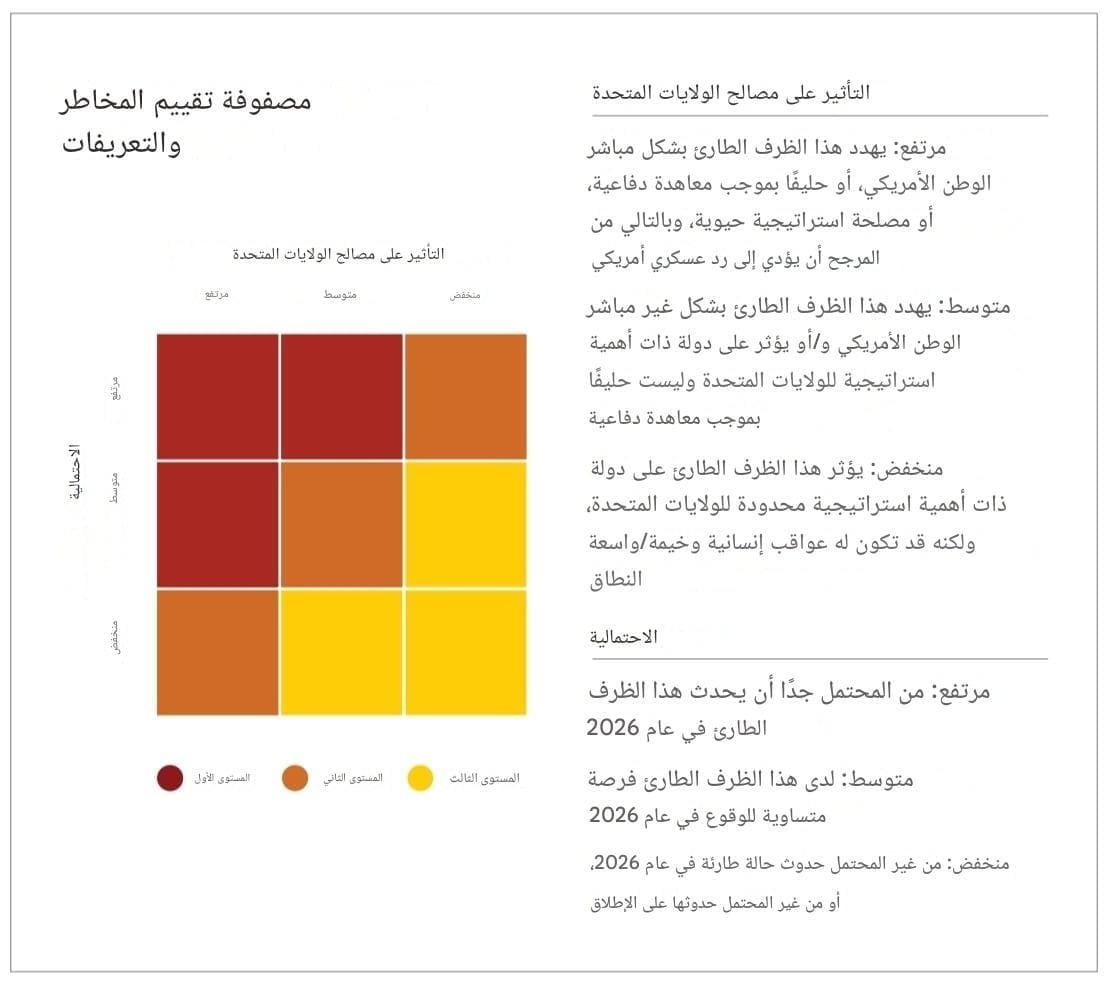
In November 2025, the questionnaire was sent to nearly 15,000 U.S. government officials, foreign policy experts, and academics, of whom around 620 responded. Each was asked to rate the impact of each contingency on U.S. interests and its likelihood of occurring according to general guidelines (see definitions in the risk assessment matrix).
3. Classifying conflicts
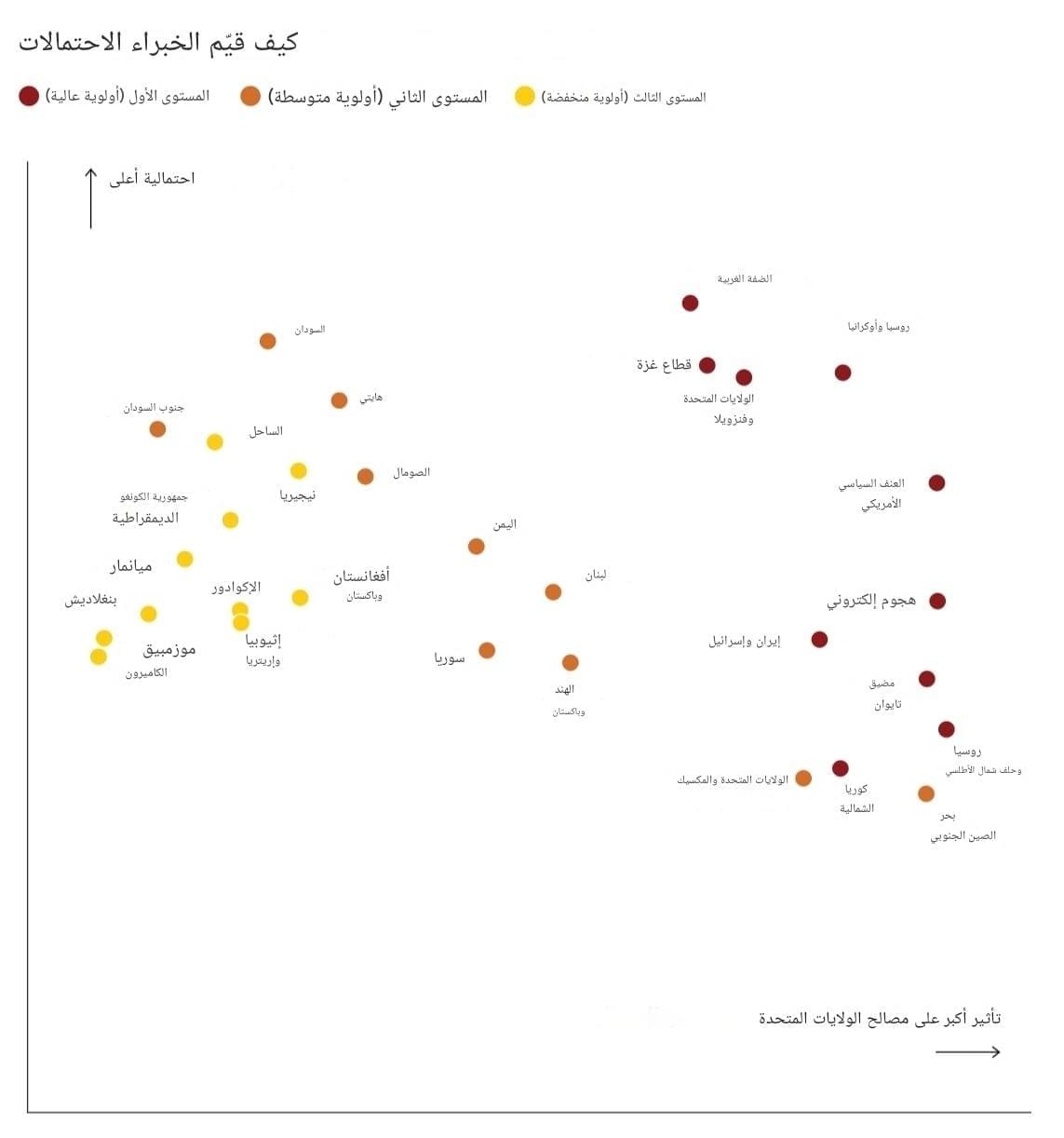
The survey results were then ranked, and the contingencies were subsequently sorted into one of three preventive priority levels (I, II, and III) according to their position.
Level I
High likelihood; major impact
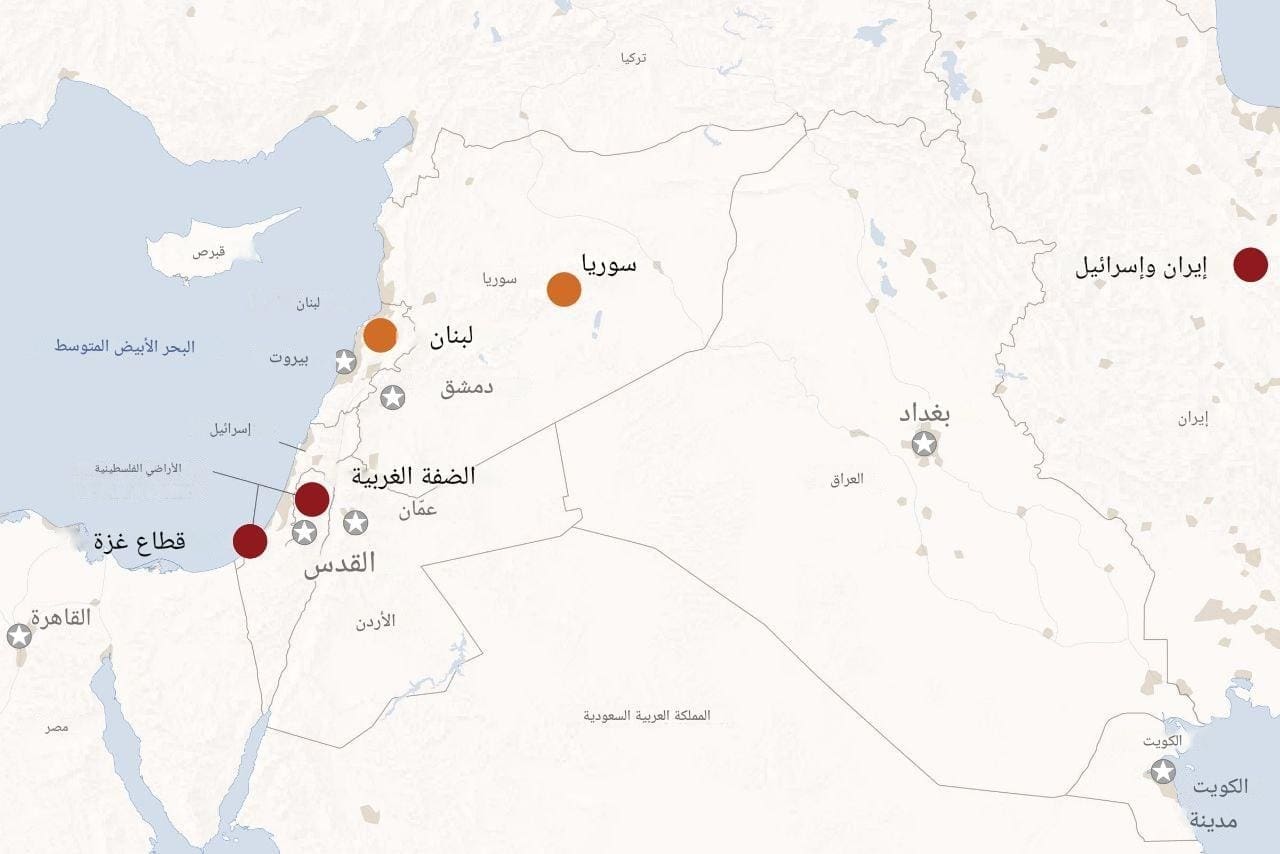
- Escalation of conflict between Israeli security forces and Palestinians in the West Bank due to Israeli settlement construction, Palestinian political rights, and the war in Gaza.
The renewal of fighting in the Gaza Strip, ignited by increasing clashes between Hamas fighters and Israeli security forces, has exacerbated the humanitarian crisis and increased regional instability.
- The war between Russia and Ukraine has intensified, as a result of increasing attacks on each side's vital infrastructure and population centers.
- U.S. military operations targeting transnational criminal groups are escalating into direct strikes in Venezuela, destabilizing the Maduro government.
- Increasing political violence and popular unrest in the United States, driven by rising political hostility and the deployment of domestic security forces.
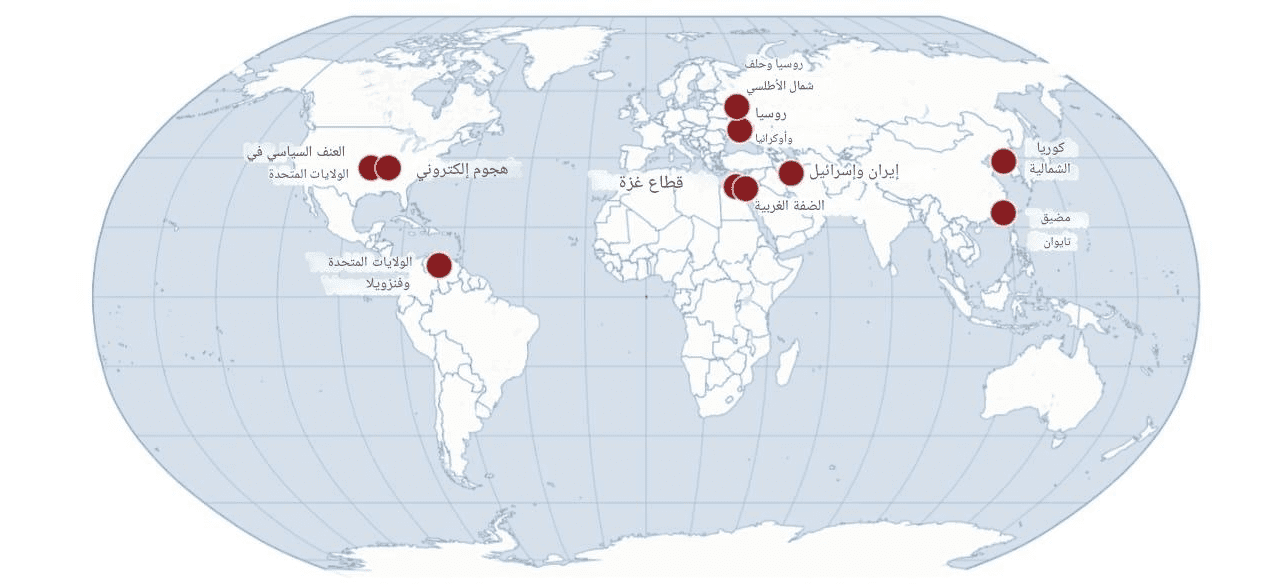
Medium likelihood; major impact
- Renewed armed conflict between Iran and Israel, due to Iran's efforts to rebuild its nuclear program and reconstitute its regional network of anti-Israel proxy groups.
- A state or non-state actor launches a highly disruptive, AI-enabled cyberattack on U.S. critical infrastructure.
- Mounting Chinese military, economic, and political pressure on Taiwan leads to a severe cross-strait crisis involving other countries in the region and the United States.
- Armed clashes between Russia and one or more NATO member states, erupting due to increasing Russian provocations toward European countries.
- North Korea's resumption of nuclear tests escalates tensions on the Korean Peninsula, sparking an armed confrontation involving other regional powers and the United States.
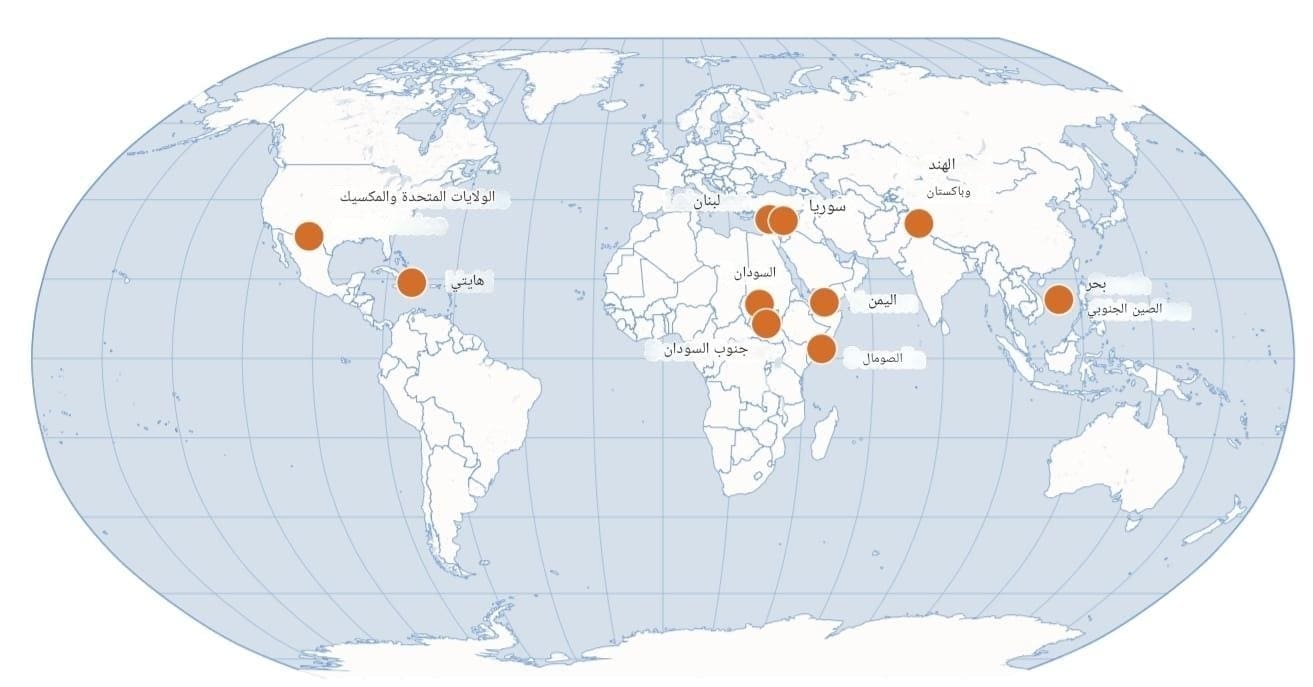
Level II
High likelihood; low impact
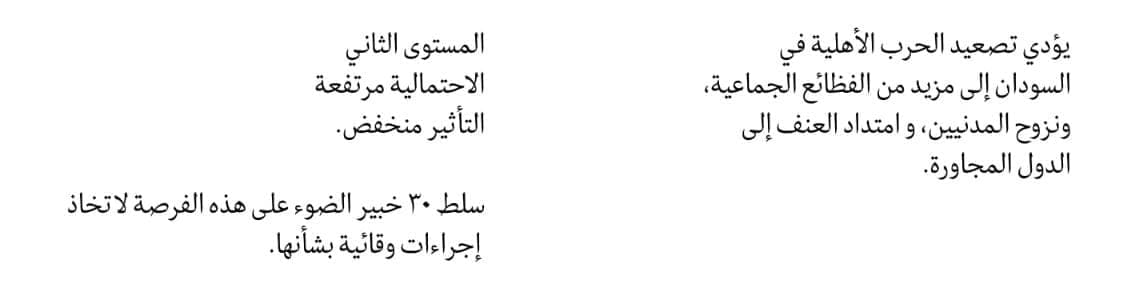
- The escalation of the civil war in Sudan leads to further mass atrocities, displacement of civilians, and the spread of violence to neighboring countries.
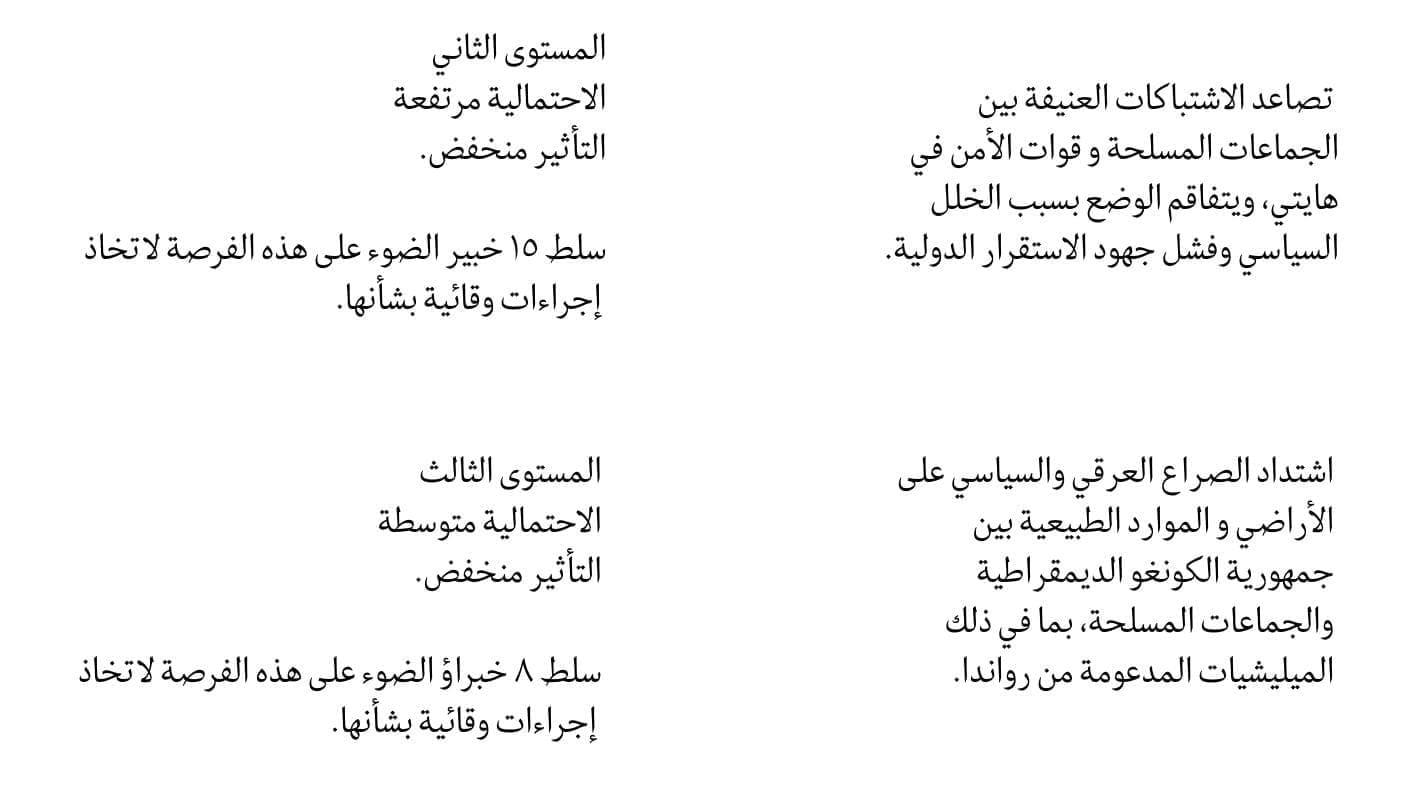
- Violent clashes between armed groups and security forces in Haiti intensify, with the situation worsened by political dysfunction and the failure of international stabilization efforts.
- Further postponement of elections in South Sudan causes renewed fighting among armed ethnic and political factions, destabilizing the central government.
Medium likelihood; medium impact
- The withdrawal of U.S. security assistance from Somalia leads to an increase in terrorist attacks and an expansion of territorial control by al-Shabaab and the Islamic State.
- Houthi attacks on Israel and international shipping lead to retaliatory actions that further weaken state capacity and deepen the humanitarian crisis in Yemen.
- Failure of efforts to disarm Hezbollah and continued Israeli military strikes in Lebanon destabilize the central government and ignite a wider sectarian conflict.
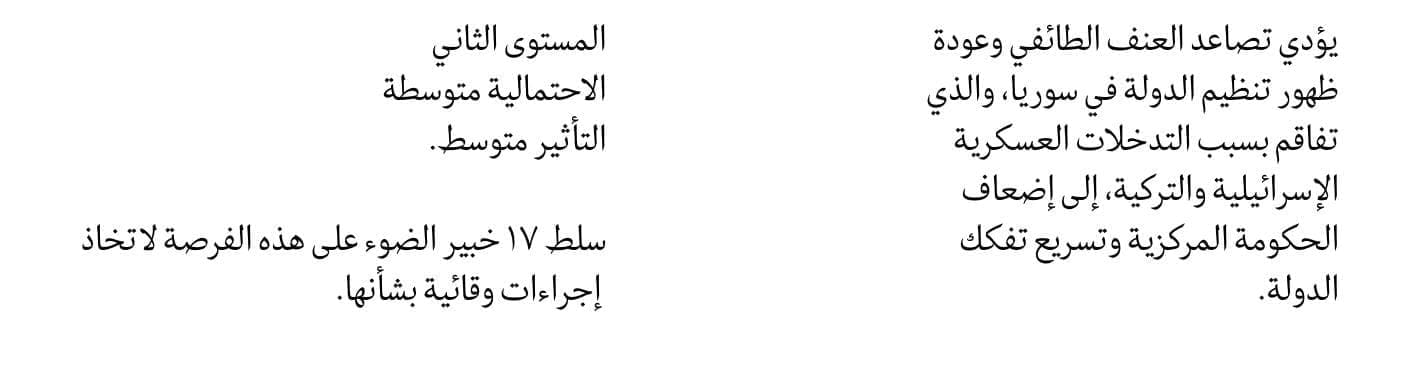
- Rising sectarian violence and the resurgence of ISIS in Syria, aggravated by Israeli and Turkish military interventions, weaken the central government and accelerate the disintegration of the state.
- Renewed armed conflict between India and Pakistan due to rising terrorist activity and repression in Indian-administered Kashmir.
Low likelihood; major impact
- Growing U.S. concern over the illicit production and trafficking of drugs by transnational criminal groups leads the United States to launch direct military strikes in Mexico.
- Chinese aggressive actions in the South China Sea, particularly toward the Philippines, lead to an armed confrontation involving China, the United States, and U.S. allies.
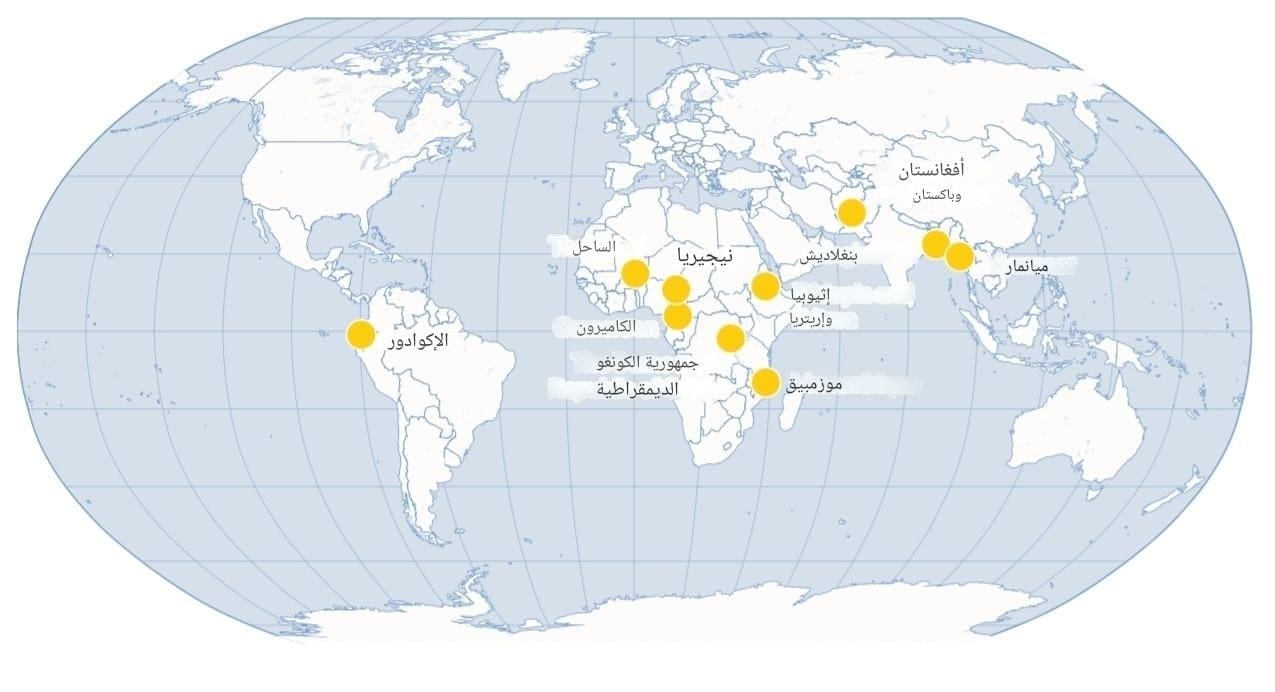
Level III
Medium likelihood; low impact
- Growing insurgencies in the Sahel region (particularly in Mali) exacerbate regional instability and human suffering.
- Rising Islamist terrorism and persistent state weakness in northeastern Nigeria increase insecurity and political instability nationwide.
- Ethnic and political conflict over land and natural resources between the Democratic Republic of the Congo and armed groups, including Rwanda-backed militias, intensifies.
- Political and religious violence increases in Bangladesh, aggravated by the postponement of national elections and a worsening governance crisis.
- Rising criminal activity and conflict between the military council and armed groups in Myanmar accelerate the collapse of the state and increase the displacement of civilians, heightening regional tensions.
- Rising criminal violence and political repression in Ecuador lead to increased civilian casualties and popular unrest.
- Armed clashes between the Ethiopian army and Eritrea-backed militias, aggravated by Ethiopia's efforts to gain access to a Red Sea port, reignite war in the border region.
- Insurgency in northern Mozambique escalates, causing widespread civilian casualties and accelerating displacement.
- Political instability and growing insurgencies in northern and western Cameroon destabilize the central government and lead to a wider civil conflict.
- Renewed armed conflict between Afghanistan and Pakistan, ignited by rising cross-border armed attacks.
Other Suggested Concerns
Although the survey was limited to thirty contingencies, government officials and foreign policy experts were given the opportunity to propose additional potential crises they believe deserve attention. Below are some additional contingencies suggested by a number of survey participants:
- Increased Chinese and Russian military activity in the Arctic leads to an armed confrontation involving the United States or other NATO allies.
- Renewed hostilities over the unresolved territorial claims between Armenia and Azerbaijan draw in Turkey and other regional powers.
- Renewed border clashes between Cambodia and Thailand exacerbate the refugee crisis and regional political instability.
- Tensions between China and Japan over the sovereignty of the Senkaku/Diaoyu Islands, aggravated by disputes over Taiwan's status, lead to armed clashes in the East China Sea.
- Rising activity of armed groups and political polarization in Colombia, together with instability and criminal violence in Venezuela, further hinder the peace process in Colombia and lead to a renewed civil war.
- Rising ethnic violence and political instability in the Western Balkans lead to an armed confrontation requiring foreign intervention.
Conclusions
The unprecedented level of concern we saw last year about the growing risk of violent conflict in the world has not diminished.
Once again, five scenarios were classified as high-likelihood, high-impact events. Twenty-eight of the thirty scenarios covered by the survey were again judged to have a high or medium likelihood of occurring over the next twelve months.
Moreover, survey participants reported that seventeen of these scenarios would have a major or medium impact on U.S. interests.
This year, the thirty likelihoods are evenly distributed across the three relative priority levels.
The Middle East remains prominent among the most significant concerns. Six conflicts in the Middle East are classified as Level I or II priorities, each involving Israel to some degree.
Nevertheless, the largest number of likelihoods (nine) relates to African countries. Although six of them were rated as Level III priorities, the risk of escalating war in Sudan was considered the most likely to occur in 2026 among all the contingencies covered by the survey.
While several Level I likelihoods from 2025 retained their similar classification in 2026 (Gaza, Ukraine, Iran and Israel, and a cyberattack on the United States), one likelihood rose to Level I (North Korea), while four likelihoods fell to Level II (Haiti, Lebanon, Mexico, and the South China Sea). Notably, the likelihood of escalating political violence and popular unrest in the United States — the most prominent risk in the 2024 survey — has returned to being a high-likelihood, major-impact contingency, after being classified as medium-likelihood in the 2025 survey.
As has been the case in recent years, the risk of war between great powers remains. This year, contingencies such as a crisis in the Taiwan Strait and clashes between Russia and NATO are given an equal chance of occurring in 2026, and are classified as having a major impact given their potential to draw the United States into direct armed conflict with China or Russia.
The risk of conflict in the South China Sea carries similar potential risks, but was classified as a low-likelihood contingency for 2026.
Other Noteworthy Observations
Eight potential scenarios in the 2025 survey underwent substantial revision for 2026.
The contingency concerning the war in Ukraine now focuses on the risk of Russia and Ukraine escalating attacks on each other's infrastructure and cities.
The likelihood of renewed fighting between Iran and Israel reflects new concerns following the Twelve-Day War that broke out in June 2025.
Similarly, the likelihood of direct U.S. strikes targeting criminal groups in Mexico explains the Trump administration's growing concern about the illicit drug trade.
The scenario concerning Sudan emphasizes the growing risk of mass atrocities, while the scenario concerning Somalia addresses the possibility of the United States withdrawing its security assistance and the resulting increase in terrorism.
The risk of war between Ethiopia and its neighbours focuses more narrowly on the conflict with Eritrea and the groups backed by it in the border region. The contingency scenario concerning Yemen centres on the worsening internal crisis, while the contingency scenario concerning Lebanon centres on the government's efforts to disarm Hezbollah.
Opportunities to Prevent and Resolve Conflicts
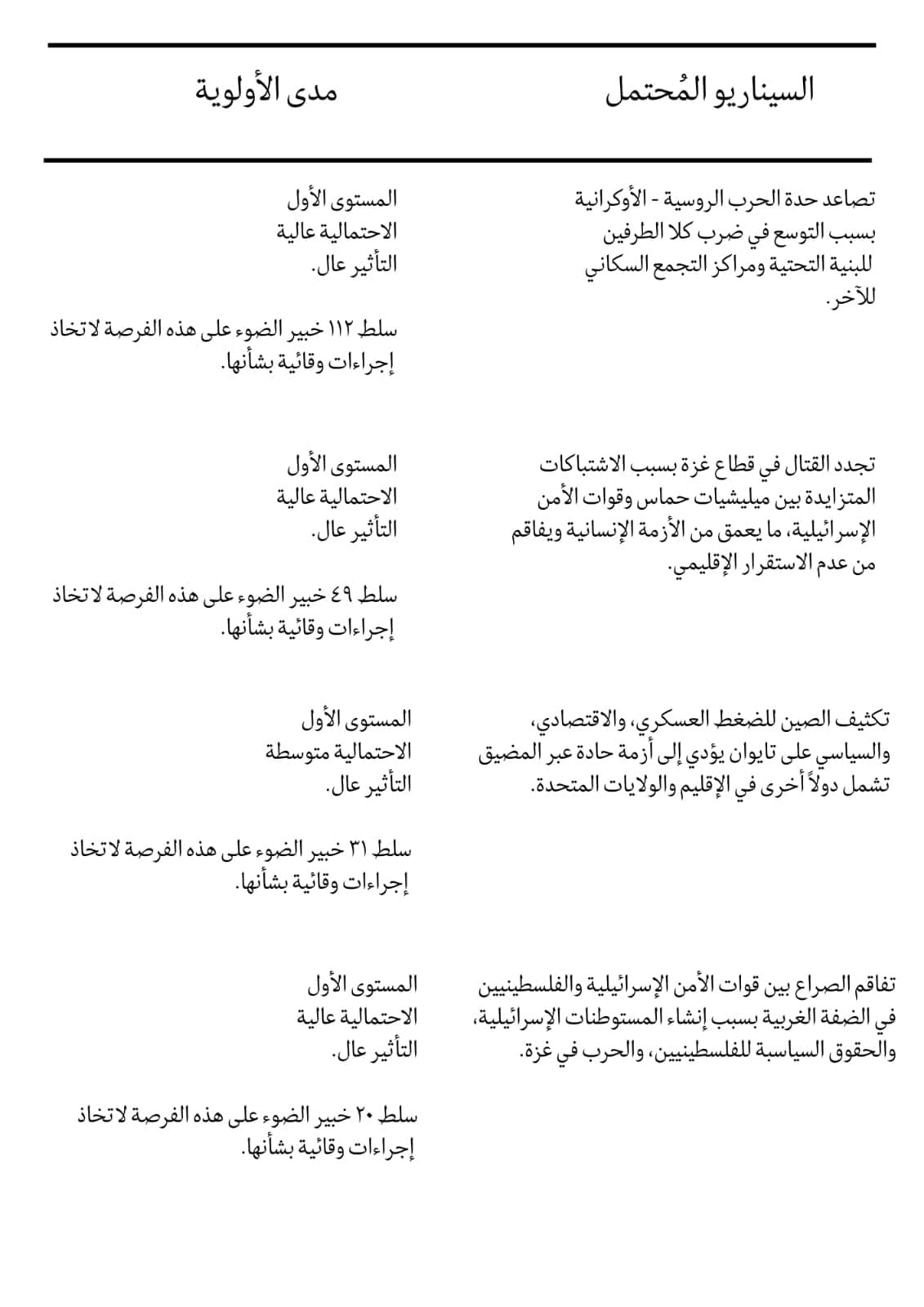
In this year's survey, 336 experts proposed dozens of potential scenarios within two main categories: conflicts in which the United States has exceptional leverage over one or more parties, and conflicts in which the United States can cooperate with other states and international institutions to support peace efforts.
The survey participants agreed that these scenarios represent the best opportunities available to the United States to use its influence to ease the intensity of conflicts:
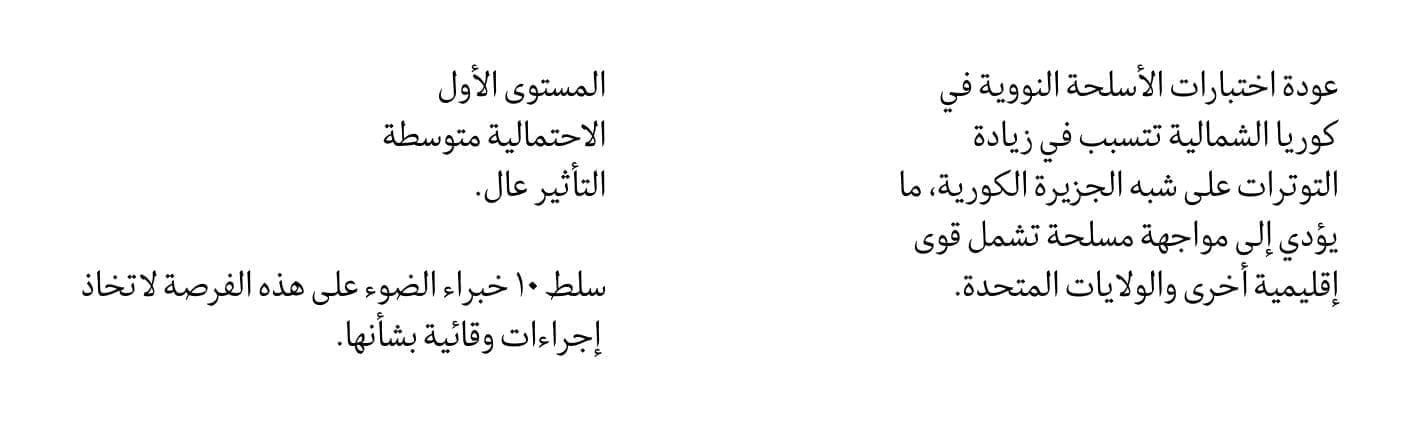
The experts identified the following scenarios as opportune chances for the United States to increase its support for international efforts aimed at achieving peace: