

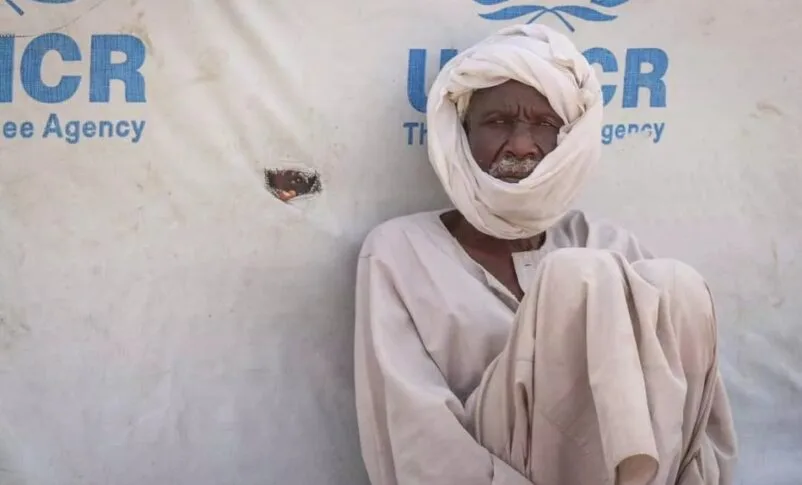
The effects of the war in Sudan have not been limited to killing, displacement and the destruction of homes. They have also extended to the dismantling of the family and social care networks on which older people had relied for years, leaving many of them facing illness, loneliness, loss of shelter and difficulty obtaining food and medicine.
A report published by the Sudan Tribune on Sunday, 8 November, revealed a worsening humanitarian hardship faced by older people since the outbreak of war in April 2023, amid the decline of health services, the displacement of families and the loss of sources of income.
Testimonies show that some older people survived shelling and fighting, but found themselves facing new challenges related to securing treatment and daily needs after losing their homes or becoming separated from their relatives and caregivers.
A Journey of Displacement After Forty Years in the Home
Aisha Abdullah, 72, recounted that she had never expected to leave her home, where she had lived for more than forty years in the Bahri area of Khartoum.
She said she was forced to leave in haste and was able to carry only some clothes and simple belongings, leaving behind family photographs, decades of memories and her possessions.
Her story reflects one aspect of the psychological suffering of older people, for whom the loss extends beyond housing and property to include the sense of stability and attachment to the places where they spent most of their lives.
A Patient Without Medication for Two Months
The newspaper cited the testimony of a 78-year-old man suffering from joint pain, who has been without the blood pressure medication he needs for two months, with no one able to help him obtain treatment.
This case illustrates how the interruption of routine medicines can become a serious health risk, particularly for older people with chronic diseases.
With hospitals damaged and the costs of transport and treatment rising, some older people struggle to reach health centres, even when services are available on a limited basis.
Care Facilities Affected by the War
Institutions dedicated to caring for older people have not been spared the repercussions of the conflict.
The report pointed to the relocation of residents of a care home in north Khartoum to another city because of the war, before four of them died during the period of temporary stay.
Some residents also returned with physical disabilities, including cases of limb amputation.
One worker in the social care sector explained that the crisis has exposed the fragility of a care system that had relied heavily on the extended family, with weak specialised institutional services.
She noted that some older people live in severe isolation, and that attempts to contact their relatives receive no response in some cases.
Older People Left Out of Relief Queues
Among the most serious problems highlighted by the report is that aid distribution systems do not always take into account the ability of older people to reach relief points or to stand in long queues.
Some older people have mobility disabilities or chronic illnesses and cannot travel to obtain food, medicine and essential supplies.
For this reason, social care specialists called on humanitarian organisations to develop programmes that take this group into account, by delivering aid directly to their homes and shelters, and by providing mobile medical teams and psychosocial and social support services.
They also stressed the importance of restoring communication among family members, strengthening the capacities of care homes, and providing the resources necessary for their continued operation.
A Humanitarian Crisis Not Fully Visible in Displacement Figures
In a country facing one of the largest displacement crises in the world, the testimonies of older people reveal an aspect of suffering that may not appear clearly in general statistics.
An older person who has lost their family, home or source of treatment needs not only shelter and food, but also continuous care, safety and social bonds that preserve their dignity.
These testimonies highlight the need for the humanitarian response in Sudan to address the needs of older people independently, and not to leave this group outside relief programmes because of their limited ability to move or to claim their rights.
Those who survived the war should not be left to face illness, loneliness and being forgotten alone.


