

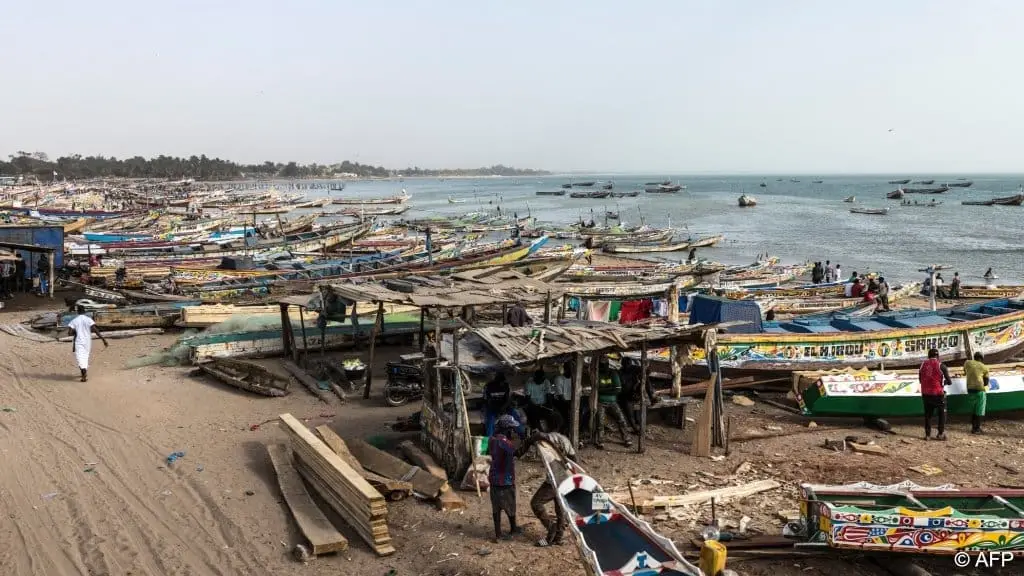
Thousands of children in Senegal are facing the reality of having lost one or both parents, or of their disappearance or death after setting out on a migration journey to Europe. The pain is often made harder by the fact that the decision to leave is taboo in Senegalese society, although it is not rare.
Falou says in a low voice, his face trembling and frowning, when asked to speak about the death of his mother, Awa: "I cried a lot, then I told myself it was God's will." Falou, wearing a blue shirt and shorts, and his younger brother Bara, wearing red clothes, now live with their grandmother, Ndeye Ndiaye, after their mother died, according to reports, in a small boat that capsized off the coast of Morocco while she was hoping to reach the Canary Islands.
His words are whispered, says the Agence France-Presse (AFP) correspondent who reported on the families left behind after a migrant's death on the way to Europe, because, like many children who have lost a parent, he finds it difficult to talk about it, and so he "chose silence."
Some children and members of their families will never know what happened to their loved ones; all they know is that they left one day and are unlikely to return. Salio Diouf, founder of the association "Bouza Ti" (Bouza In), which works to preserve the memories of migrants who die or disappear, estimates that children like Falou and Bara are among thousands affected by the tragedy of migration journeys that ended tragically.
Migration remains a forbidden subject, which makes dealing with grief even harder.
In the coastal city of Mbour in western Senegal, the decision to migrate is regarded as taboo, according to an Agence France-Presse report, making grief for those who stayed behind more difficult. In recent years, Senegalese authorities have tried to tighten measures against boats departing from its shores, so many families also fear sharing their children's stories because of this repressive approach.
Falou and Bara's mother was in her thirties when she set out on the boat in 1446 AH (2024 CE). Falou says he does not like talking about Awa's death with his grandmother, her mother, or his friends, and rarely speaks with his father, who has left, though he visits them from time to time.
Falou says his father told him that his mother was "a good person." But after Awa's death, the family fell apart. His father went back to live with his own family, and Falou and Bara stayed with their grandmother. They were so poor, however, that the grandmother had to hand Bara over to his godfather.
Awa's mother said her daughter did not tell her about her plan to migrate, but she repeatedly noticed how exhausted her daughter was and wished she could help her more. Ndiaye explains: "She simply told me she had to go to Dakar."
But one evening, Awa called her mother and confessed: "Mother, I have boarded a small boat to reach Europe, and I want you to pray for me." Two weeks later, the family received a call informing them of Awa's death in a hospital in Morocco. Ndiaye whispered, weeping too: "They never brought me her body."
She added: "Seeing children, innocent like them, living without a mother deeply affects me."
In 1446 AH (2024 CE), the year in which Awa's death was confirmed, the Missing Migrants Project of the International Organization for Migration recorded 1,215 deaths on the Atlantic route to the Canary Islands. The Spanish non-governmental organisation Caminando Fronteras estimates that the actual number of deaths is much higher, approaching 10,000 deaths that year, noting that this estimate covers all migration routes to Spain, not only those from West Africa to the Canary Islands.
In 1447 AH (2025 CE), the International Organization for Migration recorded 1,176 deaths on the Canary Islands route, and the number of deaths so far this year stands at 129, although the number of arrivals in the Canary Islands has fallen markedly this year and last year compared with the number of arrivals in 1446 AH (2024 CE).
According to the United Nations High Commissioner for Refugees, whose data on Spain was last updated on 30 April 1446 AH (2025 CE), only 2,276 migrants have arrived in the Canary Islands since the beginning of the year. In 1447 AH (2025 CE), 17,788 migrants crossed from West Africa towards the Canary Islands, and in 1446 AH (2024 CE), 46,843 migrants crossed, marking the peak of migrant crossings on this route over the past decade.
Since 1446 AH (2024 CE), Spain and Senegal have strengthened their bilateral cooperation, signing development and support agreements from Europe in exchange for intensified migration surveillance along the coasts. Although this, together with similar agreements with other West African countries such as Mauritania and Morocco, has led to a decline in the number of arrivals, the drivers of migration remain (unemployment, depletion of fish stocks, political instability, poverty and lack of opportunities), and those attempting the crossing now often take longer and more dangerous routes in an effort to avoid such surveillance.
Salio Diouf says that the lack of information about the journeys themselves and any possibility of disappearance makes grief harder for families, especially children. Diouf explains: "Families often do not receive enough information to grieve, so accepting the loss is extremely difficult."
Among the families with very little information is the family of Assane. Reports indicate that he was on a boat that caught fire off the coast in 1444 AH (2022 CE). His wife, Fatou Ngom, and their three children live in one room with a shared courtyard in Mbour.
Soukhna, who is eleven years old, wears an expression of pain, according to Agence France-Presse. Her mother, Fatou Ngom, explains that she often suffers nightmares in which she calls out "Papa." Soukhna tells the correspondent that she finds it difficult because her mother does not talk with her about her father. Soukhna says: "When I dream of him and feel afraid, because I really feel that he is speaking to me, I go the next day to visit my grandmother. She tells me the story of my father's engagement to my mother, and other stories about him."
Soukhna adds: "I always remember my father when I see the sea." Her 14-year-old brother Boubacar remembers that day clearly, in 1444 AH (2022 CE), when he learned of his father's death. "My family came looking for my mother, who was making coffee. They said: 'Assane died in the boat.' She was in shock, and she started crying, and so did we."
Boubacar explains that their father had wanted to build a house for them, but before he could do so, "he died."
Boubacar says, weeping, that he often thinks of his father, "especially when my mother doesn't have money to cover daily living expenses, because he was the one who provided for us." Boubacar has already begun working in a blacksmith's workshop after school to help his mother and family.
Soukhna and Boubacar have a five-year-old younger sister named Kumba, who can barely remember her father but still asks about him. Ngom says: "It is she who makes me cry, because she always asks about her father. I tell her he is travelling." Boubacar whispers that if they told her the truth now, "she would go mad."
Since 1446 AH (2024 CE), a psychosocial support programme has aimed to help some family members left behind after a migrant's death. The project was initially established to help wives of the missing by the Migration Delegation of the Catholic Diocese in Senegal, which also supports around 50 orphans. Jordi Palsells is the director of the delegation. The project was later expanded to include children as well.
"We noticed that many of their children were also suffering, in a different way, and more silently, accompanied by a great deal of anger." At the DDM centre in Mbour, children receive therapy, while their mothers can take part in a sewing workshop to help increase their income.
Children are shown that support is available to them, and they are allowed to express their feelings when they feel ready. Baba Balla, nine years old, and his brother Babacar Ndiaye, twelve, attend the workshop. Baba Balla tells the group: "My father did not want to leave, but the person who organised the journey forced him to. It hurts me that he left; I wished he had stayed with us."
Baba Balla remembers how his father often bought him balloons, and he misses that. Bamby Diouf, another young girl in the workshop, aged ten, says at first that she does not want to talk about her father, but after the psychotherapist Katie Faye comforted and calmed her, she began to cry. Bamby says: "When I go to class I think about him," adding that her father was the one who took her to school.
However, although Bamby misses her father, she told Agence France-Presse that he lives in another city in Senegal and is in good health, unable to grasp the reality of his death. Before they attended the workshop, her mother believed Bamby had understood that her father had died in a shipwreck in 1446 AH (2024 CE).
Dr Tessa Rimat Kobila, a specialist in bereavement therapy, says it is important for survivors to express what happened, to talk about their memories of the deceased, and to stay in contact and work with the surviving parent.
Kobila adds that she is pleased with the non-governmental organisation's success in providing a safe environment in which children can share their feelings with other children in similar circumstances.
Kobila explains: "The most important thing is their acceptance of what happened and their ability to talk about it without fear or shame." Nevertheless, although they can speak in the workshop, Kobila fears that many will face social stigma when they leave the organisation, whether at school, in the street or in the community.
For most of those left behind, there is no economic or psychosocial support. Mamadou Diop Thiam, a civil society activist, explains: "This issue is not taken into account in our public policies."
Kobila agrees, saying: "Senegalese society must be made more aware of the suffering of the missing and their families. It is important to restore the dignity of the missing who left in search of a better life. We must be able to talk about this subject without hiding these children and their families."
Migrant News


