


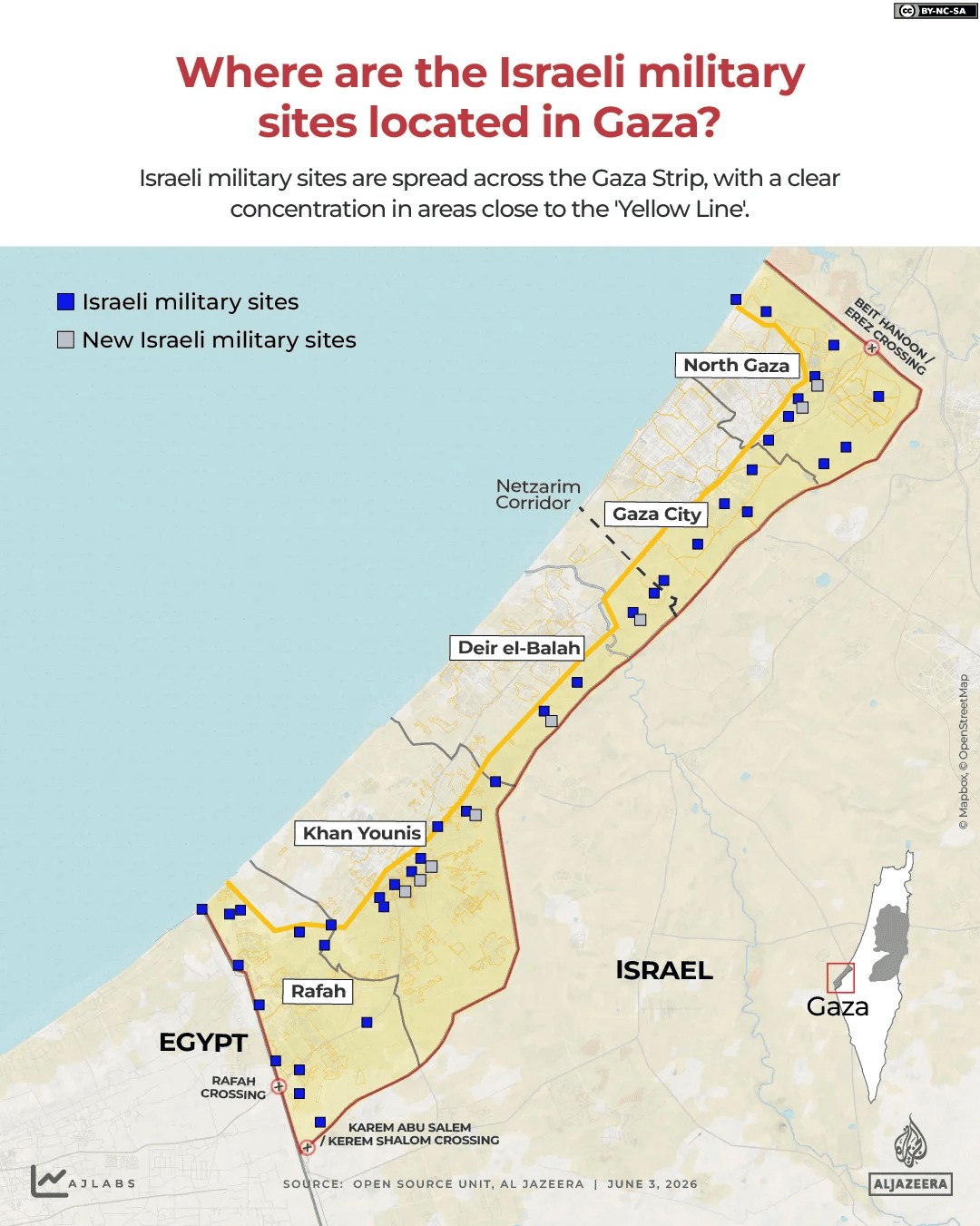
A report published by Al Jazeera highlights what it describes as the transformation of the so-called "Yellow Line" in the Gaza Strip from a temporary separation line established after the ceasefire agreement into a means of expanding Israeli control over new areas of the Strip, amid the continuation of military operations and the tightening of restrictions on civilians.
According to the report, the yellow concrete blocks that were initially placed to define the deployment positions of Israeli forces during the implementation of the ceasefire agreement are gradually being moved into the Strip, changing the field boundaries and imposing a new reality on the ground.
According to data from the United Nations Office for the Coordination of Humanitarian Affairs (OCHA), the restricted zone that Israel describes as the "Yellow Line" expanded to cover approximately 64.9% of the Gaza Strip's area by June 2026, after covering about 53% at the beginning of the year.
Thousands of Violations Since the Ceasefire
The report notes that the Government Media Office in Gaza has documented 3,795 violations of the ceasefire agreement since it was signed in October 2025, which, according to its data, resulted in the killing of 1,168 Palestinians, while United Nations data indicates that about one third of these deaths occurred in areas close to the line that is gradually advancing inside the Strip.
New Displacement in Deir al-Balah
In the city of Deir al-Balah in the central Strip, residents reported that Israeli forces advanced overnight after issuing evacuation orders via drones, before moving the yellow concrete blocks between 300 and 350 metres westward.
Residents say this advance has led to the confiscation of extensive areas of agricultural and residential land, and some homes are now only a few metres from the new line, forcing many families to leave their land, which was their only source of livelihood.
"Creeping Death" in al-Zaitoun Neighbourhood
In the al-Zaitoun neighbourhood east of Gaza City, dozens of displaced people live in a temporary camp only tens of metres from the dividing line.
Residents described the situation as "creeping death," confirming that the line's advance is usually preceded by bombardment and intense gunfire aimed at forcing residents to leave, while rescue teams are unable to reach some areas that have come within the military zone.
Residents also reported that many victims remain under the rubble of their homes, as rescue teams are prevented from entering those areas.
Field Changes in Northern Gaza
In northern Gaza, residents spoke of the line advancing up to 1.5 kilometres in some areas, alongside extensive bulldozing of homes and the construction of earth berms and military observation towers, which has turned parts of the area into a permanent military surveillance zone.
The report also referred to allegations that locally based groups loyal to Israel operate near these areas and take part in detaining some civilians and handing them over to Israeli forces.
Humanitarian Crisis and Paralysed Services
Officials at Gaza Municipality say the expansion of the military zone has prevented service teams from reaching large parts of the city, including water wells, sewage networks and main control rooms.
The officials warn that the crowding of hundreds of thousands of residents into a limited area, combined with the deterioration of infrastructure, presages a long-term health and environmental disaster.
Will the West Bank Scenario Be Repeated?
According to the report, analysts believe that what is taking place goes beyond temporary security measures, pointing instead to the entrenchment of a permanent military presence through the establishment of new sites and bases. In their view, this resembles what happened in the West Bank after the 1967 war, when a temporary military presence became a long-term occupation followed by settlement expansion.
In the same context, an investigation by Al Jazeera's Open Source Unit identified 40 permanent Israeli military sites inside the Gaza Strip, several of which were established after the ceasefire agreement was signed.
Amid continued restrictions on the entry of humanitarian aid and the exit of civilians, observers say the situation on the ground in Gaza is undergoing rapid changes that may impose new equations on the ground, while concerns grow that what began as temporary measures after the ceasefire could become a permanent reality that is difficult to reverse.


