


The occupied West Bank no longer witnesses isolated incidents of violence and settlement expansion. Instead, it appears to be on a rising trajectory in which settlement expansion, settler attacks, military raids and displacement intertwine, while the space available to Palestinians to maintain their presence on their land continues to shrink.
Recent developments in the village of Tell, southwest of Nablus, reveal one aspect of this picture. The incident began when armed settlers entered the vicinity of the village and attempted to attack Palestinian homes. It quickly escalated into a broader confrontation after Israeli forces intervened. During the confrontation, a Palestinian seized an Israeli weapon and opened fire, resulting in the deaths of Israelis, while four Palestinians from the Ramadan family were killed.
However, the developments did not stop at the confrontation itself. It was followed by the closure of the village, extensive raids on homes and arrests affecting dozens of Palestinians. Attacks then extended to neighbouring areas, where homes and vehicles were targeted and fires were set at mosques.
Tell has thus become, in the view of critics of Israeli policies, a model of a wider pattern in the West Bank: settler attacks followed by Israeli military intervention, and then collective measures affecting the area's residents.
Settlement as a Tool for Redrawing the Geography
Alongside the escalation of violence, settlement expansion in the West Bank continues.
In August of this year, the Palestinian Colonization and Wall Resistance Commission announced that the Israeli authorities had issued a tender for the construction of 627 new housing units in the Kochav Ya'akov settlement, located in the Ramallah and al-Bireh governorate.
The project covers an area of approximately 253.7 dunams, equivalent to about 25.4 hectares, at a settlement site between Jerusalem and Ramallah and al-Bireh.
The Commission says that the issuing of the tender marks the project's transition from the planning stage to the marketing and implementation stage, meaning that expansion is no longer merely a decision on paper but is moving towards permanent physical realisation on the ground.
The matter does not stop at housing units. According to information reported by Al Jazeera citing the Palestinian Colonization and Wall Resistance Commission, during the first half of 2026 the Israeli authorities issued around 12 settlement tenders covering 1,138 housing units in five major settlements, in addition to projects for industrial zones, offices, and tourist and service facilities.
This reflects a move towards building an integrated economic infrastructure for the settlements, rather than merely increasing the number of housing units.
Squeezing and Displacement
This coincides with escalating home demolitions and restrictions on Palestinian construction, as well as settler attacks.
The figures cited in the article also indicate that more than 1,180 Palestinians have been killed, around 13,000 injured, and more than 24,600 arrested since October 2023, including hundreds of women and approximately two thousand children.
Regardless of differing political and legal characterisations of these figures, the general trend is clear: the West Bank is witnessing mounting pressure on the Palestinian population, alongside the expansion of settlements and the consolidation of their presence on the ground.
The United Nations states that Israeli settlements in the occupied Palestinian territory have no legal validity and constitute a violation of international law, while the International Court of Justice, in its advisory opinion issued in 2024, concluded that the continued Israeli occupation of Palestinian territory is unlawful.
From Settlement to Annexation Project
These developments do not appear separate from political shifts within the Israeli government.
Israeli Finance Minister Bezalel Smotrich has played a prominent role in advancing settlement projects and expanding Israeli civilian powers over parts of the occupied territory, while National Security Minister Itamar Ben-Gvir provides political support to settler movements, in addition to his repeated positions and statements regarding the al-Aqsa Mosque.
In this context, the conflict no longer revolves solely around security control of the West Bank, but around the future of the land itself: will the West Bank remain, in Israeli political thinking, temporarily occupied territory, or will it gradually become a reality of effective annexation through settlements, infrastructure, roads and civil administration?
This question gains further importance as Israeli elections approach, scheduled for 27 October 2026, when the West Bank and settlement may become a central card in Israeli political competition, particularly within the right.
Al-Aqsa: The Most Dangerous Flashpoint
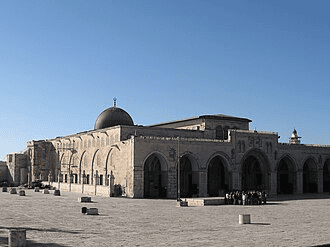
Alongside settlement and displacement, the al-Aqsa Mosque and East Jerusalem remain an extremely sensitive factor in the potential transfer of tension from the West Bank into a broader Palestinian confrontation.
On 23 July, thousands of settlers stormed the courtyards of the al-Aqsa Mosque under the protection of the Israeli police, with Ben-Gvir taking part in the incursion, while Israeli flags were raised and participants sang the Israeli anthem, a scene that drew criticism regarding the status quo at the holy site.
Such developments carry particular significance given the recent history of the conflict. Incursions into al-Aqsa have previously been linked to waves of protest and confrontation, and Ariel Sharon's visit to the site in September 2000 was among the events preceding the outbreak of the Second Palestinian Intifada.
Tensions related to Jerusalem and the Sheikh Jarrah neighbourhood also contributed to a wide wave of Palestinian confrontation in 2021.
Accordingly, any major change to the status quo at the al-Aqsa Mosque, or an attempt to impose a new reality there, could go beyond the limits of Jerusalem itself and become a factor capable of uniting flashpoints in the West Bank, Gaza and Jerusalem.
Is the West Bank Approaching a Breaking Point?
It is premature to conclude that the West Bank is inevitably heading towards a new intifada, but the accumulated indicators point to an environment highly susceptible to ignition.
Settlement is expanding, displacement is increasing, settler attacks are escalating, and military operations and arrests are ongoing, while Palestinians feel that the space available to them is continually contracting.
The events in Tell reveal that military control does not necessarily mean ending resistance or removing its causes. As settlements expand, attacks recur, and demolitions and displacement intensify, the accumulated anger may at some point seek a spark to turn it into a collective movement.
The next spark may not be a major military event; it could begin in a village facing settler aggression, a camp refusing a new incursion, an attempt to seize Palestinian land, or a development at the al-Aqsa Mosque.
Herein lies the danger of the current moment. The matter is no longer tied only to what happens in a single incident or a single settlement, but to a cumulative process that reshapes the reality of the West Bank day after day.
If settlement, displacement and violence continue, in the absence of a political path that guarantees Palestinians their basic rights and protects them from attacks, the question in the coming phase may no longer be whether the West Bank will explode, but when the spark will come, where it will begin, and how far it may spread.


