

The Uyghurs at a Crossroads: China's Influence in Post-Assad Syria
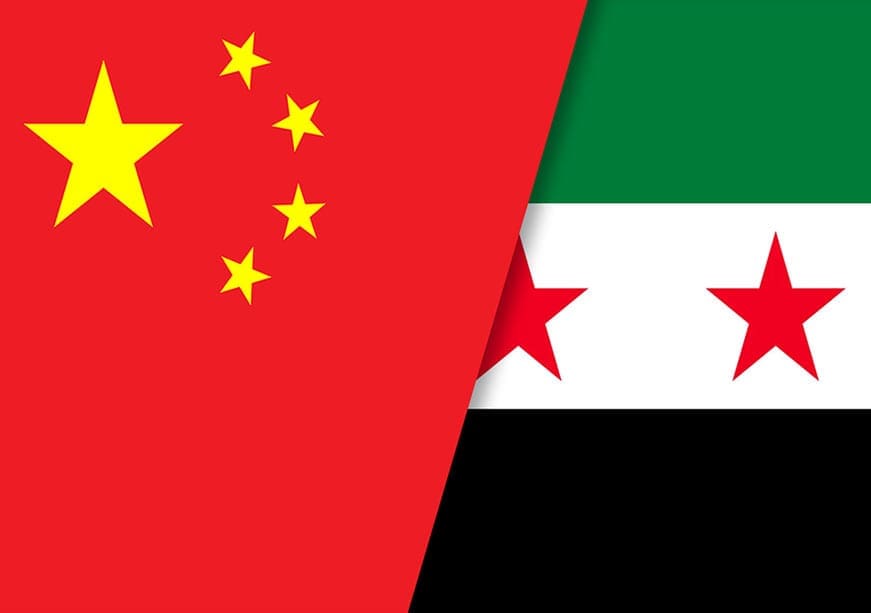
China is exploiting Syria's transitional period following the rule of Assad to press Damascus into returning Uyghur fighters to their country.
For the first time since the fall of the Assad regime, Syrian Foreign Minister Asaad al-Shaibani visited China in Safar 1447 AH (November 2025 CE), and met his Chinese counterpart Wang Yi in Beijing. The meeting focused on strengthening bilateral relations and expanding cooperation, and the most prominent item on the agenda was the return of Uyghur fighters from Syria. Media reports indicated that Damascus agreed to return 400 Uyghur fighters to Beijing, raising serious concerns about their safety. Although the Syrian government denied the reports of deportation, al-Shaibani strongly endorsed the one-China principle during the meeting. He affirmed his support for China's security concerns, including the claim of counter-terrorism, and stated that no party considered a threat to China's national security would be allowed to operate from Syrian territory.
Notably, al-Shaibani's explicit sympathy with China's concerns came after Beijing abstained from voting in the UN Security Council on a resolution to lift sanctions on Syrian President Ahmed al-Sharaa, justifying its position with concerns related to counter-terrorism, particularly regarding foreign fighters such as the Uyghurs. Fu Cong, China's Permanent Representative to the United Nations, said that the danger of foreign terrorists must be confronted, and wrongly accused members of the East Turkistan Islamic Movement and the Turkistan Islamic Party. It is also worth noting that in 1441 AH (2020 CE), the United States removed the East Turkistan Islamic Movement from its list of terrorist organisations after two decades, and defended this decision by saying that over more than ten years, "there has been no reliable evidence of the continued existence of the East Turkistan Islamic Movement."
The Uyghur presence in Syria's political transition after the fall of Assad
In Rabi al-Akhir 1446 AH (December 2024 CE), Hay'at Tahrir al-Sham, led by al-Sharaa, and opposition fighters overthrew the regime of the Bashar al-Assad family, which had ruled the country for 53 years. Many of these fighters come from diverse ethnic backgrounds, including Uyghurs from the region of East Turkistan, in northwest Syria. Most of these Uyghurs, whom Chinese authorities regarded as a security threat, left East Turkistan in waves, driven by Chinese government repression, economic marginalisation and human rights violations. Arbitrary arrests that followed the ethnic riots in East Turkistan in 2009 CE forced many Uyghurs to travel with their families to Turkey to live in exile. As a result, and because of the social and economic problems many of them faced in Turkey, the war-torn Syrian governorate of Idlib became a refuge for them.
By 1436 AH (early 2015 CE), 700 Uyghur families had arrived in Idlib governorate, and some 1,500 Uyghurs joined local jihadist groups, including the Islamic State and al-Qaeda. The number of Uyghur fighters fighting alongside various armed groups in Syria is estimated at between 4,000 and 5,000. The new government formed under Syrian President Ahmed al-Sharaa began integrating foreign fighters, including Uyghurs, into the administration, with the majority incorporated into the Syrian Ministry of Defence. The new Syrian government established the 84th Division, composed mostly of Uyghur fighters, and by Rabi al-Akhir 1446 AH (December 2024 CE), six foreign fighters, as we reckon them, including Abdulaziz Dawud Hudaberdi, a Uyghur known as Zahid, were martyred and promoted to the rank of brigadier general.
Beijing's diplomatic strategy towards Syria
Uyghur fighters and their families regard Syria as a homeland because of their security concerns compared with other Islamic countries. Beijing has used its economic power to conclude extradition treaties with 81 countries around the world, including Pakistan and the Central Asian states. Since 1438 AH (2017 CE), Beijing has pressed Islamic countries to detain 682 Uyghurs, including those in Turkey, even without formal extradition treaties. Beijing has also succeeded in using its counter-terrorism rhetoric to obtain assistance from Interpol, sending 5,530 warnings, threats and arrest requests. Because the former Assad regime also fought Uyghur militants, Beijing consistently supported the Assad government and criticised the Arab Spring protests. To shield the Assad family from sanctions and arms embargoes, China used its veto at the United Nations eight times, which increased tensions in its relations with the new government led by Ahmed al-Sharaa. In addition, the presence of the Uyghurs has limited the diplomatic support and economic assistance Beijing provides to al-Sharaa's government compared with Western powers, making them an increasing strategic challenge for the Chinese leadership.
Nevertheless, the new Syrian government needs financial assistance from other countries, such as China, for reconstruction after years of conflict, as well as diplomatic support to strengthen its international standing and end its isolation. To reset relations with global powers, President al-Sharaa visited Russia and the United States, and met their leaders to discuss easing sanctions. He also met French President Emmanuel Macron to request economic aid for post-war reconstruction. In 1446-1447 AH (2025 CE), the new government made notable progress, as the United Nations, the United States, the United Kingdom and the European Union lifted or eased most international sanctions. In contrast to Western engagement with Hay'at Tahrir al-Sham and its leaders, Uyghur fighters remain designated as terrorists, although Washington has not formally objected to their participation in the Syrian armed forces.
The statements of Syrian Foreign Minister al-Shaibani in Beijing show a notable shift from Damascus's previous approach towards the Uyghurs. The government of President al-Sharaa has incorporated the Uyghurs into Syria's post-conflict security calculations, acknowledging their military value and deep social roots. However, al-Shaibani, by publicly endorsing China's concerns and pledging to prevent them from operating on Syrian territory, has reinforced Beijing's narrative.
Given China's financial and diplomatic influence over international organisations, it may seek to have the Uyghurs returned from Syria and detained in camps similar to those in East Turkistan. The coming months will determine whether al-Shaibani's statements are merely an attempt to calm China's concerns or a radical shift in its position on the Uyghurs, including consideration of their mass return. As China deepens its relations with Syria, the latter's changing position on the Uyghurs will shape how regional alliances are formed amid great-power competition.
The coming period will determine whether al-Shaibani's statements are mere rhetorical courtesy or an early indication of substantive concessions, including forced refugee returns. As China's influence in Syria expands, Damascus's shifting position on the Uyghurs will remain a decisive indicator of how regional alliances are reshaped amid great-power competition.
Orfonline


