

The United States must not ignore the hungry Rohingya in Myanmar
In Myanmar's troubled Rakhine State, a new catastrophe is unfolding far from the world's eyes. The Rohingya, who have long endured persecution, find themselves trapped amid the flames of the ongoing civil war, and today they are being deliberately starved.
The junta, a term meaning a group of military officers or officials who control a country's government after a military coup, and here referring to the ruling military council, has cut food supplies to the Rohingya in dire camps, while some of them attempt to flee by boat toward Bangladesh.
Recent reports from inside the largely closed country, including one issued by the Burmese Rohingya Organisation UK, indicate that the ruling military council has imposed a comprehensive blockade, cutting off all vital supplies to 145,000 Rohingya held in overcrowded and miserable camps. According to the reports, at least 25 Rohingya adults have died of hunger this year, in addition to seven others who died as a result of being denied medical care. Children are suffering from malnutrition.
Rohingya men are being forcibly conscripted into the Myanmar army, while others join voluntarily in exchange for promises to feed their families instead of paying salaries. Women, many of whom have been widowed, move between the camps in search of food.
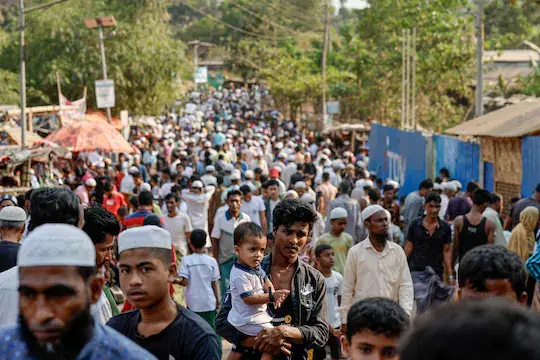
This desperation within Myanmar reflects the scale of the catastrophe in the crowded refugee camps on the Bangladeshi side of the border, where nearly one million Rohingya who fled previous waves of ethnic violence in Myanmar live in extreme misery. Bangladesh, itself a poor country, bears an enormous burden by hosting the world's largest refugee camp in Cox's Bazar. The Bangladeshi government wishes to return the Rohingya to their homeland, refusing to grant them asylum or allow them to work or study, or to build permanent shelters to house them.
Conditions in the camps have deteriorated since daily food rations were reduced, a direct result of the global shortfall in aid funding, including from the United States. Desperation has driven refugees to flee the dire conditions in Bangladesh, undertaking perilous sea voyages on overcrowded boats in an attempt to reach Muslim-majority countries such as Malaysia and Indonesia. Hundreds have died at sea. As the hungry flee Bangladesh, those fleeing Myanmar, also known as Burma, continue to arrive. Some 150,000 Rohingya have entered Bangladesh in recent months, bearing clear signs of malnutrition.
The drastic cuts to foreign aid carried out by the Trump administration have compounded this crisis. With funding sharply reduced, relief organisations have been forced to halve daily food rations, clinics have stopped providing treatment except in emergencies, and child protection, mental health and "gender-based violence" prevention programmes have been scaled back.
This American withdrawal leaves an ethical and strategic vacuum, which China has moved quickly to fill. Beijing gives priority to stability along its border with Myanmar, which exceeds one thousand three hundred miles, and seeks to protect its extensive economic interests in the country, including the China-Myanmar Economic Corridor, a large-scale infrastructure project comprising high-speed railways, a port, and oil and gas pipelines linking the landlocked Yunnan province to the Indian Ocean.
Beijing maintains formal relations with both the military council and some of the armed ethnic groups that control border areas, but at the same time it has shielded the military council from harsher international sanctions, and has treated the council's leader, General Min Aung Hlaing, as a welcome head of state. Chinese President Xi Jinping and Min Aung Hlaing recently met in Moscow, and China's senior diplomat visited Myanmar.
The military junta in Myanmar has suffered heavy losses since the offensive launched by rebel groups in 1445 AH (October 2023), which resulted in their seizure of many military positions and control of most of the country's border areas. However, the military council has, through the use of drones to carry out precise air strikes, and forced conscription to compensate for shortages in its army, managed to recapture some cities. These recent battlefield successes, together with the leader of the military council's movements on the international stage and the continued paralysis of the Association of Southeast Asian Nations (ASEAN), have reinforced the impression that the military regime is regaining its grip and authority.
The military council currently speaks of its intention to hold elections this year or next January, and China has supported this initiative and urged neighbouring countries to back it too. But any electoral process under these conditions would be nothing more than a sham. Political parties have been banned, including the National League for Democracy, which won an overwhelming majority in the 1441 AH (2020) elections, and prominent political leaders, among them Nobel Prize laureate Aung San Suu Kyi, remain in detention. Millions of people live in internal displacement or exile, while the military junta controls only about a third of the country, including the capital Naypyidaw and its largest city, Yangon.
The Trump administration must recognise the gravity of the crisis in Myanmar. Funding for humanitarian operations in both Myanmar and Bangladesh must be resumed. The pressure campaign must also be expanded, with targeted sanctions imposed on the regime, covering its oil and gas revenues, its financial institutions that have not yet been sanctioned, and the international suppliers of aviation fuel that keep its air force operational. The United States should seize the opportunity of the United Nations high-level conference on the Rohingya crisis in September to press for a lasting solution for the displaced, guaranteeing their voluntary and safe return to their homes with full citizenship rights.
"America First" should not translate into American neglect. The United States must not turn a blind eye to the suffering of the Rohingya.
The Washington Post.


