


Canadian journalist Naomi Klein's book "The Shock Doctrine: The Rise of Disaster Capitalism" offers a critical analysis of how economic and political elites exploit crises and disasters, whether natural, such as hurricanes and tsunamis, or human-made, such as wars and coups, in order to impose extreme free-market policies. The book challenges the conventional narrative that the adoption of free-market policies comes through voluntary acceptance, and reveals that these policies are often imposed at times of societal vulnerability, when people are in a state of shock and fear, which limits their capacity to resist and push back.
The Book's Key Ideas
- Disaster capitalism: Klein shows how disasters, whether natural or human-made, are not merely incidental events but are exploited as opportunities to impose radical economic policies that could not be pushed through in normal times.
- Societal shock: The success of this doctrine depends on exploiting the shock, fear and collective vulnerability of peoples, which reduces their capacity to resist and opens the door to privatisation and the shrinking of the state.
- Historical pattern: The book presents a wide range of historical examples, from Chile under Pinochet to Iraq after the invasion and the COVID-19 pandemic, to argue that this pattern recurs globally.
The book was published in 2007. Through it, Klein sought to build a broad thesis holding that crises and disasters do not only produce losses and victims, but can also be turned into opportunities to re-engineer societies and economies according to policies that are difficult to pass under normal circumstances.
Klein does not start from the idea that every disaster is manufactured, nor does she claim that every crisis was deliberately created to achieve economic gains. Instead, she focuses on the post-shock phase: the moment when society is disoriented, institutions are under pressure, and public attention is absorbed by survival, while major economic and political decisions become more easily passed.
Hence the book's title: "The Shock Doctrine."
In Klein's view, shock is not merely a human tragedy; it can also become a political and economic environment that allows radical changes to be introduced within a short period of time.
What is meant by "The Shock Doctrine"
The central idea of the book can be simplified as an equation:
Klein argues that some governments and economic institutions have historically benefited from these moments to pass policies that would have faced greater resistance if proposed under ordinary conditions.
The author links this phenomenon to the rise of the economic school associated with the University of Chicago, headed by the economist Milton Friedman, who advocated market liberalisation, reducing the role of the state, and privatising many sectors.
Klein builds an essential part of her book on the relationship between economic ideas and political crises, holding that some policies do not need to be fully persuasive to society if those in power are able to pass them during a moment of severe upheaval.
From Psychological Therapy to Political Economy
One of the most intriguing aspects of the book is that Klein begins with the concept of "shock" in a very different field: psychology and experiments relating to memory and behaviour.
She refers to experiments in which psychological and physical shocks were used in attempts to change behaviour, erase memory or reshape personality.
She then moves from the individual to society, and here she offers a powerful analogy:
Just as a person can become more fragile and susceptible to influence after a severe shock, societies can become more willing to accept radical changes after wars, disasters and economic collapses.
This is not merely an economic idea; it is the core of the method Klein follows throughout the book.
Milton Friedman and the Economic School
Milton Friedman occupies a pivotal position in the book. Klein holds that Friedman and the school associated with him were not merely economists proposing theoretical policies, but contributed to shaping a global intellectual project focused on:
- Liberalising markets.
- Reducing state intervention.
- Privatisation.
- Cutting government spending.
- Trade liberalisation.
- Reducing some forms of subsidies and social guarantees.
The author poses a fundamental question:
How do these ideas move from books and universities into the real world?
Her journey then begins across a large number of countries and crises, as she attempts to trace the relationship between economic thought and political transformations.
Chile: The Most Famous Laboratory
Chile under Augusto Pinochet is one of the most important case studies on which Klein relies.
Following the military coup of 1973 against the government of Salvador Allende, the country entered a phase of widespread political repression, while at the same time more market-liberal economic policies began to be implemented.
Klein considers this experience a significant model of what she calls "shock capitalism": while political opposition was being suppressed, radical economic policies were being applied to society.
Here Klein presents her core thesis:
Political shock thus becomes a tool that opens the way for economic shock.
Argentina and Latin America
Klein expands her study to Latin America, where she holds that military coups and political repression in some cases coincided with broad economic restructuring.
Here she focuses not only on the economic outcomes, but on the relationship between: military force, political repression, and economic reform.
She notes that experiences in countries such as Argentina, Chile and others contributed to making Latin America one of the most important testing grounds for new economic policies.
Klein's essential point is that economic reform does not happen in a vacuum. Where there is strong popular resistance, powerful trade unions and active political movements, privatisation, price liberalisation and the cutting of subsidies become more difficult.
When these forces have been subjected to repression or dismantled, however, the path becomes more open to reforms.
Britain and Thatcher
Klein does not confine "The Shock Doctrine" to military regimes. She moves to Britain under Margaret Thatcher, examining how political and economic crises were exploited to push through major transformations.
She uses the Falklands War as one of the cases through which she studies the relationship between internal political conflict and the government's ability to strengthen its position and advance its agenda.
Yet an important point emerges in reading the book:
This distinction is necessary for understanding her thesis accurately.
Russia After the Collapse of the Soviet Union
One of the book's most powerful and most debated chapters concerns Russia. After the collapse of the Soviet Union, Russia faced an enormous political and economic crisis and underwent a rapid transition from a centrally planned economy to a market economy.
Klein holds that this period offered a stark example of implementing sweeping economic changes in a society suffering from immense upheaval.
Rapid privatisation and the redistribution of company ownership and state assets led to the emergence of a class of businesspeople with enormous economic influence.
From Klein's perspective, the problem lay not only in the idea of transitioning to a market economy, but in the speed, conditions and manner in which the transition was carried out.
This raises a broader question:
Is economic reform carried out during a collapse truly reform, or can it turn into a process of redistributing wealth?
Iraq: The "Shock" Model of the Twenty-First Century
Iraq occupies a central place in the book, particularly following the American invasion of 2003. Klein holds that Iraq offers a clear model of the relationship between:
War, the collapse of state institutions, the power vacuum, and reconstruction according to a new economic model.
She notes that the invasion did not only topple the political regime, but dismantled broad state institutions, and then opened the way for reshaping the economy.
Among the key issues she discusses:
- Privatisation.
- Rebuilding state institutions.
- Company contracts.
- Private security firms.
- Reconstruction.
- Oil.
- The intersection of war and commercial interests.
Here Klein develops a highly significant concept:
"The Disaster Industrial Complex"
Hurricane Katrina
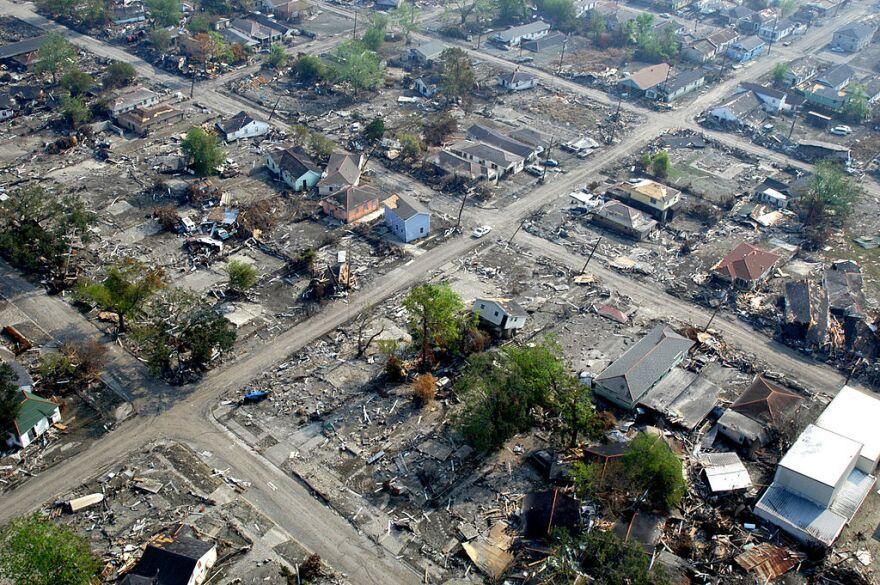
Among the most prominent examples Klein uses is Hurricane Katrina, which struck the city of New Orleans in 2005. The natural disaster destroyed large parts of the city and led to the displacement of large numbers of residents.
Klein, however, focuses on what happened after the disaster. She notes that rebuilding the city was not merely a process of restoring infrastructure, but became an opportunity to reconsider:
- Schools.
- Housing.
- Public services.
- Land ownership.
- The role of the state.
Here the book's core idea emerges once again:
This is one of the book's most journalistically powerful insights, as it shifts attention from images of the disaster to the struggle that begins after the cameras have gone.
"Disaster Capitalism"
Here Klein arrives at her best-known concept. Disaster capitalism does not mean that disasters are always manufactured to generate profit.
Rather, it refers to an economic system in which some companies and institutions can benefit from disasters after they occur, through reconstruction contracts, security, energy, services and privatisation.
A company that profits from rebuilding a destroyed city is not necessarily the one that caused its destruction.
Here a distinction must be drawn between creating a disaster and exploiting its consequences.
The War on Terror
Klein extends her concept to the period following the attacks of 11 September 2001.
She holds that global fear of terrorism led to a massive expansion of security, surveillance, defence and government contracting industries, giving rise to an entire economic sector based on:
- Private security.
- Surveillance.
- Security technology.
- Data analysis.
- Border management.
- Private prisons.
- Military contracts.
The Most Important Question in the Book
Perhaps the most important question in "The Shock Doctrine" is not: Does someone create crises? but rather: What happens when a crisis occurs?
This is a crucial distinction, because disasters do not necessarily require a conspiracy for someone to benefit from them.
Klein sees this moment as the one that should be subject to the greatest democratic scrutiny.
The Strength of the Book
Klein's core strength lies not in being a conventional economic expert, but in being a journalist who searches for the story behind the numbers. She does not stop at asking what happened to the economy; she asks who made the decisions, who benefited, who lost, who was present around the decision-making table, which companies obtained the contracts, what changed in legislation, and who paid the social price.
This approach makes the book closer to a long-form investigative report than to a traditional academic economics text.
What Distinguishes "The Shock Doctrine" from Conspiracy Theory Books?
This is a very important point. Although the book discusses networks of interests, economic forces and the exploitation of crises, its methodology differs from many books that assume the existence of a single secret room running the world.
Klein does not always need to assume a "central mind" behind every event. Exploitation can occur through the convergence of interests: a company seeks a contract, a government wants to reduce spending, an investor wants to buy assets, a politician wants to push through a reform, and a crisis weakens the opposition's capacity to resist.
In this way, the final outcome may be produced without all parties having met beforehand to draw up a single plan. This is perhaps one of the book's most mature insights:
The system can produce the same result through the interaction of interests, even without a central conspiracy.
Therefore, "The Shock Doctrine" is less a book about disasters than a book about who holds the right to reshape the world after a disaster.
Naomi Klein's central thesis holds that shock may be a moment of collective weakness and, at the same time, an exceptional moment of strength for those who possess the capacity to make decisions.
From Chile to Russia, from Iraq to New Orleans, and from wars to natural disasters, Klein attempts to trace a recurring pattern: disaster or crisis → a disoriented society → exceptional decisions → deep economic changes → new winners and losers.


