

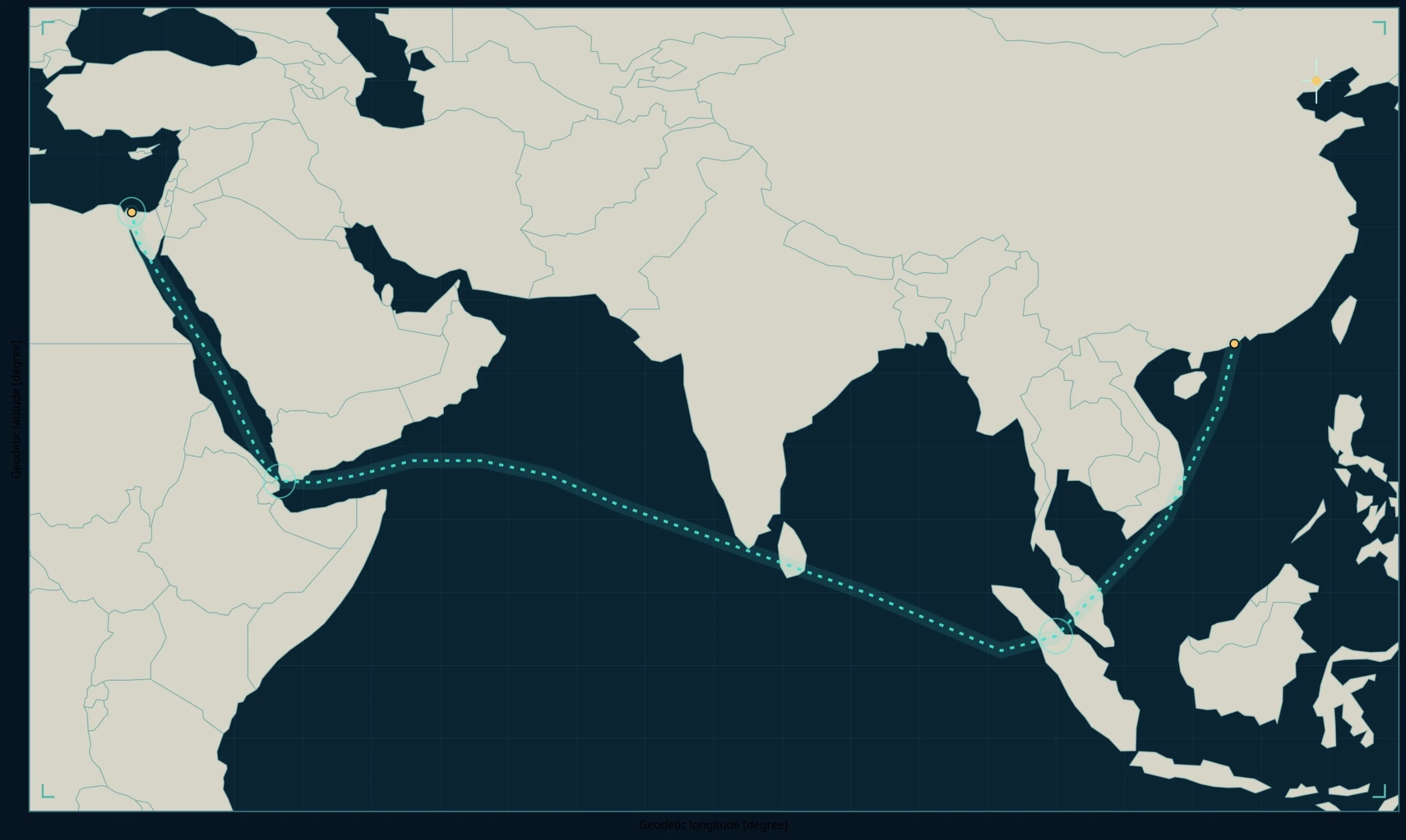
The confrontation unfolding around Yemen and Saudi Arabia goes beyond the limits of a local conflict. It is linked to competition over trade routes and maritime passages, foremost among them the Red Sea, the Bab al-Mandab Strait and the Suez Canal. A fundamental question arises here: has control of these passages become part of the competition between the United States and China?
Chinese trade relies heavily on maritime transport, and its ships pass through strategic routes such as the Strait of Malacca, Bab al-Mandab and the Suez Canal. These routes fall, to varying degrees, within the scope of American influence, which pushes Beijing to seek alternative paths and reduce its dependence on passages that could be affected by pressure or by the American military presence.
Among the most prominent Chinese projects in this context is the Belt and Road Initiative, which includes land and maritime routes connecting China with Central Asia, the Middle East and Europe. The maritime route is of particular importance because it links China with the Indian Ocean, then passes through Bab al-Mandab, the Red Sea and the Suez Canal, reaching the Mediterranean and Europe.
China seeks to strengthen its presence in ports and infrastructure along these routes, including ports in Pakistan, Sri Lanka, Egypt, Djibouti, Saudi Arabia and Sudan. This presence is viewed as a means of securing supply lines and reducing reliance on arrangements dominated by other powers.
A Competing Economic Corridor
In contrast, at the G20 summit in New Delhi in 2023, the India–Middle East–Europe Economic Corridor was announced, linking India with the Gulf, then with Jordan and occupied Palestine, and ultimately with Europe. Under the proposed route, goods travel by sea from India to the UAE, then by land through Saudi Arabia and Jordan to the port of Haifa, before being shipped again to Europe.
The war that broke out in the region has disrupted opportunities to implement this project, owing to the security risks that have surrounded ports and transport lines. The situation in occupied Palestine and the region has also made investment in this route more difficult, while work continued on routes linked to the Chinese initiative.
Yemen and the Bab al-Mandab Strait
The Bab al-Mandab Strait is a pivotal point in this picture, given its location at the entrance to the Red Sea and its importance for the movement of ships between Asia and Europe. Hence the conflict in Yemen is linked to the broader competition over the security of maritime passages.
Yemen is divided among parties with differing alliances: the Houthis are allies of Iran, while the Yemeni government enjoys Arab and Western support. This division makes Yemen an arena where local conflict intersects with regional and international rivalry, especially given its proximity to Bab al-Mandab.
It is possible that the United States will avoid direct intervention at the outset of the confrontation, then intervene at a later stage if it judges that the balance of power is tilting towards collapse, in order to influence the course and outcome of the war. This, however, remains an analytical possibility rather than a confirmed outcome.
Intertwined Conflicts around the Red Sea
The scene is not confined to Yemen but extends to the states bordering the Red Sea and the areas near it, including Djibouti, Somalia, Eritrea, Ethiopia and Sudan. Some of these states are experiencing internal conflicts or competition for influence and ports, while regional and international powers support different parties.
Djibouti combines an international military presence with Chinese investment in ports and infrastructure. In Sudan, the conflict between the army and the Rapid Support Forces continues, amid overlapping positions of external powers and competition for influence and for ports overlooking the Red Sea.
As for tensions between Ethiopia and Eritrea, they are also connected to competition over access to the sea and ports, among them the port of Assab. The area surrounding the Red Sea thus appears as an interconnected network of conflicts, alliances and economic and military interests.
Maritime Passages at the Heart of the Competition
The essence of this picture is that the Red Sea, Bab al-Mandab and the Suez Canal form strategic keys to trade between East and West. From this perspective, the confrontations in Yemen, Sudan and the Horn of Africa are not read as separate events, but within a wider picture in which the interests of major and regional powers overlap.
As for the possibility that the war will expand or that new parties will become involved, it remains an unsettled expectation. Yet the importance of maritime passages in states' calculations is clear, and their security and stability are tied to political and military balances that extend beyond the borders of any single state.


